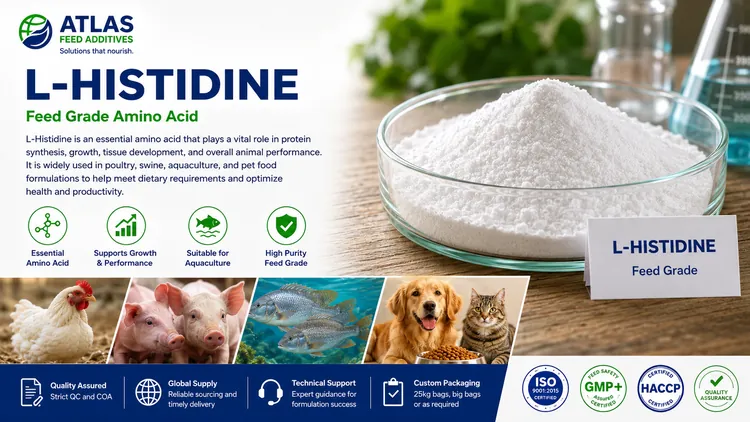
What is L-Histidine used for in animal nutrition?
L-Histidine is used as a nutritional amino acid additive in feed programs that require precise amino acid balancing. It is especially relevant when the formulation team is reviewing complete protein nutrition, aquaculture requirements, pet food amino acid profiles, or specialized diets with changing protein sources.
Why is L-Histidine important in aquaculture feed?
Aquaculture formulas often use variable levels of fish meal, animal protein, plant protein, and alternative protein ingredients. L-Histidine may be evaluated when the complete amino acid profile shows that histidine contribution needs adjustment for the target species and life stage.
Which species commonly evaluate L-Histidine?
L-Histidine may be evaluated in fish, shrimp, pet food, poultry, swine, and other species where amino acid precision is required. Correct use depends on species, production stage, formulation objective, diet composition, and applicable feed rules.
Is L-Histidine always needed in low crude-protein diets?
No. Low crude-protein diets should be evaluated by a qualified nutritionist using the complete amino acid matrix. L-Histidine may be useful in some formulas, while other formulas may already contain enough histidine from protein ingredients.
What makes L-Histidine different from other amino acids?
L-Histidine contains an imidazole side chain and has species-specific nutritional relevance. In procurement, buyers should confirm the exact L-form, assay, purity, CAS number, specification, and certificate of analysis before purchasing.
Can Atlas Feed Additives quote L-Histidine?
Yes. Send your required specification, quantity, destination, packaging preference, shipment timing, and required documents so Atlas Feed Additives can review suitable supplier options for L-Histidine.
What quality documents should buyers request for L-Histidine?
Common documents include specification, certificate of analysis, safety data sheet, origin information, batch details, shelf-life statement, label copy, and any market-specific certificates required by the buyer or destination authority.
How should L-Histidine be stored?
Store L-Histidine in clean, dry, cool, and ventilated conditions in the original packaging. Keep away from moisture, direct sunlight, damaged bags, strong odors, and non-feed chemicals. Always follow the supplier label and SDS.
What should be checked before comparing two L-Histidine offers?
Compare assay, purity, stereochemical identity, particle size, origin, manufacturer, documents, packaging, shelf life, Incoterm, freight route, payment terms, and whether the source is accepted in the destination market.