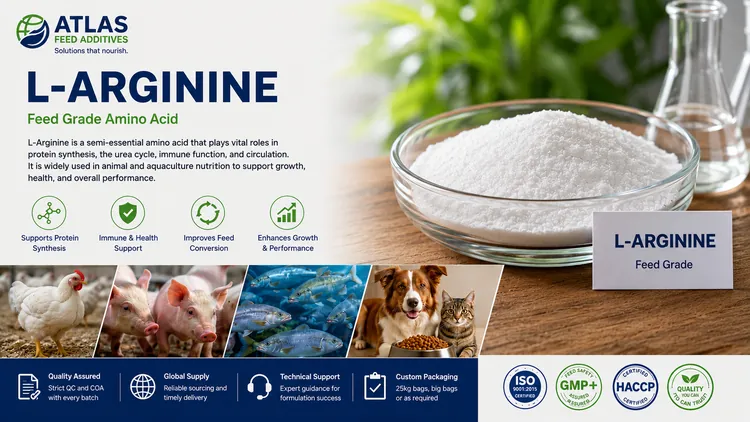
What is L-Arginine used for in animal nutrition?
L-Arginine is used as a nutritional amino acid additive in feed programs that require precise amino acid balancing. It may be evaluated in poultry, swine, aquaculture, pet food, reproductive nutrition, starter diets, and specialty formulas where the complete amino acid profile needs technical review.
Why is L-Arginine important in poultry feed?
Poultry diets often require careful essential amino acid ratio management. L-Arginine may be reviewed in relation to lysine, crude protein level, protein-source selection, growth stage, breeder objectives, and the full digestible amino acid matrix.
What is the difference between L-Arginine base and L-Arginine HCl?
L-Arginine base and L-Arginine HCl differ in chemical form, active arginine equivalent, chloride contribution, acidity, solubility, handling, and label declaration. Buyers should compare offers on the same active L-arginine basis and confirm the exact form on the specification and certificate of analysis.
Which species commonly evaluate L-Arginine?
L-Arginine may be evaluated in poultry, swine, fish, shrimp, pet food, companion animals, and specialty feed programs. Correct use depends on species, production stage, formulation objective, diet composition, product form, and applicable feed rules.
Is L-Arginine always needed in low crude-protein diets?
No. Low crude-protein diets should be evaluated by a qualified nutritionist using the complete amino acid matrix. L-Arginine may be useful in some formulas, while other formulas may already contain enough arginine from protein ingredients.
Can L-Arginine be used in pelleted or extruded feeds?
Suitability depends on the product form, carrier, coating, process temperature, moisture exposure, residence time, and post-processing storage. Buyers should request supplier stability guidance or process compatibility information before using L-Arginine in pelleted or extruded feeds.
Can Atlas Feed Additives quote L-Arginine?
Yes. Send your required specification, active L-arginine content, product form, quantity, destination, packaging preference, shipment timing, and required documents so Atlas Feed Additives can review suitable supplier options for L-Arginine.
What quality documents should buyers request for L-Arginine?
Common documents include specification, certificate of analysis, safety data sheet, origin information, active content declaration, batch details, shelf-life statement, label copy, and any market-specific certificates required by the buyer or destination authority.
How should L-Arginine be stored?
Store L-Arginine in clean, dry, cool, and ventilated conditions in original closed packaging. Keep away from moisture, condensation, direct sunlight, high heat, damaged packaging, strong odors, and non-feed chemicals. Always follow the supplier label and SDS.
What should be checked before comparing two L-Arginine offers?
Compare active L-arginine content, product form, purity, particle size, origin, manufacturer, documents, packaging, shelf life, Incoterm, freight route, payment terms, and whether the source is accepted in the destination market.