
Species programs
Poultry, swine, dairy, beef, calf, aquaculture, pet food, small ruminant, equine, and specialty livestock topics.
Industry Applications
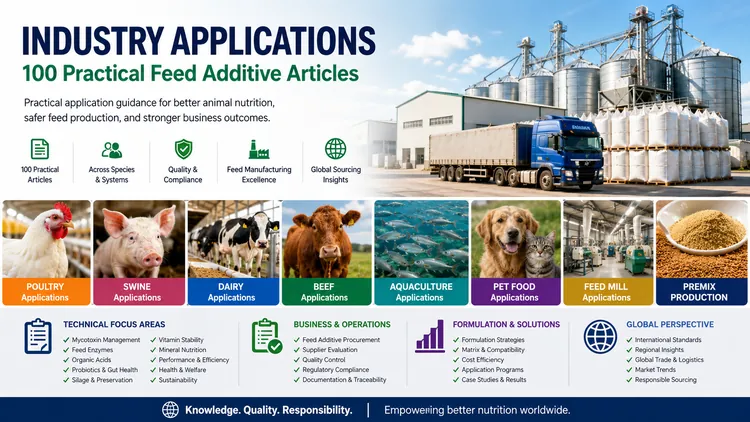
Browse 100 application-focused articles for feed mills, premix producers, integrators, distributors, farm managers, quality teams, procurement teams, and animal nutrition businesses.
This redesigned library removes crowded category blocks and presents every article in a clean, responsive card system. Search by topic, filter by application area, and use each article title as a starting point for product sourcing, documentation review, supplier comparison, or quotation requests.
Purpose
Feed additive decisions should connect species, age, production stage, feed form, raw-material profile, storage risk, processing conditions, destination-market rules, cost-in-use, and document requirements. This page helps turn broad production challenges into structured product discussions.
Poultry, swine, dairy, beef, calf, aquaculture, pet food, small ruminant, equine, and specialty livestock topics.
Dosing, mixing, pelleting, coating, flowability, dust control, carryover, enzyme recovery, and warehouse practices.
COA review, sampling, mineral safety, microbial specifications, enzyme matrices, additive combinations, and stability.
Supplier qualification, import documents, packaging, traceability, cost-in-use, regional declarations, and offer comparison.
Article library
The library uses compact category chips and one article-card grid. It avoids long category wrappers, oversized count labels, and elements that stretch beyond small screens.
Try a broader search term or choose “All” from the category filters.
Decision support
From article to quotation
If an article matches your current challenge, send Atlas Feed Additives the article title, target species, feed type, product group, current raw materials, destination country, required documents, quantity, and target shipment timing.
For example, an article about heat stress may lead to electrolyte, antioxidant, vitamin, or water-application discussions. An article about pellet quality may lead to binder, emulsifier, processing, or fat-application questions. An article about mycotoxin risk may lead to binder-spectrum, raw-material testing, and documentation review.
Documentation and compliance
Many feed additive topics involve destination-market rules, label requirements, permitted claims, species authorization, use levels, and document expectations. Before moving from article reading to purchasing, buyers should confirm whether the product is allowed for the intended use in the destination market.
Atlas Feed Additives can help coordinate available supplier documents and commercial details, while the buyer remains responsible for final regulatory, formulation, veterinary, and product-use decisions.
Questions
They are written for feed mills, premix producers, distributors, integrators, farm managers, livestock producers, aquaculture businesses, pet food teams, procurement teams, and quality-control teams that need practical feed additive guidance.
No. They are educational starting points. Final decisions should be made with qualified nutrition, veterinary, quality, and regulatory professionals.
Yes. Send details about species, diet type, raw materials, challenge, quantity, destination market, preferred product group, and required documents so the request can be reviewed properly.
Yes. Mention the article title and explain your target species, feed type, production challenge, quantity, destination country, and documentation needs. Atlas Feed Additives can then review suitable product groups and supplier options.
No. Feed additive authorization, labeling, claims, use levels, and species applications vary by destination market. Buyers should confirm local requirements before purchase and use.
Yes. Many articles are written for practical purchasing decisions, including supplier qualification, import documentation, cost-in-use calculation, packaging selection, traceability, offer comparison, and COA review.
Request a quotation
Send your product list, target specification, destination country, packaging preference, required documents, shipment timing, and delivery-term preference. If your inquiry is based on an application article, include the article title and describe the species, feed type, production challenge, raw-material profile, target result, and required quantity.