
Product identity
Clarify product name, active ingredient, grade, concentration, carrier, coating, physical form, assay, and supplier-specific specification before comparing offers.
Products
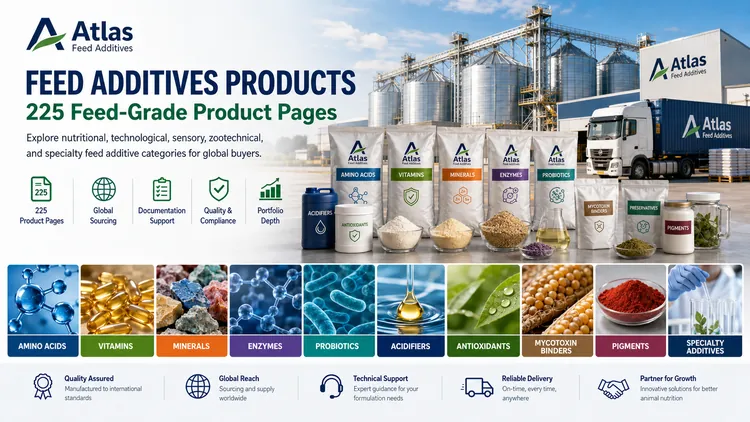
Browse 225 practical product pages used across poultry, swine, ruminant, aquaculture, pet food, premix, and feed mill operations. Each card links to an individual product page prepared for future specifications, real product images, supplier documents, and application-specific purchasing notes.
Atlas Feed Additives supports buyers who need more than a product name. We help organize product identity, grade, active content, physical form, documentation, origin options, packaging, shipment timing, and destination-market requirements before a quotation is prepared.
Portfolio overview
Feed additive purchasing involves technical, commercial, regulatory, and logistics details. This page is organized by functional category so buyers can quickly locate relevant products and then request supplier options, specifications, certificates, packaging details, and shipment information.
The portfolio includes nutritional additives such as amino acids, vitamins, minerals, and electrolytes; technological additives such as preservatives, antioxidants, binders, carriers, emulsifiers, and silage additives; sensory tools such as flavors, sweeteners, and pigments; zootechnical products such as enzymes, probiotics, and gut-support concepts; and specialty programs for ruminant, aquaculture, and coccidiosis-management applications where permitted.
Clarify product name, active ingredient, grade, concentration, carrier, coating, physical form, assay, and supplier-specific specification before comparing offers.
Request available specification sheets, certificates of analysis, safety data sheets, origin information, shelf-life data, label details, and shipment documents.
Compare minimum order quantity, pallet configuration, container load, lead time, payment terms, Incoterm, origin, packaging, and total landed cost.
Feed additive authorization, labeling, claims, use levels, and permitted species vary by market, so destination requirements should be confirmed before purchase and use.
Category navigation
Use the search box for a specific product name or jump directly to a category below. Product availability, claims, specifications, and use directions depend on supplier, origin, destination market, and local rules.
Important purchasing note: Product availability, specifications, claims, and use directions depend on origin, destination market, local rules, supplier documents, and customer specifications. Atlas Feed Additives can help coordinate supplier options and documentation for your request, but final product selection and use should be confirmed by the buyer's nutritionist, veterinarian, regulatory specialist, or authorized technical team.
Request preparation
A complete inquiry helps suppliers respond with useful offers instead of incomplete price indications. For each product, buyers should send the target grade, active content, quantity, destination, packaging preference, delivery term, expected shipment date, and required documents.
If you already use a product, share its label, previous specification, certificate of analysis, or technical data sheet. If you are developing a new formula, describe the species, feed type, production stage, processing condition, target function, and any local regulatory limitation.
Comparison criteria
Review assay, purity, active content, carrier, particle size, moisture, pH, solubility, heavy metals, microbiological limits, and product-specific quality parameters.
Check whether the product form and grade fit the target feed type, species, production stage, processing conditions, storage conditions, and formulation objective.
Confirm whether the supplier can provide current and destination-appropriate documents before order confirmation, especially for regulated or specialty additives.
Compare bag size, drum size, pallet configuration, container loading, shelf life, storage needs, hazard classification, and transport method.
Evaluate lead time, minimum order quantity, production schedule, batch availability, validity of offer, currency, payment term, and repeat-supply capacity.
Final authorization, label compliance, inclusion level, species use, claims, and market acceptance should be confirmed by the buyer for the destination country.
Documentation support
For feed mills, premix plants, integrators, and distributors, documentation can be as important as price. A technically suitable product may still be difficult to import or use if the specification, label, certificate, or origin documents do not meet the buyer's internal or destination-market requirements.
Atlas Feed Additives helps coordinate available supplier paperwork and clarify whether documents are available before shipment. This reduces confusion during purchasing, customs, quality-control review, and internal supplier approval.
Species and application fit
The same feed additive category can be used differently in poultry, swine, ruminant, aquaculture, pet food, and specialty feeds. Buyers should consider species, age, production stage, feed processing, storage conditions, local rules, and technical objective before selecting a product.
Amino acids, enzymes, pigments, minerals, vitamins, acidifiers, antioxidants, toxin-risk tools, coccidiosis programs where authorized, and gut-support additives are common discussion points.
Starter, grower, finisher, sow, and piglet feeds may require amino acids, acidifiers, flavors, sweeteners, enzymes, minerals, vitamins, probiotics, and digestive-support products.
Dairy and beef programs may involve buffers, protected nutrients, yeast products, mineral sources, silage additives, toxin-risk tools, electrolyte support, and rumen-performance concepts.
Fish and shrimp feeds may require attractants, binders, pigments, antioxidants, digestive aids, probiotics, immune-support concepts, and water-stability considerations.
Questions
Yes. The list is broad, but buyers may request additional feed-grade additives, premix ingredients, functional blends, or specialty products for review.
No. Feed additive authorization, labeling, claims, use levels, and species applications vary by destination market. Buyers should confirm local requirements before purchase and use.
Yes. Each product already has its own page and file name, so real specifications, images, documents, application notes, and supplier-specific details can be added product by product.
Send the product name, target specification, active content, grade, quantity, destination country, packaging preference, required documents, delivery term, and target shipment timing.
When multiple options are available, Atlas Feed Additives can help compare specification, origin, document package, packaging, lead time, price basis, and practical shipment conditions.
Yes. For repeat buyers, we can discuss annual demand, shipment frequency, forecast planning, alternative sources, repeat documentation, and long-term supply coordination.
Atlas Feed Additives focuses on sourcing, quotation, documentation, and supply coordination. Product use, inclusion level, species suitability, and regulatory compliance should be confirmed by the buyer's qualified technical, veterinary, or regulatory team.
Request a quotation
Send your target product names, specifications, destination country, quantity, packaging preference, required documents, and shipment timing. Our team will review your request and respond from orders@feedgradeadditives.com.
For faster evaluation, attach or describe any current specification, certificate of analysis, product label, desired active content, preferred origin, annual volume, or local registration requirement.