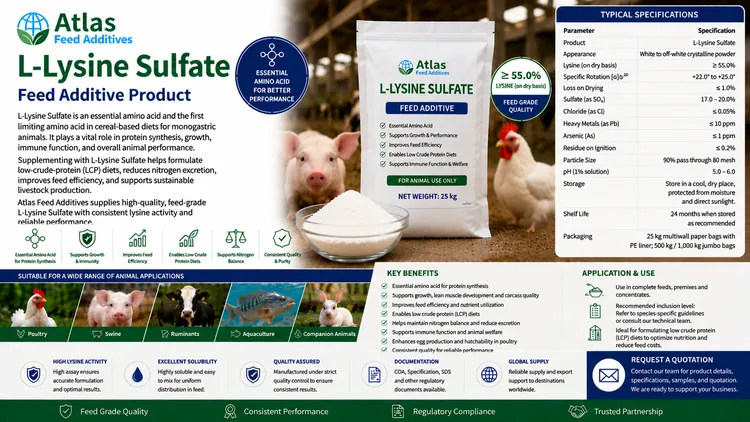
What is L-Lysine Sulfate used for in animal nutrition?
L-Lysine Sulfate supports precise protein nutrition, balanced amino acid profiles, lower-crude-protein formulation,
nitrogen efficiency, and economical ration design. It should be used according to target species,
formulation objective, digestible amino acid targets, ingredient matrix, and applicable market rules.
Why is lysine important in feed formulation?
Lysine is often one of the first limiting amino acids in poultry and swine diets. It is commonly used as a reference amino acid
for balancing other amino acids. Correct lysine supplementation helps nutritionists meet requirements without adding unnecessary crude protein.
How is L-Lysine Sulfate different from L-Lysine HCl?
Both are lysine sources, but they differ in lysine activity, accompanying components, moisture, physical form, ash or sulfate contribution,
and how they are valued in formulation software. Buyers should compare them on cost per unit of usable lysine and not only on product price per ton.
Is L-Lysine Sulfate mainly used in poultry and swine?
Poultry and swine are common application areas, especially in precision amino acid programs.
L-Lysine Sulfate may also be considered in aquaculture, pet food, and specialty nutrition where the formulation requires it.
Suitability should always be checked by species, diet type, processing method, and market rules.
Can Atlas Feed Additives quote L-Lysine Sulfate?
Yes. Send your required specification, quantity, destination, packaging preference, documents,
delivery terms, and target application so Atlas Feed Additives can review suitable supplier options for L-Lysine Sulfate.
What quality documents should buyers request for L-Lysine Sulfate?
Common documents include product specification, Certificate of Analysis, Safety Data Sheet,
origin information, batch details, manufacturing date, expiry date, packing list,
and any market-specific certificates required by the buyer or importer.
What specification should I compare between suppliers?
Compare lysine activity, assay basis, moisture, sulfate level, particle size, bulk density,
flowability, heavy metals, microbiological status, country of origin, packaging, shelf life,
traceability, and certification package.
Can L-Lysine Sulfate be used in premixes?
Yes, L-Lysine Sulfate can be handled through premix systems where the product specification and physical properties are suitable.
Buyers should review particle size, flowability, blend uniformity, compatibility with other ingredients, and storage conditions
to reduce segregation or caking risks.
Is L-Lysine Sulfate stable during pelleting?
Lysine products are commonly used in feed manufacturing, but actual stability should be checked according to the supplier specification,
processing temperature, conditioning time, moisture, and feed matrix. Buyers should request supplier guidance when using high-temperature processing.
How should L-Lysine Sulfate be stored?
Store L-Lysine Sulfate in a cool, dry, clean, and well-ventilated area. Keep bags sealed, protect from humidity,
avoid contamination, maintain batch labels, and use first-expired, first-out stock rotation.
What information is needed for a fast quotation?
Please provide product name, required lysine activity or grade, order quantity, destination country,
packaging preference, target species, application method, required certificates, delivery terms,
and preferred shipment date.
Does Atlas provide regulatory approval?
Atlas Feed Additives can help coordinate supplier documents and quotation information,
but buyers and importers should confirm local registration, permitted use, labeling rules,
and feed-additive compliance in the destination market.
Can L-Lysine Sulfate be combined with other amino acids?
Yes. It is often used alongside amino acids such as methionine, threonine, tryptophan, valine,
isoleucine, arginine, and others according to the formulation target. A qualified nutritionist should determine
the final amino acid balance.
Why does origin matter when sourcing L-Lysine Sulfate?
Origin can affect documentation, import procedures, customer approval, lead time, price, and regulatory acceptance.
Buyers should confirm country of origin, manufacturer approval, batch traceability, and destination-market requirements
before confirming an order.
How should I compare L-Lysine Sulfate prices?
Compare offers using the same lysine activity, assay basis, packaging, origin, Incoterms, lead time, payment terms,
document package, shelf life, and freight basis. A low unit price may not be the best value if lysine activity,
documentation, supply reliability, or shelf-life conditions are weaker.
Can L-Lysine Sulfate help reduce crude protein in feed?
It can be part of a low-crude-protein formulation strategy when used with other amino acids and proper ingredient matrix values.
Final diet design should be managed by a qualified nutritionist using species-specific requirements and local regulations.
What does cost per unit of usable lysine mean?
Cost per unit of usable lysine compares products according to the lysine they actually contribute to the diet.
This is more accurate than comparing price per ton when products have different lysine activity, moisture, or nutrient matrix values.