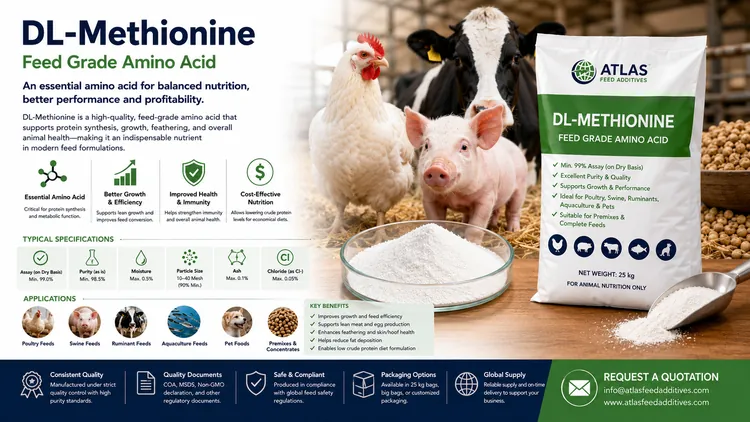
| Product name |
DL-Methionine, DL-Met, racemic methionine, or supplier-specific trade grade |
Confirms identity and avoids confusion with L-Methionine, Methionine Hydroxy Analog, MHA-Ca, or protected methionine products. |
| CAS number |
CAS 59-51-8 where applicable to DL-Methionine |
Supports customs, SDS, regulatory review, and technical identity confirmation. |
| Assay / purity |
Declared DL-Methionine percentage and test method |
Determines active nutrient value and cost per unit of methionine activity. |
| Nutrient matrix |
Methionine contribution, nitrogen contribution, sulfur contribution, and energy assumptions where needed |
Ensures accurate feed formulation and avoids inconsistent matrix values between nutrition systems. |
| Physical form |
Powder, crystalline powder, granule, microgranule, or premix-grade blend |
Affects dosing, mixing, segregation risk, dusting, and feed mill handling. |
| Appearance |
White to off-white crystalline powder or supplier-defined appearance range |
Useful for incoming inspection and detecting contamination, moisture, or handling damage. |
| Particle size |
Mesh range, sieve analysis, or particle-size distribution |
Important for premix uniformity, segregation control, dosing accuracy, and dust management. |
| Bulk density |
Loose and tapped bulk density where available |
Helps calculate dosing settings, bag volume, bin behavior, and blending performance. |
| Flowability |
Supplier handling guidance, angle of repose, anti-caking system, or feed-mill flow notes where available |
Supports reliable dosing in premix plants and automated micro-ingredient systems. |
| Loss on drying / moisture |
Maximum moisture or loss-on-drying value |
Moisture affects caking, stability, flowability, and storage quality. |
| Residue on ignition / ash |
Maximum mineral residue where specified |
Supports purity review and detection of non-active inorganic residues. |
| Heavy metals |
Lead, arsenic, cadmium, mercury, and total heavy metals where required |
Supports food-chain safety, customer quality standards, and import review. |
| Microbiology |
Total plate count, yeast and mold, coliforms, E. coli, Salmonella, or buyer-required limits |
Important for feed-grade materials handled in animal nutrition supply chains. |
| Impurities |
Related substances, residual solvents, cyanide-related process residues, or market-specific impurity checks where required |
Supports safety review, customer approval, and regulatory compliance. |
| Shelf life |
Declared shelf life under defined storage conditions |
Supports inventory planning and prevents quality loss during long storage. |
| Packaging |
25 kg bag, big bag, palletized bag, inner liner, moisture-barrier packaging, or private-label packaging |
Packaging affects moisture protection, handling, warehouse planning, and export logistics. |
| Regulatory status |
Destination-country status, feed-grade declaration, allowed application, and required label wording |
Feed additive rules and permitted claims vary by country and species. |