
Amino acids and nitrogen nutrients

L-Isoleucine

Feed-grade L-Isoleucine is a branched-chain amino acid used in precision animal nutrition programs where protein quality, digestible amino acid balance, and the relationship between isoleucine, leucine, and valine must be carefully managed.

  • Feed-grade amino acid
  • Branched-chain amino acid
  • Reviewed with leucine and valine
  • Poultry, swine, aquaculture and pet food
  • Specification-led sourcing support
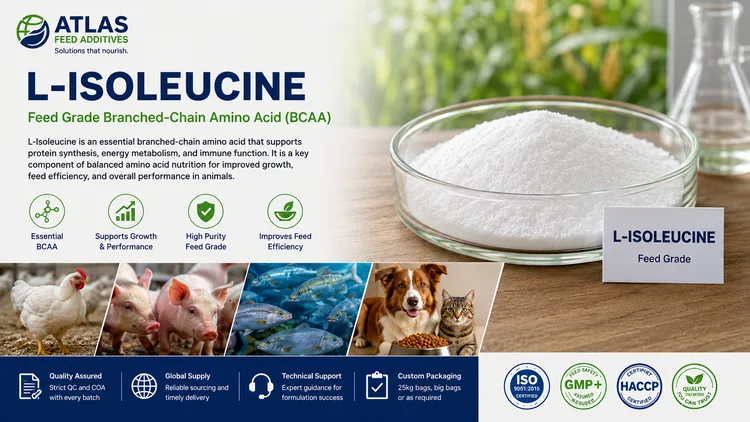
L-Isoleucine feed additive visual
Product type Nutritional amino acid additive
Amino acid group Branched-chain amino acid
Typical form Crystalline powder or granule
Supply model Global sourcing and quotation support

Product role

Where L-Isoleucine fits in animal nutrition

L-Isoleucine is part of the amino acids and nitrogen nutrients group. It is one of the branched-chain amino acids, commonly evaluated together with L-Leucine and L-Valine because these amino acids share related metabolic pathways and must be kept in balance in precision diets.

In practical feed formulation, L-Isoleucine is not usually evaluated as a stand-alone ingredient. Nutritionists review it against the complete amino acid profile, protein sources, digestible amino acid matrix, species requirements, production stage, ingredient variability, processing conditions, and the expected performance objective.

L-Isoleucine can become especially relevant when diets use lower crude-protein strategies, alternative protein sources, high cereal inclusion, distillers grains, corn gluten meal, or other ingredients that may shift the branched-chain amino acid profile. The objective is to support balanced protein nutrition rather than simply adding another amino acid to the formula.

Atlas Feed Additives can coordinate international supplier options for feed mills, premix producers, distributors, integrators, aquaculture feed producers, pet food manufacturers, and importers that require consistent feed-grade L-Isoleucine with clear quality documentation.

Technical overview

Typical technical profile buyers request

Final values must always follow the manufacturer specification and certificate of analysis. The table below is a practical procurement guide for common feed-grade L-Isoleucine requests.

Product name L-Isoleucine, feed-grade L-Isoleucine, branched-chain amino acid isoleucine.
Chemical identity L-Isoleucine is an L-form amino acid with the molecular formula C6H13NO2 and a molecular weight of approximately 131.17 g/mol.
CAS number 73-32-5.
Amino acid class Branched-chain amino acid, commonly reviewed together with L-Leucine and L-Valine.
Relationship to leucine Isoleucine and leucine share the same molecular formula but have different structural arrangement. This makes correct naming, CAS number, and specification review important during procurement.
Common commercial assay Often requested as a high-purity feed-grade amino acid. Buyers should confirm the exact assay, purity, method of analysis, stereochemical identity, moisture, residue profile, and batch result with the supplier.
Appearance White to off-white crystalline powder or granule. Color, particle size, and flowability may vary by manufacturer and production route.
Solubility and handling Solubility, dispersibility, and handling characteristics should be confirmed before use in premix, liquid application, pelleting, or extrusion systems.
Production route Commercial amino acids may be produced by fermentation, chemical synthesis, extraction, or other validated production routes depending on the product and manufacturer. Buyers should request production-route and compliance declarations when required by the destination market.
Packaging Common packaging options may include 20 kg or 25 kg bags, palletized shipments, fiber drums, cartons, big bags, or container-load supply. Final packaging depends on producer, order quantity, and destination requirements.
Shelf life Use the manufacturer shelf-life statement. Store in dry, cool, clean, and ventilated conditions according to the supplier label and safety data sheet.
Regulatory status Use must comply with feed additive rules, import rules, labeling rules, registration requirements, and species-specific restrictions in the destination market.

Animal nutrition applications

Where feed mills and nutrition teams evaluate L-Isoleucine

Swine feed

L-Isoleucine may be evaluated in swine diets when branched-chain amino acid balance becomes important, especially in low crude-protein programs or formulas containing ingredients that change the relationship between leucine, valine, and isoleucine.

  • Nursery, grower-finisher, and sow diets requiring amino acid precision
  • Low crude-protein programs where limiting amino acids are tightly controlled
  • Diets using corn, corn gluten meal, distillers grains, or other ingredients that can affect BCAA ratios
  • Review of isoleucine-to-lysine, leucine-to-isoleucine, and valine-to-isoleucine relationships
  • Coordination with lysine, methionine, threonine, tryptophan, valine, and leucine matrices

Poultry feed

In poultry nutrition, L-Isoleucine is reviewed as part of the full digestible amino acid profile. It may be considered when diet formulation uses alternative protein sources or when crude protein is reduced while maintaining performance targets.

  • Broiler starter, grower, and finisher programs
  • Layer, breeder, turkey, and minor poultry formulations
  • Alternative ingredient and high-cereal formulations
  • Digestible amino acid balancing for performance, feathering, and carcass objectives
  • Review of BCAA relationships with leucine and valine

Aquaculture and pet food

L-Isoleucine can be considered in aquaculture and pet food formulas where amino acid density, protein source replacement, extrusion performance, palatability, and complete amino acid balance must be reviewed together.

  • Fish and shrimp feeds with plant-protein replacement strategies
  • Pet food formulas using mixed animal and plant proteins
  • High-protein diets where amino acid ratios require fine adjustment
  • Extruded feeds where process stability and particle quality must be checked
  • Palatability and final product acceptance review with the formulation team
Formulation note: L-Isoleucine should be evaluated with the complete branched-chain amino acid profile. Excessive leucine relative to valine and isoleucine may create imbalance concerns, so the nutritionist should review digestible amino acid ratios before inclusion.

Formulation value

Why BCAA balance matters before price comparison

L-Isoleucine purchasing decisions should not be based only on price per kilogram. A meaningful comparison reviews the cost per unit of active amino acid, declared purity, expected contribution to the complete diet, and whether the diet already contains high or low isoleucine levels from raw materials.

Nutrition teams often evaluate L-Isoleucine in relation to L-Leucine and L-Valine because these branched-chain amino acids interact in metabolism and share related formulation considerations. The correct inclusion depends on species, diet type, protein source profile, growth phase, and the nutrient matrix used by the feed formulation system.

  • Supports precision amino acid balancing in specialized formulations
  • Useful when protein sources create unusual branched-chain amino acid ratios
  • Can support lower crude-protein strategies when all limiting amino acids are balanced
  • Requires review of isoleucine, leucine, and valine relationships
  • Should be entered into formulation software using verified matrix values
  • Must be used according to local feed additive regulations and buyer specifications

Practical formulation checks

Questions for the nutritionist

  • Which amino acid basis is used? Confirm whether the formulation uses total amino acids, digestible amino acids, standardized ileal digestibility, or another internal nutrient matrix.
  • What is the current BCAA profile? Review isoleucine, leucine, and valine levels before adding L-Isoleucine to avoid unnecessary imbalance or duplication.
  • Which ingredients drive BCAA levels? Check corn, corn gluten meal, distillers grains, soybean meal, animal proteins, fish meal, and alternative protein sources that affect BCAA ratios.
  • Which performance objective is targeted? Match the amino acid strategy to growth, feed conversion, egg production, carcass quality, aquaculture performance, or pet food nutrition goals.

Quality assurance

Buyer quality checklist for L-Isoleucine

A clear purchasing file helps reduce risk during supplier approval, import clearance, feed registration, warehouse receiving, and production use. Atlas Feed Additives can help buyers request the right documents before comparing offers.

Identity and assay

  • Product specification sheet
  • Certificate of analysis
  • Assay and purity declaration
  • Method of analysis
  • Moisture or loss on drying
  • Specific rotation or stereochemical identity when required
  • Particle size and bulk density information
  • Confirmation that the product is L-Isoleucine rather than leucine, DL-isoleucine, or another isomer

Safety parameters

  • Heavy metals such as lead, arsenic, cadmium, and mercury
  • Microbiological status
  • Salmonella statement where required
  • Residual solvents if applicable to the production route
  • Dioxins, PCBs, or other contaminants if market requires
  • Melamine or adulterant testing when required by buyer policy
  • Safety data sheet

Traceability

  • Batch or lot number
  • Manufacturing date
  • Expiry or retest date
  • Country of origin
  • Manufacturer or approved supplier information
  • Packaging label copy
  • Packing list and pallet configuration

Market documents

  • Free-sale certificate when needed
  • Health or veterinary certificate when applicable
  • Feed additive registration support documents
  • GMO or production organism statement where required
  • Halal or Kosher certificate if required
  • BSE/TSE and animal-origin statements if requested
  • Legalized or chamber-stamped documents if required by the destination country

Storage and handling

Protect quality, flowability, and shelf life

L-Isoleucine should be handled as a high-value feed additive. Storage and handling conditions can affect caking, dust formation, appearance, dosing accuracy, and ease of use in premix or feed mill systems.

  • Store in original, closed packaging in a clean, dry, and ventilated warehouse
  • Keep away from direct sunlight, moisture, condensation, and strong odors
  • Use pallets and avoid direct contact with floors or warehouse walls
  • Protect bags from tearing, contamination, and water exposure
  • Apply first-in, first-out stock rotation based on manufacturing or expiry date
  • Keep separate from non-feed chemicals, pesticides, fuels, and cleaning products
  • Follow the supplier label, safety data sheet, and local occupational safety procedures

Procurement note

Ask for the right specification before comparing prices.

Price comparisons are meaningful only when assay, purity, particle size, physical form, packaging, origin, documentation, Incoterm, delivery schedule, payment terms, and supplier approval status are aligned.

For sensitive or regulated markets, confirm feed additive authorization, import registration, label language, certificate format, and whether the manufacturer or exporter must appear on official documents.

  • Define the required grade. State whether you need feed-grade L-Isoleucine, a specific assay, a specific producer, a specific origin, or a registered source.
  • Confirm technical equivalence. Compare purity, amino acid basis, stereochemical identity, particle profile, moisture, bulk density, flowability, and packaging before comparing price.
  • Review the BCAA matrix. Ask the nutritionist whether the formulation requires L-Isoleucine addition or only a BCAA ratio adjustment through other ingredients.
  • Check documentation before ordering. Review COA, SDS, specification, origin, shelf life, production-route declarations, and destination-market certificates before shipment.

Quotation preparation

Information to send for a faster quotation

The more complete the request, the faster Atlas Feed Additives can compare suitable supplier options and avoid mismatched offers.

Commercial details

  • Required quantity and shipment frequency
  • Trial order, pallet quantity, FCL, or annual contract volume
  • Destination country, port, or delivery address
  • Preferred Incoterm such as EXW, FCA, FOB, CFR, CIF, CPT, or DAP
  • Target shipment date and delivery deadline
  • Payment preference and banking requirements

Technical details

  • Required assay and purity range
  • Accepted origin or manufacturer list
  • Physical form, particle size, or granulation preference
  • Packaging format, pallet requirements, and label requirements
  • Any internal specification or buyer standard
  • Species, formulation application, or intended feed category when relevant

Document details

  • COA and SDS requirements
  • Import registration documents
  • Health, veterinary, or free-sale certificates
  • Halal, Kosher, GMO, BSE/TSE, or origin statements
  • Production-route or fermentation declaration if required
  • Label language, legalization, or chamber-stamp requirements

Questions

Useful answers

What is L-Isoleucine used for in animal nutrition?

L-Isoleucine is used as a nutritional amino acid additive in feed programs that require precise amino acid balancing. It is especially relevant when the formulation team is reviewing branched-chain amino acid relationships and the complete protein nutrition profile.

Why is L-Isoleucine called a branched-chain amino acid?

L-Isoleucine has a branched carbon side chain and is grouped with L-Leucine and L-Valine. These three amino acids are often reviewed together because an imbalance in one may affect the practical use of the others in the diet.

Which species commonly evaluate L-Isoleucine?

L-Isoleucine may be evaluated in poultry, swine, aquaculture, pet food, and other species where amino acid precision is required. The correct use depends on species, production stage, formulation objective, diet composition, and applicable feed rules.

Is L-Isoleucine always needed in low crude-protein diets?

No. Low crude-protein diets should be evaluated by a qualified nutritionist using the complete amino acid matrix. L-Isoleucine may be useful in some formulas, while other formulas may already contain enough isoleucine from cereals and protein ingredients.

What is the difference between L-Isoleucine and L-Leucine?

L-Isoleucine and L-Leucine share the same molecular formula but are different amino acids with different structures and nutritional roles. The correct product name, CAS number, specification, and certificate of analysis should be checked before purchasing.

Can Atlas Feed Additives quote L-Isoleucine?

Yes. Send your required specification, quantity, destination, packaging preference, shipment timing, and required documents so Atlas Feed Additives can review suitable supplier options for L-Isoleucine.

What quality documents should buyers request for L-Isoleucine?

Common documents include specification, certificate of analysis, safety data sheet, origin information, batch details, shelf-life statement, label copy, and any market-specific certificates required by the buyer or destination authority.

How should L-Isoleucine be stored?

Store L-Isoleucine in clean, dry, cool, and ventilated conditions in the original packaging. Keep away from moisture, direct sunlight, damaged bags, strong odors, and non-feed chemicals. Always follow the supplier label and SDS.

What should be checked before comparing two L-Isoleucine offers?

Compare assay, purity, stereochemical identity, particle size, origin, manufacturer, documents, packaging, shelf life, Incoterm, freight route, payment terms, and whether the source is accepted in the destination market.

Request a quotation

Tell us what you need

Send your product list, target specification, destination country, packaging preference, shipment timing, and required documents. Our team will review your request and respond from orders@feedgradeadditives.com.

Product: L-Isoleucine or your required amino acid specification
Quantity: sample request, trial order, pallet quantity, FCL, or annual contract volume
Delivery: destination port, warehouse, or preferred Incoterm
Documents: COA, SDS, origin, health certificate, Halal, Kosher, GMO statement, BSE/TSE statement, or registration file