Amino acids and nitrogen nutrients

L-Valine

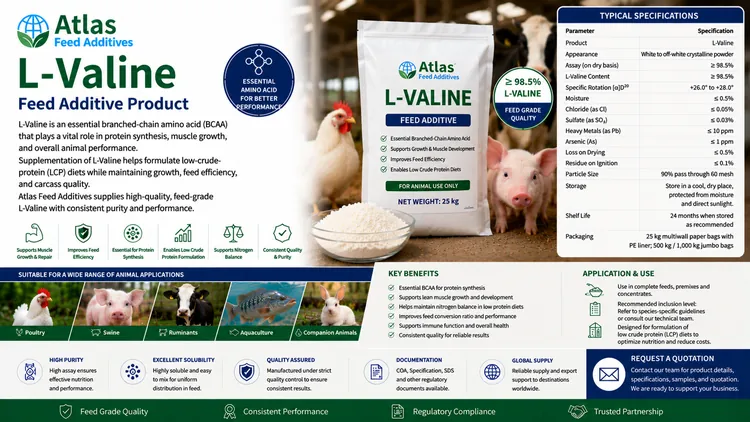
L-Valine is a feed-grade essential branched-chain amino acid used in precision nutrition programs to support balanced amino acid supply, lower-crude-protein diets, efficient nitrogen utilization, and economical ration formulation for poultry, swine, aquaculture, pet food, and specialty feed applications.

L-Valine feed additive visual

Product role

Where L-Valine fits

L-Valine is part of the amino acids and nitrogen nutrients group. In feed formulation, it is used when nutritionists need to fine-tune the amino acid profile beyond the traditional first-limiting amino acids. It is especially relevant in modern low-crude-protein diets, where precise supplementation can help maintain performance while reducing excess nitrogen intake.

Valine is one of the branched-chain amino acids, together with leucine and isoleucine. In practical poultry and swine nutrition, the relationship between these branched-chain amino acids may be important, especially when diets contain high levels of certain protein meals, corn co-products, or formulation patterns that shift the amino acid balance.

Buyers typically evaluate L-Valine by assay, purity, optical form, particle consistency, flowability, origin, manufacturing route, packaging, shelf life, batch traceability, and document package. Atlas Feed Additives coordinates international supplier options for feed mills, premix producers, distributors, integrators, and importers that need consistent feed-grade material and export-focused service.

Typical applications

L-Valine may be included in complete feeds, premixes, concentrates, mineral-vitamin blends, specialty nutrition programs, and species-specific formulations where the diet requires additional valine to meet digestible amino acid targets.

  • Poultry and swine diets with lower crude protein targets
  • Broiler and turkey formulas requiring closer amino acid balance
  • Layer, breeder, and pullet programs where amino acid precision supports production objectives
  • Nursery pig and grower-finisher diets where valine may become limiting
  • Aquaculture feeds that require precise essential amino acid supply
  • Pet food and specialty diets formulated with amino acid accuracy
  • Premix and concentrate production for integrated feed programs
  • Ruminant programs only where the ingredient and application are suitable for the species and process

Buyer quality checklist

L-Valine offers should be compared on a like-for-like basis. A product with the same name may differ in assay, purity, particle characteristics, origin, documentation, shelf life, and supply consistency.

  • Assay and purity declaration
  • Optical form and product identity confirmation
  • Loss on drying and residue on ignition
  • Particle size distribution and bulk density
  • Flowability, caking risk, and dust-control properties
  • Heavy metals and undesirable substance limits
  • Microbiological status and contamination controls
  • Country of origin and batch traceability
  • Manufacturing date, expiry date, and shelf-life statement
  • COA, SDS, specification, origin, and required market certificates

Specification guidance

How to define the right L-Valine specification

A clear purchase specification helps buyers avoid mismatched quotations. For amino acid products, the most important comparison points are assay, purity, identity, physical form, particle consistency, packaging, origin, and document readiness. Nutrition teams should also confirm whether the supplier data fits the digestible amino acid matrix used in their formulation software.

Core specification points

  • Assay: confirm the declared L-Valine percentage and the acceptable analytical tolerance.
  • Purity: review impurity profile, residue on ignition, loss on drying, and related quality indicators.
  • Optical identity: confirm that the product is L-form valine suitable for feed formulation.
  • Physical form: check whether the product is crystalline powder, granule, or a premix-ready form.
  • Particle size: important for premix homogeneity, segregation control, and dosing accuracy.
  • Bulk density: relevant for silo, bag, dosing, and blending calculations.
  • Flowability: check anti-caking properties and behavior in automated micro-dosing systems.
  • Contaminant limits: confirm heavy metals, microbiological limits, and undesirable substances.
  • Packaging: verify bag size, liner, pallet configuration, humidity protection, and export suitability.
  • Regulatory status: check permitted use, registration, and label rules in the destination country.

Species and formulation use

Application considerations by animal segment

Poultry

In broiler, turkey, layer, breeder, and pullet diets, L-Valine is used when formulation targets require closer balancing of essential amino acids. It may be especially relevant in lower-crude-protein diets and in programs where digestible lysine, methionine, threonine, isoleucine, arginine, and valine ratios are carefully managed.

Swine

In piglet, grower-finisher, and sow nutrition, L-Valine can support low-protein formulation strategies and help meet digestible amino acid targets. Nursery pig diets, in particular, may require close attention to valine when protein sources are reduced or reformulated.

Aquaculture

In fish and shrimp feeds, L-Valine may be used to support essential amino acid balance when diets include plant proteins, alternative proteins, or reduced fishmeal levels. Stability during extrusion, coating, and storage should be reviewed with the supplier.

Companion animals

In pet food, treats, and specialty diets, L-Valine may be used where amino acid balance, protein-source optimization, or nutritional positioning requires additional supplementation. Palatability, process stability, label wording, and regulatory compliance should be checked.

Ruminants

In ruminant programs, amino acid use depends heavily on species, production stage, rumen protection, formulation goal, and local practice. Buyers should confirm whether the offered ingredient is suitable for the intended ruminant application.

Premix plants

Premix producers evaluate L-Valine by blend uniformity, particle size, anti-caking behavior, compatibility with other micro-ingredients, packaging strength, lot traceability, and whether the material works reliably in automated dosing systems.

Procurement note

Ask for the right specification before comparing prices.

Price comparisons are meaningful only when assay, purity, origin, particle size, packaging, shelf life, payment terms, lead time, and documentation are aligned. For amino acids, differences in quality documentation, batch consistency, flowability, and logistics reliability can affect the real value of an offer.

A lower price may not be the best option if the material has weaker traceability, limited document support, shorter shelf life, unsuitable packaging, inconsistent particle size, higher caking risk, or uncertain market compliance.

Quality and safety

Documentation buyers should request

A complete document package helps buyers confirm identity, feed-grade suitability, shipment readiness, and compliance with destination-market expectations. Document requirements vary by country, importer, feed mill, certification program, and customer quality system.

  • Product specification sheet with assay and physical characteristics
  • Certificate of Analysis for the offered batch
  • Safety Data Sheet with handling and storage guidance
  • Country of origin and manufacturer or supplier declaration where available
  • Batch number, manufacturing date, expiry date, and shelf-life statement
  • Heavy metal and undesirable substance information where required
  • Microbiological quality statement where relevant
  • GMO, allergen, animal-origin, vegan, irradiation, or residual solvent statements if requested
  • Halal, ISO, GMP+, FAMI-QS, HACCP, or other certificates if required by the buyer
  • Import, registration, or feed-additive compliance documents for the destination country

Storage and handling

Protect quality from warehouse to mixer

Feed-grade amino acids are usually handled as dry crystalline or powder materials. Storage and handling should protect the product from moisture, contamination, caking, bag damage, and loss of traceability. Good warehouse practice supports consistent dosing and blending.

  • Store in a cool, dry, clean, and well-ventilated warehouse.
  • Keep bags sealed until use and protect them from humidity and condensation.
  • Avoid direct contact with floors, walls, water sources, and incompatible materials.
  • Use pallet covers or stretch wrap when needed for dust and moisture protection.
  • Apply first-expired, first-out stock rotation.
  • Keep batch labels visible for traceability and recall management.
  • Prevent cross-contamination with medicated additives, allergens, or restricted materials.
  • Check flowability before using in automated micro-dosing systems.

Formulation guidance

How nutrition teams evaluate inclusion

L-Valine inclusion should be determined by qualified nutritionists using species-specific amino acid requirements, digestible amino acid values, ingredient matrix data, feed intake, production stage, performance targets, and economic optimization. It is often considered after lysine, methionine, threonine, tryptophan, and isoleucine have been reviewed within the total formulation.

Practical formulation questions

  • Which species, age, weight range, and production stage is the diet designed for?
  • Is the formulation based on total amino acids or standardized ileal digestible amino acids?
  • What digestible valine-to-lysine ratio is being targeted?
  • Are leucine and isoleucine levels affecting the branched-chain amino acid balance?
  • Is crude protein being reduced to improve nitrogen efficiency or reduce diet cost?
  • Will L-Valine be added directly to complete feed or through a premix?
  • Does the product need to pass through pelleting, extrusion, or high-temperature processing?
  • Are the labeling, permitted claims, and inclusion limits acceptable in the destination market?

Commercial support

How Atlas Feed Additives supports sourcing

Supplier matching

Atlas reviews supplier options according to assay, product grade, origin, documentation, packaging, export readiness, lead time, quantity, and buyer-specific technical requirements.

Specification alignment

Before comparing prices, Atlas helps clarify assay, purity, particle size, packaging, certification needs, origin expectations, document package, and destination-market requirements.

Export coordination

Atlas can support quotation preparation with shipment terms, packing information, supplier communication, document review, and coordination between buyer, exporter, and logistics partners.

Repeat supply planning

For recurring demand, buyers can share forecasts so sourcing can be reviewed around production schedule, market availability, shelf-life management, shipping frequency, and safety stock planning.

Packaging options

Choose packaging according to plant requirements

Packaging selection affects freight cost, handling efficiency, warehouse protection, dosing accuracy, and product traceability. Buyers should match packaging to unloading capacity, storage conditions, monthly usage, and blending system.

  • Small bags: practical for premix plants, manual dosing, and smaller orders.
  • Multi-layer bags with liner: useful for moisture protection and export handling.
  • Cartons: may be used when additional protection or customer-specific packing is required.
  • Big bags: suitable for high-volume users with appropriate unloading and dosing systems.
  • Palletized export packing: supports safer handling, counting, and documentation-controlled shipments.

Logistics planning

Plan freight around shelf life and traceability

L-Valine logistics should protect the product from moisture, contamination, bag damage, and excessive storage delays. Buyers should confirm packing details, pallet dimensions, container loading, document timing, and shelf-life balance before shipment.

  • Confirm shipment quantity, bag count, pallet count, and net/gross weight.
  • Request batch numbers and shelf-life information before dispatch.
  • Check container dryness and cleanliness for sea shipments.
  • Protect goods from rain during loading and unloading.
  • Confirm whether fumigation, heat treatment, or pallet certificates are needed.
  • Review import documentation before the shipment leaves origin.

Questions

Useful answers

What is L-Valine used for in animal nutrition?

L-Valine supports precise protein nutrition, balanced amino acid profiles, lower-crude-protein formulation, and economical ration design. It should be used according to target species, formulation objective, digestible amino acid targets, ingredient matrix, and applicable market rules.

Why is L-Valine important in low-crude-protein diets?

When crude protein is reduced, individual amino acids may become limiting. L-Valine helps nutritionists meet valine requirements without adding unnecessary crude protein, which can support efficient nitrogen use and more precise diet formulation.

Is L-Valine mainly used in poultry and swine?

Poultry and swine are common application areas, especially in precision amino acid programs. L-Valine may also be considered in aquaculture, pet food, and specialty nutrition where the formulation requires it. Suitability should always be checked by species, diet type, and market rules.

Can Atlas Feed Additives quote L-Valine?

Yes. Send your required specification, quantity, destination, packaging preference, documents, delivery terms, and target application so Atlas Feed Additives can review suitable supplier options for L-Valine.

What quality documents should buyers request for L-Valine?

Common documents include product specification, Certificate of Analysis, Safety Data Sheet, origin information, batch details, manufacturing date, expiry date, packing list, and any market-specific certificates required by the buyer or importer.

What specification should I compare between suppliers?

Compare assay, purity, loss on drying, residue on ignition, particle size, bulk density, flowability, heavy metals, microbiological status, country of origin, packaging, shelf life, traceability, and certification package.

Can L-Valine be used in premixes?

Yes, L-Valine is commonly handled through premix systems. Buyers should review particle size, flowability, blend uniformity, compatibility with other micro-ingredients, and storage conditions to reduce segregation or caking risks.

Is L-Valine stable during pelleting?

Amino acids are generally used in feed manufacturing, but actual stability should be checked according to the supplier specification, processing temperature, conditioning time, moisture, and feed matrix. Buyers should request supplier guidance when using high-temperature processing.

How should L-Valine be stored?

Store L-Valine in a cool, dry, clean, and well-ventilated area. Keep bags sealed, protect from humidity, avoid contamination, maintain batch labels, and use first-expired, first-out stock rotation.

What information is needed for a fast quotation?

Please provide product name, required assay or grade, order quantity, destination country, packaging preference, target species, application method, required certificates, delivery terms, and preferred shipment date.

Does Atlas provide regulatory approval?

Atlas Feed Additives can help coordinate supplier documents and quotation information, but buyers and importers should confirm local registration, permitted use, labeling rules, and feed-additive compliance in the destination market.

Can L-Valine be combined with other amino acids?

Yes. It is often used alongside amino acids such as lysine, methionine, threonine, tryptophan, isoleucine, arginine, and others according to the formulation target. A qualified nutritionist should determine the final amino acid balance.

Request a quotation

Tell us what you need

Send your product list, target specification, destination country, packaging preference, and required documents. For L-Valine, please also include the required assay, order quantity, target animal species, use in premix or complete feed, preferred packaging, required certificates, destination port or delivery city, and preferred Incoterms. Our team will review your request and respond from orders@feedgradeadditives.com.