| Product name |
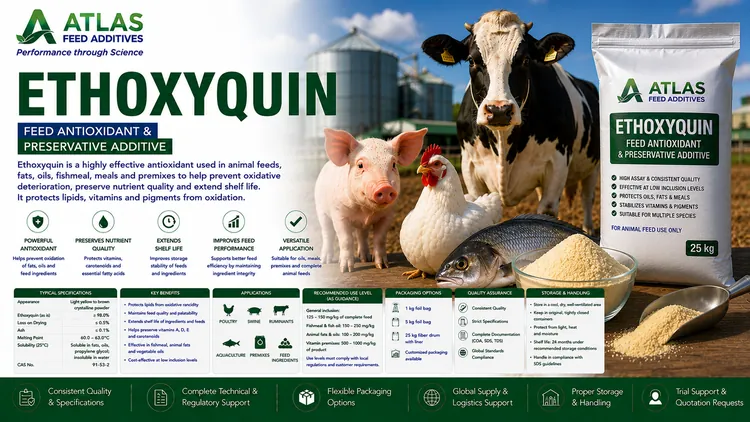
Ethoxyquin, Ethoxyquin feed antioxidant, antioxidant premix, oil antioxidant blend, or feed preservative product depending on supplier documentation and market classification. |
| Chemical identity |
1,2-Dihydro-6-ethoxy-2,2,4-trimethylquinoline; also described as 6-ethoxy-2,2,4-trimethyl-1,2-dihydroquinoline. |
| CAS number |
91-53-2. |
| Molecular formula |
C14H19NO. |
| Molecular weight |
Approximately 217.31 g/mol. |
| Chemical family |
Synthetic quinoline antioxidant. |
| Functional role |
Technological antioxidant or preservative in selected feed and ingredient applications where permitted by market rules. |
| Typical appearance |
Concentrated material is commonly a yellow to amber or brownish liquid. Carrier-based products may be free-flowing powders, granules, or premixes depending on formulation. |
| Assay |
Buyer should specify active Ethoxyquin content. Concentrated liquid, diluted liquid, oil blend, carrier powder, and premix products require different assay expectations. |
| Analytical method |
Common buyer requests may include HPLC, GC, or validated supplier methods for active assay and impurity profile. Method suitability should be confirmed for the offered matrix. |
| p-Phenetidine |
Request a declaration or test value for p-phenetidine where required by regulation, customer policy, or internal quality control. This impurity is a key point in Ethoxyquin procurement review. |
| Other impurities |
Buyers may request limits for oxidation products, quinone imine-related compounds, residual solvents, heavy metals, process impurities, and unknown peaks according to destination-market or customer requirements. |
| Solubility and dispersion |
Liquid Ethoxyquin is commonly used in oil-soluble antioxidant systems. Powder or premix forms depend on carrier, particle size, and mixing conditions for uniform distribution. |
| Carrier system |
For dry products, confirm carrier identity, carrier percentage, anticaking system, particle size, bulk density, dust profile, and compatibility with premix or feed manufacturing. |
| Application substrate |
Confirm whether the product is intended for fats, oils, fishmeal, animal meals, vitamin premixes, pigment materials, canned pet food, dry feed, or another permitted use. |
| Recommended dose |
Dose depends on market authorization, substrate oxidation risk, active concentration, desired protection, and customer specification. Final use level must not exceed applicable legal limits. |
| Performance tests |
Buyers may request peroxide value, anisidine value, TBA/TBARS, oxidative stability index, active recovery, heat stability, carry-through, or retained vitamin/pigment studies. |
| Packaging |
Liquid forms may be supplied in bottles, jerrycans, drums, or IBCs. Powder forms may be supplied in lined bags, cartons, drums, or big bags depending on product type and order quantity. |
| Storage |
Store tightly closed in a cool, dry, well-ventilated area, protected from excessive heat, sunlight, oxidation, moisture, and incompatible materials. Follow supplier SDS and label instructions. |
| Shelf life |
Confirm supplier shelf-life statement, production date, expiry or retest date, recommended storage temperature, and whether opened containers require faster use or resealing procedures. |
| Documentation |
Specification, COA, SDS, technical data sheet, active assay, impurity profile, origin declaration, batch traceability, packaging list, shelf-life statement, and destination-market authorization documents. |