Antioxidants

TBHQ

TBHQ is a feed-grade antioxidant used to help control oxidation in fats, oils, animal by-products, premixes, and finished feed where freshness, odor control, palatability, and nutrient protection are important.

Atlas Feed Additives supports international buyers with TBHQ sourcing, active-assay review, antioxidant application comparison, quality-document coordination, packaging options, and export-focused quotation service for feed mills, premix producers, rendering plants, oil processors, distributors, and integrators.

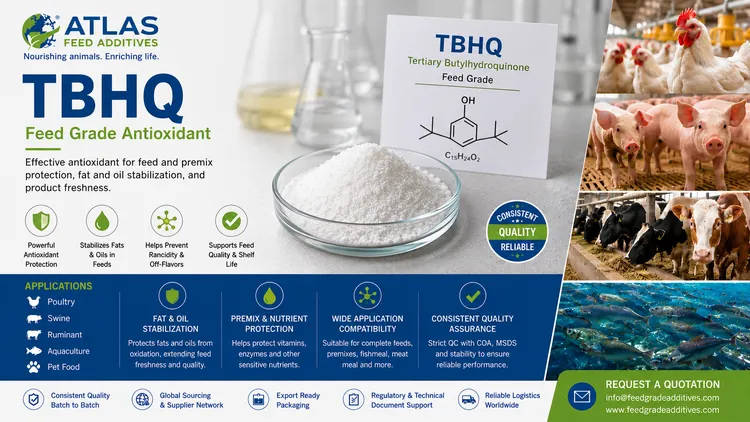
TBHQ feed additive visual

Product role

Where TBHQ fits

TBHQ belongs to the antioxidants group. In animal nutrition and feed ingredient handling, antioxidants are used to help slow oxidative deterioration in fat-rich raw materials, oils, meals, premixes, and finished feeds. Oxidation can affect odor, flavor, palatability, pigment stability, vitamin retention, fat quality, and overall shelf-life.

TBHQ is typically evaluated as a technological additive rather than a nutrient. Buyers compare it by active antioxidant level, purity, physical form, application method, solubility in fat or oil systems, blending behavior, carry-through stability, packaging, shelf-life, origin, impurity profile, and authorization status in the destination market.

Atlas Feed Additives can coordinate international supplier options for customers that need consistent feed-grade material, responsive documentation, export support, and clear comparison of technical and commercial offers.

Technical identity

Product names and commercial descriptions

Suppliers may present TBHQ using chemical, technical, or commercial antioxidant terminology. Before approving a source, buyers should confirm that the offered product matches the intended application, local authorization status, and required feed or technical specification.

  • TBHQ
  • tBHQ
  • Tertiary Butylhydroquinone
  • tert-Butylhydroquinone
  • 2-tert-Butylbenzene-1,4-diol
  • Antioxidant TBHQ
  • Feed-grade TBHQ
  • Oil-soluble antioxidant
  • Fat and oil stabilizer
  • Antioxidant premix ingredient

Oxidation control

Why antioxidants matter in feed

Feed ingredients that contain unsaturated fats, oils, meals, pigments, vitamins, or sensitive nutrients can deteriorate when exposed to oxygen, heat, light, moisture, metals, and long storage periods. Antioxidants help delay this process when selected and applied correctly.

  • Helps protect fats and oils from rancidity
  • Supports freshness in fat-rich feed ingredients
  • Helps preserve odor and palatability
  • Supports vitamin and pigment protection strategies
  • Useful for long-distance ingredient logistics
  • Helps stabilize selected animal by-products and rendered meals
  • Can be used in antioxidant systems with other approved ingredients where suitable

Formulation value

A targeted antioxidant for fat, oil, and feed ingredient protection

TBHQ is often evaluated when buyers need strong antioxidant support in fat and oil systems. It can be considered for raw material stabilization, ingredient preservation, premix protection, and finished feed shelf-life strategies where the destination market permits its use.

The value of TBHQ depends on the full application system. A meaningful comparison should consider the active concentration, product form, solubility, method of application, dosage accuracy, distribution in the treated material, compatibility with other antioxidants, storage environment, and the oxidative challenge of the ingredient being protected.

Typical applications

Where TBHQ is commonly evaluated

TBHQ may be reviewed for fats, oils, rendered ingredients, premixes, and selected finished feed systems. Final use should always match the product specification, application method, local feed legislation, maximum permitted level, customer policy, and technical recommendation.

Fats and oils

Used to help stabilize vegetable oils, animal fats, blended fats, and other lipid ingredients where oxidative rancidity is a key quality risk. Buyers should review solubility, application temperature, mixing time, dosage accuracy, and legal use limits.

Fishmeal and marine ingredients

Reviewed for fishmeal, fish oil, krill-related materials, and marine by-products where high unsaturated-fat content can increase oxidation risk. Market-specific authorization and customer acceptance should be checked carefully.

Meat meal and rendered meals

Can be considered for meat and bone meal, poultry meal, feather meal blends, and other rendered animal by-products where odor, fat quality, and storage stability are important.

Vitamin and mineral premixes

May be evaluated in premix systems where fat-soluble vitamins, pigments, flavors, oils, or other sensitive ingredients require protection. Compatibility with minerals, choline chloride, acids, and moisture should be assessed.

Finished feed

Reviewed for selected poultry, swine, ruminant, aquaculture, pet food, and specialty feed programs when the formula contains oxidation-sensitive fat, oil, or high-risk raw materials. Final application must comply with destination-market rules.

Long-distance logistics

Useful where feed ingredients face long transport times, warm climates, high humidity, bulk storage, or export routes that increase oxidation pressure before the material reaches the buyer.

Specification guide

What to check before approving a TBHQ supplier

TBHQ prices and performance can vary according to purity, assay method, physical form, application medium, formulation system, packaging, shelf-life, and document package. Buyers should align the following details before comparing offers.

Parameter Why it matters What to request
TBHQ assay Determines the active antioxidant contribution and cost per unit of active material. Minimum assay, typical assay, test method, and COA confirmation.
Chemical identity Confirms that the material is tert-butylhydroquinone and not another antioxidant. Product identity, CAS number, formula, supplier declaration, and identification test.
Physical form Affects weighing, blending, dissolution, dust level, and handling safety. Powder, flakes, granules, liquid blend, or carrier-based premix details.
Purity profile Supports regulatory approval, customer audits, and quality comparison. Impurity limits, hydroquinone-related impurities where applicable, and chromatographic data when required.
Solubility and application medium TBHQ must be distributed properly in fat, oil, or treated material to provide effective protection. Solubility guidance, application temperature, dilution recommendation, and mixing instructions.
Carrier or blend composition Some commercial products may be diluted or blended with carriers, emulsifiers, or other antioxidants. Full composition, active percentage, carrier declaration, allergen/GMO status, and feed-grade declaration.
Particle size Influences dissolution speed, blend uniformity, dust exposure, and dosing accuracy. Sieve analysis, particle size range, and dust-control information when available.
Moisture or loss on drying High moisture can affect flowability, caking, shelf-life, and product consistency. Maximum moisture limit and recommended storage conditions.
Heavy metals and contaminants Important for feed safety, import approval, and customer specifications. Lead, arsenic, cadmium, mercury, and any buyer-specific contaminant limits.
Stability Antioxidant activity must remain reliable during storage and application. Shelf-life, storage guidance, packaging protection, and stability data when available.
Regulatory authorization Permitted use and maximum levels may differ between countries and applications. Destination-market suitability, feed-use declaration, registration support, and label wording guidance.
Packaging Impacts warehouse handling, dust control, moisture protection, odor control, and export logistics. Bag, drum, carton, liner, pallet configuration, net weight, and container loading information.

Formulation considerations

How buyers evaluate practical use

TBHQ should be evaluated as part of the full antioxidant program. The best result depends on selecting the correct product form, applying it uniformly, and treating the ingredient before oxidation has already advanced too far.

  • Confirm whether the product is pure TBHQ or a formulated blend.
  • Check solubility in the target fat or oil system.
  • Review the recommended application temperature and mixing time.
  • Confirm dosage accuracy and distribution in treated material.
  • Assess compatibility with BHA, BHT, propyl gallate, citric acid, tocopherols, or other antioxidant systems where permitted.
  • Consider metal contamination, moisture, heat, light, and oxygen exposure in the treated material.
  • Apply antioxidant early enough to protect quality before rancidity develops.
  • Verify all use levels against the destination country's feed legislation and customer requirements.

Application review

Questions before use

  • Will TBHQ be used in oil, rendered fat, fishmeal, meat meal, premix, or finished feed?
  • What is the fat content and oxidative risk of the treated material?
  • Is the product being applied before, during, or after processing?
  • What mixing equipment and application method will be used?
  • Is a dry powder, liquid blend, or carrier-based antioxidant more practical?
  • Will the material be stored in bulk, bags, silos, tanks, drums, or containers?
  • What shelf-life and transport duration must the treated material withstand?
  • Does the destination market authorize TBHQ for the intended feed or ingredient application?

Buyer quality checklist

Documents to request for TBHQ

Documentation requirements vary by buyer, destination country, and application. For feed-grade or technical-use TBHQ, procurement teams normally request a complete technical, quality, and regulatory package before approving a supplier.

Core product documents

  • Product specification sheet
  • Certificate of Analysis
  • Safety Data Sheet
  • Technical Data Sheet
  • Manufacturing date, batch number, and shelf-life
  • Country of origin statement
  • Feed-use, food-use, or technical-use declaration as required
  • Recommended storage and handling instructions

Assay and identity documents

  • TBHQ assay result
  • Assay method reference
  • Identification test result
  • Purity or impurity profile when required
  • Melting range or physical identity where included in the specification
  • Particle size or sieve analysis when relevant
  • Loss on drying or moisture result

Safety and contaminant controls

  • Heavy metal limits
  • Residual solvent statement when relevant
  • Microbiological limits when required
  • Dioxin, PCB, or PAH statement when requested
  • Allergen declaration
  • GMO declaration
  • BSE/TSE and animal-origin declaration when required

Market and audit documents

  • Destination-market authorization support when available
  • Halal certificate when required
  • Kosher certificate when required
  • ISO, GMP+, FAMI-QS, HACCP, or similar quality-system documents when available
  • Free sale certificate or registration support when needed
  • Customer-specific questionnaire or vendor approval package

Procurement note

Ask for the right specification before comparing prices.

Price comparisons are meaningful only when active assay, purity, physical form, application medium, carrier system, packaging, origin, shelf-life, authorization status, and documentation are aligned. A lower price per kilogram may not be the best value if the product is diluted, difficult to dissolve, poorly documented, unsuitable for the target market, or not practical for the buyer's application equipment.

For sensitive antioxidant programs, buyers should also review storage conditions, application method, treated-material fat content, existing peroxide value or rancidity status, metal contamination, heat exposure, logistics duration, and the regulatory requirements of the destination market. Atlas Feed Additives can help collect supplier information so your technical, regulatory, and purchasing teams can compare offers clearly.

Storage and handling

Practical warehouse guidance

Storage and handling should always follow the supplier's SDS, product label, and technical sheet. In general, antioxidant raw materials should be stored in clean, dry, well-ventilated areas and protected from heat, direct sunlight, moisture, incompatible materials, and contamination.

  • Keep bags, drums, cartons, or containers tightly closed when not in use.
  • Store in a cool, dry, ventilated warehouse.
  • Protect from direct sunlight, high humidity, and excessive heat.
  • Keep away from oxidizing agents and incompatible materials according to the SDS.
  • Use appropriate personal protective equipment during handling.
  • Control dust exposure during weighing and mixing.
  • Prevent contamination with non-feed or rejected materials.
  • Maintain batch traceability and first-in, first-out stock rotation.
  • Do not use expired or damaged material without quality approval.

Packaging options

Common commercial packing

Available packaging depends on supplier, product form, order size, and export route. Atlas Feed Additives can request packaging alternatives during quotation.

  • Small bags for premix and specialty additive users
  • Multi-layer bags with inner liner for powder or crystalline material
  • Cartons or fiber drums depending on supplier format
  • HDPE drums or sealed containers for liquid blends
  • Palletized cargo for export handling
  • Moisture-protective packaging where required
  • Customer-specific labeling when available
  • Sample packing for technical approval when supplier policy allows
  • Container-load options for distributors and importers

Quotation preparation

Information to send for a faster TBHQ offer

To prepare a complete quotation, please include technical, commercial, and documentation requirements. This helps match the correct supplier, product form, packing, and export document package.

Product requirements

  • Required product name: TBHQ
  • Required assay or active concentration
  • Pure powder, flakes, liquid blend, or carrier-based premix preference
  • Target application: oil, fat, fishmeal, meat meal, premix, or finished feed
  • Required solubility or application guidance
  • Current specification sheet if available
  • Any approved manufacturer, origin, or audit requirement

Commercial requirements

  • Required quantity
  • Trial order, spot order, tender, or regular monthly volume
  • Destination country and destination port
  • Preferred Incoterms
  • Target delivery schedule
  • Preferred payment and shipping document requirements

Documentation requirements

  • Specification and COA
  • SDS and technical data sheet
  • Origin statement
  • Feed-use or relevant-use declaration
  • Heavy metals and impurity limits
  • GMO, allergen, BSE/TSE, halal, kosher, or customer-specific statements
  • Registration, import, or authorization documents required by your market

Commercial support

How Atlas Feed Additives supports your purchase

Supplier matching

We review your required TBHQ assay, application, product form, destination market, order size, packaging preference, and documentation needs to identify suitable supplier options.

Specification comparison

We help collect and organize key details such as active assay, physical form, purity, solubility, application method, carrier system, shelf-life, packing, container loading, and available batch documents.

Document coordination

We coordinate supplier communication for specifications, COA, SDS, technical data sheets, origin declarations, relevant-use statements, quality-system certificates, and other documents required for import or customer approval.

Export-focused service

We support international customers with quotation follow-up, packing clarification, shipment timing, document expectations, and communication from Ankara, Turkey.

Questions

Useful answers

What is TBHQ used for in animal nutrition?

TBHQ is used as an antioxidant to help control oxidation in fats, oils, fishmeal, meat meal, premixes, and selected finished feed applications. It helps protect freshness, odor, palatability, and nutrient value when used correctly and where permitted.

What does TBHQ stand for?

TBHQ stands for tertiary butylhydroquinone, also written as tert-butylhydroquinone. It is a synthetic phenolic antioxidant used in selected stabilization applications.

Is TBHQ a nutritional additive or a technological additive?

TBHQ is generally evaluated as a technological additive because its main role is oxidation control, not direct nutrient supply. The exact regulatory category and permitted use depend on the destination market.

Where is TBHQ commonly applied?

TBHQ is commonly evaluated for fats, oils, rendered meals, fishmeal, meat meal, vitamin premixes, ingredient logistics, and finished feed systems where oxidation risk is important. Final use should follow local authorization and customer requirements.

Can TBHQ be blended with other antioxidants?

TBHQ may be used in antioxidant systems with other permitted antioxidants or synergists such as BHA, BHT, propyl gallate, tocopherols, or citric acid depending on the application and market rules. Compatibility and legal use levels must be checked before use.

What quality documents should buyers request for TBHQ?

Common documents include specification, certificate of analysis, safety data sheet, technical data sheet, origin statement, batch details, shelf-life, assay method, relevant-use declaration, impurity limits, heavy metal limits, and market-specific certificates.

Can Atlas Feed Additives quote TBHQ?

Yes. Send your required specification, active assay, quantity, destination, packaging preference, application, and documents so Atlas Feed Additives can review suitable supplier options for TBHQ.

What should be included in a TBHQ quotation request?

Please include the required product form, assay, quantity, destination country and port, Incoterms, packaging preference, target application, required certificates, target delivery date, and whether the order is for a trial, spot purchase, tender, or regular supply.

How should TBHQ be stored?

Follow the supplier's SDS and technical sheet. In general, keep TBHQ in tightly closed packaging in a clean, dry, ventilated area, away from heat, direct sunlight, moisture, oxidizing agents, incompatible materials, and contamination.

Why is market authorization important for TBHQ?

Antioxidant rules differ between countries, species, feed categories, and treated materials. Buyers should confirm the destination market's permitted use, maximum levels, label requirements, and customer policy before purchasing or applying TBHQ.

Request a quotation

Tell us what you need

Send your product list, target specification, active assay, application, destination country, packaging preference, quantity, and required documents. Our team will review your request and respond from orders@feedgradeadditives.com.

Suggested message details

  • Required product: TBHQ
  • Target active assay or concentration
  • Required product form: powder, flakes, liquid blend, or premix
  • Application: fat, oil, fishmeal, meat meal, premix, or finished feed
  • Required quantity and delivery schedule
  • Destination country and port
  • Required documents and certificates
  • Current specification sheet if available