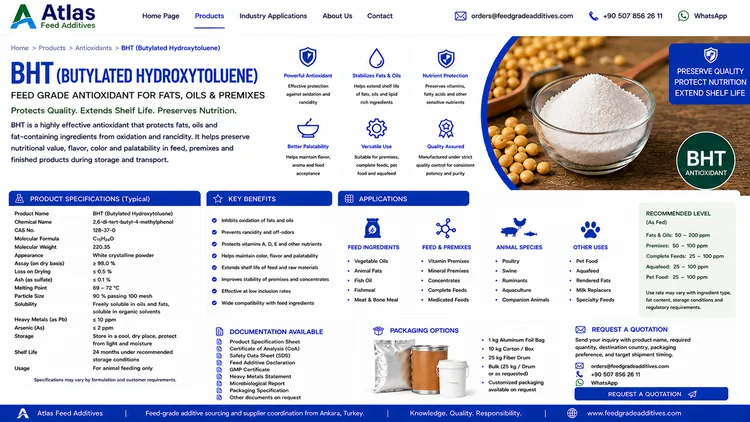
| Product identity |
Exact product name, chemical name, grade, and feed-use declaration where applicable |
Confirms that the material matches the intended feed, ingredient, premix, or processing application. |
| BHT assay |
Guaranteed BHT content and analytical method |
The main active-content value for price comparison and cost-in-use calculation. |
| Purity profile |
Purity, impurities, related substances, residue limits, and method information where required |
Important for supplier qualification, customer standards, and regulatory review. |
| Physical form |
Powder, crystals, flakes, granules, prills, liquid blend, carrier-based blend, or premix-ready form |
Physical form affects dosing, blending, dust, solubility, and application method. |
| Melting range |
Declared melting range and method where available |
Useful for identifying product consistency and confirming suitability for fat or oil applications. |
| Application medium |
Oil-soluble, fat-soluble, carrier-based, dry-blend, or liquid-application guidance |
BHT must be matched to the actual application system for uniform distribution. |
| Carrier system |
Carrier declaration, dilution basis, anti-caking system, or liquid solvent system if blended |
Carrier affects active content, flowability, handling, compatibility, and price comparison. |
| Moisture |
Maximum moisture and analytical method |
Moisture affects caking, flowability, storage stability, and shelf life. |
| Ash |
Ash limit or residue on ignition where applicable |
Supports impurity control and incoming quality review. |
| Particle size |
Mesh size, sieve analysis, crystal size, granulation range, or customer-specific particle-size target |
Particle size affects dissolution, blending, dust, segregation risk, and application uniformity. |
| Appearance and odor |
Color, visual standard, odor profile, and acceptable variation |
Supports incoming inspection and helps identify shipment damage or contamination. |
| Solubility or dispersion |
Supplier statement on solubility in fats, oils, solvents, carriers, or target application medium |
Important for oil treatment, liquid blends, premix distribution, and process compatibility. |
| Bulk density |
Loose density, tapped density, or handling-density range where available |
Useful for dosing equipment, packaging planning, warehouse calculations, and freight optimization. |
| Dust and flowability |
Dust-control notes, anti-caking system, flowability statement, or customer-specific handling standard |
Important for worker handling, dosing accuracy, premix quality, and plant cleanliness. |
| Carry-through stability |
Supplier statement on processing, heat exposure, pelleting, extrusion, oil coating, and storage conditions |
Processing and storage conditions can influence practical antioxidant performance. |
| Heavy metals |
Lead, arsenic, cadmium, mercury, or buyer-specific limits |
Important for feed safety, import clearance, and customer compliance programs. |
| Contaminants |
Residual solvents, impurities, microbiology, dioxins, undesirable substances, or market-specific tests where applicable |
Some destination markets and large feed groups require strict contaminant documentation. |
| Shelf life |
Declared shelf life under recommended storage conditions |
Important for import planning, premix production planning, and distributor stock rotation. |
| Packaging |
Bag size, carton, drum, inner liner, foil bag, pallet quantity, and label information |
Packaging affects moisture protection, contamination prevention, handling safety, and freight cost. |
| Certification |
ISO, HACCP, GMP+, FAMI-QS, Halal, Kosher, or other certificates when required |
Some buyers require supplier quality-system documents before approval. |
| Regulatory status |
Destination-market authorization, maximum permitted levels, label rules, feed-grade status, and import documentation |
Use and import must comply with the rules of the destination country. |