Antioxidants

Mixed Tocopherols

Mixed Tocopherols are natural antioxidant compounds used to help control oxidation in fats, oils, rendered meals, fishmeal, vitamin premixes, pet food, aquaculture feed, and finished feed, supporting freshness, nutrient protection, odor stability, and longer storage performance.

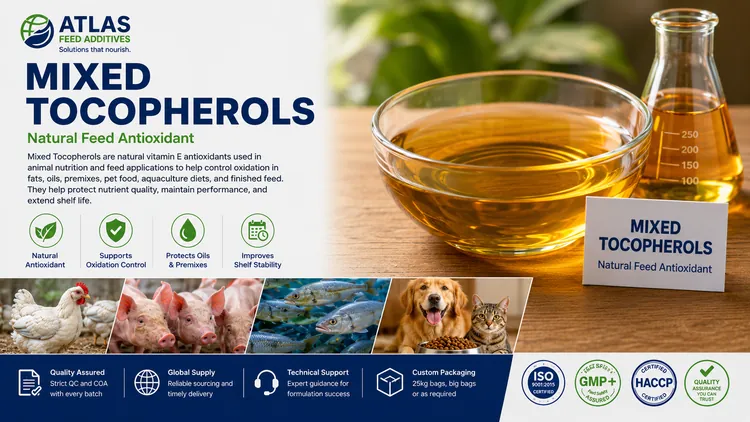
Mixed Tocopherols feed additive visual

Product role

Where Mixed Tocopherols fits

Mixed Tocopherols is part of the antioxidants group. It is selected when feed manufacturers, premix producers, rendering companies, oil suppliers, pet food producers, aquaculture feed plants, and integrators need an antioxidant system that helps delay oxidative deterioration in lipid-rich or nutrient-sensitive materials.

Oxidation can reduce product freshness, create rancid odors, damage sensitive vitamins and pigments, reduce palatability, and shorten commercial shelf life. Mixed Tocopherols are commonly evaluated as a natural-origin antioxidant option for customers that want to protect fats, oils, meals, premixes, and finished feeds while meeting customer, label, or market expectations.

Atlas Feed Additives can coordinate international supplier options for feed-grade Mixed Tocopherols in liquid, oil-soluble, dry carrier-based, or custom antioxidant formats depending on the application, documentation requirements, target market, and buyer specification.

Typical applications

  • Animal fats, vegetable oils, fish oils, poultry fat, tallow, and blended feed fats
  • Fishmeal, meat meal, meat and bone meal, poultry meal, blood meal, and other rendered products
  • Vitamin premixes, mineral premixes, specialty blends, concentrates, and functional additive systems
  • Pet food, treats, palatants, coated kibbles, and high-fat companion-animal products
  • Aquaculture feeds containing fish oil, marine meals, high-energy ingredients, or sensitive pigments
  • Long-distance feed ingredient logistics where heat, oxygen exposure, and storage time increase oxidation risk
  • Natural-positioned feed programs where buyers prefer non-synthetic antioxidant systems where permitted

Buyer quality checklist

  • Total tocopherol concentration and individual tocopherol profile where available
  • Oil solubility, carrier system, physical form, viscosity, and application method
  • Antioxidant activity in the intended substrate, not only in laboratory specification
  • Compatibility with fats, oils, meals, vitamins, pigments, flavors, acids, and processing aids
  • Storage stability, light protection, oxygen exposure control, and packaging barrier quality
  • Market-specific authorization status, label requirements, and customer approval documents
  • SDS, COA, specification, shelf-life statement, origin information, and batch traceability

Technical overview

Natural antioxidant support for lipid-rich feed materials

Mixed Tocopherols are used to help slow oxidative chain reactions in fats, oils, and feed ingredients that contain unsaturated lipids. They are especially relevant when raw materials are exposed to oxygen, heat, light, metal ions, moisture, long storage periods, or long-distance transport.

The practical value of Mixed Tocopherols depends on the substrate being protected, the stage of addition, product concentration, tocopherol profile, dosage, distribution quality, packaging, storage conditions, and whether the material has already started oxidizing before treatment. For best results, antioxidants are normally applied early, before peroxide value, rancid odor, or quality deterioration becomes difficult to control.

Common evaluation points

Total tocopherols
Declared active antioxidant concentration and assay method
Tocopherol profile
Alpha, beta, gamma, and delta fractions where available
Application medium
Oil-soluble liquid, fat blend, liquid carrier, or dry carrier system
Stability target
Freshness, odor control, peroxide delay, nutrient protection, and shelf-life support
Documentation
Specification, COA, SDS, origin, shelf life, and market-specific declarations

Formulation value

Why feed manufacturers use Mixed Tocopherols

Oxidation control

Fats and oils can oxidize during storage, transport, processing, and finished-feed distribution. Mixed Tocopherols help delay the development of rancid odor, off-flavors, color deterioration, and other quality issues associated with lipid oxidation.

Nutrient protection

Oxidation can negatively affect sensitive nutrients such as fat-soluble vitamins, pigments, essential fatty acids, and aroma systems. A well-selected antioxidant program can help maintain feed quality from production to consumption.

Natural-positioned formulas

Mixed Tocopherols are often considered when a customer needs a more natural-origin antioxidant approach compared with synthetic antioxidants, subject to destination-market rules, labeling requirements, performance expectations, and cost-in-use evaluation.

Supply-chain protection

International shipments, warm climates, long storage periods, and repeated handling can increase oxidation pressure. Antioxidant treatment helps protect ingredient value during procurement, storage, transport, and feed manufacturing.

Application targets

Where antioxidant protection is often needed

  • Feed fats and oils: Used to stabilize poultry fat, fish oil, vegetable oil, tallow, acid oils, blended fats, and high-energy lipid ingredients.
  • Rendered meals: Considered for meat meal, poultry meal, fishmeal, feather meal, blood meal, and other high-risk protein meals containing residual fat.
  • Premixes: Used in vitamin, mineral, and functional premixes where sensitive nutrients require protection from oxidation and storage stress.
  • Pet food: Used in kibble, treats, fat coatings, palatability systems, and premium formulas where freshness and label positioning are important.
  • Aquaculture feed: Used in diets containing fish oil, marine meals, krill products, pigments, or high levels of unsaturated fatty acids.
  • Specialty nutrition: Used in functional feeds, young-animal products, supplements, concentrates, and export-oriented formulas requiring shelf-life support.

Performance factors

What affects antioxidant performance

  • Initial quality of the fat, oil, meal, premix, or finished feed before treatment
  • Peroxide value, anisidine value, free fatty acid level, moisture, and metal contamination
  • Degree of unsaturation in the lipid source and presence of marine oils or sensitive pigments
  • Temperature exposure during processing, transport, and warehouse storage
  • Oxygen exposure caused by open tanks, headspace, damaged packaging, or poor sealing
  • Light exposure, especially for transparent packaging or poorly protected liquid products
  • Application point, mixing quality, dosage accuracy, and compatibility with other antioxidants

Procurement note

Ask for the right specification before comparing prices.

Price comparisons are meaningful only when total tocopherol concentration, tocopherol profile, carrier, physical form, application method, solubility, packaging, origin, shelf life, and documentation are aligned. A lower price may not be the better option if the product has lower active content, weak dispersion, poor stability, unsuitable packaging, incomplete documentation, or limited performance in the buyer’s substrate.

Active-content alignment

Confirm the declared total tocopherol level, individual tocopherol profile where available, assay method, batch tolerance, and whether the offer is for a concentrated liquid, diluted liquid, dry carrier preparation, or custom antioxidant blend.

Application alignment

The best product form depends on whether the antioxidant will be added to oil tanks, rendered meal, fishmeal, premix, pet food coating, aquaculture feed, mash feed, pellets, or a liquid palatability system.

Packaging alignment

Packaging should protect the antioxidant from heat, light, oxygen, moisture, leakage, and contamination. Buyers may request drums, jerrycans, IBCs, lined bags, cartons, pallets, or other packaging depending on product form.

Documentation alignment

Importers and QA teams may need specification, certificate of analysis, safety data sheet, origin statement, GMO statement, allergen statement, residual solvent declaration, heavy metal data, shelf-life statement, and market-specific compliance documents.

Quality control

How to evaluate a Mixed Tocopherols offer

Mixed Tocopherols should be evaluated in the intended application rather than only by product name. A liquid tocopherol concentrate used in an oil tank may require different handling than a dry carrier product used in a premix. Buyers should compare active level, solubility, dispersion, application equipment, carrier compatibility, dosage guidance, and the quality of supporting documents.

For performance validation, buyers may monitor peroxide value, anisidine value, TOTOX value, rancid odor, color, vitamin retention, pigment retention, sensory quality, or shelf-life behavior depending on the ingredient or finished product being protected.

Practical QA checks

Appearance
Color, clarity, viscosity, sediment, separation, or carrier uniformity
Odor
Fresh, characteristic profile without rancid or contaminated notes
Assay
Total tocopherols and individual tocopherol profile where required
Compatibility
Solubility or dispersion in the intended oil, fat, meal, or premix
Stability
Retention under expected storage, handling, and processing conditions

Documents

Documents commonly requested by buyers

  • Technical specification sheet
  • Certificate of analysis for recent or offered batch
  • Safety data sheet
  • Total tocopherol assay and tocopherol profile where available
  • Origin statement and manufacturer information when available
  • Batch number, production date, expiry date, and shelf-life statement
  • Storage and handling guidance
  • GMO, allergen, BSE/TSE, residual solvent, heavy metal, or contaminant statements when required
  • Feed-grade, GMP, HACCP, ISO, FAMI-QS, or other quality certificates where applicable
  • Market-specific authorization, registration, or labeling documents requested by the buyer

RFQ preparation

Information that helps us quote faster

  • Required total tocopherol concentration or target product grade
  • Preferred physical form: liquid, oil-soluble concentrate, dry carrier product, or custom blend
  • Application target: fat, oil, fishmeal, rendered meal, premix, pet food, aquaculture feed, or finished feed
  • Required quantity, shipment frequency, and forecast volume
  • Destination country, destination port, or final delivery address
  • Preferred Incoterm such as EXW, FOB, CFR, CIF, DAP, or DDP
  • Packaging preference such as drums, jerrycans, IBCs, bags, cartons, pallets, or customer-specific format
  • Required document list for customs, registration, QA approval, tender, or customer approval
  • Expected shipment date, payment terms, and whether the request is spot, trial, repeat, or contract-based

Handling and storage

Protect antioxidant activity from heat, light, oxygen, and contamination.

Mixed Tocopherols should be stored in tightly closed original packaging in a cool, dry, clean, and well-ventilated warehouse. Protect the product from direct sunlight, excessive heat, moisture, oxidizing agents, damaged containers, dust, and cross-contamination. Liquid products should be kept sealed when not in use to reduce oxygen exposure and preserve product quality.

After opening, containers should be closed immediately and used according to supplier guidance. For bulk or tank applications, buyers should review pump compatibility, line cleanliness, tank headspace, heating conditions, application accuracy, and whether the antioxidant is being added early enough to protect the target material effectively.

Commercial support

Structured sourcing for antioxidant programs

Atlas Feed Additives supports buyers that need antioxidant products for feed ingredients, premixes, finished feeds, pet food, aquaculture diets, and export-oriented formulations. We help organize supplier options by active content, product form, application target, documentation package, packaging format, lead time, and commercial terms.

For feed mills

We can review antioxidant options for fats, oils, complete feed, pellets, mash feeds, and high-risk formulas where freshness and storage performance are important.

For premix producers

We can help compare dry and liquid options for vitamin premixes, mineral blends, specialty additives, and sensitive functional ingredients.

For pet food producers

We can coordinate options for kibble coating systems, fats, palatants, treats, and natural-positioned formulas where label expectations and odor stability are important.

For ingredient traders

We can support export documentation, repeat-order planning, packaging review, shipment coordination, and supplier comparison for fats, oils, meals, and marine ingredients.

Cost-in-use

Compare performance, not only unit price.

The commercial value of Mixed Tocopherols depends on cost per protected ton, not only the price per kilogram. Buyers should consider active concentration, dosage rate, substrate oxidation risk, application loss, distribution quality, packaging, shelf life, and whether the antioxidant program reduces claims, odor problems, nutrient loss, or rejected material.

Selection guidance

Questions to ask before ordering

  • Is the product intended for oil, meal, premix, pet food, aquaculture feed, or finished feed?
  • Does the product form match the application equipment and manufacturing process?
  • Is the material being protected already oxidized, or is the antioxidant applied preventively?
  • Are the active level, dosage guidance, and documentation acceptable to the buyer’s QA team?
  • Does the packaging protect the product during storage and transport?
  • Are local authorization, labeling, and customer requirements confirmed before purchase?

Questions

Useful answers

What is Mixed Tocopherols used for in animal nutrition?

Mixed Tocopherols are used as antioxidant feed additives to help control oxidation in fats, oils, rendered meals, fishmeal, vitamin premixes, pet food, aquaculture diets, and finished feed. They help support freshness, odor stability, nutrient protection, and shelf-life performance.

Can Atlas Feed Additives quote Mixed Tocopherols?

Yes. Send your required specification, quantity, destination, packaging preference, application target, Incoterm, shipment timing, and documents so Atlas Feed Additives can review suitable supplier options for Mixed Tocopherols.

What quality documents should buyers request for Mixed Tocopherols?

Common documents include specification, certificate of analysis, safety data sheet, origin information, batch details, shelf-life statement, storage guidance, and any market-specific certificates required by the buyer.

Are Mixed Tocopherols natural antioxidants?

Mixed Tocopherols are commonly positioned as natural-origin antioxidants because they are often derived from plant oils. Buyers should confirm origin, processing status, labeling rules, and customer requirements before making claims in the destination market.

What is the difference between Mixed Tocopherols and synthetic antioxidants?

Mixed Tocopherols are vitamin E-family antioxidant compounds often selected for natural-positioned formulas. Synthetic antioxidants such as BHT, BHA, TBHQ, or ethoxyquin may offer different performance, cost, regulatory status, and application behavior. The best choice depends on the target product, market rules, label expectations, and oxidation challenge.

Which tocopherol profile is best?

The preferred profile depends on the application. Buyers often review total tocopherols and the alpha, beta, gamma, and delta distribution where available. Performance should be checked in the intended substrate rather than selected only by name.

Can Mixed Tocopherols be used in pet food?

Yes, Mixed Tocopherols are commonly considered for pet food fats, coatings, kibbles, treats, and premium formulas where freshness, odor control, and natural-positioned antioxidant systems are important. Use should follow applicable market rules and customer requirements.

Can Mixed Tocopherols protect fish oil or marine meals?

They may be used in marine ingredients, but high-risk substrates such as fish oil, fishmeal, krill products, and aquaculture diets require careful evaluation of dosage, initial freshness, packaging, oxygen exposure, storage temperature, and possible combination with other antioxidant systems.

How should Mixed Tocopherols be stored?

Store in tightly closed original packaging in a cool, dry, clean, well-ventilated area away from heat, sunlight, moisture, oxidizing agents, damaged containers, and contamination. Follow the supplier SDS and shelf-life guidance.

What should be checked before comparing prices?

Buyers should align total tocopherol concentration, tocopherol profile, carrier, physical form, application medium, dosage guidance, packaging, shelf life, origin, documentation, Incoterm, shipment timing, and supplier reliability before comparing prices.

Request a quotation

Tell us what you need

Send your product list, target tocopherol concentration, application medium, destination country, quantity, packaging preference, Incoterm, shipment timing, and required documents. Our team will review your request and respond from orders@feedgradeadditives.com.