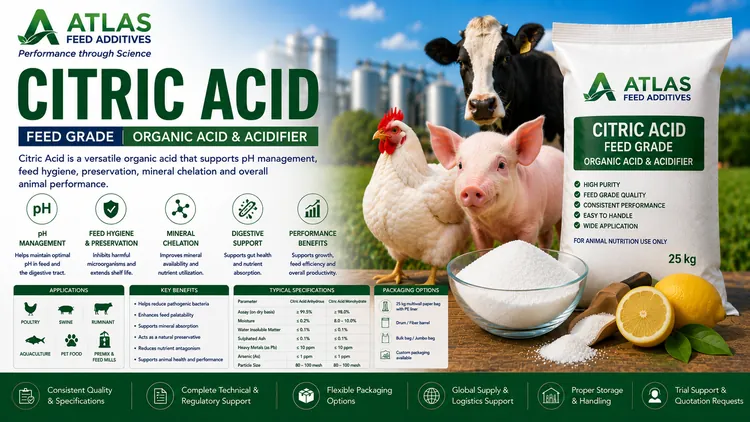
What is Citric Acid used for in animal nutrition?
Citric Acid is commonly used for pH management, feed acidification, feed hygiene, preservation support, mineral chelation, and digestive-support programs. It should be used according to the target species, formulation objective, processing conditions, and applicable market rules.
Can Atlas Feed Additives quote Citric Acid?
Yes. Send your required specification, form, assay, quantity, destination, packaging preference, delivery terms, and required documents so Atlas Feed Additives can review suitable supplier options for Citric Acid.
What quality documents should buyers request for Citric Acid?
Common documents include specification, certificate of analysis, safety data sheet, origin information, batch details, shelf-life statement, packaging details, impurity profile, heavy metal limits, and any market-specific certificates required by the buyer.
What is the difference between anhydrous Citric Acid and Citric Acid monohydrate?
Anhydrous Citric Acid contains no water of crystallization, while Citric Acid monohydrate contains one molecule of water of crystallization. This difference affects assay basis, moisture, molar mass, handling, and price comparison.
Why does particle size matter?
Particle size influences flowability, dust level, dissolution speed, mixing uniformity, segregation risk, and handling in premixes, compound feed, liquid feed, and water applications.
Is Citric Acid suitable for pelleted feed?
Citric Acid can be used in feed manufacturing, but suitability depends on the formula, processing conditions, equipment compatibility, total acid load, moisture, and the desired function. Confirm technical requirements before use in pelleted feeds.
Can Citric Acid be used in drinking water?
Citric Acid may be used in water-acidification systems where permitted, but the correct use depends on water quality, target pH, dosing equipment, corrosion risk, regulatory status, and species-specific nutrition guidance.
Does Citric Acid replace other organic acids?
Not automatically. Citric Acid, formic acid, propionic acid, lactic acid, acetic acid, fumaric acid, and acid salts have different pKa values, antimicrobial profiles, volatility, palatability, handling risks, and application strengths. Selection depends on the formulation objective.
What impurities should be checked?
Buyers often check assay, moisture, residue on ignition, oxalate, sulfate, chloride, readily carbonizable substances, arsenic, lead, mercury, heavy metals, color, clarity, and other parameters required by their specification or destination market.
How should Citric Acid be stored?
Store Citric Acid in a dry, covered, well-ventilated area with closed packaging. Avoid moisture pickup, damaged bags, contamination, and contact with incompatible materials. Follow the supplier safety data sheet for detailed storage and handling guidance.
Is Citric Acid corrosive to equipment?
Dry Citric Acid is generally easier to handle than liquid mineral acids, but acidic solutions can still create corrosion concerns depending on concentration, temperature, contact time, and equipment material. Review SDS and equipment compatibility before use.
How should buyers compare different Citric Acid offers?
Compare form, assay, moisture, particle size, grade, impurity limits, packaging, shelf life, origin, document package, freight, lead time, payment terms, and landed cost. Avoid comparing anhydrous and monohydrate offers as if they were identical.
What information should I send for a fast quotation?
Please send the required form, assay, particle size, quantity, destination, target application, packaging preference, delivery terms, and required documents. If the product will be used in water or liquid feed, include concentration, dosing system, and target pH information where available.