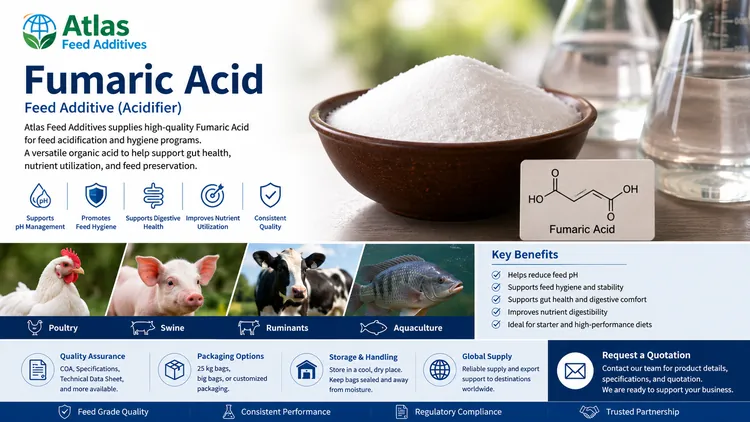
What is Fumaric Acid used for in animal nutrition?
Fumaric Acid is used in feed-related applications for pH management, acidification, feed hygiene,
preservation support, and digestive-support programs. It should be used according to the target species,
formulation objective, supplier instructions, and applicable market rules.
Is Fumaric Acid an organic acid?
Yes. Fumaric Acid is an organic dicarboxylic acid. In feed additive sourcing, it is usually grouped with
organic acids and acidifiers.
Is Fumaric Acid the same as citric acid?
No. Fumaric Acid and citric acid are different organic acids with different molecular structures, solubility,
acidity profiles, handling behavior, and formulation roles. They should not be substituted without technical
review.
Is Fumaric Acid water-soluble?
Fumaric Acid has limited water solubility compared with several other organic acids. Buyers should confirm
whether the offered grade is suitable for the intended application, especially for water or liquid feed
systems.
Can Fumaric Acid be used in premixes?
Fumaric Acid may be used in premix-related applications where permitted and technically suitable. Buyers
should check particle size, flowability, dust behavior, compatibility with minerals and vitamins, and
mixing uniformity.
Can Fumaric Acid be used in starter diets?
Fumaric Acid is commonly evaluated in young-animal acidification programs, including starter and transition
diets. The inclusion level and suitability should be set by a qualified nutritionist according to species,
age, feed type, and local regulation.
Does Fumaric Acid replace good feed hygiene practice?
No. Organic acids can support feed hygiene strategies, but they do not replace clean raw materials, moisture
control, good manufacturing practice, suitable storage, pest control, sanitation, and regular quality
monitoring.
What tests can be used to evaluate acidifier performance?
Buyers may evaluate feed pH, acid-binding capacity, moisture, water activity, microbial indicators,
palatability, feed intake, growth performance, feed conversion, and shelf-life stability depending on the
formulation objective.
What quality documents should buyers request for Fumaric Acid?
Common documents include product specification, certificate of analysis, safety data sheet, origin
information, batch details, shelf-life statement, storage statement, and any market-specific certificates
required by the buyer or importer.
What should be checked on the certificate of analysis?
Buyers should check batch number, assay, moisture or loss on drying, appearance, particle size if listed,
heavy metals or impurity results where required, manufacturing date, expiry or retest date, and consistency
with the approved specification.
Can Atlas Feed Additives quote Fumaric Acid?
Yes. Send the required specification, quantity, destination, packaging preference, preferred Incoterm,
application, and document requirements so Atlas Feed Additives can review suitable supplier options for
Fumaric Acid.
How should Fumaric Acid be stored?
Follow the supplier’s safety data sheet and label. In general, dry organic acids should be stored in a cool,
dry, well-ventilated area, protected from moisture, direct sunlight, contamination, and excessive heat.
Is Fumaric Acid allowed in every country?
No. Authorization, use levels, labeling, documentation, and import rules can vary by country, feed type,
species, and final application. Buyers should verify current local requirements before import, formulation,
or resale.
What is the difference between pure Fumaric Acid and a formulated acidifier blend?
Pure Fumaric Acid is normally purchased by its own assay and purity. A formulated acidifier blend may contain
Fumaric Acid plus other acids, salts, coatings, carriers, anti-caking agents, or processing aids. Buyers
should compare active acid content, composition, declaration, and application instructions.
Why does particle size matter?
Particle size affects dusting, flowability, blending uniformity, segregation risk, dissolving behavior, and
performance in premixes or finished feeds. Buyers should request particle size data when uniformity or
handling is critical.
Can Fumaric Acid be combined with other organic acids?
Yes, it may be used in acidifier blends where technically suitable and permitted. Common comparisons or
combinations may include formic acid, propionic acid, lactic acid, citric acid, malic acid, acetic acid, and
salts of organic acids.