Organic acids and acidifiers

Lactic Acid

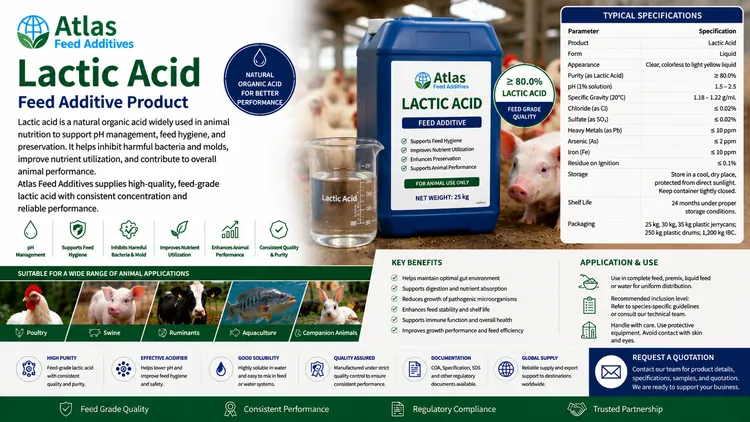
Lactic Acid is an organic acid feed additive option used for pH management, feed and liquid-feed hygiene, preservation support, and digestive-environment programs in animal nutrition, where permitted by the target market.

Lactic Acid feed additive visual

Product role

Where Lactic Acid fits

Lactic Acid is part of the organic acids and acidifiers group. In feed and animal nutrition applications, buyers typically evaluate this product by active concentration, acid value, physical form, purity, application method, packaging type, storage requirements, corrosion profile, and destination-market documentation.

It is commonly considered in programs focused on feed hygiene, pH reduction, liquid feed preservation, starter-feed support, raw material preservation, and acidifier blends. It can be supplied as a liquid product, a buffered product, a coated or encapsulated form, or as part of an organic acid blend depending on supplier availability and buyer specification.

Atlas Feed Additives can coordinate international supplier options for feed mills, premix producers, distributors, integrators, and importers that need consistent feed-grade material, technical documentation, export-ready packaging, and quotation support.

Typical applications

Lactic Acid may be used alone or in combination with other organic acids depending on the formulation goal. The correct application depends on species, age, feed format, local legislation, product concentration, and whether the acid is used in feed, water, liquid feed, silage, raw material preservation, or a premix blend.

  • Feed and water acidification where permitted by local rules
  • Starter diets and hygiene-focused formulas for young animals
  • Liquid feed preservation and pH adjustment
  • Raw material and grain preservation programs
  • Premix or acidifier blend manufacturing
  • Digestive-support strategies in poultry, swine, ruminant, aquaculture, and pet nutrition
  • Support for feed hygiene programs where microbial load control is part of the quality objective
  • Use in multi-acid combinations with formic, propionic, acetic, citric, fumaric, or sorbic acid sources

Buyer quality checklist

Organic acid quotations should be compared on an aligned basis. Two offers may look similar by product name but differ in assay, concentration, water content, buffering, coating, packing, handling requirements, transport classification, and document readiness.

  • Active acid concentration and assay method
  • Liquid, powder, buffered, coated, or blended form
  • Density, color, odor, clarity, and appearance
  • Moisture or water content where applicable
  • Heavy metals and undesirable substance limits
  • Microbiological purity and contamination controls
  • Corrosion and handling precautions
  • Packaging compatibility and leakage protection
  • Shelf life, storage temperature, and warehouse conditions
  • Certificate of Analysis, SDS, specification, origin, and market-specific certificates

Specification guidance

How to define the right Lactic Acid specification

A complete specification helps prevent unsuitable quotations and improves purchasing accuracy. Lactic Acid can be sold in different concentrations and forms, and each version may have different handling, storage, equipment, and formulation implications. Buyers should define the intended use before comparing offers.

Core specification points

  • Assay / active concentration: confirm the declared percentage of Lactic Acid and acceptable tolerance.
  • Physical form: liquid solution, powder, buffered product, coated product, or acidifier blend.
  • Purity profile: request limits for ash, chloride, sulfate, heavy metals, and other impurities where relevant.
  • pH and acidity: confirm acidity-related test values according to supplier specification.
  • Density and viscosity: important for dosing systems, pumping, storage tanks, and liquid handling.
  • Color and appearance: useful for incoming quality control and batch consistency.
  • Carrier or buffering system: relevant for dry acidifier blends, coated forms, and premix applications.
  • Particle size and flowability: important for powders, granules, premixes, and automated dosing.
  • Compatibility: check compatibility with minerals, enzymes, vitamins, probiotics, medications, and packaging materials.
  • Regulatory status: verify acceptability and label wording in the destination country before shipment.

Species and formulation use

Application considerations by animal segment

Poultry

In broiler, layer, breeder, and turkey programs, Lactic Acid may be reviewed for feed hygiene, digestive-environment support, and acidifier blends used in starter or grower formulas. Nutrition teams should check inclusion level, product form, premix stability, and compatibility with pelleting.

Swine

In piglet, grower, finisher, and sow nutrition, Lactic Acid may be considered for nursery-feed acidification, transition diets, liquid feeding systems, and hygiene-focused programs. Product concentration, palatability, corrosion control, and dosing accuracy are key purchase considerations.

Ruminants

In calf, dairy, beef, sheep, and goat applications, product selection should consider the target use: milk replacer, liquid feed, silage-related programs, complete feed, mineral premix, or specialty additive blend. Buyers should verify species-specific suitability and permitted use.

Aquaculture

In fish and shrimp nutrition, organic acid products may be reviewed for feed hygiene, gut-environment support, palatability, and processing compatibility. For extruded or coated feeds, stability and leaching behavior should be checked with the supplier.

Companion animals

In pet food and treats, Lactic Acid may be used in acidifier, preservation, or palatability-related formulations where permitted. The product must be evaluated for odor, label wording, purity, safety documentation, and processing compatibility.

Feed mills and premix plants

For industrial users, Lactic Acid procurement often focuses on storage tank compatibility, dosing system accuracy, worker safety, corrosion control, blending uniformity, dust control for dry forms, and reliable batch-to-batch documentation.

Procurement note

Ask for the right specification before comparing prices.

Price comparisons are meaningful only when concentration, assay, form, purity, packaging, origin, logistics terms, and documentation are aligned. For liquid acids, also review container type, transport classification, leakage protection, corrosion resistance, shelf life, and storage requirements.

A lower unit price may not be the best value if the offered product has lower active concentration, unsuitable packaging, missing documents, higher freight risk, shorter shelf life, limited market compliance, or handling requirements that do not match the buyer’s production system.

Quality and safety

Documentation buyers should request

A complete document package helps buyers confirm product identity, grade, purity, handling requirements, shipment readiness, and compliance with the destination market. Requirements vary by country, use type, customer quality system, and whether the product is supplied as a feed additive, processing aid, blend component, or raw material.

  • Product specification sheet with active concentration and physical form
  • Certificate of Analysis for the offered batch
  • Safety Data Sheet with handling, PPE, transport, and storage guidance
  • Country of origin and manufacturer or supplier declaration where available
  • Batch number, manufacturing date, expiry date, and shelf-life statement
  • Heavy metal and undesirable substance information where required
  • Microbiological quality statement where relevant
  • GMO, allergen, animal-origin, vegan, irradiation, or residual solvent statements if required
  • Halal, ISO, GMP+, FAMI-QS, HACCP, or other certificates if requested by the buyer
  • Import, registration, or feed-additive compliance documents for the destination country

Storage and handling

Plan for safe handling and stable quality

Lactic Acid handling depends on concentration and form. Liquid products may require corrosion-resistant tanks, pumps, seals, hoses, and dosing equipment. Dry products may require moisture protection, dust control, and careful blending procedures.

  • Store in the original closed packaging unless bulk storage is approved.
  • Use compatible containers, pumps, pipes, valves, and seals for liquid acid systems.
  • Protect from extreme heat, freezing, direct sunlight, and incompatible materials.
  • Keep dry forms away from moisture and condensation.
  • Use appropriate personal protective equipment according to the SDS.
  • Train workers on spill response, first aid, and safe transfer procedures.
  • Use first-expired, first-out stock rotation.
  • Inspect packaging before unloading and before transfer into storage systems.

Formulation guidance

How nutrition and production teams evaluate inclusion

Lactic Acid inclusion depends on the formulation objective, desired pH effect, feed format, species, age, diet buffering capacity, ingredient matrix, water quality, and local permitted use. The same product may behave differently in mash feed, pelleted feed, liquid feed, premix, drinking-water systems, or raw material preservation.

Practical formulation questions

  • Is the product intended for complete feed, premix, liquid feed, water, raw material preservation, or a specialty blend?
  • What pH target or acidification objective is required?
  • What is the buffering capacity of the diet or raw material?
  • Does the product need to be coated, buffered, or blended with other acids?
  • Will the acid contact minerals, vitamins, enzymes, probiotics, medications, or sensitive additives?
  • Is corrosion-resistant equipment available for storage and dosing?
  • Does the final product require specific label wording or regulatory approval?
  • Are worker-safety procedures already in place for organic acid handling?

Commercial support

How Atlas Feed Additives supports sourcing

Supplier matching

Atlas reviews available supplier options according to concentration, grade, form, documentation, packaging, export readiness, lead time, origin, and buyer-specific technical requirements.

Specification alignment

Before comparing prices, Atlas helps clarify active concentration, assay, packaging, handling constraints, safety documentation, certificates, destination requirements, and application type.

Export coordination

Atlas can support quotation preparation with shipment terms, packing information, document review, supplier communication, and coordination between buyer, exporter, and logistics partners.

Repeat supply planning

For recurring demand, buyers can share forecasts so sourcing can be reviewed around production schedule, shelf-life management, stock availability, shipping frequency, and packaging optimization.

Packaging options

Choose packaging according to product form and plant setup

Packaging selection affects freight cost, safety, storage, unloading, dosing accuracy, and production efficiency. Buyers should choose packaging based on product concentration, receiving equipment, warehouse layout, worker-safety procedures, and monthly consumption.

  • Drums: suitable for moderate-volume liquid acid orders and controlled plant use.
  • IBC containers: common for larger liquid acid volumes with easier transfer and storage.
  • Tanker supply: may be suitable for high-volume industrial users with bulk tanks.
  • Bags or cartons: used for dry, buffered, coated, or blended acidifier forms.
  • Palletized export packing: supports safer handling and documentation-controlled shipments.

Logistics planning

Plan freight around safety and stability

Lactic Acid shipments should be planned with attention to packaging integrity, product classification, destination regulations, port conditions, climate, delivery time, and customer unloading capability. The Safety Data Sheet and supplier shipping instructions should be checked before booking freight.

  • Confirm whether the product requires special transport handling.
  • Check container compatibility, pallet strength, labels, and seals.
  • Review destination import requirements before shipment.
  • Protect product from extreme temperature exposure during transit.
  • Plan unloading equipment for drums, IBCs, tankers, or palletized goods.
  • Request photos, packing list, and batch documents before dispatch where needed.

Questions

Useful answers

What is Lactic Acid used for in animal nutrition?

Lactic Acid is commonly used for pH management, feed hygiene, preservation, liquid feed acidification, and digestive-support programs. It should be used according to target species, formulation objective, product concentration, application method, and applicable market rules.

Is every Lactic Acid product the same?

No. Products may differ by active concentration, purity, physical form, buffering system, coating technology, packaging, storage requirement, shelf life, handling precautions, and regulatory documentation. Buyers should compare offers by full specification, not by product name only.

Can Atlas Feed Additives quote Lactic Acid?

Yes. Send your required specification, quantity, destination, packaging preference, delivery terms, application method, and documents so Atlas Feed Additives can review suitable supplier options for Lactic Acid.

What quality documents should buyers request for Lactic Acid?

Common documents include specification, Certificate of Analysis, Safety Data Sheet, origin information, batch details, manufacturing date, expiry date, packing list, and any market-specific certificates required by the buyer or importer.

What concentration should I request?

The required concentration depends on the application, handling system, formulation target, supplier availability, and local rules. Buyers should define whether they need a liquid grade, a dry acidifier, a buffered product, a coated product, or a blend before requesting prices.

Can Lactic Acid be used in drinking water?

Use in drinking water depends on local regulations, product grade, target species, water quality, equipment compatibility, dosage system, and safety procedures. Buyers should confirm permitted use and follow supplier instructions.

Can Lactic Acid be included in pelleted feed?

Suitability depends on the product form and processing conditions. Liquid acid may require special dosing, while dry buffered or coated acidifier forms may be easier to use in premix and feed manufacturing. Always confirm stability and equipment compatibility.

Does Lactic Acid affect equipment?

Liquid organic acids may affect incompatible metals, seals, pumps, pipes, and storage systems. Buyers should review the Safety Data Sheet and use corrosion-resistant equipment recommended by the supplier.

How should Lactic Acid be stored?

Storage requirements depend on concentration and packaging. In general, keep the product sealed, protected from incompatible materials, and stored according to the supplier Safety Data Sheet. Dry forms should be protected from moisture and condensation.

Can Lactic Acid be combined with other organic acids?

Yes, it is often considered in acidifier blends with acids such as formic, propionic, acetic, citric, fumaric, sorbic, or benzoic acid sources. Compatibility, label wording, active concentration, and safety handling should be confirmed before use.

What information is needed for a fast quotation?

Please provide product name, required concentration or form, order quantity, destination country, packaging preference, target application, required certificates, delivery terms, and preferred shipment date. This helps Atlas compare suitable offers on a like-for-like basis.

Does Atlas provide regulatory approval?

Atlas Feed Additives can help coordinate supplier documents and quotation information, but buyers and importers should confirm local registration, permitted claims, label wording, and feed-additive compliance in the destination market.

Request a quotation

Tell us what you need

Send your product list, target specification, destination country, packaging preference, and required documents. For Lactic Acid, please also include the required concentration, form, target animal species, application method, preferred packaging, handling limitations, delivery terms, and whether you need SDS, COA, origin, or market-specific certificates. Our team will review your request and respond from orders@feedgradeadditives.com.