What is Propionic Acid used for in animal nutrition?
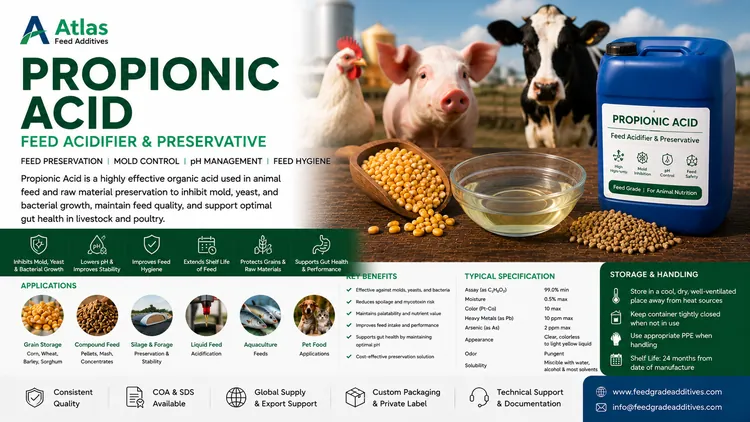
Propionic Acid is used for feed preservation, mold control, pH management, feed hygiene, grain
protection, liquid feed acidification, and selected digestive-support programs. It should be used
according to the product specification, formulation objective, supplier instructions, and local rules.
Why is Propionic Acid used as a mold inhibitor?
Propionic Acid is commonly used in preservation programs because it can help reduce mold pressure in
high-risk grains, raw materials, and finished feeds. Performance depends on moisture level, application
rate, mixing uniformity, storage conditions, and timing.
Is Propionic Acid the same as calcium propionate or sodium propionate?
No. Propionic Acid is the acid form, while calcium propionate and sodium propionate are propionate salts.
They can differ in active acid contribution, handling, corrosiveness, solubility, pH effect, and
application method. Offers should be compared on an active and functional basis.
Can Propionic Acid be used in drinking water?
Some acidifier products are used in water programs where authorized and properly managed, but not every
Propionic Acid product is suitable for water application. Buyers should confirm product form, dosage,
equipment compatibility, safety, and local regulatory status.
Can Propionic Acid be used in grain preservation?
Yes, Propionic Acid is commonly considered for grain preservation. Application should be based on grain
moisture, target storage time, application equipment, storage hygiene, and local recommendations.
What is the difference between liquid and buffered Propionic Acid?
Liquid Propionic Acid may provide high active concentration but requires careful corrosion and safety
management. Buffered products may improve handling convenience and reduce corrosiveness, but they should
be compared by active acid content, performance, and application suitability.
What specification points should buyers compare?
Buyers should compare active acid concentration, purity, water content, density, product form, buffering
system, carrier, particle size, corrosiveness, application method, packaging, shelf life, origin,
authorization status, and documentation.
What documents should buyers request?
Common documents include product specification, certificate of analysis, safety data sheet, technical data
sheet, country of origin, active acid declaration, shelf-life declaration, batch details, transport
information, feed-use declaration where available, and market-specific certificates.
How should Propionic Acid be stored?
Store Propionic Acid in compatible, tightly closed containers in a cool, dry, well-ventilated area.
Protect it from heat, incompatible materials, contamination, damaged packaging, and unauthorized access.
Always follow the supplier’s SDS and local safety requirements.
What safety precautions are important?
Propionic Acid can require corrosive-material handling precautions depending on concentration and form.
Use appropriate personal protective equipment, ventilation, spill-control materials, compatible equipment,
trained operators, and emergency procedures according to the SDS.
Can Atlas Feed Additives quote Propionic Acid?
Yes. Send your required active acid concentration, product form, target application, quantity,
destination, packaging preference, required documents, preferred Incoterm, and shipment timing so Atlas
Feed Additives can review suitable supplier options.
Can Atlas quote related organic acids?
Yes. Atlas Feed Additives can review requests for related products such as formic acid, acetic acid,
lactic acid, citric acid, fumaric acid, sorbic acid, calcium propionate, sodium propionate, and organic
acid blends depending on availability and target specification.