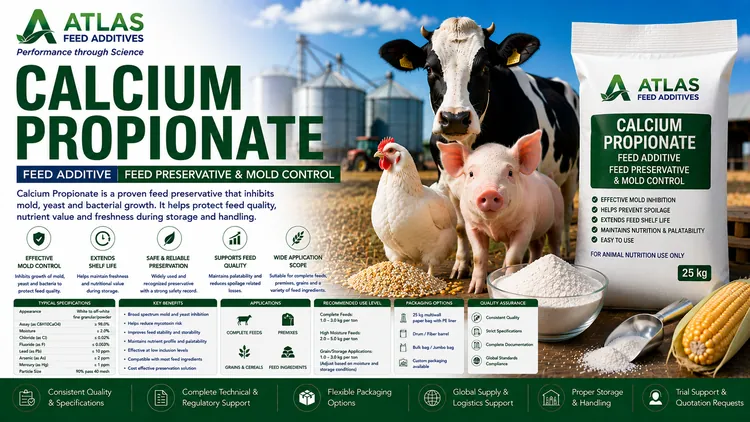
What is Calcium Propionate used for in animal nutrition?
Calcium Propionate helps protect feed and raw materials from quality losses linked to moisture, mold, and storage pressure. It is commonly evaluated for finished feed, grains, premixes, concentrates, and humid supply chains. It should be used according to the target species, formulation objective, feed type, moisture challenge, and applicable market rules.
Is Calcium Propionate a mold inhibitor?
Yes. Calcium Propionate is commonly used as a preservative and mold-control additive. Its practical performance depends on product quality, dose, application uniformity, feed moisture, storage time, temperature, humidity, packaging, and raw material hygiene.
Can Atlas Feed Additives quote Calcium Propionate?
Yes. Send your required specification, quantity, destination, packaging preference, and documents so Atlas Feed Additives can review suitable supplier options for Calcium Propionate.
What quality documents should buyers request for Calcium Propionate?
Common documents include specification, certificate of analysis, safety data sheet, origin information, batch details, shelf-life statement, packaging details, and any market-specific certificates required by the buyer.
Which specification values are most important?
Important values include assay, calcium content, moisture, pH, appearance, odor, particle size, bulk density, solubility, heavy metal limits, microbiological limits where required, shelf life, packaging, and feed-grade status.
Can Calcium Propionate be used in all animal species?
Use depends on local regulations, feed type, species, dose, formulation objective, and customer standards. Buyers should confirm authorization in the destination market and review the intended use with a qualified nutritionist or feed technologist.
Does Calcium Propionate replace proper drying and storage?
No. Mold-control additives should not replace good manufacturing and storage practice. Moisture testing, drying, cooling, cleaning, ventilation, pest control, warehouse rotation, and packaging quality remain essential.
What packaging options are commonly requested?
Buyers commonly request 20 kg or 25 kg bags, lined bags, palletized shipments, and sometimes big bags. Actual packaging depends on supplier availability, order volume, destination requirements, and moisture-protection needs.
How should Calcium Propionate be stored?
Store in a cool, dry, well-ventilated area away from water, direct sunlight, excessive heat, strong odors, and damaged packaging. Follow the supplier’s storage recommendation and apply first-expiry-first-out stock rotation.
How should buyers compare Calcium Propionate prices?
Compare prices only after confirming assay, grade, moisture, particle size, packaging, origin, certification, shelf life, minimum order quantity, freight terms, and document availability. Cost-in-use can be more important than unit price alone.
Can Calcium Propionate be used in pelleted feed?
It may be suitable for pelleted feed depending on the formulation, production process, moisture level, application method, and supplier guidance. Feed mills should check mixing, pelleting, cooling, and storage conditions before final use.
What information should be included in a quotation request?
Include target specification, grade, volume, destination country, delivery terms, packaging preference, application area, required certificates, expected order timing, and any reference product or customer standard that must be matched.