Preservatives and mold control

Potassium Sorbate

Potassium Sorbate is a preservative and mold-control additive selected to help protect feed, premixes, liquid products, specialty blends, pet food ingredients, and raw materials from quality losses linked to mold, yeast, moisture, warm climates, storage pressure, and long-distance distribution.

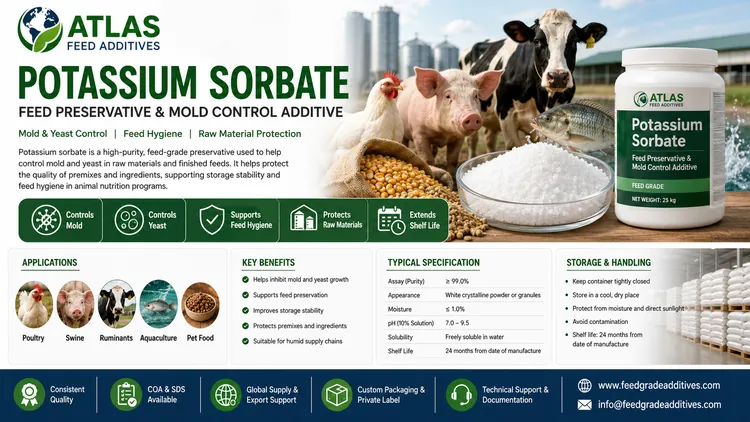
Potassium Sorbate feed additive visual

Product role

Where Potassium Sorbate fits

Potassium Sorbate is part of the preservatives and mold control group. It is commonly evaluated for applications where mold and yeast control, product freshness, shelf-life protection, and feed hygiene are important. It is the potassium salt of sorbic acid and is typically chosen because it is easier to handle and dissolve than sorbic acid in many formulation systems.

In feed and feed-ingredient supply chains, Potassium Sorbate may be considered for finished feeds, premixes, liquid feed products, pet food ingredients, aquafeed systems, specialty blends, and raw materials that face moisture exposure, warm storage, long transit, or contamination pressure. Its suitability depends on the target product, pH environment, moisture challenge, local authorization, application method, and supplier specification.

Atlas Feed Additives can coordinate international supplier options for feed mills, premix producers, pet food manufacturers, aquafeed producers, farms, integrators, distributors, and importers that need feed-grade Potassium Sorbate supported by technical documents, batch-level certificates, and export-focused service.

What Potassium Sorbate is designed to support

Potassium Sorbate is selected where preservation, mold control, yeast control, and shelf-life management are formulation priorities. It can be used alone or as part of a broader preservative system, depending on the product matrix, pH, moisture level, packaging, storage duration, and destination-market rules.

  • helps protect selected feeds and raw materials from mold-related quality losses
  • supports yeast-control programs in suitable liquid or semi-moist systems
  • supports preservation of specialty blends, premixes, pet food ingredients, and feed products
  • helps maintain product freshness during storage and distribution
  • can support humid-climate and long-distance logistics programs
  • may be used in preservative systems with propionates, benzoates, organic acids, or buffered mold inhibitors where authorized
  • helps feed businesses manage shelf-life risk when combined with good storage and hygiene practices

Typical applications

  • finished feed storage where permitted
  • premixes, concentrates, and specialty blends
  • pet food ingredients and palatability-related products
  • liquid feed products and semi-moist formulations where suitable
  • aquafeed ingredients and high-moisture-risk applications
  • raw material preservation in warm or humid supply chains
  • feed products exposed to long transit or delayed consumption
  • farm-level storage programs with defined moisture-control practices
  • preservative blends with sodium benzoate, calcium propionate, sodium propionate, or organic acids where authorized
  • technical formulations requiring mold and yeast inhibition in a defined pH range

Technical identity

Key specification points for Potassium Sorbate buyers

Potassium Sorbate buyer reference table
Item Typical buyer reference Why it matters
Product group Preservative / mold-control technological additive Confirms the product category for purchasing, formulation, regulatory, and quality records.
Chemical identity Potassium salt of sorbic acid Helps distinguish Potassium Sorbate from sorbic acid, sodium benzoate, propionates, and preservative blends.
Assay Supplier-declared Potassium Sorbate content or purity Essential for active-basis comparison, formulation, and incoming quality approval.
Sorbic acid equivalent Declared or calculated active sorbate contribution where required Allows comparison between potassium sorbate, sorbic acid, blends, and formulated preservative systems.
Physical form Powder, granule, crystalline powder, or premixed preservative preparation Affects handling, dust level, solubility, dosing, blending, and warehouse behavior.
Solubility Supplier guidance for use in liquid, semi-moist, or dry applications Determines whether the product can be applied effectively in the buyer’s process.
Particle size Declared mesh, granule size, or particle distribution where required Important for flowability, blending uniformity, dust control, and dissolution speed.
Moisture and caking Loss on drying, moisture level, caking tendency, and packaging protection Important because hygroscopicity and moisture exposure can affect handling and shelf life.
Impurity limits Heavy metals, aldehyde limits, acidity/alkalinity, residual solvents, or supplier-specific parameters Supports feed safety, regulatory approval, and customer audits.
Documentation Specification, COA, SDS, origin, batch details, shelf life, storage instructions, authorization status Supports supplier approval, customs clearance, audits, traceability, and product integrity.

Preservation context

Why Potassium Sorbate is used in mold and yeast control

Feed products and raw materials may face quality losses when moisture, oxygen, warm temperatures, long storage periods, poor warehouse hygiene, damaged packaging, or delayed consumption allow mold and yeast growth. Potassium Sorbate is used to support preservation where the product matrix, pH, application rate, and local rules make sorbate use technically suitable.

Potassium Sorbate is generally most useful when applied preventively and uniformly before visible spoilage becomes a problem. It does not replace proper drying, good raw-material quality, clean storage, moisture control, packaging integrity, or first-expired-first-out inventory management. The preservative program should be designed around the real risk profile of the product and supply chain.

  • apply early, before mold or yeast pressure becomes severe
  • match dosage to product pH, moisture level, storage time, and application matrix
  • ensure uniform distribution in dry blends, liquid products, or semi-moist systems
  • combine with clean storage, moisture control, and suitable packaging
  • confirm market authorization and label requirements before commercial use

Buyer quality checklist

What to verify before approval

Potassium Sorbate should be compared by assay, purity, sorbic acid equivalent, product form, particle size, solubility, application suitability, packaging, shelf life, and documentation. Buyers should avoid comparing only price per kilogram without considering active contribution, dose, and performance in the target application.

  • declared Potassium Sorbate assay or purity
  • sorbic acid equivalent or active contribution where required
  • grade and intended-use declaration
  • physical form: powder, granule, crystalline powder, or blend
  • particle size, dust level, and flowability
  • solubility and dissolution behavior in the target system
  • moisture content, caking tendency, and packaging protection
  • appearance, odor, and color limits
  • heavy metals, impurity limits, and contaminant declarations where required
  • recommended dose and application guidance
  • compatibility with organic acids, propionates, benzoates, minerals, vitamins, flavors, and carriers
  • shelf life and storage temperature guidance
  • certificate of analysis for each batch or lot
  • market-specific authorization status for intended application

Documents

Recommended document package

Atlas Feed Additives can help buyers request and organize the technical, safety, and commercial documents commonly required for supplier approval, import control, customer audits, feed-mill documentation, distributor registration, and export shipments.

  • product specification sheet
  • certificate of analysis by batch or lot
  • safety data sheet
  • technical data sheet
  • assay or active content declaration
  • sorbic acid equivalent declaration where required
  • country-of-origin statement
  • feed-grade or intended-use declaration where available
  • storage and handling guidance
  • residue, impurity, heavy metal, or contaminant statements where relevant
  • GMO, allergen, BSE/TSE, dioxin, or microbiological statements where required
  • Halal, Kosher, ISO, FAMI-QS, GMP+, or other certificates if available and required
  • packing list, commercial invoice, and certificate of origin for export shipments

Application and handling

Practical notes for feed mills, premixers, and ingredient suppliers

Application matrix

Potassium Sorbate should be matched to the product matrix. Dry feed, liquid feed, semi-moist products, pet food ingredients, premixes, and specialty blends may require different inclusion methods and technical validation.

pH and preservation performance

Sorbate-based preservation is influenced by pH, moisture, microbial challenge, and distribution quality. Buyers should review whether the target product conditions support the intended preservative effect.

Uniform distribution

Uniform mixing is essential. Buyers should confirm whether the product is suitable for dry blending, dissolution, spraying, liquid incorporation, or inclusion in a prepared preservative blend.

Moisture protection

Potassium Sorbate should be protected from moisture exposure during storage and handling. Moisture can affect flowability, caking, dosing accuracy, and product appearance.

Blend compatibility

Compatibility should be checked when Potassium Sorbate is used with propionates, benzoates, organic acids, antioxidants, vitamins, minerals, flavors, enzymes, probiotics, or carrier systems.

Regulatory check

Preservative authorization, allowed applications, maximum levels, label declarations, and claims vary by country. Buyers should confirm compliance before importing, selling, labeling, or using the product.

Application areas

Where Potassium Sorbate may be used

Typical Potassium Sorbate application areas
Application area Main objective Buyer considerations
Finished feed Support mold and yeast control during storage and distribution Review product pH, moisture, storage duration, packaging, and authorized use level.
Premixes and concentrates Support preservation in concentrated products where compatible Check interaction with minerals, vitamins, enzymes, choline chloride, acids, and carriers.
Liquid feed products Help manage yeast and mold pressure in suitable liquid systems Confirm solubility, pH, dosing method, tank hygiene, and preservative-system design.
Pet food and palatants Support shelf life and microbial-quality management in selected products Review label rules, sensory impact, moisture level, packaging, and finished-product stability.
Aquafeed ingredients Support preservation where moisture and lipid exposure create quality pressure Check extrusion or coating step, water stability, product pH, and local authorization.
Raw material storage Help reduce mold or yeast-related quality losses in suitable ingredients Review raw-material moisture, initial quality, storage time, dose, and application uniformity.
Tropical supply chains Support quality through warm, humid, or long-distance logistics Consider packaging, port delays, warehouse conditions, transit time, and customer shelf-life needs.

Procurement note

Ask for the right specification before comparing prices.

Price comparisons are meaningful only when assay, purity, sorbic acid equivalent, particle size, solubility, product form, packaging, shelf life, origin, authorization status, and documentation are aligned. A lower price per kilogram may not be economical if the product has lower active contribution, unsuitable solubility, poor flowability, short shelf life, or incomplete documentation.

For preservatives, the key commercial question is often not only “What is the price per kilogram?” but “What is the cost of reliable mold and yeast control for my product matrix, pH, moisture challenge, storage time, climate, and handling system?” Atlas Feed Additives helps buyers structure quotation requests so offers can be compared accurately.

Quote request details to send

  • product name and required grade
  • required assay or purity
  • sorbic acid equivalent requirement, if applicable
  • target application: finished feed, premix, liquid product, pet food, aquafeed, or raw material
  • product pH, moisture challenge, or storage-risk information if available
  • required quantity and order frequency
  • destination country, port, or delivery address
  • preferred Incoterm
  • packaging requirement: bag, carton, drum, pallet, or container
  • required certificates and declarations
  • target shipment date
  • approved or restricted origins

Commercial comparison

How to compare Potassium Sorbate offers

Commercial and technical comparison points
Comparison point Ask the supplier Reason for review
Assay What is the guaranteed Potassium Sorbate content? Allows active-basis comparison and supports accurate dosing.
Sorbic acid equivalent What active sorbate contribution should be used for formulation? Useful when comparing sorbate products, sorbic acid, or preservative blends.
Product form Is the product powder, granule, crystalline powder, or prepared blend? Determines handling, solubility, flowability, dust, and mixing behavior.
Solubility Is the product suitable for the buyer’s dry, liquid, or semi-moist application? Prevents poor dispersion, incomplete dissolution, or ineffective application.
Moisture protection What packaging and storage conditions are required? Helps avoid caking, reduced flowability, and storage claims.
Documents Which technical, quality, safety, and export documents are available? Reduces delays during supplier approval, customs clearance, and customer audits.
Authorization Is the product suitable for the destination market and intended application? Prevents regulatory problems during import, sale, labeling, or use.
Packaging What bag, carton, drum, liner, pallet, or container options are available? Affects moisture protection, warehouse handling, and transport safety.
Shelf life What is the remaining shelf life at shipment? Supports inventory planning and avoids short-dated product.
Total treated cost What is the cost per treated ton or finished product at the recommended dose? Provides a more meaningful comparison than price per kilogram alone.

Packaging and logistics

Storage and shipment considerations

Potassium Sorbate should be protected from moisture, contamination, direct sunlight, excessive heat, strong odors, incompatible materials, and damaged packaging. Export packaging should be selected according to transit duration, climate, warehouse conditions, and the buyer’s handling system.

  • sealed bags, cartons, drums, or lined packaging suitable for preservative products
  • moisture-resistant packaging where required
  • clear product, batch, net weight, manufacturing date, and expiry labeling
  • palletized export packaging for international shipments
  • container loading plan for larger orders
  • cool, dry, well-ventilated warehouse storage
  • first-expired, first-out inventory rotation
  • lot traceability from receipt to application
  • segregation from incompatible chemicals and strong odors
  • clean handling equipment to prevent contamination and caking

Who buys this product?

Suitable buyer profiles

  • feed mills producing compound feed
  • premix and concentrate manufacturers
  • liquid feed producers
  • pet food and palatant manufacturers
  • aquafeed producers
  • feed additive distributors
  • integrators managing feed hygiene programs
  • importers building preservative portfolios
  • farms managing storage and moisture pressure
  • technical buyers comparing mold and yeast control systems

Program positioning

Where Potassium Sorbate may add value

Mold and yeast control

Potassium Sorbate may be selected for products where mold and yeast pressure can affect shelf life, appearance, odor, or customer acceptance.

Liquid and semi-moist products

Sorbate systems may be useful in suitable liquid or semi-moist feed products where solubility, pH, and uniform distribution support the intended preservative effect.

Premix protection

Premixes and concentrates can face moisture and storage challenges. Potassium Sorbate may be considered where compatibility with minerals, vitamins, carriers, and other additives is confirmed.

Pet food applications

Pet food ingredients and palatants often require shelf-life and sensory-quality protection. Sorbate-based systems may be evaluated where label rules and application conditions allow.

Humid supply chains

Warm, humid climates and long transit can increase preservation pressure. Potassium Sorbate may help support quality when combined with suitable packaging and warehouse control.

Preservative blends

Potassium Sorbate may be used with propionates, benzoates, organic acids, or buffered mold inhibitors where compatible, technically justified, and legally authorized.

Why Atlas Feed Additives?

Support beyond a price quote

Atlas Feed Additives helps buyers approach Potassium Sorbate sourcing with a technical and commercial checklist. This is especially important because preservative performance depends on assay, solubility, application matrix, pH, moisture challenge, packaging, and local authorization.

  • supplier option review based on target specification
  • quotation coordination for spot or recurring demand
  • support for assay and active-equivalent comparison
  • packaging, lead time, and logistics coordination
  • support for feed mills, premixers, pet food producers, distributors, and importers
  • export-focused communication from Ankara, Turkey
  • clear communication in English and Turkish

Important disclaimer

Use according to local rules and professional formulation

Potassium Sorbate should be used according to the target application, supplier instructions, product specification, qualified formulation guidance, customer quality standards, and applicable market rules. Atlas Feed Additives does not replace veterinary, regulatory, safety, or formulation advice.

Preservative authorization, allowed applications, maximum use levels, labeling requirements, import rules, and claims can vary by country. Buyers should confirm compliance before ordering, importing, labeling, selling, or using the product in feed, pet food, aquafeed, premixes, or raw-material systems.

Questions

Useful answers about Potassium Sorbate

What is Potassium Sorbate used for in animal nutrition?

Potassium Sorbate is used as a preservative and mold-control additive to help protect selected feeds, premixes, liquid products, pet food ingredients, and raw materials from mold, yeast, moisture-related quality losses, and storage pressure.

Is Potassium Sorbate the same as sorbic acid?

No. Potassium Sorbate is the potassium salt of sorbic acid. It is often preferred in applications where easier handling or solubility is desired, but buyers should compare active contribution, suitability, local authorization, and formulation behavior.

Why is pH important for Potassium Sorbate?

Sorbate preservation performance is influenced by the pH of the product matrix. Buyers should evaluate whether the target feed, liquid product, semi-moist product, or blend has conditions that support the intended preservative effect.

Can Potassium Sorbate be used in finished feed?

It may be used in finished feed where authorized and technically suitable. Buyers should confirm product pH, moisture level, application method, dosage, mixing uniformity, and destination-market rules.

Can Potassium Sorbate be used in liquid feed?

It may be used in suitable liquid systems where solubility, pH, dosing, tank hygiene, and preservative design are properly managed. Supplier guidance and local authorization should be reviewed before use.

What specification points should buyers compare?

Buyers should compare assay, purity, sorbic acid equivalent, physical form, particle size, solubility, moisture, caking tendency, impurity limits, shelf life, packaging, origin, authorization status, and documentation.

What documents should buyers request?

Common documents include product specification, certificate of analysis, safety data sheet, technical data sheet, country of origin, assay declaration, shelf-life declaration, batch details, feed-use declaration where available, and market-specific certificates.

How should Potassium Sorbate be stored?

Store Potassium Sorbate in sealed original packaging in a cool, dry, well-ventilated area. Protect it from moisture, direct sunlight, excessive heat, strong odors, incompatible materials, contamination, and damaged packaging. Always follow the supplier’s SDS and storage instructions.

Can Potassium Sorbate be used with other preservatives?

It may be used in preservative systems with propionates, benzoates, organic acids, or buffered mold inhibitors where compatible, technically justified, and legally authorized. Compatibility and dose should be confirmed before formulation.

Can Atlas Feed Additives quote Potassium Sorbate?

Yes. Send your required specification, assay, quantity, destination, application matrix, packaging preference, required documents, preferred Incoterm, and shipment timing so Atlas Feed Additives can review suitable supplier options.

Can Atlas quote related preservative products?

Yes. Atlas Feed Additives can review requests for related products such as calcium propionate, sodium propionate, sodium benzoate, buffered mold inhibitor, propionic acid mold inhibitor, propionic acid, sorbic acid, and organic acid blends depending on availability and target specification.

Request a quotation

Tell us what you need

Send your product list, required assay, target application, destination country, packaging preference, annual or spot quantity, delivery term, required documents, and target shipment date. Our team will review your request and respond from orders@feedgradeadditives.com.