Organic acids and acidifiers

Sorbic Acid

Sorbic Acid is an organic acid used in preservation-oriented feed programs, feed hygiene strategies, ingredient stability planning, and technical additive sourcing where consistent quality, documentation, and suitable specification alignment are important.

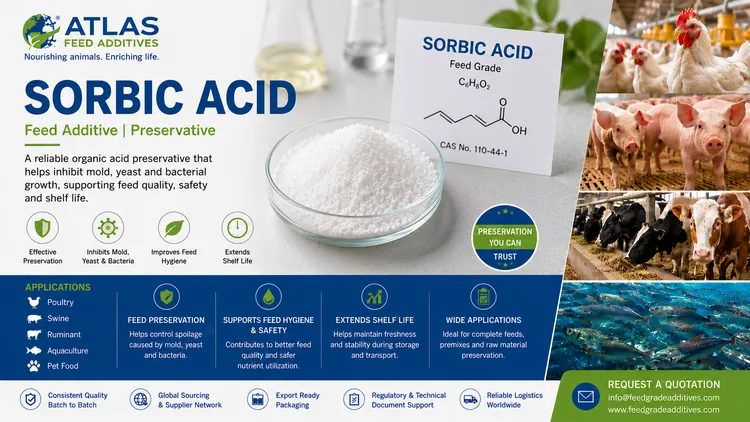
Sorbic Acid feed additive visual

Product role

Where Sorbic Acid fits

Sorbic Acid belongs to the organic acids and acidifiers group. In feed-related procurement, it is commonly evaluated as a preservation-support ingredient and as part of hygiene-focused formulation programs. Buyers usually review Sorbic Acid according to its assay, purity, particle size, moisture level, physical form, odor profile, packaging, origin, and the completeness of quality documents.

The product is typically considered by feed mills, premix producers, distributors, integrators, and ingredient importers that need feed-grade material supported by reliable supplier communication, batch documentation, and export-ready logistics coordination.

Atlas Feed Additives helps customers compare suitable supplier options by aligning commercial offers with the buyer’s required technical specification, target destination, packaging preference, shipment terms, and documentation expectations.

Typical applications

  • Feed preservation programs where Sorbic Acid is permitted by applicable market rules
  • Hygiene-focused formulations designed to support ingredient and finished-feed stability
  • Premix, compound feed, and raw material preservation strategies
  • Programs where formulators want to reduce spoilage risk under suitable storage conditions
  • Formulation systems that require an organic acid option with clear technical documentation

Buyer quality checklist

  • Assay or active content stated clearly on the product specification
  • Purity profile, moisture level, ash, and relevant impurity limits
  • Particle size, flowability, dust level, and handling characteristics
  • Heavy metal limits and other market-specific safety parameters
  • Packaging type, net weight, pallet configuration, and container loading plan
  • Shelf life, storage recommendations, and batch traceability details

Technical overview

Key points for formulation and sourcing

Sorbic Acid is usually purchased with a specification that defines assay, appearance, particle size, moisture, residue on ignition or ash, and relevant purity parameters. Because small differences in physical form can affect handling and blending behavior, buyers should request the exact technical data sheet before comparing prices.

In feed manufacturing, practical performance depends not only on the active ingredient but also on the complete formulation, storage conditions, feed moisture, raw material quality, processing temperature, mixing uniformity, and the presence of other organic acids or preservation-support ingredients.

For international purchasing, buyers should also confirm whether the offered material is suitable for the intended market, species, and application. Regulatory acceptance, labeling requirements, maximum inclusion limits, and permitted use categories may vary by country.

Specification guidance

Common specification areas buyers review

Assay and purity

The assay indicates the declared active content of the product. For meaningful comparison, buyers should avoid comparing only the price per kilogram and should instead compare the price against the declared assay, purity profile, and quality guarantees.

Physical form

Powder, crystalline, or granular characteristics can influence handling, dosing, dust formation, flow behavior, and mixing uniformity. The best option depends on the buyer’s production system and application.

Packaging

Sorbic Acid may be requested in bags, palletized loads, or other supplier-specific packaging formats. Buyers should confirm net weight, pallet dimensions, moisture protection, labeling, and container loading details before shipment.

Documentation

A complete document set helps buyers handle customs, internal quality approval, supplier registration, and customer audits. Required documents should be confirmed before placing the purchase order.

Procurement note

Ask for the right specification before comparing prices.

Price comparisons are meaningful only when assay, particle size, purity limits, packaging, origin, shelf life, and documentation are aligned. A lower price may not be the best value if the offered material has weaker documentation, unsuitable packaging, different physical characteristics, or unclear batch traceability.

When requesting a quotation, include your required quantity, destination port or delivery address, preferred Incoterms, target specification, required documents, packaging format, and expected shipment schedule. This allows Atlas Feed Additives to review supplier options more accurately.

Feed industry relevance

Why buyers evaluate Sorbic Acid carefully

Feed additive buyers often need products that are not only technically suitable but also commercially dependable. Sorbic Acid sourcing should therefore consider production consistency, supplier responsiveness, lead time, document quality, batch traceability, and the ability to support repeat shipments.

For feed mills and premix companies, a stable supply chain can be as important as the product itself. Delayed documents, unclear labeling, or inconsistent packaging can create operational challenges even when the chemical specification appears acceptable.

Handling and storage

Practical storage considerations

  • Store in a dry, clean, and well-ventilated area according to the supplier’s safety data sheet.
  • Keep packaging closed when not in use to help protect product quality.
  • Avoid exposure to moisture, contamination, and incompatible materials.
  • Use appropriate personal protective equipment according to the safety data sheet.
  • Follow local workplace safety, transport, and feed regulations.

Commercial support

How Atlas Feed Additives supports Sorbic Acid buyers

Atlas Feed Additives works with buyers that need practical sourcing support, export coordination, and technical document alignment for feed-grade additives. The goal is to help customers receive offers that match their real procurement requirements instead of incomplete or hard-to-compare quotations.

  • Review of buyer specification and target application
  • Supplier option coordination based on quantity, destination, and documentation needs
  • Support for commercial comparison between available offers
  • Packaging, lead-time, and shipment detail coordination
  • Document collection for quality approval and import preparation

Questions

Useful answers

What is Sorbic Acid used for in animal nutrition?

Sorbic Acid is commonly used in preservation, feed hygiene, and stability-focused feed programs. It may be considered for feeds, premixes, raw materials, and other feed-related systems where spoilage control and product stability are important. Use should follow the target species, formulation objective, supplier guidance, and applicable market rules.

Can Atlas Feed Additives quote Sorbic Acid?

Yes. Send your required specification, quantity, destination, packaging preference, delivery terms, and quality document requirements. Atlas Feed Additives can review suitable supplier options and provide quotation support for Sorbic Acid.

What quality documents should buyers request for Sorbic Acid?

Common documents include product specification, certificate of analysis, safety data sheet, origin information, batch details, shelf-life statement, packaging information, and any market-specific certificates required by the buyer or importing country.

What makes Sorbic Acid offers difficult to compare?

Offers can differ by assay, purity limits, particle size, physical form, packaging, documentation, shipment terms, origin, and lead time. Buyers should compare complete technical and commercial conditions, not only the unit price.

Is Sorbic Acid suitable for every feed application?

Suitability depends on the target species, feed type, formulation goal, processing conditions, local regulations, and the buyer’s internal quality requirements. Buyers should confirm permitted use and inclusion practices with qualified formulation and regulatory teams.

What details should be included in a Sorbic Acid quotation request?

A complete request should include quantity, destination, preferred Incoterms, required specification, packaging preference, required documents, target shipment date, and any special requirements related to quality approval, labeling, or import clearance.

Request a quotation

Tell us what you need

Send your product list, target specification, destination country, packaging preference, quantity, delivery terms, and required documents. Our team will review your request and respond from orders@feedgradeadditives.com.