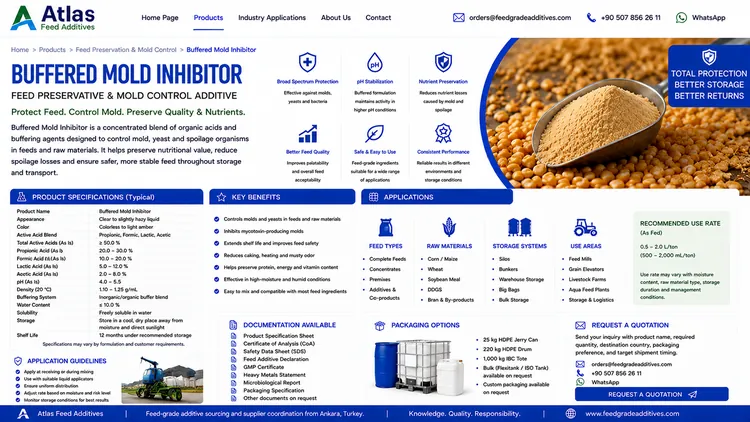
| Product identity |
Exact product name, form, grade, and feed-grade declaration |
Confirms that the material is suitable for animal feed use and matches the buyer’s application. |
| Active ingredient profile |
Declared active acids, acid salts, propionate sources, sorbate, benzoate, or other preservative components where applicable |
Different active profiles support different mold-control, handling, and cost-in-use objectives. |
| Total active concentration |
Total active ingredient content and analytical method |
Allows meaningful comparison of product strength and commercial value. |
| Buffering system |
Buffered salts, neutralizing agents, carrier system, or pH-management technology |
Influences handling, corrosivity, pH, equipment compatibility, and worker safety. |
| Recommended dose |
Dose by feed type, moisture challenge, storage time, raw material risk, and climate condition |
Cost-in-use and practical performance depend on the correct application rate. |
| Physical form |
Dry powder, granule, coated granule, liquid concentrate, carrier-based blend, or ready-to-use form |
Physical form affects dosing, mixing, dust, flowability, transport, and application equipment. |
| Carrier type |
Carrier declaration, dilution basis, anti-caking system, or flow-improvement system where available |
Carrier affects active content, uniformity, flow, dust, and compatibility with feed or premix systems. |
| Moisture |
Maximum moisture and analytical method |
Moisture affects caking, flowability, storage stability, and product shelf life. |
| pH |
Product pH, pH in solution, or supplier-defined pH method |
Helps evaluate handling, safety, compatibility, and buffering behavior. |
| Particle size |
Mesh size, sieve analysis, granulation range, or customer-specific particle-size target |
Particle size affects blend uniformity, segregation risk, dust, and application consistency. |
| Bulk density |
Loose density, tapped density, or handling-density range where available |
Useful for dosing equipment, packaging planning, warehouse calculations, and freight optimization. |
| Dust and flowability |
Dust-control notes, anti-caking system, flowability statement, or customer-specific handling standard |
Important for worker handling, dosing accuracy, premix quality, and plant cleanliness. |
| Corrosivity profile |
Compatibility with mixers, dosing equipment, stainless steel, plastic, rubber seals, tanks, pumps, and applicator materials |
Buffered systems may reduce some handling concerns, but compatibility should still be confirmed. |
| Processing compatibility |
Supplier statement on mixing, pelleting, extrusion, heat, pressure, and storage conditions |
Processing conditions can affect product behavior and practical effectiveness. |
| Heavy metals |
Lead, arsenic, cadmium, mercury, or other buyer-specific limits |
Important for feed safety, import clearance, and customer compliance programs. |
| Contaminants |
Undesirable substances, microbiology, residual solvents, dioxins, or market-specific tests where applicable |
Some destination markets and large feed groups require strict contaminant documentation. |
| Shelf life |
Declared shelf life under recommended storage conditions |
Important for import planning, distributor stock rotation, and long-distance shipments. |
| Packaging |
Bag size, liner type, drum option, IBC option, big-bag option, pallet quantity, and label information |
Packaging affects handling, moisture protection, leakage control, warehouse safety, and freight cost. |
| Certification |
ISO, HACCP, GMP+, FAMI-QS, Halal, Kosher, or other certificates when required |
Some buyers require supplier quality-system documents before approval. |
| Regulatory status |
Destination-market authorization, feed-grade status, label rules, and import documentation |
Use and import must comply with the rules of the destination country. |