Antioxidants · Natural antioxidant support

Rosemary Extract

Rosemary Extract is a plant-derived antioxidant feed additive used to help control oxidation in fats, oils, premixes, pet food, aquafeed, and finished feed, supporting freshness, odor stability, palatability, and nutrient protection during storage and logistics.

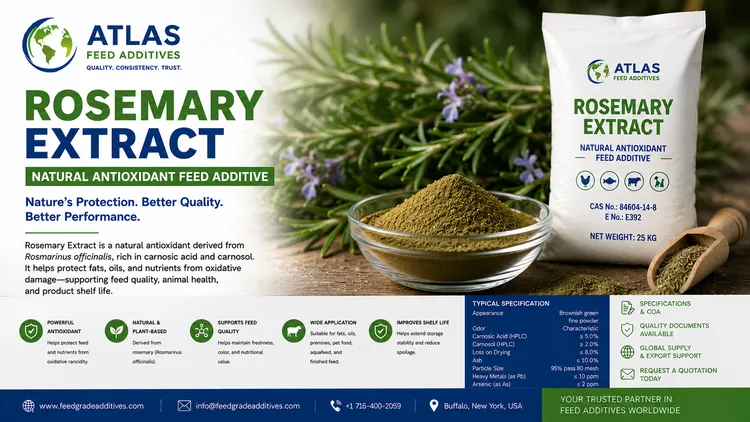
Rosemary Extract feed additive visual

Product role

Where Rosemary Extract fits in feed production

Rosemary Extract belongs to the antioxidants group of feed additive ingredients. In animal nutrition supply chains, it is selected to help manage oxidative rancidity, especially in formulations or ingredients that contain sensitive fats, oils, meals, vitamins, pigments, flavors, or other oxidation-prone components.

Oxidation can negatively affect odor, taste, nutrient value, color, and shelf life. For feed mills, premix producers, pet food manufacturers, aquafeed producers, renderers, oil processors, distributors, and integrators, antioxidant selection is therefore not only a cost decision but also a quality-control decision.

Atlas Feed Additives can coordinate international supplier options for feed-grade Rosemary Extract based on target active content, physical form, carrier, origin, documentation, packaging, destination market, and shipment requirements.

Typical applications

  • Stabilization of animal fats, vegetable oils, fish oil, poultry oil, tallow, and blended fat sources.
  • Protection of fishmeal, meat and bone meal, poultry meal, feather meal, and other rendered meals during storage and transport.
  • Support for vitamin premixes, mineral premixes, flavor systems, pigments, and sensitive micro-ingredients.
  • Use in compound feed where fat oxidation, odor control, and freshness are important quality parameters.
  • Pet food and treat applications where clean-label positioning, odor stability, and palatability are commercially important.
  • Aquafeed applications involving fish oil, marine ingredients, high-energy diets, and long storage periods.
  • Long-distance ingredient logistics where temperature, oxygen exposure, humidity, and time increase oxidation risk.

Buyer quality checklist

  • Active antioxidant level and assay method.
  • Declared active compounds such as carnosic acid, carnosol, or rosmarinic acid.
  • Physical form, carrier, particle size, flowability, and dusting behavior.
  • Oil solubility, water dispersibility, or suitability for the intended application medium.
  • Recommended inclusion range from the supplier for the buyer's specific application.
  • Thermal stability under pelleting, extrusion, rendering, or premix processing conditions.
  • Compatibility with fats, oils, meals, vitamins, trace minerals, enzymes, acids, and other additives.
  • Market-specific authorization status and customer documentation requirements.

Technical overview

Why antioxidant specification matters

Rosemary Extract products can differ significantly. Two products with the same commercial name may have different active levels, extraction systems, carriers, solubility profiles, odor profiles, particle sizes, colors, and application performance. This is why price comparison should always be based on an aligned technical specification.

The most common buying mistake is comparing offers only by product name or kilogram price. A meaningful comparison should consider active assay, use rate, total cost in the finished feed or ingredient, expected shelf-life benefit, documentation quality, and whether the product can be handled in the buyer's production system.

Atlas Feed Additives helps buyers clarify these technical variables before requesting final pricing, reducing the risk of mismatched offers, unsuitable materials, or incomplete documentation during import and quality approval.

Specification guidance

Common Rosemary Extract specification items

Final parameters depend on supplier, origin, processing route, active level, carrier, and customer requirements. Buyers should request a current specification sheet and certificate of analysis for the exact grade being offered.

Identity and composition

  • Product name and grade name.
  • Botanical source and extract type.
  • Active antioxidant declaration.
  • Carrier or diluent, when applicable.
  • Extraction solvent declaration, when applicable.
  • Country of origin and manufacturing site information, when available.

Physical and chemical parameters

  • Appearance, color, odor, and physical form.
  • Assay value and analytical method.
  • Moisture, ash, or loss on drying where relevant.
  • Particle size or mesh size for powder grades.
  • Solubility or dispersibility in the intended application medium.
  • Bulk density, flowability, and handling characteristics where required.

Safety and purity checks

  • Heavy metals according to buyer or market requirements.
  • Microbiological criteria for sensitive applications.
  • Residual solvent declaration where applicable.
  • Pesticide residue information where requested.
  • Undesirable substances statement where applicable.
  • Allergen, GMO, BSE/TSE, and irradiation statements when required by the buyer.

Commercial and logistics data

  • Packaging type and net weight per unit.
  • Pallet configuration and container loading estimate.
  • Shelf life and recommended storage conditions.
  • Minimum order quantity and lead time.
  • Incoterms, destination port, and shipment documentation.
  • Batch traceability and certificate availability.

Application details

How buyers use Rosemary Extract in feed and ingredient systems

Fats and oils

Fats and oils are among the most oxidation-sensitive feed ingredients. Rosemary Extract may be considered where buyers need antioxidant support for vegetable oil, animal fat, fish oil, poultry oil, tallow, or blended energy sources. Product selection should consider oil solubility, mixing method, temperature, contact time, and expected storage duration.

Rendered meals and protein ingredients

Rendered meals such as poultry meal, meat and bone meal, feather meal, fishmeal, and other animal protein meals may contain residual fat that can oxidize during storage and transport. Antioxidant support can help manage odor development and quality deterioration, especially during warm-weather logistics or long-distance shipments.

Premixes and micro-ingredients

Vitamin premixes, pigment systems, flavor preparations, and other sensitive micro-ingredient blends may require protection from oxidative stress. When using Rosemary Extract in premixes, buyers should review compatibility with minerals, acids, carriers, enzymes, and humidity conditions.

Pet food and aquafeed

Pet food and aquafeed often contain high levels of fat, marine ingredients, palatability enhancers, and sensitive oils. Rosemary Extract may be evaluated as part of an antioxidant strategy for freshness, odor stability, and clean-label positioning, depending on target market rules and customer formulation objectives.

Formulation note

Use level depends on the oxidation challenge

Rosemary Extract inclusion should be determined by the supplier's recommendation, the target substrate, fat level, peroxide value, storage time, temperature exposure, processing conditions, and the buyer's quality objective. A product that performs well in an oil may not perform the same way in a dry premix or finished pellet.

For accurate evaluation, buyers should run practical trials using their own raw materials, production conditions, packaging, and storage environment. Oxidative stability testing, sensory evaluation, peroxide value monitoring, and shelf-life checks may be useful depending on the application.

Compatibility note

Check processing and carrier fit

Processing temperature, oxygen exposure, moisture, mineral content, fat type, and contact time can influence antioxidant performance. Buyers should also confirm whether the selected grade is suitable for direct oil application, dry blending, premix inclusion, spraying, or other manufacturing steps.

Carrier-based products may improve handling or dispersion, while concentrated liquid grades may be better suited for fat and oil systems. The right form depends on the equipment and process used by the buyer.

Quality documents

Documents to request before purchase

Documentation requirements vary by country, customer, species, and final application. Atlas Feed Additives can help buyers organize supplier documentation for review before shipment.

Core documents

  • Product specification sheet.
  • Certificate of analysis for the offered batch or representative batch.
  • Safety data sheet.
  • Technical data sheet.
  • Batch number and traceability information.
  • Manufacturing date, expiry date, and shelf-life statement.

Import and compliance documents

  • Country of origin certificate when required.
  • Invoice, packing list, and transport documents.
  • Market-specific feed additive declarations.
  • GMO, allergen, BSE/TSE, irradiation, or residual solvent statements where applicable.
  • Heavy metal, microbiological, pesticide, or contaminant results where required.
  • Halal, kosher, ISO, GMP+, FAMI-QS, HACCP, or other certificates when available and requested.

Handling and storage

Protect the product before it protects the feed

Rosemary Extract should be stored according to the supplier's label and technical documents. In general, antioxidant products should be protected from excessive heat, direct sunlight, moisture, open air exposure, and contamination. Containers should remain tightly closed when not in use.

For powders, buyers should review dusting, flowability, clumping tendency, and hygroscopicity. For liquids, buyers should review viscosity, pourability, pumpability, low-temperature behavior, and compatibility with dosing equipment. Storage and handling procedures should be validated by the buyer's quality and production teams.

Warehouse checklist

  • Keep packaging closed and clearly labeled.
  • Follow first-expiry, first-out stock rotation.
  • Separate from incompatible materials.
  • Avoid prolonged exposure to heat and humidity.
  • Record batch number and receiving date.
  • Inspect packaging before acceptance.

Procurement note

Ask for the right specification before comparing prices

Price comparisons are meaningful only when assay, carrier, particle size, packaging, origin, shelf life, documentation, and application suitability are aligned. A lower unit price may not mean lower cost if the active content is weaker, the use rate is higher, or the product does not fit the buyer's process.

For sensitive products, also review storage conditions, oxidation challenge, compatibility with pelleting or extrusion, and the expected shelf-life target of the finished feed or ingredient.

Quotation preparation

Information to send for a faster quote

  • Target product name and active level.
  • Powder, liquid, oil-soluble, or water-dispersible preference.
  • Application area such as fat, oil, premix, pet food, aquafeed, or finished feed.
  • Estimated annual and first-order quantity.
  • Destination country, port, or delivery location.
  • Required packaging and pallet preference.
  • Required certificates and quality documents.
  • Target Incoterms and requested delivery timeline.

Comparison guide

Rosemary Extract compared with other antioxidant options

Feed and ingredient producers may compare Rosemary Extract with synthetic antioxidants or antioxidant blends. The best choice depends on regulatory status, customer preference, label objective, substrate, processing conditions, and shelf-life target.

Rosemary Extract

Often selected where plant-derived antioxidant positioning is important. Product performance depends heavily on active content, application medium, and formulation fit.

Ethoxyquin, BHT, BHA, and TBHQ

Traditional antioxidant options may be considered depending on target market rules and buyer policy. Buyers should verify authorization, permitted applications, and customer acceptance before use.

Mixed antioxidant systems

Some applications use combinations of antioxidants, chelators, acids, carriers, or synergists to improve performance. Compatibility and legality should be checked for the exact market and species.

Application testing

Laboratory and production trials are recommended when changing antioxidant systems, changing suppliers, or targeting a new shelf-life requirement.

Related products

Other antioxidant feed additives

Atlas Feed Additives can support sourcing requests for Rosemary Extract and other antioxidant ingredients used in feed, premixes, fats, oils, meals, and ingredient logistics.

Questions

Useful answers

What is Rosemary Extract used for in animal nutrition?

Rosemary Extract is used as antioxidant support in fats, oils, meals, premixes, pet food, aquafeed, and finished feed. It helps manage oxidative rancidity and supports freshness, odor stability, palatability, and nutrient protection when used according to the target application and applicable market rules.

Which active compounds are commonly evaluated?

Common active markers include carnosic acid, carnosol, and sometimes rosmarinic acid, depending on the extract type and supplier specification. Buyers should compare products by assay, analytical method, active level, carrier, solubility, and certificate of analysis.

Can Rosemary Extract be used in pet food?

Rosemary Extract is often evaluated for pet food and treat applications where fat stability, odor control, palatability, and clean-label positioning are important. The selected grade must match the buyer's formulation, process, destination market, and customer requirements.

Can Rosemary Extract be used in aquafeed?

Aquafeed may contain fish oil, marine ingredients, and high-energy formulations that are sensitive to oxidation. Rosemary Extract may be considered as part of an antioxidant strategy, but performance should be confirmed through application trials and supplier guidance.

Is Rosemary Extract oil-soluble or water-soluble?

It depends on the grade. Some products are designed for oil systems, while others are powder, carrier-based, or water-dispersible formulations. Buyers should specify their application medium before requesting a quote.

Is Rosemary Extract always a replacement for synthetic antioxidants?

No. Replacement depends on performance targets, active content, processing conditions, substrate, cost-in-use, customer requirements, and local regulations. Buyers should test the product under their own production and storage conditions before making a full switch.

What documents should buyers request?

Common documents include specification, certificate of analysis, safety data sheet, technical data sheet, origin information, batch details, shelf-life statement, storage recommendation, and any market-specific certificates required by the buyer.

Can Atlas Feed Additives quote Rosemary Extract?

Yes. Send your target specification, active level, quantity, destination, packaging preference, required documents, and application area so Atlas Feed Additives can review suitable supplier options for Rosemary Extract.

Request a quotation

Tell us what you need

Send your product list, target specification, active level, destination country, packaging preference, expected quantity, application area, and required documents. Our team will review your request and respond from orders@feedgradeadditives.com.