| Product name |
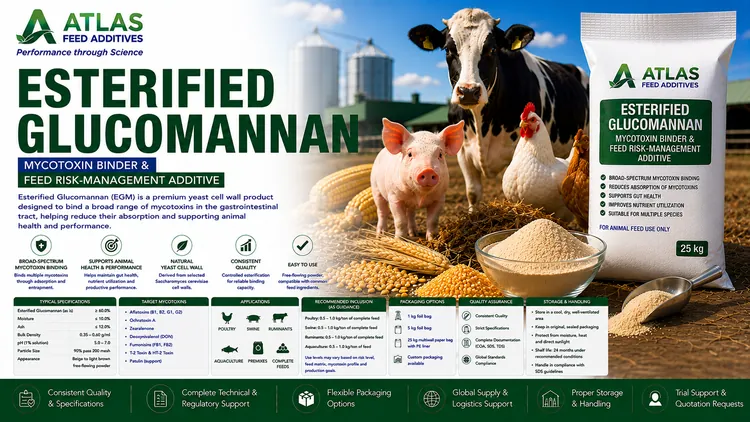
Esterified Glucomannan, EGM, modified glucomannan, yeast-cell-wall glucomannan, esterified yeast polysaccharide, or mycotoxin binder premix depending on supplier documentation and market classification. |
| Functional category |
Mycotoxin binder, adsorbent, detox-support additive, technological additive, or functional feed additive depending on market authorization and label claim. |
| Typical source |
Processed yeast cell wall fractions, commonly associated with Saccharomyces cerevisiae derivatives, subject to supplier declaration. |
| Main fractions |
Mannan-rich and glucan-associated polysaccharide fractions; exact composition varies by production route and analytical method. |
| Modification |
Esterification or other processing may be used to improve surface functionality and binding characteristics. Buyers should request a production-process description or functional specification where available. |
| Appearance |
Usually beige, cream, light brown, or tan powder or granule, depending on yeast source, carrier, moisture, and processing method. |
| Odor |
Typically mild yeast-like or cereal-like odor. Strong, burnt, musty, rancid, or chemical odor should trigger quality review. |
| Active declaration |
Request yeast cell wall content, glucomannan fraction, beta-glucan and mannan content, esterification declaration, or supplier-defined active marker values. |
| Target toxins |
Ask for data by toxin: aflatoxin B1, ochratoxin A, zearalenone, fumonisin B1/B2, deoxynivalenol, T-2 toxin, HT-2 toxin, and multi-toxin models where relevant. |
| Binding capacity |
Request capacity at realistic toxin concentrations, not only at very high challenge levels. Data should show method, pH, contact time, binder dose, toxin concentration, and analytical recovery. |
| Binding affinity |
Ask whether the product can bind low toxin concentrations effectively. High capacity alone may not be enough when contamination levels are low but biologically important. |
| pH stability |
Request binding and desorption data across stomach, crop, gizzard, intestinal, rumen, and neutral pH models as appropriate for the target species. |
| Selectivity |
Request evidence that the product does not meaningfully bind vitamins, trace minerals, amino acids, enzymes, coccidiostats, medications, pigments, or other valuable feed components at the recommended inclusion rate. |
| Particle size |
Confirm particle size distribution, flowability, dust level, bulk density, and mixing behavior in premix and feed mill systems. |
| Moisture |
Low and controlled moisture supports storage stability. Request moisture or loss-on-drying limits from the supplier specification. |
| Microbiology |
Request total plate count, yeast and mold, Salmonella, E. coli, Enterobacteriaceae, and other microbiological criteria required by the buyer's quality system. |
| Contaminants |
Request heavy metals, dioxins, PCBs, pesticide residues, residual solvents where relevant, mycotoxin background level, and undesirable substances according to destination-market rules. |
| Inclusion rate |
Inclusion depends on product concentration, species, toxin challenge, contamination level, raw-material risk, and regulatory approval. Buyers should request dose-by-risk guidance and technical justification. |
| Packaging |
Common options may include 20 kg or 25 kg bags, foil-lined bags, paper bags with PE liners, cartons, drums, or big bags depending on product form and supplier capability. |
| Storage |
Store sealed in a cool, dry, well-ventilated area, protected from moisture, pests, direct sunlight, high heat, and contamination. Follow supplier SDS and label instructions. |
| Shelf life |
Confirm production date, expiry or retest date, shelf-life statement, and recommended storage conditions. Shelf life should be supported by product stability data where possible. |
| Documentation |
Specification, COA, SDS, technical data sheet, source declaration, binding-profile data, batch traceability, contaminant statements, microbiological status, packaging list, shelf-life statement, and market-specific certificates. |