Mycotoxin binders and detox support

Hydrated Sodium Calcium Aluminosilicate

Hydrated Sodium Calcium Aluminosilicate, commonly abbreviated HSCAS, is a feed-grade aluminosilicate ingredient used in mycotoxin risk-management programs for grains, by-products, oilseed meals, DDGS, and compound feeds exposed to variable contamination pressure.

  • Feed-grade aluminosilicate
  • Commonly abbreviated HSCAS
  • Mycotoxin risk-management support
  • Poultry, swine, dairy, beef, aquaculture and pet food
  • Specification-led sourcing support
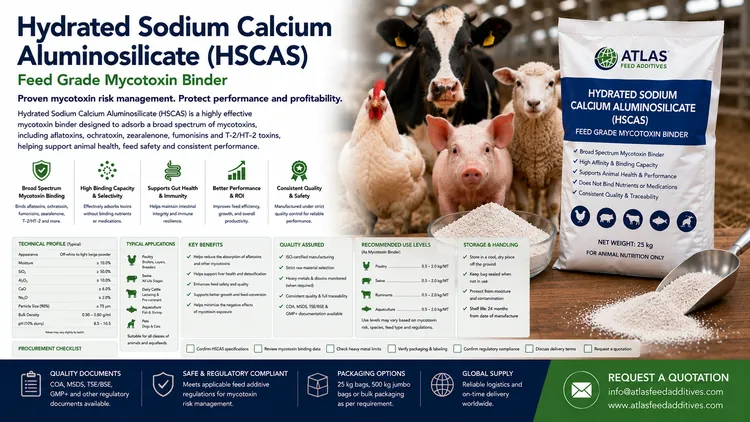
Hydrated Sodium Calcium Aluminosilicate feed additive visual
Product type Hydrated aluminosilicate mineral
Common abbreviation HSCAS
Functional use Mycotoxin binder and raw-material risk management
Supply model Global sourcing and quotation support

Product role

Where Hydrated Sodium Calcium Aluminosilicate fits in feed programs

Hydrated Sodium Calcium Aluminosilicate is part of the mycotoxin binders and detox support group. It is typically evaluated as a mineral-based feed ingredient used in risk-management programs where feed mills, integrators, and nutrition teams need practical support for raw materials exposed to mycotoxin pressure.

In practical feed production, HSCAS is reviewed by mineral composition, adsorption profile, target toxins, particle size, moisture, bulk density, pH, cation exchange capacity, surface characteristics, heavy metal levels, dioxin and PCB status, inclusion guidance, compatibility with premixes, and documentation required by the destination market.

HSCAS may be considered for corn, wheat, barley, sorghum, rice by-products, DDGS, oilseed meals, peanut meal, cottonseed meal, compound feeds, concentrates, and premixes where contamination risk varies by harvest, origin, storage, shipping route, and weather conditions.

Atlas Feed Additives can coordinate international supplier options for feed mills, premix producers, distributors, integrators, livestock companies, aquaculture feed producers, pet food manufacturers, and importers that require consistent feed-grade Hydrated Sodium Calcium Aluminosilicate with clear quality documentation.

Technical overview

Typical technical profile buyers request

Final values must always follow the manufacturer specification, certificate of analysis, safety data sheet, and destination-market requirements. The table below is a practical procurement guide for common feed-grade Hydrated Sodium Calcium Aluminosilicate requests.

Product name Hydrated Sodium Calcium Aluminosilicate, sodium calcium aluminosilicate, HSCAS, feed-grade aluminosilicate binder, or mineral mycotoxin binder depending on the requested grade and supplier description.
Ingredient identity Mineral-based hydrated aluminosilicate material containing aluminum, silicon, sodium, calcium, oxygen, and bound water in a naturally derived or processed mineral matrix. Exact composition varies by deposit, supplier, purification, and processing method.
Functional class Technological and functional feed ingredient used in mycotoxin risk-management, raw-material quality programs, and feed safety support strategies.
Common target profile Often evaluated for aflatoxin-risk programs and may be included in broader programs with other binders, yeast cell wall fractions, enzymes, organic acids, antioxidants, hepatoprotective ingredients, or gut-support components depending on the toxin challenge.
Binding selectivity Buyers should request target-toxin binding information, test conditions, pH range, inclusion rate, and whether the product has been evaluated for nutrient selectivity. Binding performance can vary by product, toxin type, particle size, surface properties, and diet matrix.
Mineral composition Common checks include silicon dioxide, aluminum oxide, calcium oxide, sodium oxide, moisture, ash, loss on ignition, pH, bulk density, and insoluble mineral fraction. Results should be confirmed by batch COA or supplier specification.
Particle size Particle size distribution is important for dispersion, surface area, premix uniformity, flowability, dust level, and handling. Buyers should request sieve analysis or laser particle size information when dosing accuracy is critical.
Cation exchange and surface properties Cation exchange capacity, surface area, swelling behavior, adsorption capacity, and pH can help buyers compare different mineral binders, but values should be interpreted together with actual target-toxin data.
Appearance Typically light grey, beige, cream, off-white, or white powder depending on source and processing. Color, odor, dust level, granulation, and flowability may vary by deposit and supplier.
Processing compatibility HSCAS is commonly considered for mash, pellets, crumbles, concentrates, premixes, and some extrusion systems. Buyers should confirm compatibility with pelleting, heat exposure, liquid application, mineral premixes, fat addition, enzymes, probiotics, acids, and medication programs.
Inclusion guidance Inclusion rate should be based on supplier recommendation, raw-material risk assessment, toxin test results, animal species, diet type, regulatory limit, and complete nutrition program. HSCAS should not replace raw-material testing or good storage practices.
Packaging Common packaging options may include 20 kg or 25 kg bags, paper or PP bags with liner, big bags, palletized shipments, or container-load supply. Final packaging depends on order size, dust-control needs, moisture protection, and destination requirements.
Shelf life Use the manufacturer shelf-life statement. Store under dry, clean, covered, and ventilated conditions according to the supplier label and safety data sheet.
Regulatory status Use must comply with feed additive rules, mycotoxin-binder authorization rules, import rules, labeling rules, claims restrictions, contaminant limits, and species-specific requirements in the destination market.

Animal nutrition applications

Where feed mills and nutrition teams evaluate HSCAS

Poultry feed programs

Hydrated Sodium Calcium Aluminosilicate is commonly evaluated in poultry feed programs where grain quality, mycotoxin pressure, raw-material origin, storage conditions, and performance risk need to be managed together.

  • Broiler starter, grower, finisher, withdrawal, layer, breeder, turkey, duck, and minor poultry feed review
  • Corn, wheat, barley, sorghum, rice bran, DDGS, and oilseed meal risk programs
  • Aflatoxin-pressure management when raw-material testing indicates elevated risk
  • Use in mash, pellet, crumble, and premix systems when compatible with the process
  • Review with enzymes, organic acids, probiotics, yeast products, antioxidants, minerals, and coccidiosis programs
  • Supplier documentation review for feed safety, contaminant status, and market compliance

Swine, dairy and ruminant feeds

In swine, dairy, beef, calf, and small-ruminant programs, HSCAS may be considered when grain, silage, by-product, and oilseed meal risks vary by season, harvest, supplier, storage, or import origin.

  • Piglet, nursery, grower-finisher, sow, gilt, lactation, and gestation diets
  • Dairy cow, beef cattle, calf starter, sheep, goat, and transition-period programs
  • Corn silage, grain, DDGS, cottonseed, peanut meal, soybean meal, and mixed by-product review
  • Programs where testing, segregation, dilution, and binder use are combined
  • Compatibility review with mineral premixes, buffers, live yeast, probiotics, enzymes, acids, and fat sources
  • Use according to animal species, toxin challenge, regulatory rules, and nutritionist-approved inclusion rates

Aquaculture and pet food

HSCAS can be evaluated in aquaculture and pet food formulas where raw materials include grain fractions, plant proteins, oilseed meals, rice by-products, corn products, or other ingredients that may vary in mycotoxin pressure.

  • Fish and shrimp feeds using plant protein replacement strategies
  • Dog, cat, and specialty pet food formulas containing grains or plant protein meals
  • Extruded feeds where process compatibility, dust, and dispersion must be checked
  • Functional blends combining mineral binders with yeast fractions, beta-glucans, probiotics, or antioxidants
  • Palatability, texture, ash contribution, mineral contribution, and finished-product declaration review
  • Documentation review for heavy metals, dioxins, PCBs, origin, GMO, allergen, and market-specific requirements
Risk-management note: HSCAS should be used as part of a complete mycotoxin-control program. It does not replace raw-material testing, supplier approval, proper drying, storage hygiene, segregation of contaminated lots, legal compliance, or nutritionist review of the full diet matrix.

Formulation value

Why binder specification matters before price comparison

Hydrated Sodium Calcium Aluminosilicate purchasing decisions should not be based only on price per kilogram. A meaningful comparison reviews target-toxin binding profile, adsorption data, inclusion rate, selectivity, mineral composition, particle size, moisture, dust level, heavy metals, dioxin and PCB status, origin, processing method, packaging, and documentation.

Two HSCAS products may look similar visually but differ in deposit source, purification, particle distribution, mineral ratios, contaminant profile, flowability, and practical binding performance. A lower-cost mineral powder is not equivalent unless the quality, safety, and functional data match the buyer's intended use.

  • Supports feed safety and raw-material risk-management programs
  • Often evaluated for aflatoxin-risk programs and high-risk grain supply chains
  • Useful where corn, DDGS, oilseed meals, and imported raw materials vary by origin
  • Requires comparison by target-toxin profile, inclusion guidance, and batch quality
  • Must be reviewed for unwanted binding or dilution effects at the intended inclusion rate
  • Should be entered into formulation software with correct ash, mineral, sodium, calcium, and analytical values when relevant
  • Must be used according to local feed additive regulations, claims rules, and buyer specifications

Practical formulation checks

Questions for the nutritionist and quality team

  • Which toxins are the priority? Confirm whether the program is focused on aflatoxins, multi-toxin pressure, storage mold risk, field mold risk, or a specific raw-material problem.
  • What do raw-material tests show? Use laboratory results, supplier history, harvest conditions, storage risk, and incoming inspection data before selecting inclusion level.
  • Which feed process will be used? Check mash production, pelleting, crumbling, extrusion, premixing, liquid addition, fat coating, storage time, and mixing uniformity.
  • Could nutrients or additives be affected? Review mineral balance, vitamins, trace minerals, medications, enzymes, probiotics, acids, pigments, and other sensitive ingredients when high inclusion levels are used.

Quality assurance

Buyer quality checklist for Hydrated Sodium Calcium Aluminosilicate

A clear purchasing file helps reduce risk during supplier approval, import clearance, feed registration, warehouse receiving, premix production, and finished-feed declaration. Atlas Feed Additives can help buyers request the right documents before comparing offers.

Identity and composition

  • Product specification sheet
  • Certificate of analysis for each batch
  • Mineral composition and major oxide profile
  • Moisture or loss on drying
  • Loss on ignition
  • pH value
  • Bulk density and tapped density
  • Particle size distribution
  • Cation exchange capacity or surface data when available
  • Confirmation that the product is HSCAS rather than generic clay, bentonite, zeolite, kaolin, or undeclared blend

Binding and functionality

  • Target-toxin binding profile
  • Aflatoxin binding data where available
  • Test pH and test method description
  • Inclusion-rate guidance by challenge level
  • Selectivity data or nutrient-interaction review where available
  • Compatibility with yeast cell wall, organic acids, enzymes, probiotics, and antioxidants
  • Premix, pelleting, extrusion, and mixing guidance
  • Recommended use level and regulatory limitations by market

Safety parameters

  • Safety data sheet
  • Heavy metals such as lead, arsenic, cadmium, mercury, and chromium where required
  • Dioxins and PCBs where required by buyer or destination market
  • Fluorine, crystalline silica, or other mineral contaminants where relevant
  • Microbiological status when required
  • Radioactivity statement where required by destination market
  • Melamine, adulterant, or undeclared additive testing when required by buyer policy
  • Animal-origin, GMO, allergen, irradiation, and BSE/TSE statements when requested

Traceability and market documents

  • Batch or lot number
  • Mining source, production site, or origin declaration when available
  • Manufacturing date
  • Expiry or retest date
  • Country of origin
  • Manufacturer or approved supplier information
  • Packaging label copy
  • Free-sale, health, veterinary, feed registration, Halal, Kosher, GMO, BSE/TSE, or origin documents if required
  • Legalized or chamber-stamped documents if required by the destination country

Storage and handling

Protect quality, dispersion, and shelf life

Hydrated Sodium Calcium Aluminosilicate products should be handled as mineral feed additives. Storage and handling conditions can affect moisture, caking, dust level, flowability, dosing accuracy, mixing uniformity, and suitability for premix or feed mill systems.

  • Store in original, closed packaging in a clean, dry, and covered warehouse
  • Protect from rain, standing water, condensation, excessive humidity, and direct ground contact
  • Keep away from strong odors, non-feed chemicals, fuels, pesticides, fertilizers, and cleaning products
  • Use pallets and avoid direct contact with floors or warehouse walls
  • Protect bags and big bags from tearing, puncture, water exposure, and contamination
  • Control dust during unloading, batching, and premix production according to workplace safety rules
  • Apply first-in, first-out stock rotation based on manufacturing date, expiry date, or retest date
  • Follow the supplier label, safety data sheet, and local occupational safety procedures

Procurement note

Ask for the right specification before comparing prices.

Price comparisons are meaningful only when binding profile, target toxins, inclusion rate, mineral composition, particle size, moisture, heavy metals, dioxins and PCBs, packaging, origin, documentation, Incoterm, delivery schedule, payment terms, and supplier approval status are aligned.

For sensitive or regulated markets, confirm feed additive authorization, import registration, label language, certificate format, claims restrictions, contaminant limits, and whether the manufacturer or exporter must appear on official documents.

  • Define the target challenge. State whether the program is focused on aflatoxin risk, multi-toxin pressure, corn risk, DDGS risk, oilseed meal risk, storage-mold risk, or broad raw-material variability.
  • Confirm functional equivalence. Compare binding data, inclusion recommendation, particle size, mineral profile, contaminant status, and safety documentation before comparing price.
  • Review process compatibility. Ask whether the product is suitable for your premix, mash, pelleting, crumbling, extrusion, top-dress, or specialty-feed process.
  • Check documentation before ordering. Review COA, SDS, specification, origin, heavy metals, dioxins and PCBs, particle size, shelf life, and destination-market certificates before shipment.

Quotation preparation

Information to send for a faster quotation

The more complete the request, the faster Atlas Feed Additives can compare suitable supplier options and avoid mismatched offers.

Commercial details

  • Required quantity and shipment frequency
  • Sample request, trial order, pallet quantity, FCL, big-bag quantity, or annual contract volume
  • Destination country, port, or delivery address
  • Preferred Incoterm such as EXW, FCA, FOB, CFR, CIF, CPT, or DAP
  • Target shipment date and delivery deadline
  • Payment preference and banking requirements

Technical details

  • Required product grade and HSCAS specification
  • Target toxins and intended inclusion range
  • Required particle size, bulk density, moisture, pH, or mineral profile
  • Heavy metal, dioxin, PCB, and contaminant limits
  • Packaging format, pallet requirements, and label requirements
  • Any internal specification or buyer standard
  • Species, formulation application, or intended feed category when relevant

Document details

  • COA and SDS requirements
  • Import registration documents
  • Health, veterinary, or free-sale certificates
  • Halal, Kosher, GMO, BSE/TSE, animal-origin, allergen, or origin statements
  • Binding data, contaminant statement, heavy metal report, dioxin and PCB report if required
  • Label language, legalization, or chamber-stamp requirements

Questions

Useful answers

What is Hydrated Sodium Calcium Aluminosilicate used for in animal nutrition?

Hydrated Sodium Calcium Aluminosilicate is used as part of mycotoxin risk-management programs for grains, oilseed meals, DDGS, by-products, compound feeds, and premixes exposed to contamination pressure. It should be used according to target species, toxin challenge, inclusion guidance, and applicable market rules.

What does HSCAS mean?

HSCAS is a common abbreviation for Hydrated Sodium Calcium Aluminosilicate. It describes a mineral-based aluminosilicate material used in feed programs where mycotoxin binding and raw-material risk management are part of the quality strategy.

Is HSCAS effective for every mycotoxin?

No. HSCAS products can differ in binding profile and may not perform equally across all toxin types. Buyers should review target-toxin data, pH conditions, inclusion rate, diet matrix, and whether additional detox-support components are required for the intended program.

Which raw materials are commonly reviewed with HSCAS programs?

Common raw materials include corn, wheat, barley, sorghum, rice by-products, DDGS, corn gluten feed, soybean meal, sunflower meal, cottonseed meal, peanut meal, and other grains or by-products where mycotoxin pressure may vary by origin, harvest, storage, and transport conditions.

Can HSCAS replace raw-material testing?

No. HSCAS should be part of a broader risk-management plan. Raw-material testing, supplier approval, correct drying, storage hygiene, segregation, dilution strategy, and legal compliance remain essential parts of the program.

Is Hydrated Sodium Calcium Aluminosilicate suitable for pelleting or extrusion?

Suitability depends on the product grade, particle size, dust level, inclusion rate, process temperature, moisture exposure, mixing time, and finished-feed application. Buyers should request supplier guidance before using HSCAS in pelleted or extruded feeds.

Can Atlas Feed Additives quote Hydrated Sodium Calcium Aluminosilicate?

Yes. Send your required specification, target toxins, inclusion rate, quantity, destination, packaging preference, shipment timing, and required documents so Atlas Feed Additives can review suitable supplier options for Hydrated Sodium Calcium Aluminosilicate.

What quality documents should buyers request for HSCAS?

Common documents include specification, certificate of analysis, safety data sheet, origin information, mineral profile, particle size, moisture, heavy metals, dioxins and PCBs where required, batch details, shelf-life statement, label copy, and any market-specific certificates required by the buyer or destination authority.

How should Hydrated Sodium Calcium Aluminosilicate be stored?

Store HSCAS in clean, dry, covered, and ventilated conditions in original closed packaging. Keep away from rain, condensation, direct floor contact, damaged packaging, strong odors, and non-feed chemicals. Always follow the supplier label and SDS.

What should be checked before comparing two HSCAS offers?

Compare target-toxin binding profile, inclusion guidance, mineral composition, particle size, moisture, bulk density, contaminant status, heavy metals, dioxins and PCBs, origin, manufacturer, documents, packaging, shelf life, Incoterm, freight route, payment terms, and whether the source is accepted in the destination market.

Request a quotation

Tell us what you need

Send your product list, target specification, destination country, packaging preference, shipment timing, and required documents. Our team will review your request and respond from orders@feedgradeadditives.com.

Product: Hydrated Sodium Calcium Aluminosilicate, HSCAS, aluminosilicate binder, or your required specification
Risk profile: state the target toxins, raw materials, inclusion rate, particle size, contaminant limits, and binding-data requirements
Quantity: sample request, trial order, pallet quantity, big-bag quantity, FCL, or annual contract volume
Delivery: destination port, warehouse, or preferred Incoterm
Documents: COA, SDS, origin, heavy metals, dioxins and PCBs, binding profile, health certificate, Halal, Kosher, GMO statement, BSE/TSE statement, or registration file