Mycotoxin binders and detox support

Bentonite

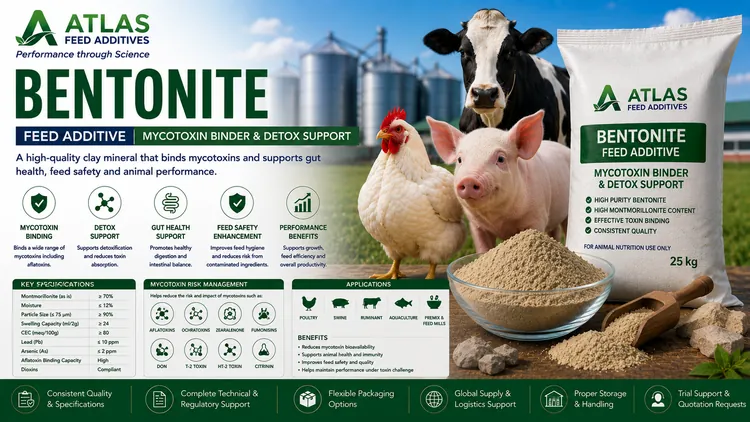
Bentonite is a clay mineral feed additive used as part of risk-management programs for grains, oilseed meals, DDGS, cereal by-products, and multi-origin raw materials exposed to mycotoxin pressure.

  • Used in mycotoxin-risk management programs where clay-mineral binding, raw-material control, and feed hygiene are important
  • Commonly evaluated by montmorillonite content, swelling capacity, cation exchange capacity, particle size, and toxin-binding profile
  • Specification support available for feed mills, premix producers, poultry and swine integrators, ruminant farms, aquafeed producers, and distributors
Bentonite feed additive visual

Product role

Where Bentonite fits in feed formulation

Bentonite is part of the mycotoxin binders and detox support group. It is a naturally occurring clay material typically evaluated for its smectite or montmorillonite-rich mineral composition, swelling behavior, adsorption properties, and ability to support practical feed-risk management when raw materials are exposed to contamination pressure.

In animal nutrition, Bentonite is most often reviewed as a mineral binder in programs focused on aflatoxin-risk control, feed hygiene, grain variability, raw-material quality assurance, moisture management, and practical supply-chain risk reduction. It is not a substitute for raw-material testing, supplier control, good storage, mold prevention, or regulatory compliance. The most effective mycotoxin programs combine incoming ingredient screening, risk mapping, storage control, correct inclusion rate, and product-specific binding data.

Atlas Feed Additives coordinates international supplier options for feed mills, premix manufacturers, poultry and swine integrators, dairy and beef producers, aquafeed manufacturers, pet food producers, distributors, private-label buyers, and regional importers that need consistent feed-grade Bentonite with suitable technical, commercial, and quality documentation.

Functional purpose

Why formulators use Bentonite

  • Mycotoxin-risk management: used as part of programs designed to reduce exposure risk from contaminated grains and by-products, especially when aflatoxin pressure is a key concern.
  • Clay-mineral binding support: montmorillonite-rich bentonite can provide adsorption surfaces and exchange sites that may support binding of selected contaminants.
  • Feed hygiene and raw-material control: helps support practical risk reduction when ingredients come from variable origins or high-risk harvest conditions.
  • Moisture and flow support: selected grades may help manage moisture, caking, and flow behavior in premix or feed systems, depending on particle size and inclusion rate.
  • Pelleting and physical quality support: some bentonite grades can contribute to pellet quality or binding effect, but this should be validated in the buyer’s feed process.
  • Cost-effective binder strategy: often used as a mineral base in binder programs where raw-material risk, inclusion cost, and documentation requirements must be balanced.
  • Blend compatibility: may be combined with HSCAS, zeolite, yeast cell wall, activated carbon, enzymes, botanicals, antioxidants, or liver-support ingredients in broader risk-management blends.

Buying focus

Key points before comparing offers

  • Confirm whether the product is sodium bentonite, calcium bentonite, activated bentonite, micronized bentonite, or a blended binder.
  • Request mineralogical profile, especially smectite or montmorillonite content where available.
  • Compare target-toxin binding data, not only price per metric ton.
  • Ask whether binding tests are performed for aflatoxin and other relevant toxins under realistic pH conditions.
  • Review selectivity so the product does not bind excessive nutrients, vitamins, minerals, medications, or beneficial additives.
  • Check particle size, dust level, bulk density, flowability, moisture, swelling capacity, and cation exchange capacity.
  • Request heavy-metal, dioxin, PCB, microbiological, and origin documentation before purchase.

Technical overview

Bentonite value depends on mineralogy, binding profile, and safety documentation

Bentonite products are not interchangeable only by product name. Natural deposits vary in mineral composition, montmorillonite level, exchangeable cations, swelling behavior, particle size, impurities, pH, moisture, heavy-metal profile, and adsorption capacity. Processing methods such as drying, grinding, sieving, activation, granulation, or blending can further change handling and performance.

Mycotoxin-binding performance is toxin-specific and product-specific. A product that performs well for aflatoxin may not automatically bind zearalenone, DON, fumonisins, ochratoxin, or T-2 toxin at the same level. Buyers should request target-toxin data, test method details, inclusion-rate guidance, and independent quality documentation when available.

Atlas Feed Additives can help buyers request comparable supplier data so that offers are evaluated according to mineral profile, binding claims, safety limits, inclusion cost, processing suitability, and documentation instead of only the lowest price per bag.

Typical applications

Application areas in animal nutrition

Poultry feed

In broiler, layer, breeder, and turkey programs, Bentonite may be used as part of mycotoxin-risk management when corn, wheat, barley, sorghum, soybean meal, sunflower meal, DDGS, bran, or other raw materials show contamination pressure. Poultry producers often monitor aflatoxins, DON, zearalenone, fumonisins, ochratoxin, T-2 toxin, and multi-toxin exposure depending on region and raw-material supply.

  • Broiler starter, grower, and finisher feeds exposed to grain variability
  • Layer and breeder diets where feed safety, production consistency, and egg quality must be protected
  • Programs using DDGS, bran, oilseed meals, or multi-origin grains
  • Binder blends used with yeast cell wall, enzymes, antioxidants, organic acids, or liver-support ingredients

Swine feed

In swine nutrition, Bentonite may be reviewed for nursery, grower-finisher, gilt, sow, and boar diets when grain or by-product quality is uncertain. Swine can be sensitive to certain mycotoxins, especially in early-life, reproductive, or high-performance programs. A binder strategy should be combined with ingredient testing, storage control, and careful formulation.

  • Nursery diets where feed intake and gut health are critical
  • Grower-finisher feeds containing corn, wheat, barley, DDGS, or by-products
  • Sow and gilt programs where reproductive performance and feed consistency matter
  • Risk programs that include mycotoxin testing and supplier approval

Ruminant feed

In dairy, beef, sheep, and goat nutrition, Bentonite may be used in feeds exposed to grain, silage, forage, or by-product contamination pressure. Ruminant programs may require special attention to aflatoxin transfer risk, milk-quality requirements, ration moisture, mineral balance, palatability, and total inclusion level.

  • Dairy concentrates and TMR programs where raw-material risk is monitored
  • Beef feedlot rations using corn, barley, wheat, by-products, or silage
  • Sheep and goat feeds requiring practical toxin-risk management
  • Programs where aflatoxin control, milk safety, and documentation are commercially important

Aquaculture feed

In fish and shrimp feeds, Bentonite may be reviewed for mycotoxin-risk management, pellet binding, water stability, and practical raw-material quality control. Aquafeeds often use plant proteins, cereal by-products, and oilseed meals that may contribute mycotoxin exposure. Product choice should consider extrusion, water stability, palatability, digestibility, and target species.

  • Fish and shrimp feeds using soybean meal, wheat, corn gluten meal, DDGS, or plant by-products
  • Low-fishmeal diets where plant-ingredient risk mapping is important
  • Pelleted and extruded feeds requiring physical-quality and water-stability review
  • Binder systems combined with yeast cell wall, organic acids, antioxidants, or functional additives

Pet food and specialty feed

Pet food and specialty feeds require careful review of ingredient safety, label language, palatability, processing, and contaminant limits. Bentonite may be evaluated where clay mineral functionality, moisture control, feed hygiene, or risk management is relevant and permitted. Buyers should confirm species suitability, label acceptance, and regulatory status before use.

  • Dry pet food and treats using cereals, pulses, by-products, or plant proteins
  • Specialty feeds where feed safety and ingredient variability require documentation
  • Products requiring low dust, good flowability, and stable shelf-life
  • Private-label programs requiring strong traceability and contaminant declarations

Premix and distributor products

Premix producers and distributors often require consistent particle size, low dust, predictable flowability, strong contaminant control, and reliable documents. Bentonite may be supplied as a single ingredient or as part of a binder blend. Compatibility with vitamins, trace minerals, enzymes, probiotics, medications, organic acids, and other additives should be reviewed.

  • Single-ingredient mycotoxin binder premixes
  • Multi-component detox support blends
  • Distributor products for high-risk grain seasons
  • Private-label programs requiring recurring specification and document control

Mycotoxin strategy

How Bentonite fits with broader risk management

Bentonite should be used as part of a structured risk-management program. Mycotoxin control begins with raw-material supplier approval, harvest-risk monitoring, moisture control, storage hygiene, mold prevention, sampling, laboratory testing, segregation, and formulation decisions. A binder can help reduce exposure risk, but it should not be the only control step.

  • Aflatoxins: bentonite products are commonly evaluated for aflatoxin-binding capacity, but performance depends on product quality and test conditions.
  • Zearalenone: binding may be limited or product-specific, so request toxin-specific data.
  • DON / vomitoxin: mineral binding is often challenging; consider broader strategies and verified data.
  • Fumonisins: review product-specific data and species risk before relying on binder claims.
  • Ochratoxin and T-2 toxin: require specific risk review, testing, and technical support.
  • Multi-toxin exposure: practical feed programs often need binder blends, ingredient screening, antioxidants, gut support, and liver-support strategies.

Evaluation questions

What nutritionists and buyers should confirm

  • Which mycotoxins are present in the buyer’s raw materials?
  • Are contamination levels based on representative sampling and a reliable laboratory method?
  • Is the target toxin primarily aflatoxin, or is a broader multi-toxin profile present?
  • What inclusion rate is recommended for the contamination level and species?
  • Does the product bind nutrients, vitamins, trace minerals, medications, or other feed additives?
  • Does the supplier provide binding data at digestive pH ranges?
  • Is the product authorized in the destination market for the intended claim and species?
  • Are heavy metals, dioxins, PCBs, and microbiological limits controlled?

Specification guidance

Typical feed-grade specification items

The values below are procurement guidance points, not a universal specification. Exact limits vary by deposit, mining location, activation process, grinding method, particle size, purification, and supplier. Buyers should always confirm the latest supplier specification and certificate of analysis before purchase.

Common specification review table

Parameter Typical buyer question Why it matters
Product identity Is the product sodium bentonite, calcium bentonite, activated bentonite, micronized bentonite, or a clay blend? Prevents confusion between different clay types and commercial preparations.
Mineralogical profile What are the levels of montmorillonite, smectite, quartz, feldspar, calcite, kaolinite, illite, or other minerals? Mineralogy influences swelling, binding behavior, safety review, and product consistency.
Montmorillonite / smectite content Is the active clay fraction declared or supported by analysis? Often central to binder performance and product comparison.
Cation type Is the product sodium-dominant, calcium-dominant, or activated? Influences swelling, water absorption, dispersion, and handling behavior.
Cation exchange capacity Is CEC declared, and which method is used? Useful for clay-mineral characterization and comparison, though it does not alone prove toxin binding.
Swelling capacity What is the swelling index or swelling volume? Important for sodium bentonite characterization, water behavior, and process suitability.
Binding profile Which toxins are tested and under what pH conditions? Binding is toxin-specific and method-specific; aflatoxin data cannot automatically represent broad-spectrum performance.
Selectivity Does the product avoid excessive binding of vitamins, trace minerals, amino acids, medications, or nutrients? Important for safety, performance, and diet precision.
Particle size Is the particle-size distribution suitable for premix and complete-feed production? Supports uniform distribution, dosing accuracy, dust control, and feed processing.
Bulk density What is the typical bulk density? Useful for dosing equipment, packaging volume, silo handling, and logistics.
Moisture What is the moisture limit? Influences flowability, caking, microbial risk, and shipment weight.
pH What is the pH in suspension? Relevant for product characterization and compatibility review.
Dust level Is the product fine powder, low-dust granule, or pelleted form? Important for worker handling, factory housekeeping, and dosing systems.
Heavy metals Are lead, arsenic, cadmium, mercury, and other elements controlled? Natural minerals must be checked carefully for feed safety and import compliance.
Dioxins and PCBs Are dioxin, dioxin-like PCB, and non-dioxin-like PCB declarations available when required? Important for mineral feed additives and export-market compliance.
Crystalline silica / quartz Is the quartz or respirable crystalline silica level declared where required? Relevant for worker-safety review and dust exposure management.
Microbiological status Are total plate count, yeast, mold, Salmonella, and other parameters declared? Important for feed-safety systems, premix producers, and export buyers.
Packaging Is the product supplied in 20 kg, 25 kg, big bags, bulk, lined bags, or palletized format? Impacts storage, moisture control, handling, and shipment planning.
Shelf-life What is the expiry or retest period under recommended storage? Needed for stock planning, distributor resale, and quality control.
Country of origin Where is the product mined and processed? Often required for import clearance, customer approval, and traceability.

Testing and validation

Binding claims should be supported by target-toxin data

Not all mycotoxin binders have the same binding profile. Bentonite products are commonly evaluated for aflatoxin, but the ability to bind other toxins can vary widely. Buyers should request test reports that show toxin type, toxin concentration, pH range, inclusion rate, contact time, analytical method, and whether the study is in vitro, in vivo, internal, independent, or peer-reviewed.

  • In vitro testing: useful for screening binding capacity under controlled pH, toxin, and inclusion-rate conditions.
  • In vivo testing: more relevant for biological response, but harder to compare across species, diets, and challenge levels.
  • Digestive pH simulation: important because binding should remain relevant through stomach and intestinal conditions.
  • Selectivity testing: helps evaluate whether the binder also captures nutrients or feed additives.
  • Batch consistency testing: important for natural minerals because deposit and processing variability can affect results.

Interpreting results

What to look for in a binding report

  • Exact toxin tested: aflatoxin B1, zearalenone, DON, fumonisin, ochratoxin, T-2 toxin, or mixed challenge
  • Binder inclusion level and toxin concentration
  • pH values used during the test
  • Contact time and temperature
  • Analytical method and detection limit
  • Comparison against a blank control and reference binder
  • Whether binding remains stable after pH changes
  • Whether nutrient or medication binding was evaluated

Processing compatibility

Mixing, pelleting, extrusion, premix, and bulk handling

Bentonite is usually stable under standard feed processing, but practical performance depends on particle size, moisture, dust level, bulk density, flowability, and distribution in the final feed. Fine powders can mix well but may create dust. Granular forms may improve handling but require confirmation of distribution and binding performance. Buyers should match the grade to their factory process.

  • Premix use: requires uniform particle size, low segregation, good flowability, and compatibility with other micro-ingredients.
  • Complete feed addition: requires consistent distribution and dosing accuracy.
  • Pelleted feed: may benefit from clay binding effects, but pellet quality and nutrient dilution should be checked.
  • Extruded aquafeed or pet food: requires review of water stability, feed texture, density, palatability, and final product appearance.
  • Bulk handling: requires attention to dust, bridging, silo flow, moisture exposure, and transport compaction.
  • Binder blends: require compatibility review with yeast cell wall, activated carbon, zeolite, enzymes, botanicals, acids, and mineral carriers.

Factory questions

Questions to ask before purchase

  • Is the product suitable for micro-dosing, premix, direct feed addition, or bulk use?
  • Does the particle size support uniform mixing at the intended inclusion rate?
  • Does the product create dust that requires special handling or respiratory protection?
  • Will it affect pellet durability, feed texture, water stability, or flowability?
  • Does the product absorb moisture and cause caking in the buyer’s climate?
  • Is it compatible with vitamins, minerals, medications, enzymes, probiotics, acids, and other additives?
  • Does the supplier provide batch-to-batch consistency data?

Procurement note

Ask for the right Bentonite specification before comparing prices.

Price comparisons are meaningful only when mineralogy, montmorillonite content, activation status, particle size, moisture, binding profile, heavy-metal limits, dioxin/PCB status, microbiological quality, packaging, origin, and documentation are aligned. A lower price per metric ton can be misleading if the product has weak binding data, high contaminants, poor flowability, high dust, inconsistent mineralogy, or incomplete export documents.

For Bentonite products, the most useful commercial comparison is often cost per metric ton of complete feed at the target inclusion rate, supported by toxin-specific binding data, safety documentation, and consistency of supply. Atlas Feed Additives can help buyers collect supplier specifications and review offers on a comparable basis.

Quality assurance

Documents buyers should request

Documentation requirements vary by buyer, country, species, feed process, contaminant risk, final label, and import procedure. Atlas Feed Additives can help collect and review supplier documentation before confirming an order.

Core commercial and quality documents

  • Product specification sheet
  • Certificate of analysis for the offered batch or representative lot
  • Safety data sheet
  • Commercial invoice and packing list
  • Certificate of origin or origin declaration when required
  • Batch number, mining or production lot, manufacturing date, expiry date, or retest date
  • Packaging details, pallet configuration, and loading quantity

Mineral and technical documents

  • Mineralogical profile, including montmorillonite or smectite content when available
  • Particle-size distribution and bulk-density data
  • Moisture, pH, swelling capacity, and cation exchange capacity where available
  • Toxin-binding profile and target-toxin data
  • Recommended inclusion guidance by species and challenge level, if available
  • Selectivity or nutrient-binding information when available
  • Processing and premix compatibility information

Feed-safety and contaminant documents

  • Heavy-metal declaration, including lead, arsenic, cadmium, and mercury
  • Dioxin and PCB declaration when required
  • Microbiological declaration, including Salmonella where relevant
  • Crystalline silica or quartz declaration where required for worker-safety review
  • GMO status statement when required
  • Animal-origin-free, BSE/TSE, or animal-origin declaration where applicable
  • Halal, Kosher, ISO, GMP+, FAMI-QS, HACCP, or other certificates when available and relevant
  • Market-specific documents for feed registration or import clearance

Traceability and supplier qualification

  • Mine or production-site information when disclosed
  • Country of origin and processing location
  • Lot number and production date
  • Retained-sample policy, if available
  • Change-control statement for recurring supply programs
  • Distributor authorization or supply-chain confirmation when required

Storage and handling

Protect clay quality and manage dust exposure

Bentonite should be stored according to the supplier’s safety data sheet and local workplace rules. Although many bentonite products are mineral-based and physically stable, poor warehouse control can lead to moisture uptake, caking, dust exposure, contamination, loss of flowability, and handling problems. Correct storage helps protect product consistency and worker safety.

  • Store in a cool, dry, well-ventilated warehouse.
  • Keep bags, big bags, cartons, or containers sealed until use.
  • Protect from moisture, rain, condensation, and direct floor contact.
  • Keep away from strong odors, pests, chemicals, and incompatible or contaminating materials.
  • Control dust during bag opening, weighing, transfer, and mixing.
  • Use appropriate personal protective equipment according to the safety data sheet.
  • Avoid rough handling that causes bag breakage and excessive dust.
  • Apply first-in, first-out stock rotation.
  • Do not use damaged, wet, caked, contaminated, or leaking packages without quality review.

Packaging and logistics

Plan packaging around dust, moisture, and bulk density

Packaging, palletization, container loading, label language, and document preparation should be confirmed before shipment. Bentonite is a high-volume mineral product, so freight cost, bulk density, pallet count, moisture protection, and loading configuration strongly affect the final delivered price. Export buyers should also check whether their importing country requires feed registration, mineral-additive approval, or special contaminant declarations.

  • Common packaging may include 20 kg or 25 kg bags, lined bags, big bags, bulk loading, or palletized formats depending on supplier.
  • Moisture-protective liners or sealed packaging may be important for flowability.
  • Palletized or non-palletized loading should be agreed before quotation.
  • Container loading quantity depends on packaging, bulk density, pallet use, road limits, and port requirements.
  • Buyers should confirm HS code, import permits, feed registration, and mineral-additive label requirements with local authorities.

Supplier qualification

How Atlas Feed Additives supports Bentonite buyers

1. Requirement review

We review your target species, target toxin profile, contamination pressure, binder objective, specification requirement, product form, feed process, destination country, packaging preference, delivery terms, and documentation requirements before matching supplier options.

2. Specification alignment

We help align offers so that mineralogy, montmorillonite content, activation status, particle size, binding data, heavy-metal limits, dioxin/PCB declarations, packaging, origin, and quality documents can be compared clearly.

3. Quotation coordination

We coordinate price, lead time, payment terms, shipment terms, packaging, palletization, loading quantity, document availability, sample availability, and market-specific requirements before order confirmation.

4. Export-focused follow-up

We support buyers with practical export communication, document tracking, shipment coordination, and recurring-supply planning from inquiry stage through commercial execution.

Trial planning

Suggested evaluation approach

Before moving to large-scale use, buyers may run a controlled feed evaluation in the target species and production system. The goal is to confirm practical handling, inclusion rate, palatability, feed performance, and risk-management value in the real feed matrix, not only in a supplier specification.

  • Define the objective before the trial: aflatoxin-risk management, broad toxin support, feed hygiene, pellet quality, moisture control, or binder-blend evaluation.
  • Test incoming raw materials for relevant toxins using representative sampling.
  • Set a control diet and one or more binder inclusion levels.
  • Keep other binder products, yeast cell wall, enzymes, antioxidants, medications, and feed additives consistent where possible.
  • Monitor feed intake, growth, feed conversion, production, manure or litter observations, mortality, health signs, and product quality.
  • Record raw-material origin, toxin levels, feed process, storage time, climate, product form, and handling observations.
  • Evaluate cost per ton of complete feed together with biological results, raw-material risk, and factory practicality.

Buyer checklist

Information to send for a faster quotation

  • Product name: Bentonite
  • Required grade: sodium bentonite, calcium bentonite, activated bentonite, micronized bentonite, or binder blend
  • Target toxin profile and contamination level, if known
  • Target species and feed phase
  • Application objective: mycotoxin binder, aflatoxin binder, feed hygiene, pellet quality, moisture management, or premix use
  • Preferred particle size, dust level, bulk density, or packaging format
  • Feed process: mash, pellet, crumble, extruded feed, premix, bulk feed, or specialty process
  • Monthly, trial, or spot quantity requirement
  • Destination country and delivery port or address
  • Preferred Incoterms, such as EXW, FOB, CFR, CIF, or DAP
  • Packaging preference and pallet requirement
  • Required certificates, declarations, registration support, or safety documents

Commercial comparison

How to compare competing Bentonite offers

  • Compare binding data: ask for toxin-specific binding results, especially for aflatoxin and any target toxins in your raw materials.
  • Compare cost per ton of finished feed: evaluate offers at the recommended inclusion rate, not only product price per metric ton.
  • Review mineralogy: montmorillonite or smectite content, cation type, and impurity profile can strongly affect product value.
  • Review safety limits: heavy metals, dioxins, PCBs, microbial status, and crystalline silica data may be critical for approval.
  • Check handling behavior: particle size, dust, caking, moisture, bulk density, and flowability affect factory performance.
  • Validate selectivity: ensure the binder does not create problems by binding nutrients, trace minerals, medications, or beneficial additives.
  • Check label and regulatory fit: species, inclusion level, claim language, and documentation must match the destination market.
  • Review documentation: ensure COA, SDS, origin, traceability, and certificates are acceptable for your market.
  • Evaluate supplier consistency: recurring supply programs need stable mineralogy, batch traceability, and reliable document flow.

Questions

Useful answers about Bentonite

What is Bentonite used for in animal nutrition?

Bentonite is used as part of mycotoxin-risk management, feed hygiene, raw-material quality control, and practical feed-safety programs. It is commonly reviewed for grains and by-products exposed to mycotoxin pressure, especially when aflatoxin binding or clay-mineral support is required. Use should follow the target species, contamination profile, product specification, and applicable market rules.

Is Bentonite the same as montmorillonite?

Bentonite is a natural clay material commonly rich in smectite clay minerals, especially montmorillonite. Commercial bentonite products vary by deposit, activation, sodium or calcium form, purity, particle size, swelling behavior, and contaminant profile, so buyers should request mineralogical data and a certificate of analysis.

Which mycotoxins does Bentonite bind?

Many bentonite products are primarily evaluated for aflatoxin-binding capacity. Binding of other mycotoxins may be weaker or product-specific. Buyers should request toxin-specific support data for aflatoxins, zearalenone, ochratoxin, fumonisins, DON, T-2 toxin, and other target challenges before assuming broad-spectrum performance.

Can Bentonite replace mycotoxin testing?

No. Bentonite should not replace raw-material testing, supplier approval, sampling, storage control, or mold prevention. It is best used as part of a wider risk-management program that includes ingredient testing and quality control.

Can Bentonite be used in poultry feed?

Yes, it may be used in poultry feed when permitted by local rules and when the product is suitable for the target toxin profile and diet. It is commonly reviewed in broiler, layer, breeder, and turkey programs where grain or by-product quality is variable.

Can Bentonite be used in swine feed?

Yes, it may be evaluated in swine feeds, including nursery, grower-finisher, gilt, sow, and boar programs. Swine programs should review target toxins, inclusion level, selectivity, palatability, mineral balance, and regulatory status before use.

Can Bentonite be used in dairy and ruminant feeds?

Yes, it may be reviewed for dairy, beef, sheep, and goat feeds, especially where grain, silage, forage, or by-product contamination risk exists. Dairy programs should pay special attention to aflatoxin risk, milk safety, mineral balance, and documentation.

Can Bentonite be used in aquaculture feed?

Yes, it may be evaluated in fish and shrimp feeds as part of mycotoxin-risk management, pellet binding, and water-stability strategies. Aquafeed applications should review extrusion conditions, water stability, feed texture, palatability, and species suitability.

What is the difference between sodium and calcium Bentonite?

Sodium and calcium bentonite differ in dominant exchangeable cation, swelling behavior, water absorption, and handling properties. The best choice depends on the intended application, processing method, binding target, and supplier data. Buyers should not substitute one for the other without reviewing specification and performance information.

What is the most important quality parameter?

No single parameter is enough. Buyers should review mineralogical profile, montmorillonite or smectite content, binding profile, selectivity, particle size, moisture, cation exchange capacity, swelling capacity, heavy metals, dioxins, microbiological status, and origin documentation.

Is a higher swelling capacity always better?

Not always. Swelling capacity helps characterize bentonite, especially sodium bentonite, but it does not alone prove mycotoxin-binding performance or feed suitability. Binding data, selectivity, safety, particle size, flowability, and contaminant limits must also be reviewed.

What documents should buyers request?

Common documents include product specification, certificate of analysis, safety data sheet, mineralogical profile, particle-size data, moisture, heavy-metal declaration, dioxin and PCB declaration when required, microbiological declaration, origin declaration, batch details, manufacturing date, expiry or retest date, and market-specific certificates required by the buyer.

How should Bentonite be stored?

Store according to the supplier’s safety data sheet, generally in a cool, dry, well-ventilated warehouse. Keep packages sealed, protect from moisture and contamination, control dust, avoid damaged bags, and use first-in, first-out stock rotation.

Does Bentonite require special handling?

Handling requirements depend on particle size, dust level, packaging, and safety data sheet. Buyers should review dust control, ventilation, personal protective equipment, spill response, moisture exposure, and worker-safety requirements before use.

Can Atlas Feed Additives support recurring supply?

Yes. Atlas Feed Additives can review recurring monthly demand, supplier availability, mineral specification, packaging needs, shipment planning, documentation requirements, and distributor support for regular bentonite and mycotoxin-binder supply programs.

Can Atlas Feed Additives quote Bentonite?

Yes. Send your required specification, target toxin profile, quantity, destination, packaging preference, delivery terms, and required documents so Atlas Feed Additives can review suitable supplier options for Bentonite and prepare a quotation.

Request a quotation

Tell us what you need

Send your product list, target specification, binder objective, target toxin profile, destination country, packaging preference, quantity, delivery terms, and required documents. Our team will review your request and respond from orders@feedgradeadditives.com.

For faster pricing, include:

  • Required bentonite type or mineral specification
  • Target toxin profile and challenge level, if known
  • Target species and feed application
  • Preferred particle size, dust level, and packaging format
  • Order quantity and delivery frequency
  • Destination country and port
  • Packaging and pallet preference
  • Required certificates, contaminant declarations, registration documents, or safety documents