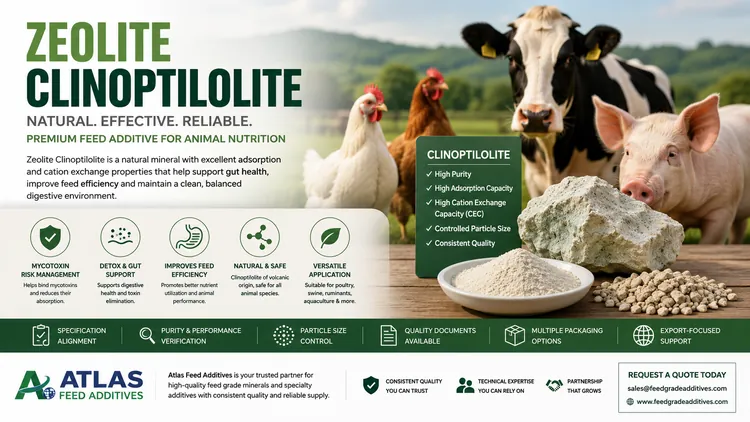
What is Zeolite Clinoptilolite used for in animal nutrition?
Zeolite Clinoptilolite is used as part of risk-management programs for grains and by-products exposed to mycotoxin pressure. It may also be reviewed for feed hygiene, moisture control, flow support, ammonia-binding support, and functional carrier use. It should be used according to the target species, formulation objective, product label, and applicable market rules.
Can Atlas Feed Additives quote Zeolite Clinoptilolite?
Yes. Send your required specification, clinoptilolite content, particle size, intended function, quantity, destination, packaging preference, delivery terms, and documents so Atlas Feed Additives can review suitable supplier options for Zeolite Clinoptilolite.
What quality documents should buyers request for Zeolite Clinoptilolite?
Common documents include specification, certificate of analysis, safety data sheet, technical data sheet, mineralogical analysis, clinoptilolite content statement, origin information, batch details, shelf-life statement, storage guidance, and any market-specific certificates required by the buyer.
Why is clinoptilolite content important?
Clinoptilolite content helps confirm that the material contains the target zeolite mineral. Natural zeolite products can include other minerals, so buyers should request mineralogical testing or a clear specification.
How should two Zeolite Clinoptilolite offers be compared?
Compare clinoptilolite content, mineralogical profile, adsorption or CEC data, target toxin profile, particle size, moisture, dust level, heavy metal and dioxin limits, packaging, shelf life, documents, lead time, Incoterms, and total landed cost.
Is higher adsorption capacity always better?
No. Adsorption capacity should be interpreted together with test method, target toxin, pH condition, selectivity, inclusion rate, and nutrient interaction risk. Product-specific data is more useful than broad claims.
Why does particle size matter?
Particle size affects surface area, dust, flowability, mixing uniformity, premix compatibility, and practical handling. Fine powders may bind efficiently but can create dust, while coarse material may mix differently.
Can Zeolite Clinoptilolite replace mycotoxin testing?
No. It should be used as part of a risk-management program that includes raw-material testing, supplier control, storage management, and formulation review. It should not be treated as a replacement for quality control.
Why are heavy metal and dioxin results important?
Natural mineral products can contain undesirable substances depending on quarry source and processing. Buyers should request contaminant results where required by their customer, quality system, or destination market.
Can Zeolite Clinoptilolite be used in all animal species?
No single specification should be assumed suitable for every species, phase, or market. Suitability depends on product grade, local regulation, diet formulation, inclusion rate, and customer requirements.
What storage conditions should be checked?
Buyers should confirm recommended temperature range, humidity protection, sealed packaging requirements, caking risk, shelf life, and handling after opening.
What information helps Atlas respond faster?
The fastest quotation requests usually include required clinoptilolite content, particle size, target function, quantity, destination country, Incoterm, packaging preference, required documents, and order timeline.
Does Atlas Feed Additives provide regulatory approval?
Atlas Feed Additives provides sourcing, quotation, and documentation coordination support. Buyers should confirm regulatory acceptance, product registration, label claims, maximum limits, and final use permissions with local authorities or qualified regulatory advisors.