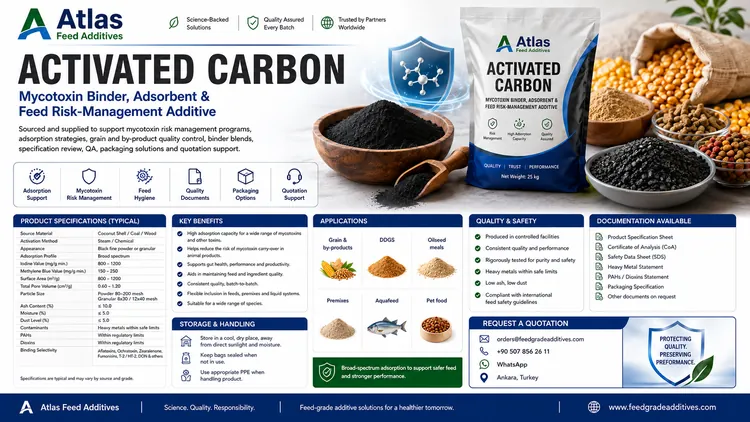
| Product identity |
Trade name, activated carbon type, feed-grade status, source material, activation method, intended use, supplier article code, and functional group. |
Confirms that the offered product is suitable for feed applications and not merely an industrial adsorbent. |
| Source material |
Coconut shell, wood, coal, peat, bamboo, agricultural by-product, or other source, plus origin and traceability details where available. |
Source can influence pore structure, ash, hardness, dust, contaminant profile, and adsorption behavior. |
| Activation method |
Steam activation, chemical activation, washing process, acid washing, post-treatment, and any residual-process statements where relevant. |
Activation method affects pore development, surface chemistry, pH, ash, residual impurity concerns, and contaminant review. |
| Adsorption indicators |
Iodine value, methylene blue value, surface area, pore volume, pore size distribution, and adsorption isotherm data where available. |
These values help buyers compare adsorption potential and suitability for different molecule sizes. |
| Target-toxin profile |
Binding data for aflatoxins and, where available, ochratoxin, zearalenone, fumonisins, DON, T-2, and mixed challenges. |
Activated carbon performance can differ by toxin, matrix, pH, and inclusion rate; target-specific data is more useful than broad claims. |
| Selectivity |
Data on interaction with vitamins, amino acids, minerals, pigments, medications where permitted, enzymes, probiotics, organic acids, and flavors. |
A broad adsorbent may also bind valuable nutrients or additives if selectivity is not controlled. |
| Particle size |
Powder fineness, sieve analysis, granular size, micronized fraction, fine fraction, and particle size compatibility with premixes or finished feed. |
Particle size influences contact surface, mixing uniformity, dust, flowability, segregation risk, and handling. |
| Dust level |
Dusting tendency, low-dust treatment, workplace handling guidance, PPE needs, ventilation needs, and housekeeping recommendations. |
Fine carbon dust can affect worker handling, cleanliness, dosing accuracy, and finished feed appearance. |
| Bulk density and flowability |
Bulk density, tapped density, angle of repose, flowability, caking tendency, and bag-emptying behavior. |
Affects dosing, warehouse handling, feeder calibration, premix dilution, and bag or big-bag discharge. |
| Ash and mineral residue |
Total ash, acid-soluble ash, insoluble residue, mineral impurities, soluble matter, and pH of aqueous extract. |
Helps assess purity, source differences, and suitability for sensitive feed applications. |
| Moisture |
Moisture limit, drying loss, hygroscopicity, sealed-package storage, and opened-bag handling. |
Moisture affects flow, microbial risk, adsorption quality, shelf-life, and warehouse stability. |
| Contaminants |
Heavy metals, arsenic, lead, cadmium, mercury, PAHs, dioxins or PCBs where relevant, pesticide residues, residual process chemicals, and unwanted impurities. |
Activated carbon sources and activation processes require careful contaminant review before feed use. |
| Microbiological quality |
Total plate count, yeast and mold, Salmonella status, Enterobacteriaceae limits, and other microbiological parameters where required. |
Supports feed safety and buyer quality programs, especially for imported additives and premix use. |
| Inclusion guidance |
Recommended inclusion rate, target challenge level, species guidance, feed type, and whether inclusion depends on laboratory testing results. |
Correct use depends on challenge level, target toxin, diet, species, and regulatory status. |
| Processing compatibility |
Pelleting, extrusion, mixing, coating, premix stability, segregation behavior, liquid addition compatibility, and finished feed color impact. |
Feed processing can influence distribution and handling, while color can affect product appearance and customer acceptance. |
| Packaging |
Net weight, bag, liner, drum, carton, jumbo bag, pallet configuration, container loading estimate, label language, and batch coding. |
Affects logistics, dust control, moisture protection, warehouse handling, and traceability. |
| Documents |
Technical data sheet, product specification, COA, SDS, origin statement, batch details, feed-grade declaration, contaminant statements, binding data, and market-specific certificates. |
Allows importers and feed manufacturers to confirm quality and compliance before purchase and shipment. |