Mycotoxin binders and detox support

Yeast Cell Wall

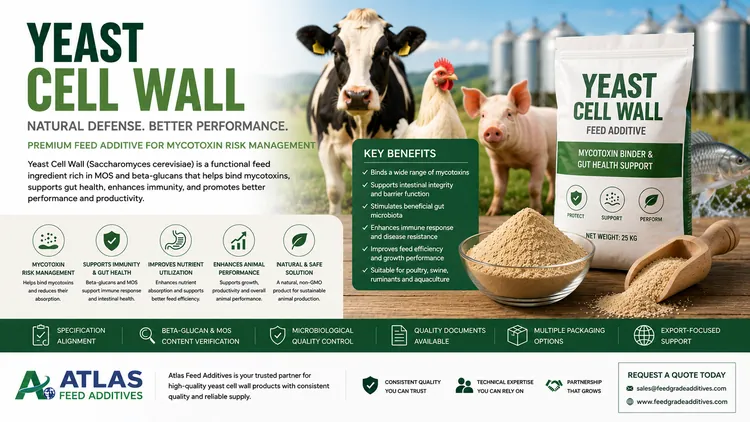
Yeast Cell Wall is a functional feed additive ingredient used in animal nutrition programs where buyers need support for mycotoxin risk-management, gut-support formulation, feed quality control and species-specific additive strategies.

Yeast Cell Wall feed additive visual

Product role

Where Yeast Cell Wall fits

Yeast Cell Wall is part of the mycotoxin binders and detox support group. It is typically evaluated by feed mills, premix producers, distributors and integrators that need a functional additive ingredient for grain-risk programs, gut-support formulations and multi-ingredient feed safety strategies.

Commercial Yeast Cell Wall products are usually derived from yeast biomass, commonly associated with Saccharomyces cerevisiae production streams. Depending on the manufacturing process, the final material may contain mannan-rich fractions, mannan oligosaccharides, beta-glucan-rich fractions, mannoproteins and other yeast cell wall components. Because product composition varies by supplier, buyers should not compare offers only by product name.

Atlas Feed Additives can coordinate international supplier options for feed-grade Yeast Cell Wall and help buyers align specification, documentation, quantity, packaging, origin, shipment terms and destination-market requirements before quotation confirmation.

Typical applications

  • Grain and by-product programs involving corn, wheat, barley, DDGS, bran, oilseed meals and other variable raw materials.
  • Mycotoxin risk-management strategies where testing indicates contamination pressure or high-risk supply conditions.
  • Premix formulas that combine binders, adsorbents, yeast fractions, antioxidants, liver-support nutrients or gut-support additives.
  • Poultry, swine, ruminant and aquaculture programs where feed safety, digestive support and raw-material variability are closely managed.
  • Multi-origin raw material supply chains where changing harvest conditions, storage conditions and transport exposure increase quality variation.
  • Feed programs where mineral binders are combined with organic yeast-derived fractions for broader risk-management coverage.

Buyer quality checklist

  • Declared beta-glucan, mannan, MOS or total polysaccharide content, where applicable.
  • Binding profile and target toxins supported by supplier data.
  • Inclusion guidance by species, feed type and challenge level.
  • Selectivity against nutrients, vitamins, trace minerals and medications where relevant.
  • Physical quality: appearance, odor, particle size, flowability, bulk density and moisture.
  • Independent quality, safety and contaminant documentation where available.
  • Storage temperature, shelf life, packaging integrity and transport conditions.
  • Regulatory suitability for the intended market and animal species.

Procurement note

Ask for the right specification before comparing prices.

Price comparisons are meaningful only when technical basis, active composition, binding profile, carrier, particle size, packaging, origin, shelf life and documents are aligned. A low-cost offer may not be technically comparable if beta-glucan level, mannan content, binding data, contaminant control or documentation depth differs.

For Yeast Cell Wall, buyers should request clear product identity, source organism or production basis, active-fraction declaration, quality limits, recommended inclusion rate, target species, processing stability and available analytical methods. If the product is intended for mycotoxin risk management, ask which toxins are supported by supplier data and under what conditions the data were generated.

Technical overview

What buyers should understand about Yeast Cell Wall

Yeast-derived functional fractions

Yeast Cell Wall is valued because the yeast cell wall contains structured carbohydrate fractions that can be relevant to feed applications. Depending on the raw material and process, commercial products may emphasize beta-glucans, mannans, mannan oligosaccharides, mannoproteins or broader yeast cell wall solids. These fractions can influence how the product is positioned in gut-support, immune-support, pathogen-pressure management or mycotoxin risk-management programs.

Organic fraction in binder programs

In many feed safety programs, Yeast Cell Wall is used as an organic component alongside mineral adsorbents such as bentonite, HSCAS, zeolite or activated carbon. The purpose is not to replace raw-material control, but to add another functional layer to the feed program where contamination pressure, storage risk or ingredient variability must be managed.

Product definition matters

Some products are described as yeast cell wall, some as MOS, some as beta-glucan products and some as broad yeast derivatives. These names are not automatically interchangeable. Buyers should confirm the actual analytical values, manufacturing process, intended use, regulatory category and supplier claims before importing or using the product.

No substitute for testing

Yeast Cell Wall should be viewed as part of a risk-management system. Raw-material sampling, mycotoxin testing, supplier approval, correct storage, moisture control and professional nutrition review remain important. A binder or yeast-derived additive should not be used as a reason to ignore contaminated raw-material risk.

Species and feed applications

Where Yeast Cell Wall may be evaluated

Poultry

In broiler, layer, breeder and turkey diets, Yeast Cell Wall may be evaluated in feed programs dealing with grain variability, gut-support concepts, litter-quality concerns, mycotoxin risk and performance consistency. Use should be aligned with nutritionist recommendations and local feed additive rules.

  • Broiler starter, grower and finisher diets exposed to variable grain quality.
  • Layer and breeder feeds where egg production, feed quality and raw-material control are important.
  • Programs combining mycotoxin binders, antioxidants, organic acids, probiotics or enzymes.
  • Feed mills handling corn, wheat, DDGS, oilseed meal or imported raw materials from multiple origins.

Swine

In swine nutrition, Yeast Cell Wall may be used in nursery, grower-finisher and sow programs as part of gut-support and raw-material risk-management strategies. Buyers should confirm inclusion guidance for piglets, sows and finishing pigs separately because target use can differ.

  • Nursery feeds where digestive support and post-weaning transition are priorities.
  • Grower-finisher diets using grain and by-products with variable quality.
  • Sow diets where feed safety, consistency and reproductive-cycle nutrition are closely managed.
  • Premix applications requiring stable handling and uniform distribution.

Ruminants

For dairy cattle, beef cattle, calves, sheep and goats, Yeast Cell Wall may be considered where forage, silage, grain or by-product quality creates formulation risk. It may be included in broader programs that combine binder technology, rumen-support additives and careful raw-material testing.

  • Dairy diets using silage, concentrates, by-products and multi-origin ingredients.
  • Beef cattle programs during receiving, adaptation and finishing periods.
  • Calf feeds where early-life digestive support is a formulation focus.
  • Small ruminant diets where feed quality varies seasonally.

Aquaculture and companion animals

In aquaculture and pet food, product suitability depends strongly on processing method, pellet or extrusion stability, palatability, regulatory approval and species-specific use. Buyers should confirm whether the Yeast Cell Wall product is suitable for fish, shrimp, dogs, cats or specialty diets before purchase.

  • Fish and shrimp feeds where digestive-support ingredients are included in the formula.
  • Extruded pet food where process stability and palatability are important.
  • Specialty feed programs requiring clean label, functional yeast-derived ingredients.
  • Export applications requiring clear label statements and market-specific documentation.

Mycotoxin risk management

Using Yeast Cell Wall in practical feed safety programs

Risk starts before the additive

Effective mycotoxin risk management begins with raw-material sourcing, harvest monitoring, supplier approval, moisture control, correct storage, cleaning, sampling and testing. Yeast Cell Wall can be part of the additive strategy, but it should not be treated as a replacement for ingredient control or laboratory analysis.

Target toxins should be clear

Different binder technologies may show different behavior against aflatoxins, ochratoxin, zearalenone, fumonisins, deoxynivalenol, T-2 toxin and other concerns. Buyers should request supplier data showing target toxins, test method, dosage, pH conditions and whether the data are in vitro, in vivo or field-oriented.

Selectivity matters

A functional binder should be evaluated not only by toxin binding, but also by selectivity. Buyers may want to review whether the product has unwanted binding interactions with vitamins, amino acids, trace minerals, medications or other feed additives under practical feed conditions.

Challenge level affects inclusion

The appropriate inclusion level may vary according to raw-material risk, toxin type, test result, species, production stage and formulation objective. Always follow supplier guidance, nutritionist review and local regulations.

Commercial buying guide

Information to confirm before placing an order

Technical information

  • Exact product name and product type: Yeast Cell Wall, MOS, beta-glucan product or blended binder.
  • Source organism, production process or raw material basis where disclosed.
  • Declared beta-glucan, mannan, MOS, polysaccharide, protein, ash and moisture levels.
  • Binding profile, target toxins and supplier-supported inclusion rate.
  • Species suitability and recommended production phases.
  • Physical form, particle size, bulk density, flowability and mixing behavior.
  • Heat, pelleting, extrusion or premix stability if the product will be processed.
  • Compatibility with acids, enzymes, probiotics, minerals, vitamins, coccidiostats and medications where relevant.

Commercial information

  • Required order quantity and expected annual demand.
  • Destination country, destination port or delivery address.
  • Preferred Incoterms, shipment method and target delivery date.
  • Bag size, pallet configuration, container loading and label requirements.
  • Required certificates, legalization needs and import documents.
  • Minimum shelf life required at loading and at arrival.
  • Sample requirement, pre-shipment inspection or third-party testing request.
  • Payment terms, lead time and regular supply expectations.

Quality and documentation

Documents commonly requested by professional buyers

Documentation requirements vary by destination country, buyer policy, species application and regulatory classification. Atlas Feed Additives can help clarify which documents are available from supplier options before quotation confirmation.

Core documents

  • Product specification sheet with physical, chemical and functional parameters.
  • Certificate of Analysis for the offered batch or representative lot.
  • Safety Data Sheet for handling, transport and storage review.
  • Country of origin statement and supplier or manufacturer details where available.
  • Batch number, manufacturing date, expiry date and shelf-life statement.
  • Packaging specification, net weight, gross weight, pallet details and container loading information.

Additional documents when required

  • GMO status declaration.
  • Allergen statement, BSE/TSE statement or animal-origin declaration where relevant.
  • Heavy metals, dioxins, undesirable substances and microbiological analysis.
  • Mycotoxin analysis of the product itself where required by buyer policy.
  • Binding profile, efficacy summary or technical data sheet where available.
  • Halal, free-sale, health, sanitary or market-specific certificates where available.
  • Regulatory compliance statement for the destination country when requested.

Handling and storage

Storage, transport and shelf-life considerations

Storage recommendations

Yeast Cell Wall should generally be stored in a clean, cool, dry and well-ventilated area. Packaging should remain sealed until use and protected from moisture, direct sunlight, strong odors, pests and cross-contamination. Always follow the supplier’s official storage statement because stability can vary by production process, moisture level and packaging system.

  • Keep bags, cartons or drums closed when not in use.
  • Avoid wet floors, condensation, roof leaks and high-humidity storage zones.
  • Store away from pesticides, disinfectants, chemicals and strong-smelling materials.
  • Use first-expired, first-out stock rotation.
  • Inspect damaged, wet or contaminated packaging before acceptance.
  • Record batch numbers for traceability and quality follow-up.

Transport considerations

For export shipments, buyers should confirm whether the product needs moisture protection, container lining, desiccants, fumigation-free pallets, temperature protection or special handling. Palletized dry feed additives should be protected from rain during loading and unloading.

  • Confirm packaging condition before loading.
  • Request label and pallet photos when needed.
  • Check shelf life remaining at dispatch and expected shelf life at arrival.
  • Confirm whether certificates must be issued before shipment.
  • Align product description, HS code guidance and import documents with destination requirements.
  • Avoid long exposure to humidity or high heat during transport and storage.

Formulation compatibility

How to evaluate Yeast Cell Wall in a feed program

Questions for nutritionists

  • What species and production phase will receive the product?
  • Is the main objective mycotoxin risk management, gut support, immune-support positioning or a combined program?
  • Which raw materials are driving risk: corn, wheat, barley, DDGS, soybean meal, rapeseed meal, silage or other by-products?
  • Which toxins are most relevant based on testing and regional history?
  • Will the product be used alone or combined with bentonite, HSCAS, zeolite, activated carbon, enzymes, acids or probiotics?
  • Will the feed be pelleted, extruded, crumbled, mixed into premix or applied in another process?
  • What inclusion level is technically justified for the risk level?
  • What incoming quality-control marker will be checked by the buyer?

Questions for procurement teams

  • Is the offered product technically equivalent to the requested product?
  • Does the supplier declare beta-glucan, mannan, MOS or binding data?
  • Are batch documents available before shipment?
  • Is the product suitable for the destination market and animal species?
  • Does packaging protect the material during export transport?
  • Is the price based on the same assay, composition and document package?
  • Is regular supply available or only spot stock?
  • Does the supplier support trial quantities, container quantities or both?

Comparison guide

Yeast Cell Wall compared with related binder products

Yeast Cell Wall

An organic yeast-derived ingredient that may contain beta-glucans, mannans, MOS and other yeast cell wall fractions. It is often used in functional feed programs and may be combined with mineral binders in mycotoxin risk-management strategies.

Bentonite

A clay-based mineral adsorbent commonly used in feed binder programs. Buyers should compare swelling capacity, mineral profile, dioxin risk, heavy metals, particle size and authorized use conditions.

HSCAS

Hydrated sodium calcium aluminosilicate is a mineral adsorbent often evaluated for aflatoxin-focused programs. Product quality and regulatory status should be reviewed before purchase.

Zeolite clinoptilolite

A natural aluminosilicate mineral with adsorbent properties. Buyers should confirm purity, clinoptilolite level, particle size, heavy metals, dioxins and permitted feed use in the destination market.

Activated carbon

A high-surface-area adsorbent used in selected binder programs. Buyers should carefully evaluate selectivity, nutrient interactions, dosage, dust, handling and regulatory status.

Why Atlas Feed Additives

Export-focused sourcing support

Atlas Feed Additives supports international buyers that need practical sourcing help for feed-grade additives. Instead of only providing a product name and price, our team can review the intended use, confirm the quotation basis, collect available supplier documents and help buyers compare technically similar options.

Support areas

  • Supplier option review for Yeast Cell Wall and related mycotoxin-risk products.
  • Specification matching according to buyer target and destination requirements.
  • Document coordination for COA, SDS, origin, packaging and shelf-life information.
  • Quotation support for trial orders, container orders and regular supply programs.
  • Communication support for English and Turkish-speaking buyers.
  • Export-focused coordination from Ankara, Turkey.

Questions

Useful answers

What is Yeast Cell Wall used for in animal nutrition?

Yeast Cell Wall is used in animal nutrition as part of functional feed programs, mycotoxin risk-management strategies and gut-support formulations. It should be selected according to the target species, product specification, inclusion guidance, supplier documentation and applicable market rules.

Is Yeast Cell Wall the same as MOS?

Not always. MOS, or mannan oligosaccharides, may be one fraction of yeast cell wall products, but commercial Yeast Cell Wall may also contain beta-glucans, mannoproteins, residual yeast nutrients and other components. Buyers should confirm declared analytical values before comparing products.

Does Yeast Cell Wall bind all mycotoxins?

No binder should be assumed to bind all mycotoxins equally. Binding behavior depends on toxin type, product composition, dosage, pH conditions, test method and feed matrix. Buyers should request supplier data for the target toxins that matter in their feed program.

Can Yeast Cell Wall replace laboratory testing?

No. Yeast Cell Wall should not replace raw-material testing, sampling, supplier approval, proper storage or professional feed safety review. It should be used as part of a broader risk-management program.

Which species can evaluate Yeast Cell Wall?

Depending on the product specification and local authorization, Yeast Cell Wall may be evaluated for poultry, swine, ruminants, aquaculture, companion animals and specialty feed applications. Species suitability should be confirmed before purchase.

Can Yeast Cell Wall be used in pelleted feeds?

Many dry yeast-derived products can be used in pelleted feed programs, but buyers should confirm heat stability, process tolerance, application point and supplier guidance. Pelleting temperature, conditioning time and moisture may influence product quality.

What quality documents should buyers request for Yeast Cell Wall?

Common documents include specification, Certificate of Analysis, Safety Data Sheet, origin information, batch details, production date, expiry date, packaging specification, storage instructions and any market-specific certificates required by the buyer.

What should be checked on the Certificate of Analysis?

Check product name, batch number, date, declared active fractions, moisture, ash, physical quality, microbiological results, contaminant results where available, expiry date and whether the values match the agreed specification.

Why do Yeast Cell Wall prices vary?

Prices vary because products may differ in source, beta-glucan level, mannan or MOS level, processing method, carrier, purity, binding data, packaging, origin, shelf life, documentation, order quantity and freight conditions.

Can Atlas Feed Additives quote Yeast Cell Wall?

Yes. Send your required specification, target species, quantity, destination, packaging preference and document requirements so Atlas Feed Additives can review suitable supplier options for Yeast Cell Wall.

What information should I send for the fastest quotation?

Please send the product name, target specification, species or feed application, required quantity, destination country, preferred Incoterms, packaging preference, required documents and target delivery timing.

Can Yeast Cell Wall be combined with mineral binders?

Many feed programs combine organic yeast-derived fractions with mineral binders such as bentonite, HSCAS, zeolite or activated carbon. Compatibility and inclusion should be reviewed by a nutritionist and confirmed according to the product specification.

Request a quotation

Tell us what you need

Send your product list, target specification, destination country, packaging preference, required documents and expected order quantity. Our team will review your request and respond from orders@feedgradeadditives.com.

Recommended message format

For a faster response, include: “We need Yeast Cell Wall for [species/application], target specification [beta-glucan/MOS/binding profile], quantity [kg or MT], destination [country/port], packaging [bag size], documents [COA/SDS/origin/etc.], target delivery date [date].”