
Vitamins and vitamin-like nutrients

Choline Chloride

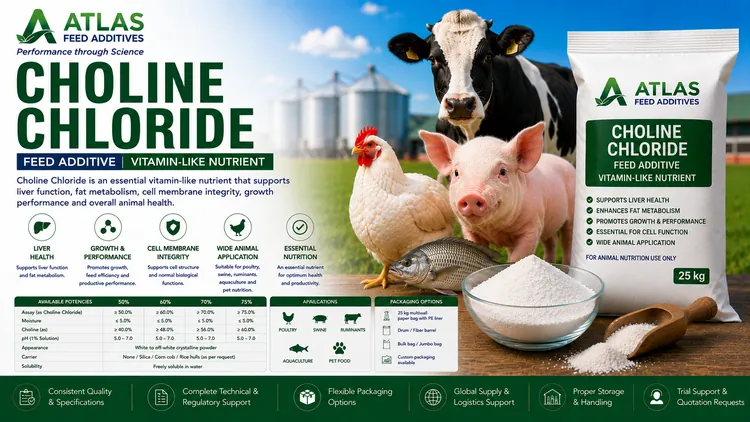
Choline Chloride is a vitamin-like nutrient source used by feed mills and premix producers to support reliable choline fortification across poultry, swine, ruminant, aquaculture, pet food, breeder, starter, and high-performance nutrition programs.

Vitamin-like nutrient Choline source 50% and 60% powder grades 70% and 75% liquid grades Export documentation support
Choline Chloride feed additive visual

Product role

Where Choline Chloride fits

Choline Chloride is part of the vitamins and vitamin-like nutrients group. Buyers typically evaluate this product by matching the declared active content, choline basis, carrier system, physical form, intended species, processing conditions, packaging, storage requirements, and documentation package.

In animal nutrition, choline is associated with phospholipid formation, liver function, lipid transport, methyl-group metabolism, nervous-system function, and performance support. Choline Chloride is widely used because it provides a concentrated and practical choline source for compound feed, premixes, concentrates, mineral feeds, and specialty nutrition formulas.

Commercial Choline Chloride products can differ significantly. A powder grade may be supplied on corn cob, silica, rice hull, or another carrier, while liquid grades may require different handling, storage, pumping, and dosing systems. For this reason, buyers should compare offers by active content, usable choline value, carrier quality, handling behavior, shelf life, and document completeness rather than product name alone.

Atlas Feed Additives can coordinate international supplier options for feed mills, premix producers, distributors, integrators, poultry operations, swine producers, dairy businesses, aquafeed manufacturers, pet food producers, and specialty feed companies that need consistent feed-grade Choline Chloride with clear documentation.

At a glance

Commercial and formulation value

Reliable choline fortification

Used where feed formulators need a concentrated choline source for compound feeds, premixes, concentrates, and specialty diets.

Multi-species application

Commonly evaluated in poultry, swine, ruminant, aquaculture, breeder, pet food, starter, and high-performance feeding programs.

Grade-specific handling

Powder and liquid grades differ in dosing equipment, carrier, storage, moisture sensitivity, flowability, and warehouse requirements.

Documentation-led sourcing

Supplier selection depends on active assay, carrier declaration, moisture, COA, SDS, packaging, shelf life, origin, and destination-market rules.

Technical profile

Specification points buyers should confirm

Choline Chloride offers should not be compared only by price per metric ton. Meaningful comparison requires the same active percentage, product form, carrier, moisture, particle size, storage requirement, packaging, shelf life, and documentation package.

Product name Choline Chloride; also referenced as 2-hydroxy-N,N,N-trimethylethanaminium chloride or choline chloride salt in technical documentation.
Product group Vitamins and vitamin-like nutrients for feed, premix, concentrate, mineral feed, liquid feed, aquafeed, and specialty nutrition applications.
Nutrient function Choline source used in formulations related to liver function, fat metabolism, methyl-group nutrition, cell membrane components, nervous-system function, reproduction, growth, and performance support.
Formula reference C5H14ClNO.
CAS reference 67-48-1.
Theoretical note Pure Choline Chloride has a molar mass of approximately 139.62 g/mol and contains approximately 74.6% choline cation by weight. Commercial feed grades are usually standardized or diluted, so the supplier COA controls practical formulation values.
Common powder grades Choline Chloride 50% powder and Choline Chloride 60% powder are widely traded. Powder grades typically use a carrier to improve handling and blending.
Common liquid grades Choline Chloride 70% liquid and Choline Chloride 75% liquid may be used where plants have liquid storage, pumping, and dosing systems. Viscosity, crystallization risk, and temperature conditions should be checked.
Carrier system Powder products may use carriers such as corn cob, silica, rice hull, calcium carbonate, or supplier-specific materials. Carrier choice affects active level, flowability, dust, caking, bulk density, and mixing uniformity.
Physical checks Appearance, odor, color, particle size, moisture, bulk density, flowability, dust, caking tendency, hygroscopic behavior, liquid clarity, viscosity, and pumpability where relevant.
Quality checks Active content, choline chloride assay, carrier declaration, moisture, trimethylamine or related odor indicators where specified, pH for liquid grades, heavy metals, microbial status, and lot traceability.
Feed-grade checks Feed suitability declaration, certificate of analysis, safety data sheet, country of origin, manufacturer details, batch traceability, shelf life, packaging information, and destination-market compliance documents.
Storage note Choline Chloride is hygroscopic. Powder products should be protected from moisture and liquid products should be stored under supplier-recommended temperature and equipment conditions.
Formulation note Final inclusion should be defined by a qualified nutritionist using the complete diet, natural choline contribution from ingredients, target species, production phase, and applicable feed regulations.

Typical applications

Where Choline Chloride is commonly evaluated

  • complete feed premixes and concentrates
  • broiler, layer, breeder, turkey, and other poultry formulas
  • swine nursery, grower-finisher, sow, and reproduction programs
  • dairy, beef, calf, and small-ruminant nutrition programs
  • aquaculture feeds where vitamin-like nutrient fortification is required
  • pet food and companion animal nutrition formulas
  • starter feeds and high-performance diets
  • stress and transition-period nutrition programs
  • liver, lipid metabolism, and methyl-donor support concepts
  • vitamin-mineral premixes, mineral feeds, and liquid feed systems

Buyer quality checklist

Documents and tests to request

  • declared Choline Chloride percentage
  • choline basis or active-content calculation method
  • powder or liquid grade declaration
  • carrier type and carrier percentage for powder products
  • moisture, particle size, bulk density, and flowability
  • liquid concentration, pH, viscosity, and clarity where relevant
  • certificate of analysis for each supplied batch
  • safety data sheet and handling precautions
  • origin, manufacturer details, lot number, and traceability
  • shelf life, storage conditions, packaging, and retest policy
  • feed-grade declaration and destination-market compliance documents
  • customer-specific statements such as GMO, allergen, halal, or kosher where required

Species and formulation context

How buyers typically position Choline Chloride

Choline Chloride should be selected according to the target species, production phase, natural choline contribution from raw materials, feed format, processing method, storage duration, and local rules. The same product may not be ideal for every system unless the active level, carrier, product form, and dosing method match the intended use.

Poultry

Commonly used in broiler, layer, breeder, turkey, and young-bird programs where choline fortification, liver support, growth, egg production, hatchability, and feed efficiency are commercial priorities.

Swine

Evaluated in nursery, grower-finisher, sow, and reproduction programs where feed intake, growth, reproductive performance, liver function, and nutrient balance are important.

Ruminants

Used in dairy, beef, calf, and small-ruminant programs. In ruminants, protected or rumen-stable choline sources may be considered for specific transition and lactation strategies.

Aquaculture and pet food

Reviewed where micronutrient fortification, palatability, processing stability, extrusion compatibility, water stability, and finished-product quality are important.

Important formulation note: Atlas Feed Additives supports sourcing and documentation coordination. Final inclusion rates, target species suitability, choline source selection, claims, and label language should be confirmed by the supplier, a qualified nutritionist, and applicable feed additive regulations in the destination market.

Form selection

Powder, liquid, carrier-based, or protected form?

Choline Chloride 50% powder

Commonly used in premix and complete-feed production where carrier-based handling, flowability, and easy dry blending are required.

Choline Chloride 60% powder

Higher active powder grade that may reduce inclusion volume but requires careful review of carrier, dust, caking, moisture, and flow behavior.

Choline Chloride 70–75% liquid

Useful for plants with liquid dosing systems. Buyers should confirm concentration, viscosity, crystallization risk, tank compatibility, pumpability, and temperature limits.

Protected choline concepts

For some ruminant applications, protected or rumen-stable choline products may be considered instead of standard Choline Chloride, depending on the nutrition objective.

Procurement tip: Always confirm whether the quoted price is based on total product weight, declared Choline Chloride percentage, or usable choline contribution. Powder and liquid products are not directly comparable unless the active basis and logistics are aligned.

Function-focused buying

Questions to ask before selecting a Choline Chloride grade

What grade is required?

Confirm whether the request is for 50% powder, 60% powder, 70% liquid, 75% liquid, a custom concentration, or a protected choline product.

What is the active basis?

Ask whether the declared percentage refers to Choline Chloride content, choline cation contribution, or another basis used by the supplier or local regulation.

Which carrier is used?

Carrier affects bulk density, flowability, dust, caking, moisture absorption, mixing uniformity, and compatibility with vitamins, minerals, enzymes, probiotics, and acids.

How will it be stored?

Because Choline Chloride can absorb moisture, buyers should confirm warehouse conditions, packaging barrier, opened-bag handling, and shelf-life controls.

How will it be dosed?

Powder grades require blending controls, while liquid grades require tank, pump, line, temperature, viscosity, and metering review.

What documents are required?

Importers may need COA, SDS, origin, feed-grade declaration, carrier statement, GMO or allergen statement, halal or kosher documents, and buyer-specific forms.

Matrix-specific evaluation

Different feed systems require different specification priorities

Vitamin-mineral premixes

Focus on active level, carrier, flowability, dust, particle size, mixing uniformity, vitamin compatibility, and shelf-life behavior.

Complete feed

Check inclusion accuracy, mixer distribution, pelleting exposure, moisture, caking, finished-feed label requirements, and carry-through from premix.

Liquid feed systems

Review liquid concentration, viscosity, pumpability, storage tank compatibility, crystallization risk, freezing risk, line flushing, and dosing calibration.

Ruminant specialty formulas

Evaluate whether standard Choline Chloride is appropriate or whether protected choline technology is needed for the intended rumen and metabolic objective.

Quality and standardization

Why Choline Chloride requires careful supplier screening

Choline Chloride products can vary significantly by active content, carrier, moisture, manufacturing quality, odor, caking tendency, packaging, and shelf-life behavior. A structured supplier review helps buyers avoid non-comparable offers and production issues.

Identity confirmation

Request product name, grade, active content, chemical identity, carrier declaration, product form, supplier specification, and confirmation that the supplied product matches the requested grade.

Batch consistency

Review COA values, active tolerance, particle size, moisture, carrier level, color, odor, bulk density, flowability, shelf-life guarantee, and historical batch consistency.

Safety controls

Ask for SDS, heavy metal data, microbiological status where required, contamination controls, manufacturing quality system information, and traceability from raw material to final batch.

Practical warning

Do not compare only by product name.

Two products labeled “Choline Chloride” may differ in active percentage, carrier, moisture, powder or liquid form, flowability, caking behavior, packaging, shelf life, freight cost, and practical usability.

Best practice: compare cost per delivered active unit, process fit, storage risk, documentation quality, packaging, and landed cost together.

Procurement note

Ask for the right specification before comparing prices.

Price comparisons are meaningful only when active content, choline basis, carrier, particle size, packaging, origin, shelf life, storage conditions, shipment terms, and documentation are aligned. For Choline Chloride, also review hygroscopic behavior, caking tendency, trimethylamine odor, liquid handling, tank compatibility, and compatibility with premix or pelleting processes.

1 Define the grade

Confirm whether the request is for 50% powder, 60% powder, 70% liquid, 75% liquid, custom concentration, or protected choline technology.

2 Confirm the active basis

Request Choline Chloride content, choline basis, assay method, specification tolerance, batch COA, and whether values are reported as-is or dry basis.

3 Check process fit

Review carrier, moisture, particle size, dust, caking, flowability, liquid viscosity, pumpability, pelleting compatibility, and storage requirements.

4 Compare landed value

Evaluate price together with active content, document quality, packaging, freight, lead time, payment terms, storage risk, and supplier reliability.

Processing and compatibility

Questions for feed mills and premix plants

Choline Chloride must match the production system. Dry premix blending, complete feed inclusion, liquid dosing, pelleting, extrusion, and protected-ruminant products can each require different specification priorities.

  • What grade and active percentage are required?
  • Is the product powder, liquid, granular, or protected?
  • What carrier is used in powder grades?
  • Does the particle size match other microingredients?
  • Is the product free-flowing and suitable for automated dosing?
  • Is dust control required in the production area?
  • Is there a risk of caking during warehouse storage?
  • Will the product be added directly or through premix dilution?
  • For liquid grades, are tanks, pumps, and dosing lines compatible?
  • Does the supplier provide batch COA, shelf life, and storage guidance?

Storage and handling

Protect product quality during use

Choline Chloride should be stored and handled according to the supplier safety data sheet and the buyer’s feed safety system. Moisture control is especially important for powder grades, while liquid grades require suitable tank and dosing equipment.

  • store in a dry, covered, well-ventilated area
  • keep bags, drums, IBCs, or containers sealed when not in use
  • avoid moisture pickup, caking, and damaged packaging
  • protect liquid grades from unsuitable temperature conditions
  • use calibrated weighing or metered liquid dosing
  • follow SDS guidance for PPE, dust control, spills, and eye or skin contact
  • segregate from non-feed chemicals and incompatible materials
  • use first-expiry-first-out stock rotation
  • record batch numbers for traceability and customer audits
  • verify opened-package handling and resealing recommendations

Quality and compliance

Recommended documents for Choline Chloride procurement

Commercial documents

Proforma invoice, packing list, commercial invoice, certificate of origin when required, shipment details, Incoterms, lead time, and payment terms.

Quality documents

Product specification, batch COA, active assay, choline basis, carrier declaration, particle size, moisture, bulk density, liquid concentration, shelf-life statement, and storage recommendation.

Safety and compliance

SDS, feed-grade declaration, label information, origin statement, allergen or GMO statement where required, halal or kosher certificates if needed, and destination-specific regulatory documents.

Documentation tip: Ask whether the assay is reported as Choline Chloride content, choline cation content, or another declared basis. The COA should clearly support the buyer’s formulation calculation.

Risk management

Common purchasing risks to avoid

Choline Chloride products can look similar on paper but behave differently in real feed systems. A structured purchasing checklist reduces the risk of buying a product that does not match the intended application.

Unclear active basis

Confirm whether the declared percentage refers to Choline Chloride, choline cation, solution concentration, or product-on-carrier concentration.

Moisture and caking problems

Hygroscopic products can cake or lose flowability if packaging or warehouse conditions are poor. Review moisture, packaging, and storage instructions carefully.

Wrong grade for equipment

Powder grades suit dry blending systems, while liquid grades require appropriate tanks, pumps, temperature control, and metered dosing equipment.

Performance reminder

Choline nutrition is formula-dependent.

Practical requirements depend on natural ingredient contribution, species, production phase, diet energy level, methionine and methyl-donor balance, liver challenge, management conditions, and regulatory use conditions.

Best practice: use supplier guidance, qualified nutrition support, and local regulatory review before adding Choline Chloride to commercial formulas.

Quotation preparation

Information to include in your request

A complete inquiry helps Atlas Feed Additives respond faster and compare supplier options more accurately. Use the checklist below when requesting a quotation for Choline Chloride.

Product details

Required grade, active percentage, choline basis, powder or liquid form, carrier preference, particle size, moisture limit, and any preferred origin.

Application details

Target species, production stage, feed type, premix use, liquid-feed use, inclusion rate, storage conditions, and compatibility concerns.

Quantity and logistics

Trial quantity, monthly demand, annual forecast, destination country, delivery terms, packaging preference, lead time, and shipment conditions.

Document requirements

COA, SDS, origin, feed-grade statement, carrier declaration, assay method, shelf life, packaging details, halal, kosher, GMO, allergen, or buyer-specific documents.

Supplier coordination

How Atlas Feed Additives supports buyers

Atlas Feed Additives helps customers compare Choline Chloride options from a sourcing perspective: grade selection, active basis, carrier suitability, supplier reliability, document completeness, packaging suitability, shipment planning, and quotation clarity. This is especially useful for buyers comparing multiple offers that may differ in active concentration, carrier, product form, storage requirement, and logistics cost.

  • reviewing buyer specifications before quotation
  • checking whether supplier documents match the requested Choline Chloride grade
  • coordinating product, packaging, and shipment details
  • supporting feed mills, premix producers, distributors, integrators, poultry producers, swine producers, dairy operations, aquafeed producers, and pet food manufacturers
  • helping buyers avoid non-comparable offers based on different active levels, carriers, or liquid/powder forms
  • organizing document requests such as COA, SDS, origin, shelf life, carrier declaration, assay, and feed-grade declaration

Questions

Useful answers

What is Choline Chloride used for in animal nutrition?

Choline Chloride is used as a vitamin-like nutrient and choline source in animal nutrition. It supports micronutrient fortification programs related to liver function, lipid metabolism, methyl-group nutrition, nervous-system function, growth, reproduction, and performance. It should be used according to the target species, formulation objective, and applicable market rules.

What are the common commercial grades of Choline Chloride?

Common grades include Choline Chloride 50% powder, Choline Chloride 60% powder, Choline Chloride 70% liquid, and Choline Chloride 75% liquid. Customer-specific carrier-based or premix grades may also be available.

Can Atlas Feed Additives quote Choline Chloride?

Yes. Send your required grade, active percentage, product form, quantity, destination, packaging preference, delivery terms, and required documents so Atlas Feed Additives can review suitable supplier options for Choline Chloride.

What quality documents should buyers request for Choline Chloride?

Common documents include specification, certificate of analysis, safety data sheet, carrier declaration, active-content result, origin information, batch details, shelf-life statement, packaging details, storage guidance, and any market-specific certificates required by the buyer.

What is the difference between Choline Chloride 50% and 60% powder?

The main difference is the declared active concentration and carrier balance. Choline Chloride 60% powder contains more active material per kilogram than 50% powder, but buyers should also compare carrier, moisture, flowability, dust, caking tendency, and price per active unit.

What is the difference between powder and liquid Choline Chloride?

Powder grades are usually used in dry premixes and complete feed, while liquid grades are suited to plants with liquid storage and dosing equipment. Liquid grades require review of concentration, viscosity, tank compatibility, pumpability, and temperature conditions.

Why is Choline Chloride storage important?

Choline Chloride is hygroscopic. Powder products can absorb moisture and cake if packaging is damaged or storage conditions are poor. Buyers should keep bags sealed and follow supplier storage guidance.

Can Choline Chloride be used in pelleted feed?

Choline Chloride can be used in compound feed programs, but suitability depends on grade, carrier, moisture, process temperature, storage, and premix design. Confirm process compatibility with the supplier and formulation team.

Is standard Choline Chloride suitable for ruminant transition cow programs?

Standard Choline Chloride may be used in some ruminant feeds, but transition cow programs often evaluate protected or rumen-stable choline products for specific objectives. The correct source should be chosen by a qualified nutritionist.

How should buyers compare Choline Chloride offers?

Compare active content, choline basis, carrier, moisture, particle size, flowability, dust, odor, caking tendency, liquid concentration, packaging, shelf life, certificate of analysis, freight, lead time, and landed cost.

What should be checked in the COA?

The COA should show product grade, active assay, batch number, manufacturing date or expiry date, moisture where relevant, carrier or form information, and any buyer-required quality parameters.

Does Choline Chloride require special handling?

Handling should follow the supplier safety data sheet. Use appropriate PPE, dust control for powders, spill control for liquids, calibrated dosing, clear labeling, and segregation from non-feed materials.

What information should I send for a fast quotation?

Please send the required grade, active percentage, product form, target species, feed application, order quantity, destination, packaging preference, delivery terms, and required documents.

Request a quotation

Tell us what you need

Send your product list, target specification, required Choline Chloride grade, active percentage, product form, destination country, packaging preference, estimated quantity, target species, feed application, delivery terms, and required documents. Our team will review your request and respond from orders@feedgradeadditives.com.