Mycotoxin binders and detox support

Diatomaceous Earth

Diatomaceous Earth is a porous siliceous mineral material used in feed-related applications as a carrier, anti-caking support material, absorbent, flow-support ingredient, and part of practical risk-management programs for grains and by-products exposed to mycotoxin pressure.

Feed-grade Diatomaceous Earth should be selected carefully because commercial materials vary by source deposit, freshwater or marine origin, processing method, crystalline silica level, particle size, dust profile, absorbency, contaminant profile, and documentation. Buyers should not assume that industrial, pool-filter, calcined, or non-feed grades are acceptable for animal nutrition use.

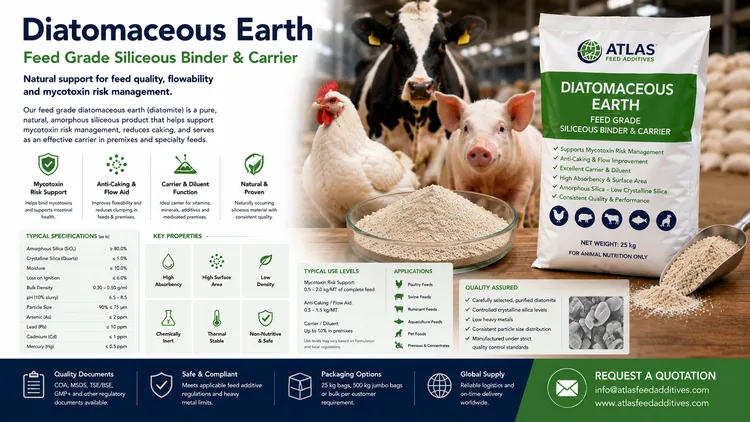
Diatomaceous Earth feed additive visual

Product role

Where Diatomaceous Earth fits

Diatomaceous Earth is part of the mycotoxin binders and detox support group. It is a siliceous mineral material formed from fossilized diatom structures, giving it a porous and absorbent character. In feed manufacturing, it may be used as a functional carrier, flow aid, anti-caking support ingredient, absorbent mineral, and binder-support component depending on grade, local rules, and supplier documentation.

In mycotoxin risk-management programs, Diatomaceous Earth should be viewed as one component of a wider strategy rather than a stand-alone cure. Effective risk management also requires raw material testing, storage hygiene, moisture control, supplier qualification, mycotoxin monitoring, correct binder selection, species-specific risk assessment, and clear formulation procedures.

Atlas Feed Additives can coordinate international supplier options for feed mills, premix producers, integrators, grain users, distributors, aquafeed producers, pet food manufacturers, and importers that need consistent feed-grade Diatomaceous Earth supported by technical, safety, quality, and export documentation.

Technical identity

What buyers should know

Diatomaceous Earth, also called diatomite or kieselguhr, is a naturally occurring material rich in silica. Its commercial performance depends on deposit quality, processing method, pore structure, surface area, particle size, density, moisture, pH, and impurity profile. Feed-grade buyers should confirm that the product is suitable for animal feed and not intended only for filtration, industrial absorbency, pool treatment, construction, or pesticide use.

  • Can support flowability, anti-caking, absorbency, and carrier functions in dry feed and premix systems.
  • May be evaluated as part of a mycotoxin risk-management program when supplier data supports the intended use.
  • Should be reviewed for amorphous silica basis and crystalline silica limit because respiratory safety and feed suitability depend on grade.
  • Requires contaminant review, including heavy metals and any market-required dioxin, PCB, microbiology, or radioactivity checks.
  • Should be selected by application: mycotoxin support, anti-caking, liquid absorption, premix carrier, flow aid, or multi-ingredient blend.

Commercial value

Why grade selection matters

Two Diatomaceous Earth products can differ significantly even if they share the same name. Freshwater-origin, uncalcined, feed-grade, low-crystalline-silica products are different from industrial or calcined filtration grades. The right choice depends on the intended animal feed application, safety requirements, dust-control needs, binding or adsorption data, and the destination market’s rules.

  • Source: deposit origin influences silica composition, mineral impurities, and contaminant profile.
  • Processing: calcination can change silica structure and feed suitability.
  • Particle size: affects dusting, flowability, absorption, mixing, and animal feed handling.
  • Surface properties: influence liquid absorption, flow support, and adsorption behavior.
  • Documentation: feed-grade approval depends on COA, SDS, safety data, and regulatory support.

Procurement note

Ask for the right specification before comparing prices.

Price comparisons are meaningful only when silicon dioxide content, amorphous silica basis, crystalline silica limit, particle size, dust level, moisture, pH, bulk density, absorbency, binding data, packaging, origin, and documentation are aligned. A cheaper product may be unsuitable if it is industrial grade, high in crystalline silica, too dusty, poorly documented, contaminated, or not approved for the buyer’s target application.

For Diatomaceous Earth, buyers should also evaluate cost-in-use. A grade with better flowability, lower dust, stronger documentation, and more reliable contaminant control can reduce handling losses, quality risk, and customer approval delays.

Commercial specification

Typical specification points for Diatomaceous Earth

The final specification must be confirmed by the supplier and aligned with the destination market. The table below shows practical parameters that purchasing, formulation, quality, and regulatory teams commonly review before approving a Diatomaceous Earth source.

Parameter What to request Why it matters
Product name Diatomaceous Earth, diatomite, kieselguhr, siliceous earth, or supplier-specific feed grade Confirms identity and avoids confusion with industrial filter aid, pool grade, calcined grade, bentonite, zeolite, kaolin, or synthetic silica products.
Feed-grade status Feed-grade declaration and intended use statement Essential because not all Diatomaceous Earth is suitable for feed applications.
Source origin Freshwater, marine, deposit location, mining origin, and processing route where available Source affects silica form, contaminants, particle structure, and buyer acceptance.
Processing status Natural, uncalcined, calcined, flux-calcined, milled, dried, classified, or blended Processing can influence crystalline silica, particle size, safety profile, and feed suitability.
Silicon dioxide content Declared SiO2 percentage and analytical method Indicates main mineral composition and helps compare grades.
Amorphous silica basis Confirmation of amorphous silica content or natural amorphous silica character Important for safety review and product classification.
Crystalline silica Quartz, cristobalite, tridymite, or total respirable crystalline silica result where available Critical for worker safety, dust handling, feed-grade approval, and regulatory review.
Particle size Mesh range, laser particle-size distribution, D10/D50/D90, or sieve analysis Influences dust, flowability, absorption, uniform mixing, and segregation risk.
Dust level Fine fraction, respirable dust data, or supplier dust-control statement High dust can increase worker exposure, handling loss, and plant contamination.
Bulk density Loose and tapped bulk density Supports dosing settings, bag volume, bin behavior, and freight cost calculations.
Absorbency Water absorption, oil absorption, or supplier-specific absorption method Important for carrier use, liquid premixes, flow support, and moisture management.
Surface area / porosity BET surface area or porosity information where available Can help evaluate adsorbent and carrier behavior, though results must be linked to real application data.
pH pH in water suspension or supplier method Supports compatibility review with acids, enzymes, probiotics, vitamins, and premix systems.
Moisture Maximum moisture or loss-on-drying result Moisture affects flowability, caking, microbial risk, and storage stability.
Insoluble matter Acid-insoluble matter or supplier-defined insoluble fraction Helps evaluate mineral purity and non-functional residue.
Heavy metals Lead, cadmium, arsenic, mercury, and total heavy metals where required Supports food-chain safety, import approval, and customer quality standards.
Dioxins / PCBs Report or statement where required by buyer, region, or origin May be requested for mineral feed materials in sensitive markets and export programs.
Microbiology Total plate count, yeast and mold, Salmonella, E. coli, or buyer-required limits where relevant Important when used in pet food, premixes, or sensitive feed applications.
Mycotoxin-binding profile In vitro or in vivo data for aflatoxin, ochratoxin, zearalenone, fumonisins, DON, T-2 toxin, or target toxins where claimed Claims should be supported by data because binders differ in selectivity and performance.
Nutrient interaction Data on adsorption of vitamins, minerals, amino acids, enzymes, or medications where relevant Helps assess selectivity and avoid unwanted nutrient binding.
Packaging 25 kg bags, 50 kg bags, big bags, inner liner, palletized units, or private-label packaging Packaging affects dust control, moisture protection, handling, and logistics cost.
Regulatory status Feed-grade declaration, destination-country compliance, origin certificate, and any market-specific approvals Feed mineral and binder rules vary by country and buyer program.

Typical applications

Where Diatomaceous Earth is commonly evaluated

  • Grain-based feed programs: corn, wheat, barley, sorghum, oats, and mixed grains where moisture, flowability, and mycotoxin risk must be managed.
  • By-product formulas: DDGS, wheat middlings, rice bran, oilseed meals, and other variable raw materials exposed to storage and transport risk.
  • Mycotoxin risk-management programs: practical support where raw material testing shows contamination pressure and the supplier provides relevant binding data.
  • Premix carriers: dry mineral or functional additive blends where absorbency and flow support are required.
  • Liquid absorption: conversion of small amounts of liquid additives, oils, flavors, or extracts into manageable dry blends where suitable.
  • Anti-caking support: moisture and flow management in powdered or granular materials.
  • Feed mill handling: support for flowability, bin discharge, bagging, dosing, and dust-managed blending.
  • Pet food and specialty feed: applications where documentation, particle size, contaminant control, and label acceptability are carefully reviewed.

Use-stage options

Where it can be added

  • Raw material treatment: blending with grains or by-products when a risk-management program requires early treatment.
  • Premix stage: use as a carrier or flow-support ingredient in dry premixes, if compatible with active ingredients.
  • Compound feed: inclusion in mash or pelleted feed where target application and local rules allow.
  • Aquafeed dry mix: use only where particle size, ash contribution, water stability, and market rules are suitable.
  • Pet food dry mix: possible where grade, contaminants, and finished-product label rules are acceptable.
  • Custom binder blends: combination with bentonite, HSCAS, zeolite, activated carbon, yeast cell wall, enzymes, or antioxidants after compatibility review.

Species and program fit

How formulators evaluate Diatomaceous Earth by animal group

Animal group Common formulation objective Buyer questions to confirm
Poultry Support practical raw material risk management, flowability, anti-caking, and binder-blend programs. What toxins are targeted? Does the product have aflatoxin or multi-mycotoxin binding data? Is dust controlled in the feed mill?
Swine Support grain and by-product risk programs where DON, zearalenone, fumonisins, or other mycotoxin challenges may be relevant. Does the product have data for the target toxins, and is the inclusion rate compatible with diet density?
Dairy cattle Support TMR and concentrate programs where raw material variability and storage conditions must be managed. Is the binder strategy aligned with forage and concentrate testing? Does the material affect mineral balance or palatability?
Beef cattle Support feedlot, grazing supplement, and by-product programs where moisture, flowability, and raw material quality vary. Is the product suitable for mineral mixes, pellets, blocks, or TMR inclusion?
Aquaculture Potential carrier or binder-support use in extruded feeds where ash, water stability, and ingredient safety are controlled. Does the product affect pellet quality, water stability, ash content, or nutrient density?
Pet food Carrier, anti-caking, or binder-support use where contaminant limits and label requirements are strict. Is the grade suitable for pet food documentation, dust control, heavy metals, and customer label review?
Young animal feeds Use only where particle size, inclusion level, safety profile, and nutrient interaction are carefully controlled. Does the product bind nutrients or reduce diet density at the intended inclusion rate?
Premix and additive blends Carrier and flow-support function for dry premixes and multi-additive programs. Is it compatible with enzymes, probiotics, vitamins, organic acids, essential oils, and trace minerals?

Functional profile

Practical benefits buyers look for

Diatomaceous Earth is usually purchased for functional feed manufacturing support and risk-management positioning. Its value is linked to physical structure, absorbency, particle size, dust control, contaminant profile, and the data package behind any binding or detox-support claim.

  • Can improve handling of some powders by reducing caking and supporting flowability.
  • Can absorb liquids or moisture in selected dry blends when the grade is suitable.
  • May function as a carrier for low-inclusion additives in premixes.
  • May support practical mycotoxin risk-management programs when used with testing, supplier data, and professional formulation.
  • Can be blended with other mineral or biological binder technologies in multi-component products.
  • Can support raw material logistics where moisture, storage, and variable ingredient quality are concerns.

Important limitations

What not to assume

  • Do not assume all Diatomaceous Earth is feed grade.
  • Do not assume pool-filter or calcined grades are acceptable for animal feed.
  • Do not assume every grade has low crystalline silica; request batch data.
  • Do not assume Diatomaceous Earth binds every mycotoxin equally.
  • Do not use unsupported deworming, therapeutic, or disease-treatment claims.
  • Do not ignore dust exposure and worker-safety controls during handling.
  • Do not compare prices without aligning particle size, absorbency, contaminant profile, and documentation.
  • Do not overlook possible dilution of nutrient density at high inclusion rates.
  • Do not assume compatibility with enzymes, probiotics, vitamins, medications, or trace minerals without testing.

Quality assurance

Buyer quality checklist

A feed-grade Diatomaceous Earth product should be evaluated by identity, silica profile, crystalline silica level, physical quality, contaminant limits, dust behavior, binding data, packaging condition, origin, and document availability. For binder and detox-support applications, buyers should also confirm target-toxin data and selectivity against nutrients.

  • Product identity confirmation for Diatomaceous Earth or diatomite.
  • Feed-grade declaration and statement of intended feed use.
  • Natural, uncalcined, calcined, or processed status clearly declared.
  • Silicon dioxide content and amorphous silica basis.
  • Crystalline silica result, including quartz and cristobalite where required.
  • Particle-size distribution suitable for the intended feed or premix application.
  • Dust profile and handling guidance for worker safety and plant hygiene.
  • Moisture, pH, bulk density, flowability, and caking behavior.
  • Water or oil absorption data where carrier or absorbent use is intended.
  • Heavy metals such as lead, cadmium, arsenic, and mercury where required.
  • Dioxins, PCBs, radioactivity, microbiology, or other contaminant checks where required by region or customer.
  • Mycotoxin-binding data for the target toxins when binder claims are made.
  • Batch traceability, production date, expiry date, lot number, and origin statement.

Binder comparison

Diatomaceous Earth and alternative binder technologies

Mycotoxin binder products are not interchangeable by name. Minerals and carbon-based adsorbents differ in surface charge, pore structure, swelling behavior, selectivity, pH behavior, and target-toxin profile. Buyers should compare supplier data against the actual contamination risk in their raw materials.

Product type Commercial notes Buyer questions
Diatomaceous Earth Porous siliceous material used as carrier, absorbent, flow aid, anti-caking support, and binder-support ingredient where data supports use. What is crystalline silica content? Which toxins are supported by binding data?
Bentonite Clay mineral commonly evaluated for aflatoxin binding and pellet or premix applications. What is swelling capacity, montmorillonite level, aflatoxin binding, and heavy metal profile?
HSCAS Hydrated sodium calcium aluminosilicate materials are often selected for aflatoxin-focused programs. What is the validated binding profile and selectivity against nutrients?
Zeolite Clinoptilolite Aluminosilicate with ion-exchange and adsorption properties used in some feed and litter-related applications. What clinoptilolite purity, particle size, and contaminant limits are guaranteed?
Activated Carbon High-surface-area carbon adsorbent with broad adsorption potential but possible nutrient or additive interaction concerns. Does the product bind vitamins, medications, amino acids, pigments, or other additives?
Yeast Cell Wall Biological binder-support ingredient used in multi-mycotoxin and gut-support concepts. What beta-glucan, MOS, and target-toxin data are available?
Enzyme or biotransformation products Products designed to transform or degrade selected toxins rather than only adsorb them. Which toxin, species, pH range, and feed process are supported by evidence?
Multi-component binder blends Combination of mineral, carbon, yeast, plant, enzyme, or antioxidant technologies. Are all components declared and supported by independent data?

Processing compatibility

Premix, pelleting, extrusion, and feed mill handling

Diatomaceous Earth is physically stable under many dry feed processing conditions, but performance depends strongly on particle size, dust, moisture, density, and blending behavior. A grade suitable for liquid absorption may not be ideal for micro-dosing, and a very fine grade may create dust problems in open handling systems.

Process factor What to check Recommended buyer action
Micro-dosing Bulk density, flowability, bridging, dusting, and dosing accuracy Test the exact grade in the buyer’s dosing equipment before switching suppliers.
Premix blending Particle-size compatibility with carriers, minerals, vitamins, enzymes, probiotics, and acids Confirm uniformity and avoid segregation during transport or storage.
Liquid absorption Oil absorption, water absorption, carrier capacity, and free-flowing behavior after loading Run a small loading trial with the exact liquid ingredient.
Pelleting Pellet durability, die wear, mineral distribution, steam moisture, and additive interaction Check pellet quality and finished-feed uniformity at the intended inclusion rate.
Aquafeed extrusion Water stability, ash contribution, pellet density, and nutrient dilution Use only where the grade and inclusion level support the aquafeed target.
Pet food extrusion Kibble texture, ash level, label review, and post-coating compatibility Verify final product quality and documentation before commercial use.
Warehouse storage Humidity, caking, bag damage, dust migration, and contamination Store sealed packaging in a dry, clean, ventilated area and follow FIFO inventory control.
Worker handling Airborne dust, respirable particles, crystalline silica exposure, and housekeeping Use dust-control procedures, local ventilation, PPE guidance, and SDS-based safety practices.

Packaging

Packaging and handling considerations

Packaging should protect Diatomaceous Earth from moisture uptake, contamination, bag breakage, excessive dust release, and loss of product identity. The correct packaging depends on shipment route, dust-control needs, warehouse climate, unloading method, turnover speed, and whether the customer needs bagged, big-bag, premix, or private-label supply.

  • Common commercial packaging may include 20 kg, 25 kg, or 50 kg bags, 500 kg big bags, 1,000 kg big bags, palletized units, or supplier-specific packaging.
  • Paper-plastic composite bags, woven bags, polyethylene inner liners, moisture-resistant packaging, and shrink-wrapped pallets may be available.
  • Fine powders should be handled with dust-control procedures and good housekeeping practices.
  • Opened packaging should be resealed and protected from humidity, dust, pests, and cross-contamination.
  • Private-label or distributor orders should define label language, net weight, batch coding, expiry format, hazard statements, pallet configuration, and document format before production.
  • For humid climates or sea freight, buyers should review moisture barrier requirements, container desiccants, pallet covers, and liner options.

Storage

Storage questions before ordering

  • What storage temperature and humidity conditions are recommended?
  • Is the product prone to caking in humid or coastal warehouses?
  • What is the shelf life at the declared storage condition?
  • Does the supplier guarantee crystalline silica and contaminant limits through the batch?
  • What pallet height and stacking limits apply?
  • Should the product be stored away from liquids, acids, strong odors, or high-moisture materials?
  • Can the product tolerate long sea freight without caking or bag hardening?
  • Are desiccants, container liners, or special pallet covers recommended?
  • What dust-control and PPE recommendations are listed on the SDS?

Compliance note

Regulatory status is grade, source, processing, claim, and country specific

Diatomaceous Earth should be reviewed under the feed additive, feed material, technological additive, carrier, anti-caking, mycotoxin binder, contaminant, labeling, and import rules of the destination market. A material accepted as a carrier or anti-caking ingredient may not automatically be allowed for every binding, detox-support, veterinary, insect-control, or therapeutic claim.

Buyers should confirm whether the product is feed grade, whether the source and processing method are acceptable, whether crystalline silica is within required limits, whether contaminants meet local standards, and whether mycotoxin-binding claims require registration, specific wording, or supporting data.

Atlas Feed Additives can help collect supplier documents for buyer review, but final import clearance, registration, label approval, feed use decision, and legal interpretation remain the responsibility of the buyer, importer, consultant, feed manufacturer, or competent authority in the destination country.

Procurement guidance

How to request a precise quotation

The most accurate quotation is based on a complete technical and logistics profile. When sending an inquiry, include all product requirements rather than only the product name and quantity.

  • Product name: Diatomaceous Earth.
  • Required grade: feed grade, uncalcined, natural, granular, powder, carrier grade, or binder-support grade.
  • Target application: mycotoxin risk support, anti-caking, carrier, absorbent, premix, pet food, aquafeed, or custom blend.
  • Required silicon dioxide content, crystalline silica limit, and contaminant limits.
  • Preferred particle-size range, dust level, bulk density, and absorbency requirement.
  • Target toxins and required binding data if used in mycotoxin programs.
  • Any restrictions on source origin, calcination, carrier blending, or label claims.
  • Quantity per shipment and annual forecast.
  • Destination country and port.
  • Preferred Incoterms such as EXW, FCA, FOB, CFR, CIF, DAP, or DDP if applicable.
  • Required documents for customs, registration, quality approval, or customer review.
  • Packaging size, palletization, label language, private-label needs, and container-loading requirements.

Buyer comparison

Questions to ask every supplier

  • Is the product specifically declared as feed grade?
  • Is it freshwater-origin, marine-origin, natural, uncalcined, calcined, or flux-calcined?
  • What silicon dioxide and amorphous silica values are declared?
  • What crystalline silica result is guaranteed?
  • What particle-size distribution and dust profile are supplied?
  • What water or oil absorption value is available?
  • What heavy metal, dioxin, PCB, microbiology, and radioactivity documents are available where required?
  • What target-toxin binding data supports any mycotoxin-related claim?
  • What storage conditions and shelf life are declared?
  • Can batch documents be issued before shipment?

Cost-in-use

Comparing Diatomaceous Earth offers by real functional value

Diatomaceous Earth purchasing should be based on cost-in-use, not only product price per metric ton. A product with low dust, controlled crystalline silica, stronger contaminant documentation, better absorbency, and clear feed-grade status may be more economical even when its invoice price is higher.

Comparison point Why it changes real cost Buyer action
Feed-grade status Non-feed grades can create rejection, relabeling, or safety risk. Approve feed-grade declaration and SDS before purchase.
Crystalline silica Higher crystalline silica affects worker-safety controls and product suitability. Request batch-specific or supplier-standard crystalline silica results.
Particle size and dust Dusty material can increase losses, exposure, housekeeping cost, and complaints. Select powder or granular grade according to equipment and handling needs.
Absorbency Higher absorbency can reduce required carrier volume for some liquid additives. Compare cost per unit of absorption capacity for carrier applications.
Binding data Products without target-toxin data may not support the intended claim. Match supplier data to the mycotoxin risk identified in raw material testing.
Contaminant profile Heavy metals or other contaminants can cause customer or import rejection. Approve contaminant documents before shipment.
Packaging Weak packaging can cause moisture uptake, bag breakage, and dust release. Choose packaging suitable for the destination climate and handling method.
Documentation Incomplete documents can delay customs, registration, or customer approval. Approve specification, COA format, SDS, origin, and compliance documents before shipment.

Formulation note

Use Diatomaceous Earth inside a complete risk-management strategy

Diatomaceous Earth should be evaluated inside the full feed and raw material system, not as a substitute for testing, supplier control, storage hygiene, or correct formulation. Mycotoxin risk depends on crop origin, weather, moisture, storage, insect damage, transport, temperature, grain condition, by-product variability, and the target animal’s sensitivity.

For new formulas or supplier changes, Atlas Feed Additives recommends sample approval, document review, crystalline silica verification, contaminant review, particle-size testing, feed mill handling trials, binding-data review, and finished-feed validation where claims or customer guarantees are involved. This is especially important for young animal feeds, pet food, aquafeed, export premixes, and markets with strict worker-safety or contaminant requirements.

Document pack

Suggested document package for Diatomaceous Earth orders

Document Purpose When to request
Product specification Defines silica content, crystalline silica, particle size, moisture, pH, bulk density, contaminants, and packaging. Before price comparison and sample approval.
Certificate of analysis Confirms batch-specific results for agreed quality parameters. For each production batch and shipment.
Safety data sheet Provides handling, dust exposure, storage, transport, and safety information. Before import, warehouse approval, and feed mill use.
Feed-grade declaration Confirms intended suitability for feed-related use. Before order confirmation and regulatory review.
Crystalline silica report Supports worker-safety review and product suitability assessment. For every supplier approval and according to buyer protocol.
Heavy metal report Supports food-chain safety and customer quality standards. When required by buyer, importer, or market.
Dioxin / PCB statement Supports compliance for sensitive regions and export customers. When required by regulation or customer protocol.
Microbiology report Supports feed hygiene for sensitive applications. When requested for pet food, young animal feed, or premix-grade materials.
Particle-size report Supports dust control, premix uniformity, dosing accuracy, and handling review. When feed mill handling or segregation control is important.
Absorbency report Supports carrier and liquid absorption applications. When used for liquid loading, flow support, or custom premix carrier functions.
Binding data Supports mycotoxin-related claims and target-toxin selection. When used as part of mycotoxin risk-management programs.
Origin certificate Supports customs, import, tariff, or customer origin requirements. When requested by importer or destination authority.
Free-sale or registration support document Supports local approval and market access. When required by the destination country.
Shelf-life statement Defines validity period and storage conditions. Before order confirmation and inventory planning.

Questions

Useful answers

What is Diatomaceous Earth used for in animal nutrition?

Diatomaceous Earth may be used as a carrier, anti-caking support material, absorbent, flow-support ingredient, and part of practical risk-management programs for grains and by-products exposed to mycotoxin pressure. It should be used according to the target species, formulation objective, supplier data, and applicable market rules.

Is all Diatomaceous Earth suitable for feed?

No. Buyers should request feed-grade material and confirm source, processing method, crystalline silica content, contaminant profile, particle size, safety data, and local authorization. Pool-filter, industrial, calcined, or high-crystalline-silica grades should not be assumed suitable for feed.

What is the difference between feed-grade and pool-grade Diatomaceous Earth?

Feed-grade Diatomaceous Earth should be selected for animal feed use and supported by feed-grade documents. Pool-grade or filtration-grade products may be calcined or processed differently and may contain higher crystalline silica, so they should not be treated as feed materials unless a competent authority and supplier documentation specifically support the use.

Does Diatomaceous Earth bind all mycotoxins?

No binder should be assumed to bind all mycotoxins equally. Binding depends on toxin type, pH, mineral surface, pore structure, inclusion rate, feed matrix, and product data. Buyers should request target-toxin binding information and use raw material testing to guide the program.

Can Diatomaceous Earth replace testing for mycotoxins?

No. Testing is still essential. Diatomaceous Earth or any binder product should be used as part of a wider risk-management program that includes ingredient testing, supplier control, storage hygiene, moisture management, and professional formulation.

Why is crystalline silica important?

Crystalline silica is important for worker-safety and product-suitability review. Buyers should request crystalline silica data, read the safety data sheet, and use dust-control procedures during handling.

Can Diatomaceous Earth be used as a carrier?

It may be used as a carrier or absorbent in some dry blends when particle size, absorption capacity, dust level, compatibility, and regulatory status are suitable. Buyers should run compatibility tests with the exact liquid or active ingredient being carried.

Why does Diatomaceous Earth price vary between suppliers?

Price varies because products may differ in source, processing method, silica profile, crystalline silica level, particle size, dust, absorbency, contaminant limits, packaging, origin, binding data, and documentation package. Buyers should compare cost-in-use and compliance value, not only price per metric ton.

Can Atlas Feed Additives quote Diatomaceous Earth?

Yes. Send your required specification, target application, quantity, destination country, packaging preference, and required documents so Atlas Feed Additives can review suitable supplier options for Diatomaceous Earth.

What quality documents should buyers request?

Common documents include product specification, certificate of analysis, safety data sheet, feed-grade declaration, silicon dioxide content, crystalline silica report, heavy metal report, moisture, pH, particle-size data, bulk density, absorbency data, mycotoxin-binding data where claimed, shelf-life statement, storage guidance, origin information, and market-specific certificates requested by the buyer.

What information is needed for a fast quotation?

Please send the required grade, target application, crystalline silica limit, particle-size preference, target toxin or carrier function, quantity, destination, Incoterms, packaging size, label requirements, and documentation requirements. This allows Atlas Feed Additives to compare supplier options correctly.

Request a quotation

Tell us what you need

Send your product list, target specification, crystalline silica limit, target application, destination country, packaging preference, and required documents. Our team will review your request and respond from orders@feedgradeadditives.com.