Antioxidants

Antioxidant Blend

Feed-grade antioxidant sourcing for programs that need to help control oxidation in fats, oils, fishmeal, rendered meals, premixes, concentrates, aquafeed, pet food, and finished feed while protecting freshness, sensory quality, and sensitive nutrient value.

Atlas Feed Additives supports buyers that need active-system comparison, oxidation-risk review, dosage planning, regulatory checks, supplier documentation, application guidance, handling instructions, packaging confirmation, and export-focused quotation coordination.

Fat & oil stabilization Premix protection Fishmeal & meat meal Finished feed freshness Active-system review Export documents
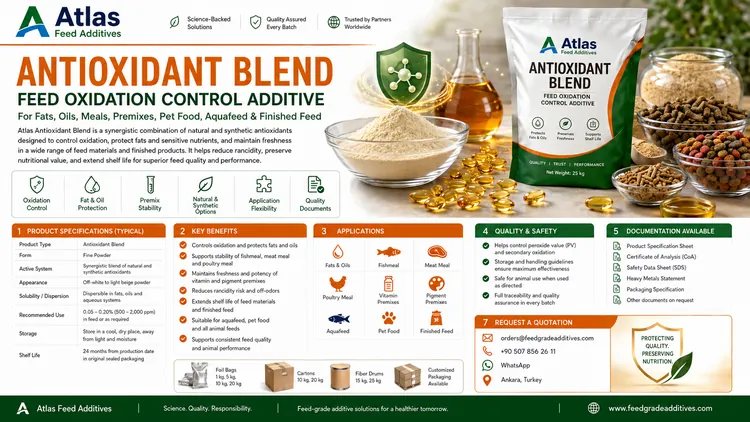
Antioxidant Blend feed additive visual

Product role

Where Antioxidant Blend fits

Antioxidant Blend is part of the antioxidants group and is typically treated as a technological feed additive. It is evaluated when feed mills, premix producers, rendering plants, oil suppliers, distributors, integrators, aquafeed manufacturers, and pet food producers need a documented solution for oxidation control in feed ingredients and finished products.

Oxidation risk is especially important in materials that contain unsaturated fats, residual oil, fish oil, poultry fat, vegetable oils, animal meals, fishmeal, full-fat oilseeds, premixes with fat-soluble vitamins, pigment preparations, palatants, and long-distance export shipments. The correct antioxidant system depends on substrate type, fat level, moisture, storage time, temperature, exposure to air, metal contamination, application method, and destination-market rules.

Antioxidant Blend should not be evaluated by name alone. Two offers can differ significantly in active system, total active concentration, individual active levels, carrier, liquid or dry form, solubility, dose guidance, legal status, packaging, shelf life, safety handling, and total cost-in-use.

Atlas Feed Additives can coordinate international supplier options for buyers that need consistent feed-grade material, clear active declarations, practical document review, application guidance, export-focused service, and quotation support from Ankara, Turkey.

Functional objectives

Why antioxidant blends are used in feed production

Oxidation control

Antioxidant blends are used to help slow oxidative deterioration in fat-containing raw materials and finished feeds. The objective is to reduce rancidity risk and support more consistent feed quality during production, storage, transport, and use.

Fat and oil stabilization

Oils, poultry fat, tallow, fish oil, and blended fat sources can be sensitive to oxygen, heat, metal ions, and storage time. A suitable antioxidant system should be matched to the oil type, dose, temperature, and application method.

Meal protection

Fishmeal, meat meal, poultry meal, feather meal, blood meal, and other rendered ingredients may contain residual fat that can oxidize during storage and shipping. Antioxidant treatment can be part of a broader receiving and quality-control program.

Premix and vitamin support

Premixes often contain sensitive vitamins, pigments, oils, carriers, and trace minerals. Antioxidant systems can help protect fat-soluble components and reduce quality drift during storage.

Finished feed freshness

Finished feed may be stored under heat, humidity, and oxygen exposure before consumption. Antioxidant selection should consider feed type, fat content, storage period, packaging, and farm conditions.

Export and logistics stability

Long-distance shipments, container heat, port delays, and extended warehousing increase oxidation-control needs. Buyers should review shelf-life, packaging, treatment point, and storage conditions before shipment.

Oxidation pathway

Where antioxidant control is usually needed

Feed oxidation is not a single event. It is a chain of quality changes influenced by raw-material condition, oxygen exposure, heat, light, metal ions, moisture, time, and processing. An antioxidant program should be designed around the full handling chain, not only the point where the additive is purchased.

Raw material condition Processing exposure Storage conditions Transport time Finished feed use

The most effective program combines suitable antioxidant chemistry, correct dose, good application coverage, clean storage, oxygen control where possible, and routine quality monitoring.

Typical applications

Where buyers commonly consider Antioxidant Blend

  • Fat, oil, fish oil, poultry fat, tallow, and vegetable oil stabilization.
  • Fishmeal, meat meal, poultry meal, blood meal, feather meal, and rendered raw-material protection.
  • Vitamin premixes, mineral premixes, pigment premixes, palatant systems, and functional additive concentrates.
  • High-fat poultry, swine, ruminant, pet food, and aquaculture feeds.
  • Extruded feeds, pelleted feeds, mash feeds, crumbles, concentrates, and specialty feed products.
  • Long-distance feed ingredient logistics, export shipments, containerized transport, and extended warehousing.
  • Programs where peroxide value, anisidine value, TOTOX, free fatty acids, odor, color, vitamin retention, or nutrient stability must be monitored.

Antioxidant systems

Possible active systems and blend concepts

“Antioxidant Blend” is a functional sourcing concept rather than one universal formula. Buyers should always request the exact active system, total active concentration, individual active levels, assay method, carrier, application medium, dose range, authorized species, and destination-market status before comparing supplier offers.

Synthetic antioxidant systems

Depending on local authorization and supplier specification, commercial antioxidant systems may include BHT, BHA, TBHQ, propyl gallate, ethoxyquin where permitted, or other approved synthetic antioxidants. Buyers must confirm legal status and allowed use in the destination market.

Natural antioxidant systems

Some buyers request tocopherol-based, rosemary-based, plant-extract-based, ascorbyl-palmitate-based, or mixed natural antioxidant systems for specific feed, pet food, aquafeed, or customer-positioning requirements.

Synergist systems

Citric acid, ascorbyl palmitate, phosphates, chelators, or other synergists may be used in certain systems to support antioxidant function, especially where metal-catalyzed oxidation is a concern.

Liquid oil-soluble blends

Liquid antioxidant systems are often considered for direct dosing into fats, oils, fish oil, rendering streams, spray systems, or coating applications where dispersion in oil is required.

Dry carrier-based blends

Dry blends may be selected for premixes, meals, mash feed, concentrates, and dry feed additive systems where flowability, particle size, dusting, and mixing uniformity are important.

Customized substrate-specific blends

Some buyers need a blend designed around fishmeal, poultry fat, vitamin premix, pigment premix, aquafeed, pet food, or export logistics. The formulation should match the substrate and application method.

Regulatory note

Antioxidant authorizations can differ significantly by country, species, feed type, maximum use level, and active ingredient. Always confirm the legal status of each active component before purchase, import, label approval, or commercial use.

Application format

Choose the antioxidant form according to the substrate and equipment

Oil tank dosing

Oil-soluble antioxidant blends may be dosed into oil or fat tanks. Buyers should confirm solubility, mixing time, dose calculation, tank turnover, pump compatibility, and application temperature.

Rendering stream treatment

Rendering plants may apply antioxidant systems at hot-fat, meal, or finished-product stages. Timing, heat exposure, spray coverage, and retained-sample monitoring are important.

Dry meal treatment

Fishmeal, poultry meal, meat meal, and other dry materials may require carrier-based or sprayable systems. Application coverage and mixing uniformity are critical.

Premix inclusion

Dry antioxidants may be selected for vitamin, pigment, and additive premixes. Particle size, trace-mineral contact, moisture, and storage duration should be checked.

Finished feed addition

Feed mills may add antioxidant blends in mixers, coating systems, or oil lines. The application point should match where the oxidation risk is highest.

Pet food and palatant systems

Pet food producers may require antioxidant systems for fats, coatings, palatants, and high-fat kibble. Label review, sensory stability, and packaging control are especially important.

Correct product selection depends on the target material, active system, solubility, equipment, safety handling, legal status, and monitoring plan. The same antioxidant blend may not be suitable for every substrate.

Specification review

Key details to compare before selecting an Antioxidant Blend supplier

Price comparisons are meaningful only when active antioxidant system, assay basis, carrier, product form, solubility, application medium, packaging, origin, shelf-life, regulatory status, and documentation are aligned. Use the table below to structure supplier comparison and avoid comparing incomplete or non-equivalent offers.

Specification area What to request Why it matters
Product identity Trade name, technical name, feed-grade status, functional group, intended application, and active antioxidant list. Confirms that the offered product matches the buyer’s application and regulatory classification.
Active antioxidant system Declared active components, total active concentration, individual active levels, assay unit, and analytical method. Antioxidant blends should be compared by active system and cost-in-use, not only by price per kilogram.
Regulatory status Authorized markets, authorized species, maximum use levels, label wording, and any restricted or suspended active ingredients. Legal acceptability can differ by destination country, animal species, feed category, and customer requirement.
Application medium Oil, fat, fishmeal, rendered meal, premix, mash feed, pellet feed, aquafeed, pet food, palatant, or specialty feed application. The best antioxidant system depends on the substrate and how the product will be applied.
Physical form Liquid, powder, granule, coated form, carrier-based blend, density, viscosity where relevant, particle size, and flowability. Affects dosing accuracy, mixing, pumpability, spraying, handling, dusting, and feed mill application equipment.
Solubility and dispersibility Oil solubility, water dispersibility, carrier compatibility, premix compatibility, and application equipment requirements. Poor dispersion can reduce antioxidant coverage and lead to inconsistent protection.
Target substrate condition Initial peroxide value, anisidine value, acid value, moisture, fat level, age of material, and raw-material origin. Antioxidants help slow further oxidation but cannot fully restore heavily oxidized raw materials.
Dose guidance Recommended inclusion level, dose per metric ton, dose per oil weight, treatment point, re-treatment guidance, and maximum use guidance where relevant. Correct dosage depends on substrate risk, storage time, temperature, and regulatory limits.
Application method Direct oil dosing, spray application, mixer addition, premix dilution, rendering-stream treatment, post-pellet coating, or palatant addition. Application method influences coverage, efficacy, equipment needs, and practical cost-in-use.
Processing tolerance Heat exposure, pelleting, extrusion, drying, cooling, coating, liquid application temperature, and carry-through stability. Feed processing can reduce active levels or change antioxidant distribution if the product is not suited to the process.
Quality monitoring Peroxide value, anisidine value, TOTOX, free fatty acids, moisture, odor, color, vitamin retention, pigment stability, and sensory indicators where relevant. Monitoring helps confirm whether the antioxidant program is protecting the target material during storage and transport.
Microbiological quality Total plate count, yeast and mold, Salmonella status, Enterobacteriaceae limits, E. coli limits, and other relevant microbiological parameters. Supports feed safety and buyer quality programs, especially for imported additives and premix applications.
Contaminants Heavy metals, dioxins or PCBs where relevant, pesticide residues where relevant, solvent residues where relevant, residual impurities, and unwanted contaminants. Supports feed safety, export compliance, customer approval, and internal quality programs.
Stability Shelf-life, expiry date, retest date, storage temperature, humidity limits, light protection, oxidation protection, and opened-pack handling. Helps buyers protect active content during shipping, warehousing, and production use.
Packaging Net weight, drum, IBC, canister, bag, liner, pallet configuration, container loading estimate, label language, and batch coding. Affects logistics, warehouse control, handling safety, moisture protection, and traceability.
Documents Technical data sheet, product specification, COA, SDS, origin statement, batch details, allergen or GMO statement where relevant, and market-specific certificates. Allows importers and feed manufacturers to confirm compliance before purchase and shipment.

Buyer quality checklist

Questions to answer before ordering

  • What material will be protected: oil, fat, fishmeal, meat meal, premix, finished feed, palatant, pet food, or specialty product?
  • What is the exact active antioxidant system and total active concentration?
  • Is the product liquid, powder, granule, oil-soluble, water-dispersible, or carrier-based?
  • Which species, feed types, and destination markets are authorized for the active components?
  • What dose range is recommended for the target substrate and storage period?
  • Where will the product be applied: rendering line, oil tank, mixer, premix plant, coating system, or finished feed stage?
  • What are the baseline peroxide value, anisidine value, acid value, moisture, fat level, and sensory condition of the target material?
  • What documents are required for customs, registration, buyer approval, finished feed label review, and internal QA?

Oxidation risk factors

Why the same dose may perform differently

Antioxidant performance can vary between raw materials, feed mills, transport routes, climates, storage conditions, and application systems. Buyers should evaluate the selected specification under their own process conditions before full commercial adoption.

  • Unsaturated fat level and fatty acid profile.
  • Initial raw-material freshness and oxidation status.
  • Exposure to air, light, moisture, heat, and metal ions.
  • Storage temperature and storage duration.
  • Processing temperature, extrusion, pelleting, drying, and cooling conditions.
  • Application coverage and mixing uniformity.
  • Packaging type, headspace, sealing, and warehouse rotation.
  • Compatibility with vitamins, pigments, palatants, acids, minerals, enzymes, probiotics, and organic carriers.

Formulation considerations

Use Antioxidant Blend as part of a complete quality-control program

Antioxidant Blend should not be treated as a substitute for poor raw-material quality or unsuitable storage. It works best when paired with good receiving procedures, clean tanks and silos, proper temperature control, sealed packaging, first-expired-first-out inventory rotation, and routine quality monitoring.

For high-risk materials such as fish oil, poultry fat, fishmeal, meat meal, high-fat pet food, aquafeed, vitamin premix, and pigment premix, the buyer should confirm whether the antioxidant should be applied at the raw-material supplier, at receiving, during blending, before pelleting or extrusion, after drying, through oil coating, or at multiple points in the supply chain.

Important limitation

Antioxidants help slow additional oxidation, but they cannot reverse severe rancidity, remove off-odors, restore destroyed vitamins, or make unsafe raw materials suitable for feed. Incoming quality should always be checked before treatment.

Application examples

Practical use cases by material type

Fats and oils

Liquid antioxidant systems may be applied directly into oil tanks, fat lines, blending vessels, or spray systems. Buyers should confirm solubility, mixing time, pump compatibility, application temperature, and tank turnover.

Fishmeal and rendered meals

Dry or liquid systems may be considered for meal stabilization where residual fat, storage time, and export logistics increase oxidation risk. Application coverage and retained-sample monitoring are important.

Vitamin premixes

Antioxidant systems may be selected to help protect fat-soluble vitamins, pigments, carriers, and sensitive components during premix storage, especially when trace minerals or moisture are present.

Aquafeeds

Fish oil, marine meals, pigments, and high-energy formulas can increase oxidation sensitivity. Buyers should consider pelleting, extrusion, drying, cooling, oil-coating, and long farm storage conditions.

Pet food

High-fat kibble, palatants, coatings, treats, and shelf-stable products require careful antioxidant selection, label review, packaging control, odor monitoring, and sensory stability checks.

Finished compound feed

Antioxidant blends may be considered where feed is exposed to warm climates, long storage, high fat levels, or extended distribution channels before reaching the farm.

Oxidation-control program

How to manage freshness more consistently

Define the target material

Identify whether the product is protecting oil, fat, fishmeal, rendered meal, premix, coating liquid, finished feed, palatant, or a specialty feed product. Each substrate has different risk factors.

Measure baseline quality

Check peroxide value, anisidine value, TOTOX, free fatty acids, moisture, odor, color, and raw-material age where relevant before treatment decisions are made.

Select the active system

Choose synthetic, natural, synergist, liquid, or dry systems according to the substrate, legal status, customer requirement, storage risk, and application equipment.

Apply at the right point

Application may be most effective at oil production, rendering, receiving, mixing, premix production, coating, or packaging depending on where oxidation risk begins.

Verify coverage

Mixing, spraying, pump calibration, nozzle condition, dilution, carrier selection, and particle size can influence how evenly the antioxidant reaches the target material.

Monitor during storage

Use retained samples, warehouse records, temperature logs, sensory checks, and laboratory parameters to confirm whether the antioxidant program is performing as expected.

Compatibility review

How antioxidant blends may interact with other feed components

With vitamins

Antioxidants may help protect sensitive vitamins in premixes and finished feed, but compatibility should be reviewed when trace minerals, moisture, or long premix storage are present.

With pigments

Carotenoid pigments and colorant systems can be oxidation-sensitive. Antioxidants may be evaluated to support pigment stability in premixes and finished feed.

With fats and oils

Oil-soluble systems must disperse properly in the fat source. Poor mixing can leave untreated zones and reduce practical protection.

With minerals

Trace minerals and metal contamination can accelerate oxidation. Chelators or synergists may be considered where permitted and technically appropriate.

With organic acids

Acid systems, moisture, pH, and premix contact time may influence antioxidant stability. Compatibility should be reviewed before combining concentrated additives.

With enzymes and probiotics

Biological additives can be sensitive to storage environment and aggressive premix conditions. Contact time, moisture, carrier, and temperature should be reviewed.

Production and handling

Practical feed mill checkpoints

Receiving

Check supplier name, product name, active antioxidant system, batch number, manufacturing date, expiry or retest date, container condition, seal integrity, and match against purchase order and documents before unloading.

Sampling

Retain representative samples according to the buyer’s quality procedure. Identify samples with date, batch, supplier, product name, receiving reference, and sampler name so the material remains traceable.

Storage

Store closed packaging in a dry, clean, ventilated warehouse away from heat, direct sunlight, moisture, strong oxidizers, incompatible chemicals, pests, and strong odors. Follow supplier-specific storage instructions.

Dosing

Use calibrated pumps, scales, spray systems, or micro-dosing equipment. Verify dose per metric ton, dose per oil weight, dilution ratio, flow rate, and application point before production.

Mixing

Use a validated premix or dilution step when needed to improve distribution. Check mixer sequence, retention time, oil addition sequence, and batch records to reduce under- or over-treatment risk.

Traceability

Keep supplier documents, receiving records, batch usage, production lots, retained samples, and shipment records connected so finished feeds can be traced back to the antioxidant batch.

Equipment checks

For liquid systems, inspect pumps, hoses, filters, seals, spray nozzles, flow meters, and tank agitation. For dry systems, inspect dosing screws, hoppers, dust control, and carrier flow.

Operator safety

Review SDS guidance for ventilation, skin contact, eye protection, spill response, storage segregation, first aid, and personal protective equipment before handling concentrated blends.

Finished-product review

Check odor, color, feed appearance, retained samples, peroxide value, vitamin retention, pigment stability, and customer feedback to confirm whether the program is working.

Quality documents

Documents commonly requested by buyers

Technical data sheet

Explains active system, product form, target applications, dosage guidance, solubility, handling, storage, and positioning.

Product specification

Defines active concentration, appearance, carrier, density or particle size, moisture, quality limits, shelf-life, and recommended storage conditions.

Certificate of analysis

Confirms batch-specific results for active assay, appearance, moisture, density, microbiology, contaminants, or other agreed quality limits.

Safety data sheet

Provides handling, storage, transport, exposure, spill, first-aid, and safety information for warehouse and feed mill teams.

Origin and batch details

Supports import control, traceability, customer audits, registration review, and destination-market documentation.

Compliance statements

May include GMO, allergen, BSE/TSE, heavy metal, dioxin, pesticide, solvent residue, residual impurity, or other statements depending on buyer and market needs.

Stability information

May include shelf-life, active retention data, storage temperature, light protection, humidity protection, opened-package handling, and heat-exposure guidance.

Regulatory support

May include feed additive status, functional group, authorized species, maximum inclusion guidance, customs code suggestion, or label wording support where available.

Logistics documents

Commercial invoice, packing list, certificate of origin, bill of lading or airway bill, and any special import documents requested by the buyer.

Before commercial use

Internal approval questions

  1. Which raw material, premix, oil, fat, palatant, or finished feed will the antioxidant protect?
  2. What active antioxidant system is allowed in the destination market and customer program?
  3. Is the product suited for liquid dosing, dry mixing, spraying, oil coating, rendering treatment, or premix dilution?
  4. What baseline oxidation parameters are measured before treatment?
  5. What storage period, warehouse temperature, shipment route, and packaging system will the material face?
  6. Which lab parameters will be used to validate performance during storage?
  7. Does the supplier provide COA, SDS, TDS, specification, origin statement, and batch traceability?
  8. Has the buyer calculated cost-in-use based on active antioxidant level and recommended dose?

Procurement note

Ask for the active antioxidant system before comparing prices.

Two Antioxidant Blend offers can differ significantly in active composition, concentration, carrier, solubility, application medium, regulatory status, dose range, packaging, shelf-life, safety handling, and document package. For that reason, Atlas Feed Additives recommends comparing offers on a specification-aligned and cost-in-use basis rather than price per kilogram alone.

For sensitive antioxidant products, buyers should also review oxidized-substrate limits, storage conditions, heat exposure, opened-package handling, application equipment, batch coding, retained-sample procedure, and the legal status of each active component in the destination market.

Information to include in your RFQ

  • Product name: Antioxidant Blend
  • Target application: oil, fat, fishmeal, meat meal, premix, finished feed, pet food, palatant, or aquafeed
  • Required active antioxidant system or reference specification
  • Preferred form: liquid, powder, granule, oil-soluble, water-dispersible, or carrier-based
  • Target dose range or current treatment rate
  • Baseline peroxide value, anisidine value, acid value, TOTOX, moisture, or other quality data if available
  • Processing method and application point
  • Trial quantity, monthly demand, or annual forecast
  • Destination country and preferred Incoterms
  • Packaging preference: drum, IBC, canister, bag, carton, or pallet format
  • Required documents and certificate format
  • Target delivery date and preferred shipment method
Send RFQ details

Cost-in-use

Compare active protection value, not only invoice price

The commercial value of Antioxidant Blend depends on active system, dose, substrate risk, application coverage, legal status, storage duration, process exposure, quality monitoring, and packaging. A lower price per kilogram may not reduce total feed cost if active content is lower, dose requirement is higher, or application coverage is weaker.

  • Compare active antioxidant supplied per kilogram of product.
  • Confirm whether active concentration is guaranteed at production, shipment, or expiry.
  • Calculate dose per metric ton of feed or per metric ton of oil/fat.
  • Include freight, duties, document fees, packaging, storage, equipment, and shelf-life risk.
  • Evaluate the cost of rancidity, vitamin loss, pigment loss, off-odor, customer complaints, and rejected material.

Practical cost-in-use formulas

Cost per metric ton of finished feed = antioxidant price per kg × inclusion kg per metric ton of feed.

Cost per metric ton of oil or fat = antioxidant price per kg × treatment kg per metric ton of oil or fat.

Cost per active unit = product price ÷ declared active antioxidant supplied.

Use these calculations only after confirming that compared products have similar active systems, legal status, assay method, stability, dose guidance, and document package.

Commercial fit

Who usually requests Antioxidant Blend?

Feed mills

For finished feed, high-fat formulas, stored feed, and feed lines where freshness, odor control, nutrient value, and shelf-life expectations must be managed.

Premix producers

For vitamin, pigment, mineral, and functional additive premixes where sensitive ingredients need protection during storage and distribution.

Rendering plants

For fishmeal, meat meal, poultry meal, feather meal, blood meal, and fat streams where oxidation control is important before shipment or long-term storage.

Oil and fat suppliers

For poultry fat, tallow, fish oil, vegetable oils, and blended fat products that require stabilization before delivery to feed manufacturers.

Pet food producers

For high-fat kibble, palatants, coatings, treats, and shelf-stable products where flavor, odor, label acceptance, and consumer quality perception are important.

Distributors and importers

For market-ready antioxidant sourcing with supplier coordination, regulatory review, document collection, packaging options, and export-focused support.

Responsible positioning

Use clear and compliant claim language

Because antioxidant feed additives may be regulated differently across countries, claim language should be reviewed before labels, brochures, product pages, and technical sheets are finalized. Antioxidant Blend should be presented through supported technological benefits rather than unsupported therapeutic or animal-performance claims.

  • Use “helps control oxidation” when the product is positioned for fats, oils, meals, premixes, or finished feed.
  • Use “supports freshness during storage” when supported by supplier data and buyer validation.
  • Use “helps protect sensitive nutrients” only where the product and application data support that positioning.
  • Use “technological feed additive” when appropriate under the destination market’s classification system.
  • Avoid disease, growth, immunity, treatment, veterinary, or guaranteed performance claims unless independently authorized and documented.
Regulatory reminder

Atlas Feed Additives can help organize supplier documents and quotation details, but buyers remain responsible for confirming registration, import permission, feed-label rules, antioxidant authorization status, maximum inclusion levels, safety handling requirements, and allowed claims in the destination market before purchase or commercial use.

Handling and storage

Protect antioxidant activity and operator safety through correct storage.

Antioxidant blends can be affected by heat, moisture, direct sunlight, oxygen exposure, damaged containers, incompatible chemicals, and long storage. Some liquid or concentrated systems may also require special attention to ventilation, spill control, PPE, storage segregation, and container compatibility.

Opened packaging should be resealed tightly and used according to supplier guidance and internal quality procedures. For liquid systems, tanks, pumps, caps, hoses, seals, and dosing lines should be inspected regularly to prevent leaks, dosing errors, or contamination.

Storage checklist
  • Keep in original sealed packaging.
  • Store in a clean, dry, cool, ventilated warehouse.
  • Protect from heat, direct sunlight, moisture, and incompatible materials.
  • Segregate from strong oxidizers or chemicals where required by the SDS.
  • Use first-expired, first-out inventory rotation.
  • Check container integrity, labels, seals, and batch coding before use.
  • Record batch number and usage in finished-feed production.

Risk management

Common mistakes in antioxidant sourcing

Comparing only price per kilogram

Price per kilogram can be misleading when active systems, concentration, dose range, application coverage, and legal status differ between products.

Ignoring baseline oxidation

Antioxidants cannot restore badly oxidized raw materials. Incoming peroxide value, anisidine value, odor, and raw-material age should be reviewed before treatment.

Using the wrong application point

Adding antioxidant too late in the supply chain may reduce practical value if oxidation has already advanced during raw-material storage or transport.

Skipping regulatory review

Active components may be approved, restricted, or not accepted depending on country, species, feed type, and customer standard.

Poor application coverage

Incorrect spraying, mixing, pump calibration, dilution, or particle distribution can leave part of the material under-protected.

Buying too much stock

Large inventory may lose value if shelf life is short, warehouse conditions are poor, or active content declines before use.

Implementation plan

Suggested steps from sample to commercial order

  1. Define the oxidation challenge. Identify the material, fat level, storage time, packaging, shipment route, climate, current quality issue, and expected shelf-life target.
  2. Review baseline data. Check peroxide value, anisidine value, TOTOX, free fatty acids, moisture, odor, color, raw-material age, and retained samples where available.
  3. Select the active system. Match synthetic, natural, synergist, liquid, or dry antioxidant systems to the substrate, customer standard, and destination-market rules.
  4. Confirm application method. Decide whether the product will be applied in oil, rendering, mixing, premix production, coating, palatant preparation, or finished feed handling.
  5. Request documents. Collect technical data sheet, product specification, COA, SDS, origin statement, shelf-life, storage guidance, handling guidance, and market-specific certificates.
  6. Run a controlled trial. Use a defined dose, application point, batch records, retained samples, sensory review, and laboratory monitoring so the buyer can evaluate cost-in-use objectively.
  7. Approve commercial specification. Finalize active system, dose, packaging, document set, label wording, supplier quality expectations, shipment terms, and reorder plan.

Questions

Useful answers

What is Antioxidant Blend used for in animal nutrition?

Antioxidant Blend helps control oxidation in fats, oils, rendered meals, fishmeal, premixes, concentrates, raw materials, pet food, aquafeed, and finished feed. It is used to support freshness, reduce rancidity risk, and protect sensitive feed components during storage and transport.

Is Antioxidant Blend one fixed specification?

No. It is a functional product concept. Commercial offers can differ by active antioxidant system, concentration, carrier, liquid or dry form, solubility, dose guidance, regulatory status, packaging, origin, shelf-life, and documentation. Always request the exact supplier specification before comparing offers.

Which active antioxidants may be included?

Depending on supplier specification and destination-market authorization, antioxidant systems may include BHT, BHA, TBHQ, propyl gallate, tocopherols, rosemary extract, ascorbyl palmitate, citric acid, chelators, synergists, or other approved components. Buyers must confirm legal status before purchase and use.

Can antioxidants restore rancid oil or spoiled feed?

No. Antioxidants help slow further oxidation but cannot reverse severe rancidity, remove off-odors, restore destroyed nutrients, or make unsafe raw materials suitable for feed. Incoming quality should be checked before treatment.

How should buyers compare Antioxidant Blend prices?

Buyers should compare offers by active antioxidant system, active concentration, dose range, application medium, regulatory status, storage stability, packaging, document package, and cost-in-use. Price per kilogram alone can be misleading when active levels and dosage differ.

What quality parameters are useful for oxidation monitoring?

Common monitoring points may include peroxide value, anisidine value, TOTOX, free fatty acids, moisture, odor, color, vitamin retention, pigment stability, sensory condition, and retained-sample comparison. The exact test plan depends on the material and buyer quality system.

Can Antioxidant Blend be used in premixes?

Yes, a suitable dry or carrier-based antioxidant system may be considered for vitamin premixes, pigment premixes, mineral premixes, and functional additive concentrates. Buyers should confirm particle size, mixing uniformity, compatibility, moisture limits, and trace-mineral interactions.

Can Antioxidant Blend be used in aquafeed?

It may be considered in aquafeed programs where fish oil, marine meals, pigments, and high-energy formulas increase oxidation sensitivity. Buyers should confirm compatibility with extrusion, drying, cooling, coating, and destination-market rules.

Can Antioxidant Blend be used in pet food?

It may be considered for pet food fats, palatants, coatings, high-fat kibble, treats, and long-shelf-life products. Buyers should review active-system authorization, label acceptability, sensory stability, packaging, and customer requirements.

What quality documents should buyers request for Antioxidant Blend?

Common documents include technical data sheet, product specification, certificate of analysis, safety data sheet, active antioxidant declaration, origin information, batch number, manufacturing date, expiry or retest date, storage conditions, contaminant statements, and market-specific certificates required by the buyer.

What information is needed for a quotation?

Send the target application, substrate type, desired active system, preferred form, target dose, quantity, destination country, delivery term, packaging preference, and required documents so Atlas Feed Additives can review suitable supplier options.

Can Atlas Feed Additives quote Antioxidant Blend?

Yes. Send your required specification, quantity, destination, packaging preference, and documents so Atlas Feed Additives can review suitable supplier options for Antioxidant Blend.

Request a quotation

Tell us what you need

Send your product list, target specification, destination country, packaging preference, and required documents. Our team will review your request and respond from orders@feedgradeadditives.com.

For faster review, include target application, active antioxidant system, substrate type, preferred product form, dose range, baseline oxidation data if available, quantity, preferred Incoterms, destination port, packaging preference, shipment timing, and required certificate format.