Preservatives and mold control

Grain Preservative Blend

Grain Preservative Blend is a feed-grade mold-control and storage-support additive used to help protect grains, oilseed meals, by-products, compound feeds, concentrates and finished feeds from quality losses linked to moisture, mold pressure, heat, transport and storage conditions.

  • Preservative and mold-control support
  • Liquid or dry blend options
  • Organic acid and propionate systems
  • Grain, raw material and finished-feed applications
  • Specification-led sourcing support
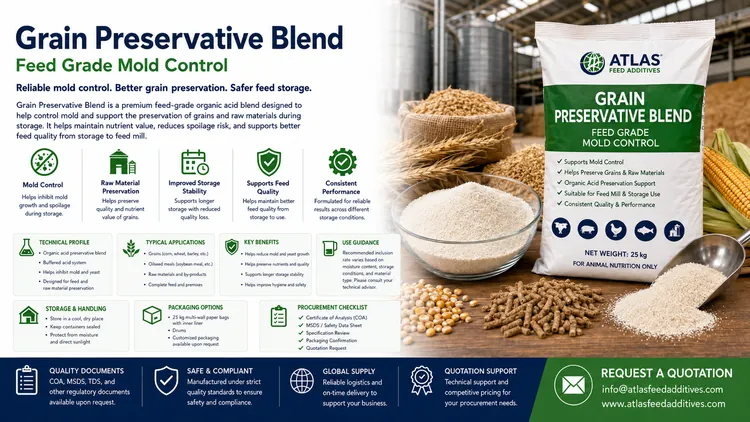
Grain Preservative Blend feed additive visual
Product type Feed preservative and mold-control blend
Common active systems Organic acids, propionates and buffered blends
Typical form Liquid, buffered liquid, dry powder or carrier blend
Supply model Global sourcing and quotation support

Product role

Where Grain Preservative Blend fits in feed and grain programs

Grain Preservative Blend is part of the preservatives and mold control group. It is used by feed mills, grain handlers, premix producers and integrators where raw materials or finished feeds face moisture, mold, heating, spoilage and storage-quality pressure.

Unlike a single organic acid product, a preservative blend may combine acids, acid salts, buffered acid systems, carriers, application aids and flow-support components. The exact composition should always be confirmed on the specification, safety data sheet, label and certificate of analysis.

In practical feed operations, this product is evaluated by active acid content, neutralized acid equivalent, pH, density, carrier system, corrosivity, odor, handling safety, application method, storage challenge, grain moisture, storage duration, expected temperature, mold count, mycotoxin risk, equipment compatibility and destination-market rules.

Atlas Feed Additives can coordinate international supplier options for feed mills, grain storage operators, premix producers, distributors, integrators, livestock companies, aquaculture feed producers, pet food manufacturers and importers that require consistent Grain Preservative Blend with clear quality documentation.

Technical overview

Typical technical profile buyers request

Final values must always follow the manufacturer specification, certificate of analysis, product label, safety data sheet and destination-market requirements. The table below is a practical procurement guide for common Grain Preservative Blend requests.

Product name Grain Preservative Blend, mold inhibitor blend, feed preservative blend, organic acid preservative, buffered propionic acid blend, dry grain preservative, or liquid feed preservative depending on supplier and target use.
Functional class Technological feed additive used for mold control, storage-quality support, feed preservation, raw-material risk management and shelf-life support where permitted by local rules.
Common active ingredients Supplier formulas may include propionic acid, ammonium propionate, calcium propionate, sodium propionate, formic acid, acetic acid, sorbic acid, potassium sorbate, benzoic acid, sodium benzoate, citric acid, lactic acid, carriers, surfactants, buffers or application aids.
Liquid versus dry form Liquid products may offer fast distribution with spray systems but require corrosion and handling review. Dry products may be easier for premix dosing and bagged handling but depend on carrier uniformity, dust level, particle size and active distribution.
Active content Buyers should request active acid content, neutralized acid equivalent, total organic acid content, salt content, carrier percentage and assay method. Price comparison is meaningful only when active content and application rate are aligned.
Dose guidance Recommended dose depends on moisture, mold pressure, raw-material type, storage duration, ambient temperature, aeration, application uniformity, hygiene status and product concentration. Supplier guidance and buyer quality procedures should be followed.
Target materials Corn, wheat, barley, sorghum, rice by-products, soybean meal, sunflower meal, rapeseed meal, DDGS, corn gluten feed, complete feed, premixes, concentrates, mash feed, pellets and bagged feed may require different application rates and process checks.
Moisture challenge Moisture is one of the most important factors in mold growth and feed spoilage risk. Buyers should define measured grain moisture, expected storage time, storage temperature and whether the product is for short-term holding, transport or longer storage.
Physical profile Liquid products are typically reviewed by density, pH, viscosity, color, odor, freezing point, corrosion profile and pumpability. Dry products are reviewed by particle size, bulk density, dust level, carrier, flowability, moisture and uniformity.
Application compatibility Application may require spray bars, nozzles, pumps, ribbon mixers, paddle mixers, screw conveyors, liquid dosing systems, dry micro-dosing systems, post-pellet application or grain conveyor treatment. Equipment compatibility should be confirmed before purchase.
Handling and corrosion Organic acid products may be corrosive or irritating depending on concentration and buffering. Buyers should request SDS, pH, corrosion guidance, compatible pump and storage-tank materials, PPE requirements and spill procedures.
Packaging Common packaging may include 20 kg or 25 kg bags, drums, IBC tanks, jerrycans, totes, lined bags, big bags, palletized shipments or bulk tank supply depending on liquid or dry form, active concentration and destination requirements.
Shelf life Use the manufacturer shelf-life statement. Store under dry, cool, clean, secure and ventilated conditions according to the supplier label and safety data sheet. Protect dry products from moisture and liquid products from unsuitable tank materials or leakage.
Regulatory status Use must comply with feed additive rules, preservative authorization, import rules, labeling rules, claims restrictions, worker-safety rules and species-specific requirements in the destination market.

Feed and grain applications

Where grain handlers and feed mills evaluate preservative blends

Grain and raw-material storage

Grain Preservative Blend may be evaluated where raw materials are exposed to moisture, heat, delayed drying, long transport, humid storage, silo condensation, harvest variation or mixed-origin supply chains.

  • Corn, wheat, barley, sorghum, oats, rice by-products and grain screenings
  • Oilseed meals such as soybean meal, sunflower meal, rapeseed meal, cottonseed meal and peanut meal
  • By-products such as DDGS, corn gluten feed, bran, bakery meal and variable-moisture ingredients
  • Short-term holding before drying, blending, milling or feed manufacture
  • Storage programs in tropical, humid, rainy or high-temperature regions
  • Use with grain testing, aeration, drying, cleaning, segregation and storage hygiene programs

Compound feed and finished feed

Finished feeds may require mold-control support when formulas contain moisture-sensitive ingredients, molasses, fats, by-products, high fiber, high protein meals, liquid additions or are stored and transported under humid conditions.

  • Mash, pellet, crumble and concentrate feed applications
  • Poultry, swine, dairy, beef, sheep, goat, aquaculture and pet food feeds where permitted
  • Finished feed storage in bags, silos, bins, trucks, containers and distributor warehouses
  • High-risk feed formulas containing liquid additions, molasses, fat, whey, by-products or variable moisture
  • Post-pellet liquid application or dry inclusion depending on product type
  • Finished-product label, odor, palatability, corrosion and worker-safety review

Feed mill and logistics programs

Preservative blends are most effective when used as part of a complete feed safety and storage management program, not as a substitute for poor raw-material quality or poor warehouse hygiene.

  • Receiving inspections for moisture, mold, odor, temperature, insects and caking
  • Silo, bin, warehouse and transport risk-management programs
  • Application-system calibration for pumps, nozzles, conveyors and mixers
  • Batch records showing product, dose, raw material, date, lot and operator
  • Compatibility checks with acids, enzymes, probiotics, vitamins, minerals, medications and equipment materials
  • Quality systems combining preservation, mycotoxin monitoring, supplier approval and storage hygiene
Storage note: Grain Preservative Blend should be used as part of a complete storage-quality program. It does not replace proper drying, cleaning, aeration, silo hygiene, moisture testing, mycotoxin testing, pest control, safe handling or regulatory compliance.

Formulation value

Why active content and application uniformity matter before price comparison

Grain Preservative Blend purchasing decisions should not be based only on price per kilogram or price per liter. A meaningful comparison reviews active acid content, buffered acid equivalent, carrier system, density, pH, recommended dose, moisture challenge, mold pressure, application equipment, corrosion profile, odor, packaging, safety handling and required documents.

Two products with similar names may behave differently if one is a concentrated liquid acid blend, one is buffered for safer handling, one is a dry carrier-based powder, and another is a low-active premix. The effective cost should be compared by dose per metric ton of treated feed or grain and by active content delivered under the actual storage challenge.

  • Supports mold-control and feed-quality programs across raw materials and finished feeds
  • Useful in humid, tropical, rainy, long-transport or variable-moisture supply chains
  • Requires comparison by active acid equivalent and recommended treatment rate
  • Application uniformity is critical for both liquid and dry products
  • May affect odor, palatability, corrosion, handling safety and equipment compatibility
  • Should be used together with moisture testing, drying, aeration, cleaning and storage hygiene
  • Must comply with destination-market feed additive regulations and buyer specifications

Practical process checks

Questions for the feed mill and quality team

  • Which raw material is being protected? Corn, wheat, barley, DDGS, oilseed meals, compound feed and finished feed may require different active systems and application rates.
  • What is the moisture and storage challenge? Record measured moisture, temperature, storage duration, mold count, warehouse condition, silo condition and whether aeration or drying is available.
  • How will the product be applied? Confirm whether the system uses liquid spray, dry dosing, mixer inclusion, conveyor treatment, grain intake application, post-pellet spray or premix blending.
  • Which safety and equipment controls are needed? Review PPE, ventilation, corrosion-resistant materials, tank compatibility, pump compatibility, nozzle maintenance, spill control and worker training.

Quality assurance

Buyer quality checklist for Grain Preservative Blend

A clear purchasing file helps reduce risk during supplier approval, import clearance, feed registration, warehouse receiving, feed mill dosing and finished-feed declaration. Atlas Feed Additives can help buyers request the right documents before comparing offers.

Identity and active profile

  • Product specification sheet
  • Certificate of analysis for each batch
  • Full active ingredient declaration
  • Total organic acid content or neutralized acid equivalent
  • Individual acid or salt content where required
  • Assay method and batch result
  • Carrier, buffer, surfactant or application-aid declaration
  • Liquid density, pH, viscosity or dry bulk density as applicable
  • Confirmation that the product matches the buyer's liquid, dry, buffered or carrier-based requirement

Application and performance

  • Recommended dose by moisture challenge
  • Raw-material and finished-feed application guidance
  • Application-system guidance for spray, pump, mixer or dry dosing use
  • Uniformity, dispersion or carrier distribution information where available
  • Odor and palatability guidance
  • Corrosion and equipment compatibility information
  • Storage-duration guidance under typical conditions
  • Compatibility with enzymes, probiotics, vitamins, minerals, medications, acids and mycotoxin binders

Safety parameters

  • Safety data sheet
  • Hazard classification and transport classification where applicable
  • PPE and occupational handling guidance
  • Spill, neutralization and disposal guidance
  • Heavy metals and contaminants where required
  • Microbiological status for dry carrier-based products where required
  • Dioxins, PCBs, residual solvents or other contaminants if market requires
  • GMO, allergen, animal-origin, BSE/TSE and irradiation statements when requested

Traceability and market documents

  • Batch or lot number
  • Manufacturing date
  • Expiry or retest date
  • Country of origin
  • Manufacturer or approved supplier information
  • Packaging label copy
  • Free-sale, health, veterinary, Halal, Kosher, GMO, BSE/TSE, origin or registration documents if required
  • Legalized, apostilled or chamber-stamped documents if required by the destination country

Storage and handling

Protect product performance and worker safety

Grain Preservative Blend products should be handled according to their form and acid concentration. Liquid acid blends, buffered liquids and dry carrier-based products may require different storage, PPE, corrosion, ventilation and spill-control procedures.

  • Store in original, closed, clearly labeled packaging in a clean, dry, secure and ventilated area
  • Protect dry products from moisture, condensation, caking, broken bags and contamination
  • Protect liquid products from leaks, incompatible tanks, freezing, overheating and direct sunlight according to label guidance
  • Use corrosion-compatible pumps, seals, hoses, nozzles, tanks and fittings when handling acid blends
  • Keep away from non-feed chemicals, strong oxidizers, incompatible materials, fuels, pesticides and cleaning products
  • Control odor and vapor exposure through ventilation and trained handling
  • Use appropriate PPE stated in the safety data sheet
  • Apply first-in, first-out stock rotation based on manufacturing date, expiry date or retest date
  • Follow the supplier label, safety data sheet and local occupational safety procedures

Procurement note

Ask for the right specification before comparing prices.

Price comparisons are meaningful only when active ingredient declaration, active acid equivalent, product form, carrier, pH, density, dose recommendation, corrosivity, packaging, origin, documentation, Incoterm, delivery schedule, payment terms and supplier approval status are aligned.

For sensitive or regulated markets, confirm feed preservative authorization, import registration, label language, certificate format, transport classification, worker-safety requirements and whether the manufacturer or exporter must appear on official documents.

  • Define the preservation challenge. State the raw material, moisture range, expected storage duration, temperature, mold pressure, bag or silo storage and transport conditions.
  • Confirm active equivalence. Compare active acid content, buffered acid equivalent, application rate and cost per treated metric ton before comparing price.
  • Review application compatibility. Ask whether the product is suitable for your spray system, dry dosing system, mixer, conveyor, silo, pellet mill or finished-feed application.
  • Check documentation before ordering. Review COA, SDS, specification, label, origin, shelf life, active declaration, transport classification, corrosion guidance and destination-market certificates before shipment.

Quotation preparation

Information to send for a faster quotation

The more complete the request, the faster Atlas Feed Additives can compare suitable supplier options and avoid mismatched offers.

Commercial details

  • Required quantity and shipment frequency
  • Sample request, trial order, pallet quantity, drum quantity, IBC quantity, FCL or annual contract volume
  • Destination country, port or delivery address
  • Preferred Incoterm such as EXW, FCA, FOB, CFR, CIF, CPT or DAP
  • Target shipment date and delivery deadline
  • Payment preference and banking requirements

Technical details

  • Required liquid or dry preservative form
  • Preferred active system such as propionic acid, propionates, sorbates, benzoates or buffered acids
  • Target raw material and measured moisture range
  • Expected storage duration, climate and application method
  • Packaging format, pallet requirements and label requirements
  • Any internal specification or buyer standard
  • Equipment compatibility, corrosion limits or transport classification requirements

Document details

  • COA and SDS requirements
  • Import registration documents
  • Health, veterinary, free-sale or official certificates if required
  • Halal, Kosher, GMO, BSE/TSE, animal-origin, allergen or origin statements
  • Active ingredient declaration, transport classification, corrosion statement or application guidance if required
  • Label language, legalization, apostille or chamber-stamp requirements

Questions

Useful answers

What is Grain Preservative Blend used for in animal nutrition?

Grain Preservative Blend helps protect grains, raw materials, by-products and finished feeds from quality losses linked to moisture, mold, heating and storage pressure. It should be used according to the raw material, moisture challenge, storage objective, application method and applicable market rules.

Which active ingredients are common in grain preservative blends?

Formulations vary by supplier and market. Common systems may include propionic acid, ammonium propionate, calcium propionate, sodium propionate, formic acid, acetic acid, sorbic acid, potassium sorbate, benzoic acid, sodium benzoate, citric acid, lactic acid, buffers, carriers or application aids.

Is a liquid or dry preservative better?

Neither form is automatically better. Liquid products may distribute quickly through spray systems but require pump, tank, nozzle, corrosion and worker-safety review. Dry products may be convenient for premix or bagged feed use but depend on carrier uniformity, particle size, dust level and mixing quality.

How is dose level selected?

Dose depends on grain moisture, temperature, storage duration, mold pressure, raw-material type, application uniformity, weather, aeration, storage hygiene and product concentration. Buyers should follow supplier guidance, local rules and their own quality-team decisions based on measured conditions.

Can Grain Preservative Blend replace drying?

No. Preservative blends can support storage programs, but they do not replace proper drying, cleaning, aeration, silo hygiene, pest control, moisture testing, mold monitoring, mycotoxin testing or safe raw-material management.

Can Grain Preservative Blend be used in finished feed?

Yes, where permitted and technically suitable. Finished-feed use should review application method, dose, odor, palatability, label requirements, worker safety, compatibility with vitamins, enzymes, probiotics, minerals, medications and the expected storage conditions.

Can Atlas Feed Additives quote Grain Preservative Blend?

Yes. Send your target raw material, measured moisture range, preferred liquid or dry form, active system, quantity, destination, packaging preference, application method, shipment timing and required documents so Atlas Feed Additives can review suitable supplier options.

What quality documents should buyers request for Grain Preservative Blend?

Common documents include specification, certificate of analysis, safety data sheet, active ingredient declaration, origin information, density or assay data, carrier declaration, batch details, shelf-life statement, corrosion or handling guidance, label copy and any market-specific certificates required by the buyer.

How should Grain Preservative Blend be stored?

Store according to the supplier label and SDS. Dry products should be protected from moisture, caking and contamination. Liquid acid products should be stored in compatible containers with leak control, ventilation, PPE and corrosion-safe equipment.

What should be checked before comparing two preservative blend offers?

Compare active ingredient declaration, active acid equivalent, product form, recommended dose, liquid density, pH, dry carrier, corrosion profile, application method, packaging, safety classification, shelf life, origin, documents, Incoterm, freight route and whether the product is accepted in the destination market.

Request a quotation

Tell us what you need

Send your product list, target specification, destination country, packaging preference, shipment timing and required documents. Our team will review your request and respond from orders@feedgradeadditives.com.

Product: Grain Preservative Blend, liquid mold inhibitor, dry preservative blend, buffered organic acid blend, propionate-based preservative or your required specification
Application: state raw material, moisture range, storage duration, climate, application method, dose target and equipment type
Quantity: sample request, trial order, pallet quantity, drum quantity, IBC quantity, FCL or annual contract volume
Delivery: destination port, warehouse or preferred Incoterm
Documents: COA, SDS, active declaration, origin, health certificate, Halal, Kosher, GMO statement, BSE/TSE statement, corrosion guidance, transport classification or registration file