Organic acids and acidifiers

Ammonium Propionate

Feed-grade ammonium propionate sourcing for preservation, mold-control programs, pH management, feed hygiene, grain protection, liquid feed systems, raw-material storage, and organic acidifier blends where active concentration, handling safety, cost-in-use, and documentation must be aligned before purchase.

Feed preservation Mold-control support pH management Grain protection Liquid & dry forms Cost-in-use review COA / SDS / TDS Export support
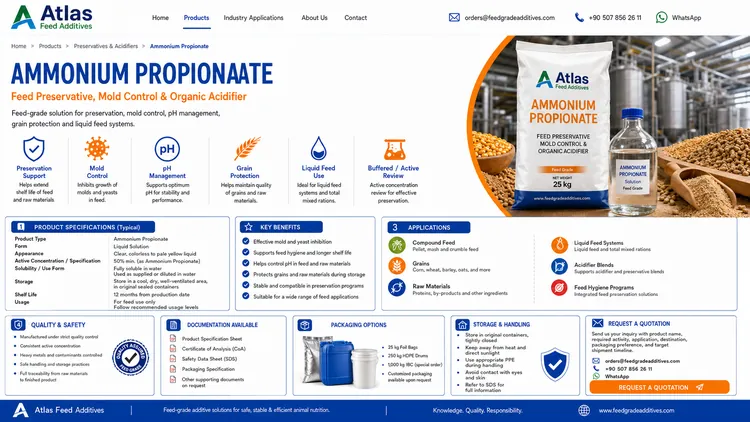
Ammonium Propionate feed additive visual

Product role

Where Ammonium Propionate fits in feed manufacturing

Ammonium Propionate is a propionate-based material in the organic acids and acidifiers category. It is typically evaluated by feed mills, premix producers, grain handlers, integrators, liquid feed producers, importers, and distributors that need a preservative or acidifier component for feed hygiene, mold-control support, pH management, or raw-material protection.

In commercial sourcing, “Ammonium Propionate” may refer to different supplier formats: a liquid solution, dry carrier-based product, buffered preparation, coated acidifier, treated preservative blend, or multi-acid system. Each format can differ in active concentration, equivalent propionic acid value, pH, density, odor, corrosivity, application behavior, and regulatory status.

The value of the product is not defined by the name alone. Buyers should review active contribution, feed type, storage conditions, dose guidance, application equipment, operator safety, packaging, shelf-life, destination-market authorization, and document completeness before comparing offers.

Atlas Feed Additives supports buyers with supplier coordination, specification comparison, export-oriented document review, packaging discussions, logistics planning, and quotation preparation from Ankara, Turkey.

Chemical and commercial identity

Understand the name before comparing offers

Ammonium Propionate is commonly described as the ammonium salt of propionic acid. In feed procurement, however, buyers usually purchase a commercial product rather than a pure laboratory reference material. That commercial product may be standardized, diluted, buffered, carried on a mineral or organic carrier, coated, or blended with other organic acids.

For that reason, a supplier quotation should always identify the exact active concentration, equivalent propionic acid contribution, physical form, free acid level, ammonium balance, pH, density or bulk density, and the intended feed application.

Identity points to verify

  • Chemical name: Ammonium propionate / ammonium propanoate.
  • General formula reference: C3H9NO2 or NH4(C2H5COO), subject to commercial form.
  • Functional basis: Propionate contribution from a propionic acid salt system.
  • Commercial reality: The sold product may be a solution, blend, coated product, or carrier-based preparation.
  • Buyer action: Compare assay and active contribution before price.

Functional objectives

Why Ammonium Propionate is used in feed programs

Feed preservation support

Ammonium Propionate may be selected where moisture, temperature, storage period, ingredient age, and mold pressure create preservation risk. The practical result depends on dose, coverage, starting quality, warehouse hygiene, and stock rotation.

Mold-control programs

Propionate systems are commonly evaluated in grains, raw materials, and finished feed where mold development must be managed. Buyers should confirm supplier dose guidance, moisture range, application method, and local authorization.

pH management

As part of an organic acidifier strategy, Ammonium Propionate can contribute to pH management in feed or liquid systems where permitted. The effect depends on active concentration, buffering, feed matrix, water quality, and inclusion level.

Grain and raw-material protection

Grain treatment programs may use propionate-based systems to support storage stability in corn, wheat, barley, sorghum, soybean meal, by-products, and other raw materials that face warm or humid storage conditions.

Liquid feed compatibility

Liquid forms can be considered for liquid feed, molasses-based systems, or spray application. Buyers should verify dilution ratio, pH target, viscosity, freezing risk, pump compatibility, tank material, and worker safety.

Buffered acid handling

Buffered or neutralized systems may reduce some handling challenges compared with stronger free-acid products, but corrosion, odor, vapor, ventilation, PPE, and storage compatibility must still be reviewed carefully.

Application pathway

Where preservation value is created

Feed preservation is a chain of controls. Ammonium Propionate performs best when combined with good receiving procedures, moisture control, clean storage, correct dose, uniform application, suitable packaging, and quality monitoring. It should not be treated as a substitute for good feed mill management.

Raw material quality Moisture level Correct dose Application coverage Storage hygiene Monitoring

This flow is conceptual. Commercial use should follow supplier instructions, buyer validation, local regulations, and the feed mill’s quality-control system.

Typical applications

Where buyers commonly consider Ammonium Propionate

  • Grain, cereal, and raw-material preservation programs where moisture and storage time increase mold risk.
  • Compound feed and finished feed programs that need feed hygiene and shelf-life support.
  • Liquid feed, molasses-based products, and water-compatible systems where permitted and properly diluted.
  • Starter diets and young animal programs where acidifier blends are used for feed hygiene and digestive-support positioning.
  • Premixes, concentrates, and acidifier blends requiring propionate-based active contribution.
  • Feed ingredients shipped long distances or stored under warm, humid, or variable warehouse conditions.
  • Programs that compare propionic acid, buffered propionates, ammonium propionate, calcium propionate, sodium propionate, and organic acid blends.

Product forms

Common forms and formulation choices

“Ammonium Propionate” can be offered in several commercial formats. Buyers should identify the exact format because it affects dosing, handling, storage, equipment compatibility, corrosion precautions, active concentration, and cost-in-use.

Liquid solution

Often considered for grain treatment, liquid feed systems, oil or molasses carriers, and pump dosing. Confirm assay, density, pH, viscosity, freezing point, pump compatibility, tank material, and dilution guidance.

Dry carrier-based product

Useful for premix, mash feed, and dry application systems. Review carrier type, active loading, free-flowing behavior, dust level, moisture sensitivity, caking risk, and mixing uniformity.

Buffered preparation

Buffered systems may be selected where handling, palatability, corrosion behavior, or release profile must be adjusted. Verify actual propionate contribution and buffering capacity.

Coated acidifier

Coating may be considered for odor management, release timing, heat tolerance, process compatibility, or targeted release. Confirm coating material, release behavior, and stability under pelleting or storage.

Multi-acid blend

Ammonium Propionate may be combined with formic, acetic, lactic, citric, fumaric, sorbic, benzoic, or other acids depending on target function, formulation logic, and legal status.

Custom preservative system

Some buyers need a system matched to moisture level, grain type, mold pressure, storage period, climate, packaging, and application equipment rather than a single active ingredient.

Regulatory note

Organic acidifier and preservative authorizations can differ by country, species, feed type, maximum use level, claim language, and labeling rules. Buyers should confirm registration status, permitted use, label wording, and inclusion rules in the destination market before purchase or commercial use.

Specification review

Key details to compare before selecting an Ammonium Propionate supplier

Price comparisons are meaningful only when active concentration, assay method, product form, pH, density, carrier, buffering system, corrosion precautions, packaging, origin, shelf-life, and documentation are aligned. Use the table below to structure supplier comparison and avoid comparing incomplete or non-equivalent offers.

Specification area What to request Why it matters
Product identity Trade name, technical name, feed-grade status, functional group, intended application, active component declaration, and supplier article code. Confirms that the product matches the buyer’s feed acidifier or preservative program and regulatory classification.
Active concentration Ammonium propionate assay, active propionate concentration, equivalent propionic acid value, and method of analysis. Products should be compared by active contribution and cost-in-use, not only by price per kilogram.
Free acid and buffering Free propionic acid level, ammonia or ammonium balance, neutralization level, pH, buffering system, and buffering capacity. These parameters influence pH effect, odor, corrosion, handling safety, palatability, and application behavior.
Product form Liquid solution, dry powder, granule, coated form, buffered blend, carrier-based product, or multi-acid blend. Form affects dosing, mixing, application uniformity, storage, transport, and feed mill equipment needs.
Physical properties Appearance, density, viscosity, solubility, moisture, particle size, bulk density, flowability, dusting, odor, freezing point, and caking risk. Physical behavior determines how the product can be pumped, sprayed, mixed, stored, or added into premixes.
Carrier system Mineral carrier, organic carrier, silica carrier, fiber carrier, starch carrier, liquid carrier, coating material, or customer-specific carrier declaration. Carrier selection influences active loading, dusting, flow, stability, corrosion risk, and mixing uniformity.
Application medium Grain, raw material, compound feed, premix, liquid feed, drinking water where permitted, silage-related systems, or preservative blends. The correct dose and product form depend on the application medium and quality objective.
Dose guidance Recommended inclusion level, dose per metric ton, moisture-based dose guidance, treatment point, dilution ratio, and re-treatment guidance where relevant. Dose depends on moisture, storage time, mold pressure, feed composition, application method, and regulatory limits.
Feed hygiene data Mold-control data, preservative performance, pH reduction data, water activity considerations, supplier trials, or application examples where available. Helps buyers evaluate whether the product is suitable for the intended preservation or hygiene objective.
Processing tolerance Pelleting, extrusion, conditioning, drying, cooling, coating, liquid application temperature, premix storage, and carry-through stability. Processing can alter acid release, odor, corrosion exposure, or active recovery if not reviewed.
Corrosion and handling Corrosion classification, compatible metals, gasket compatibility, tank guidance, pump guidance, PPE, ventilation, spill response, and transport classification. Organic acidifier products require proper safety and equipment planning before shipment and use.
Microbiological quality Total plate count, yeast and mold, Salmonella status, Enterobacteriaceae limits, and other relevant microbiological parameters. Supports feed safety and buyer quality programs, especially for imported additives and premix applications.
Contaminants Heavy metals, undesirable impurities, solvent residues where relevant, dioxins or PCBs where relevant, and unwanted by-products. Supports feed safety, export compliance, customer approval, and internal quality programs.
Stability Shelf-life, expiry date, retest date, storage temperature, humidity limits, light protection, closed-container stability, and opened-pack handling. Helps buyers protect active concentration and handling quality during shipping, warehousing, and production use.
Packaging Net weight, drum, IBC, canister, bag, liner, pallet configuration, container loading estimate, label language, and batch coding. Affects logistics, warehouse control, corrosion precautions, moisture protection, handling safety, and traceability.
Documents Technical data sheet, specification, COA, SDS, origin statement, batch details, allergen or GMO statement where relevant, and market-specific certificates. Allows importers and feed manufacturers to confirm quality and compliance before purchase and shipment.

Cost-in-use

Why price per kilogram can be misleading

Two offers can have the same product name but different active concentration, equivalent propionic acid value, dose range, carrier content, water content, packaging, freight cost, and handling requirements. A lower price per kilogram may not be cheaper if the active contribution is lower or the required dose is higher.

  • Compare active propionate per metric ton of treated feed or grain.
  • Calculate required product dose based on supplier guidance and target conditions.
  • Include freight, packaging, hazardous handling requirements, storage losses, and application cost.
  • Review whether the product can be dosed with existing equipment or requires modification.
  • Compare document completeness and regulatory readiness, not only product price.

Simple cost-in-use logic

  1. Confirm active concentration and equivalent propionic acid value.
  2. Confirm recommended dose for the target feed, moisture level, and storage period.
  3. Calculate product cost per treated metric ton.
  4. Add logistics, packaging, handling, and application costs.
  5. Compare performance evidence and document package before approving a supplier.

Application segments

Practical use cases by feed segment

Grain preservation

May be considered for cereal grains and higher-moisture raw materials where mold-control support, storage stability, and uniform treatment coverage are required.

Compound feed

Can be evaluated in mash, pellet, crumble, and finished feed programs where preservation, pH management, and feed hygiene are part of the quality plan.

Starter diets

May be used in young animal feed systems as part of an acidifier blend, subject to palatability, inclusion level, local authorization, and nutritionist approval.

Liquid feed systems

Liquid forms may be considered for liquid feed, molasses carriers, or water-compatible applications where permitted. pH target, dilution, tank material, and pump compatibility should be reviewed.

Premixes and concentrates

Dry or carrier-based products may be selected for acidifier premixes or functional concentrates where flowability, dust control, and compatibility are important.

Export logistics

Feed ingredients shipped long distances or stored in humid climates may require preservative planning, packaging review, retained samples, and shelf-life monitoring.

Species and formulation review

Formulation questions by animal production area

Poultry feed

Review feed form, acidifier blend design, palatability, pelleting conditions, finished feed storage, moisture level, and compatibility with enzymes, probiotics, vitamins, minerals, anticoccidials, and other additives.

Swine feed

Review starter feed objectives, acid load, buffering capacity, feed intake sensitivity, organic acid blend logic, premix compatibility, and local rules for young animal feed positioning.

Ruminant feed

Review TMR, concentrate, liquid feed, molasses carrier, raw-material storage, silage-related systems where relevant, and whether the product is positioned for feed hygiene rather than unsupported animal-health claims.

Aquafeed

Review moisture sensitivity, extrusion or coating process, water stability, palatability, species-specific authorization, and compatibility with other acidifiers or preservatives.

Pet food and specialty feed

Review label rules, odor, palatability, preservative claims, process temperature, packaging atmosphere, moisture level, and documentation required by brand owners.

Multi-species premixes

Review whether the acidifier system is authorized across all target species, feed types, inclusion ranges, label languages, and destination markets.

Control program

How to manage preservation and acidification more consistently

Define the target

Identify whether the objective is mold-control support, pH management, shelf-life extension, liquid feed hygiene, grain preservation, or acidifier blend contribution.

Measure starting quality

Check moisture, temperature, odor, visible mold, raw-material age, water activity where available, and microbiological parameters when required.

Select the right form

Choose liquid, dry, buffered, coated, or blended formats according to target application, equipment, storage conditions, and worker-safety requirements.

Apply uniformly

Use calibrated pumps, spray systems, micro-dosers, or premix dilution to improve coverage and reduce untreated pockets in grain, meal, premix, or finished feed.

Protect equipment

Review corrosion compatibility for tanks, pumps, nozzles, piping, seals, scales, mixers, and storage areas before introducing organic acidifier products.

Monitor during storage

Use retained samples, warehouse checks, temperature logs, moisture monitoring, sensory review, and microbiological testing where required to verify program performance.

Buyer quality checklist

Questions to answer before ordering

  • What is the active ammonium propionate concentration and equivalent propionic acid value?
  • Is the product supplied as liquid, powder, granule, coated form, buffered blend, or multi-acid system?
  • What feed type will be treated: grain, raw material, premix, liquid feed, compound feed, or finished feed?
  • What is the target function: preservation, mold-control support, pH management, feed hygiene, or acidifier blend contribution?
  • What is the raw-material moisture level, storage period, climate, and mold-pressure risk?
  • What application equipment will be used: pump, spray system, mixer, micro-doser, premix line, or grain treatment system?
  • What are the corrosion, PPE, ventilation, storage, and transport requirements?
  • Which species, feed types, and destination markets are authorized for the product?
  • What documents are required for customs, registration, buyer approval, and finished feed label review?

Result factors

Why the same dose may perform differently

Preservation and acidifier performance can vary between feed mills, ingredient batches, storage conditions, moisture levels, and application systems. Buyers should validate the selected specification under their own process conditions before full commercial adoption.

  • Initial raw-material quality and microbial load.
  • Moisture level, water activity, and storage temperature.
  • Grain type, particle size, dust level, and surface area.
  • Uniformity of spraying, mixing, or liquid dosing.
  • Storage time, warehouse ventilation, silo hygiene, and packaging type.
  • Compatibility with vitamins, enzymes, probiotics, minerals, medications, flavors, binders, and anti-caking agents.
  • Acid buffering in the feed matrix and water quality in liquid systems.
  • Regulatory maximums, label language, and customer-specific acceptance rules.

Formulation considerations

Use Ammonium Propionate as part of a complete hygiene and preservation program

Ammonium Propionate should be evaluated within the full feed or raw-material management system. The product is most relevant when preservation, pH management, or hygiene support is a defined objective and when the buyer can control moisture, application uniformity, storage hygiene, and stock rotation.

For grains and raw materials, dose guidance should consider moisture level, expected storage period, initial mold pressure, and climate. For compound feeds and starter diets, nutritionists should consider palatability, acid load, buffering, compatibility with other additives, and species-specific guidance. For liquid feed systems, buyers should review dilution, tank material, mixing, pump compatibility, pH targets, and worker safety.

Important limitation

Ammonium Propionate can help support preservation programs, but it cannot restore spoiled feed, remove established toxins, correct poor storage conditions, or make unsafe raw materials suitable for feeding. Incoming raw-material quality should always be checked before treatment.

Production and handling

Practical feed mill checkpoints

Receiving

Check supplier name, product name, active concentration, batch number, manufacturing date, expiry or retest date, container condition, seal integrity, hazard labels, and match against purchase order and documents before unloading.

Sampling

Retain representative samples according to the buyer’s quality procedure. Identify samples with date, batch, supplier, product name, receiving reference, and sampler name so the material remains traceable.

Storage

Store closed packaging in a dry, clean, ventilated area away from heat, direct sunlight, incompatible chemicals, strong oxidizers, alkaline materials, and unprotected metal surfaces. Follow supplier-specific storage instructions.

Dosing

Use calibrated pumps, spray systems, scales, or premix dilution. Verify inclusion rate, dilution ratio, flow rate, nozzle condition, and application point before production.

Handling safety

Review the safety data sheet before use. Organic acidifier products may require gloves, eye protection, ventilation, spill-control procedures, corrosion-resistant equipment, and trained operators.

Traceability

Keep supplier documents, receiving records, batch usage, production lots, retained samples, and shipment records connected so finished feeds can be traced back to the additive batch.

Risk management

Handling, storage, and equipment risks to review

Corrosion exposure

Organic acidifier products can affect metals, seals, gaskets, pumps, nozzles, scales, storage tanks, and surrounding surfaces. Review material compatibility before installation or trial use.

Odor and ventilation

Acidifier products may have noticeable odor or vapor characteristics. Use ventilation, closed handling where suitable, trained operators, and storage procedures that reduce unnecessary exposure.

Spill response

Review the SDS for spill containment, neutralization, absorbent material, disposal, first-aid, and emergency contact procedures before the product arrives at the site.

Moisture and caking

Dry products may be sensitive to humidity depending on carrier and formulation. Confirm liner quality, resealing procedure, pallet storage, and opened-bag handling.

Freezing or crystallization

Liquid products may have temperature-sensitive behavior. Confirm freezing point, crystallization risk, rewarming instructions, tank heating requirements, and product recovery procedure.

Cross-contamination

Dedicated dosing lines, flushing procedures, labeling, and controlled storage help prevent accidental contact with incompatible additives, alkaline materials, oxidizers, or sensitive premixes.

Quality documents

Documents commonly requested by buyers

Technical data sheet

Explains active concentration, target applications, dosage guidance, pH behavior, handling, storage, compatibility, and positioning.

Product specification

Defines assay, pH, density, moisture, carrier, physical form, quality limits, shelf-life, packaging, and recommended storage conditions.

Certificate of analysis

Confirms batch-specific results for active concentration, appearance, pH, density, moisture, microbiology, contaminants, or other agreed quality limits.

Safety data sheet

Provides handling, storage, transport, exposure, spill, first-aid, PPE, corrosion, and safety information for warehouse and feed mill teams.

Application guidance

May include dose per metric ton, moisture-based recommendations, application equipment advice, dilution guidance, and preservative performance notes.

Origin and batch details

Supports import control, traceability, customer audits, registration review, and destination-market documentation.

Compliance statements

May include GMO, allergen, BSE/TSE, heavy metal, undesirable substance, residual impurity, or market-specific regulatory statements.

Stability information

May include shelf-life, closed-container stability, storage temperature, humidity limits, freezing or crystallization notes, and opened-package handling.

Logistics documents

Commercial invoice, packing list, certificate of origin, bill of lading or airway bill, dangerous goods documentation where applicable, and any special import documents requested by the buyer.

Before commercial use

Internal approval questions

  1. Which feed, raw material, grain, premix, or liquid system will the product treat?
  2. What active propionate concentration and equivalent propionic acid value are required?
  3. Is the product authorized for the intended feed type, species, use level, and destination market?
  4. Will it be applied as a liquid spray, pump-dosed solution, dry premix, coated granule, or multi-acid blend?
  5. What moisture, storage time, temperature, and mold-pressure conditions must be managed?
  6. Which equipment materials, PPE, ventilation, spill-control, and corrosion precautions are needed?
  7. Does the supplier provide COA, SDS, TDS, specification, origin statement, and batch traceability?
  8. Has the buyer calculated cost-in-use based on active concentration, dose, and treatment objective?

Supplier evidence

Useful evidence to request from suppliers

Analytical method

Ask how assay, active propionate, pH, density, moisture, and impurities are measured. Method clarity improves consistency between batches and suppliers.

Application data

Request preservation or pH data relevant to the target feed type, moisture range, and storage period. Supplier examples help frame buyer trials.

Stability data

Review shelf-life, closed-container stability, opened-pack recommendations, heat exposure, humidity sensitivity, and transport temperature guidance.

Compatibility notes

Ask about compatibility with vitamins, trace minerals, enzymes, probiotics, flavors, binders, medications, and other acidifier products.

Safety classification

Review SDS classification, PPE, ventilation, storage segregation, transport classification, and spill response before shipment.

Regulatory package

Confirm whether the supplier can support destination-market review with product identity, composition, origin, feed-grade status, and required declarations.

Procurement note

Ask for active concentration before comparing prices

Two Ammonium Propionate offers can differ significantly in active propionate concentration, equivalent propionic acid value, free acid level, pH, density, carrier, buffering, corrosion profile, form, packaging, shelf-life, and document package. Atlas Feed Additives recommends comparing offers on a specification-aligned and cost-in-use basis rather than price per kilogram alone.

For sensitive acidifier and preservative products, buyers should also review storage conditions, opened-pack handling, freezing or crystallization risk, equipment compatibility, operator safety, batch coding, retained-sample procedure, and the legal status of the product in the destination market.

Information to include in your RFQ

  • Product name: Ammonium Propionate
  • Target application: grain, raw material, liquid feed, premix, compound feed, starter diet, or preservative blend
  • Required active concentration or reference specification
  • Preferred form: liquid solution, dry powder, granule, buffered blend, coated preparation, or multi-acid blend
  • Target function: preservation, mold-control support, pH management, feed hygiene, or acidifier blend contribution
  • Feed moisture level, storage period, and application method if available
  • Target dose range or current treatment rate
  • Trial quantity, monthly demand, or annual forecast
  • Destination country and preferred Incoterms
  • Packaging preference: drum, IBC, canister, bag, carton, or pallet format
  • Required documents and certificate format
  • Target delivery date and preferred shipment method
Send RFQ details

Commercial fit

Who usually requests Ammonium Propionate?

Feed mills

For compound feed, mash, pellets, crumbles, starter diets, and finished feeds where pH management, feed hygiene, and preservation are part of the quality plan.

Grain handlers

For cereal and raw-material storage programs where moisture, mold pressure, storage time, and uniform treatment coverage must be managed carefully.

Premix producers

For organic acidifier premixes and preservative concentrates where carrier, flowability, active loading, and compatibility are important.

Liquid feed producers

For liquid feed and molasses-based systems where pH targets, pump compatibility, tank materials, and safe handling need technical review.

Integrators

For internal feed hygiene programs where feed freshness, raw-material control, traceability, and reliable additive supply are operational priorities.

Distributors and importers

For market-ready organic acidifier sourcing with supplier coordination, document review, packaging options, and export-focused support.

Responsible positioning

Use clear and compliant claim language

Because organic acids, preservatives, and acidifiers may be regulated differently across countries, claim language should be reviewed before labels, brochures, product pages, and technical sheets are finalized. Ammonium Propionate should be presented through supported technological and functional benefits rather than unsupported therapeutic or disease-related claims.

  • Use “supports feed preservation” when the product is positioned for stored feed or raw materials.
  • Use “supports pH management” when the product is used in an acidifier program.
  • Use “supports feed hygiene programs” where the feed mill monitors quality and storage conditions.
  • Use “organic acidifier” or “technological additive” when appropriate under the destination market’s classification system.
  • Avoid disease, immunity, antibiotic replacement, treatment, or guaranteed performance claims unless independently authorized and documented.
Regulatory reminder

Atlas Feed Additives can help organize supplier documents and quotation details, but buyers remain responsible for confirming registration, import permission, feed-label rules, additive authorization status, maximum inclusion levels, handling classification, and allowed claims in the destination market before purchase or commercial use.

Implementation plan

Suggested steps from sample to commercial order

  1. Define the preservation or acidification objective. Identify the feed type, raw material, moisture level, storage period, pH target, mold-pressure risk, and quality-control goal.
  2. Review the specification. Confirm active concentration, equivalent propionic acid value, product form, pH, density, carrier, buffering, solubility, and shelf-life.
  3. Check documents. Request technical data sheet, product specification, COA, SDS, origin statement, storage guidance, handling precautions, and market-specific certificates.
  4. Evaluate application equipment. Decide whether the product will be pump-dosed, sprayed, mixed dry, diluted into a premix, coated, or blended into a multi-acid system.
  5. Review safety and corrosion controls. Confirm compatible tank materials, pump parts, seals, PPE, ventilation, spill control, and operator training before use.
  6. Run a controlled trial. Use a defined dose, batch records, application checks, retained samples, and moisture or microbial monitoring so the buyer can evaluate cost-in-use objectively.
  7. Approve commercial specification. Finalize active level, product form, packaging, document set, label wording, supplier quality expectations, shipment terms, and reorder plan.

Questions

Useful answers

What is Ammonium Propionate used for in animal nutrition?

Ammonium Propionate is commonly used for pH management, feed hygiene, preservation, mold-control programs, grain protection, liquid feed systems, and organic acidifier blends. It should be used according to target species, formulation objective, supplier recommendation, and applicable market rules.

Is Ammonium Propionate one fixed specification?

No. Commercial offers can differ by active concentration, equivalent propionic acid value, free acid level, pH, density, carrier, buffering system, liquid or dry form, corrosion profile, packaging, origin, shelf-life, and documentation. Always request the exact supplier specification before comparing offers.

Can Ammonium Propionate be used for grain preservation?

It may be considered for grain and raw-material preservation programs where moisture, mold pressure, storage time, and application coverage are managed carefully. Buyers should confirm dose guidance, application method, storage conditions, and destination-market authorization.

Can Ammonium Propionate be used in liquid feed?

Liquid forms may be considered in liquid feed systems where permitted. Buyers should review dilution, pH target, pump compatibility, tank material, corrosion control, ventilation, operator safety, and supplier guidance before use.

How should buyers compare Ammonium Propionate prices?

Buyers should compare offers by active propionate concentration, equivalent propionic acid value, product form, carrier, buffering, dose range, packaging, handling requirements, shelf-life, document package, and cost-in-use. Price per kilogram alone can be misleading when active levels differ.

Does Ammonium Propionate replace good storage practice?

No. It can support preservation and hygiene programs, but it cannot restore spoiled feed, remove established toxins, correct poor storage, or make unsafe raw materials suitable for feeding. Good receiving, moisture control, storage hygiene, and stock rotation remain essential.

What handling precautions are important?

Buyers should review the safety data sheet for PPE, ventilation, spill response, storage compatibility, corrosion precautions, transport classification, and worker training. Organic acidifier products may require corrosion-resistant equipment and careful handling.

What quality documents should buyers request for Ammonium Propionate?

Common documents include technical data sheet, product specification, certificate of analysis, safety data sheet, active concentration declaration, origin information, batch number, manufacturing date, expiry or retest date, storage conditions, handling precautions, contaminant statements, and market-specific certificates required by the buyer.

What storage conditions are important for Ammonium Propionate?

Store closed packaging in a clean, ventilated area away from heat, direct sunlight, incompatible chemicals, strong oxidizers, alkaline materials, and unprotected metal surfaces. Follow the supplier’s storage instructions and use proper stock rotation.

What information is needed for a quotation?

Send the target application, required active concentration, preferred product form, treatment objective, dose range, quantity, destination country, delivery term, packaging preference, and required documents so Atlas Feed Additives can review suitable supplier options.

Can Atlas Feed Additives quote Ammonium Propionate?

Yes. Send your required specification, quantity, destination, packaging preference, and documents so Atlas Feed Additives can review suitable supplier options for Ammonium Propionate.

Request a quotation

Tell us what you need

Send your product list, target specification, destination country, packaging preference, and required documents. Our team will review your request and respond from orders@feedgradeadditives.com.

For faster review, include target application, active concentration, product form, treatment objective, moisture level if relevant, dose range, expected quantity, preferred Incoterms, destination port, packaging preference, and any required certificate format.