| Product name |
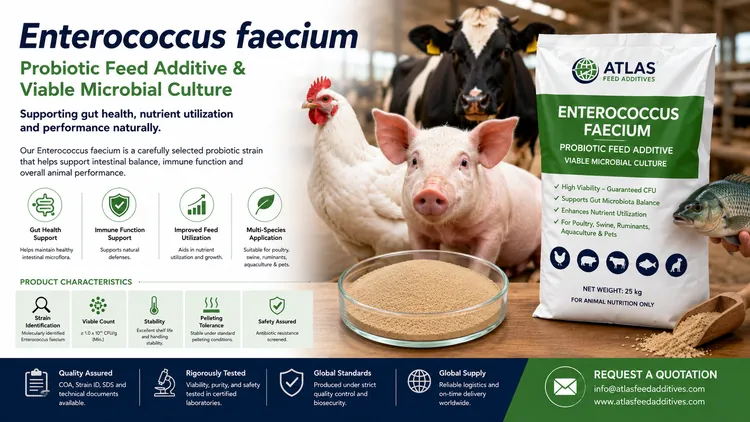
Enterococcus faecium, E. faecium probiotic, direct-fed microbial, viable microbial culture, probiotic premix, or zootechnical additive depending on supplier documentation and market classification. |
| Microorganism identity |
Request full taxonomic identification, strain code, deposit number, identification method, and confirmation that the strain matches the product authorization or customer approval file. |
| Strain specificity |
Safety and efficacy are strain-specific. Do not assume data from one E. faecium strain applies to another strain without written supplier support. |
| Viable count |
Declared as CFU/g, CFU/kg, CFU per dose, or CFU per recommended inclusion level. Buyers should request values at manufacture and at end of shelf life. |
| Guarantee basis |
Confirm whether the guaranteed viable count is at production, shipment, delivery, end of shelf life, or after processing. End-of-shelf-life guarantee is often more meaningful for feed buyers. |
| Analytical method |
Common methods include plate-count methods, strain-selective enumeration, qPCR support, genetic identification, and supplier-validated microbiological assays. Confirm method suitability for premixes and finished feed. |
| Physical form |
Fine powder, granular powder, coated granule, microencapsulated culture, spray-dried culture, freeze-dried culture, soluble powder, liquid preparation, or carrier-based premix. |
| Carrier system |
Confirm carrier identity, carrier percentage, flowability, bulk density, particle size, dust level, moisture level, and compatibility with vitamins, minerals, enzymes, acids, oils, and other probiotics. |
| Coating or encapsulation |
For protected forms, request coating material, release concept, heat-stability data, acid tolerance, storage stability, and CFU recovery after feed processing. |
| Pelleting stability |
Request CFU recovery after the expected conditioning temperature, retention time, moisture, pressure, and cooling conditions. A strain may perform differently in mash, crumble, pellet, extruded, or coated feeds. |
| Acid and bile tolerance |
For digestive-use claims, buyers may request strain-specific tolerance data for gastric acid, bile salts, digestive pH, and survival under species-relevant conditions. |
| Storage stability |
Request viable count retention over time at recommended storage temperature and humidity. Probiotic viability can decline with heat, moisture, oxygen, and long storage. |
| Moisture and water activity |
Low moisture and controlled water activity support viable count stability. Request moisture limits and packaging designed to protect against humidity. |
| Safety screening |
Request absence or acceptable status for relevant virulence factors, hemolytic activity, unwanted biogenic amine concerns, production contaminants, and other safety criteria required by the destination market. |
| Antimicrobial resistance |
Request antimicrobial susceptibility profile, absence of transferable resistance concerns, vancomycin-resistance review where relevant, and compliance with destination-market safety criteria. |
| Purity and contaminants |
Request absence of Salmonella, E. coli, coliforms, Staphylococcus aureus, molds, yeasts where relevant, unwanted microbes, and contaminants according to the buyer's quality system. |
| Compatibility |
Review compatibility with organic acids, mineral premixes, choline chloride, enzymes, coccidiostats, medications where legally used, other probiotics, essential oils, mycotoxin binders, and preservatives. |
| Recommended inclusion |
Inclusion depends on strain, viable count, species, target claim, feed type, processing loss, and legal authorization. Buyers should request CFU delivered per animal per day or per kg finished feed. |
| Target species |
Confirm species authorization and data for poultry, swine, ruminants, aquaculture, companion animals, or other species. Do not assume cross-species use without documentation. |
| Packaging |
Common options may include foil bags, moisture-barrier bags, vacuum or nitrogen-flushed packs, plastic jars, drums, cartons, pails, or lined bags depending on product stability. |
| Storage |
Store sealed in a cool, dry, well-ventilated area, protected from heat, sunlight, moisture, oxygen exposure, pests, and contamination. Some products may require refrigeration or temperature-controlled logistics. |
| Shelf life |
Confirm production date, expiry or retest date, minimum viable count at end of shelf life, storage temperature, humidity requirements, and handling after opening. |
| Documentation |
Specification, COA, SDS, technical data sheet, strain identification, deposit certificate or strain declaration, viable count method, stability data, safety screening, antimicrobial susceptibility profile, contaminant statements, packaging list, shelf-life statement, and market-specific certificates. |