Probiotics and fermentation products

Bacillus coagulans

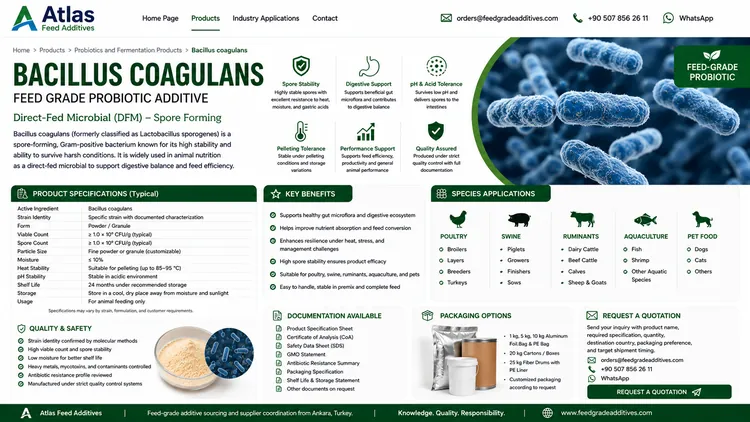
Feed-grade Bacillus coagulans is a spore-forming probiotic additive used in animal nutrition programs where digestive balance, feed-transition resilience, viable-count stability, and formulation compatibility are important purchasing criteria.

Bacillus coagulans is also encountered in technical literature under updated taxonomic naming such as Heyndrickxia coagulans. In commercial feed additive markets, the name Bacillus coagulans remains widely used, so quotations should clearly state the exact strain, viable count, assay method, carrier, and intended species.

Bacillus coagulans feed additive visual

Product role

Where Bacillus coagulans fits in feed programs

Bacillus coagulans belongs to the probiotics and fermentation products group. It is typically supplied as a feed-grade microbial preparation or carrier-based blend, with commercial value determined by strain identity, viable count, spore stability, application fit, regulatory acceptability, and supporting quality documents.

Because probiotic performance is strain-specific, buyers should not treat all Bacillus coagulans offers as equivalent. A meaningful specification should identify the strain or culture designation, declared activity in CFU/g, analytical method, carrier, moisture limit, microbiological purity, shelf life, storage conditions, packaging format, and recommended handling practices.

Atlas Feed Additives coordinates international supplier options for feed mills, premix producers, integrators, distributors, veterinary nutrition brands, and private-label buyers that need consistent feed-grade material supported by documentation for import, formulation, and customer approval.

Technical identity

What buyers should know

Bacillus coagulans is a lactic-acid-producing, spore-forming bacterial species used in probiotic feed applications. The spore-forming nature is one reason the product is evaluated for feed processing, storage, and pelleted-feed compatibility, although actual stability depends on strain, formulation, carrier, moisture, coating, process temperature, residence time, and storage conditions.

  • Often selected where feed manufacturers need a robust probiotic format for premixes, compound feed, or specialty nutrition products.
  • Typically evaluated by viable spores or viable cells, not simply by total powder weight.
  • Should be supported with strain-level documentation, purity data, and batch-specific certificate of analysis.
  • Requires destination-market review because feed additive registration, claims, species permissions, and labelling rules vary by country.

Formulation objective

Main reasons feed buyers consider it

  • Digestive ecosystem support during diet changes, weaning, transport, environmental stress, or production-stage transitions.
  • Support for balanced intestinal microbiota as part of antibiotic-reduction, gut-health, and performance-support programs.
  • Potential compatibility with dry premixes, mineral-vitamin blends, and compound feed when stability data are suitable.
  • Use in poultry, swine, ruminant, aquaculture, and companion animal diets when the strain and local rules are appropriate.
  • Inclusion in multi-strain probiotic systems, synbiotic concepts, enzyme-plus-probiotic programs, or organic-acid-plus-probiotic strategies, subject to compatibility testing.

Specification planning

Define the specification before comparing offers

Price comparison is only meaningful when offers match the same active declaration, strain, physical form, carrier, purity profile, documentation package, packaging, and logistics basis. A lower unit price may not be economical if the viable count, shelf-life guarantee, or pelleting stability is weaker.

For probiotics, the most important commercial question is not only “how many kilograms?” but “how many viable CFU are delivered, remain stable, and reach the intended formulation stage?” Buyers should request both the production specification and the shelf-life declaration under stated storage conditions.

Commercial specification

Typical specification points for Bacillus coagulans

The final specification must be confirmed by the supplier and aligned with the buyer’s target market. The table below shows practical parameters that purchasing, formulation, and quality teams commonly review before approval.

Parameter What to request Why it matters
Product name Bacillus coagulans, with updated taxonomic reference where relevant Prevents confusion between historical, commercial, and scientific naming.
Strain identity Full strain code, deposit reference, or supplier strain declaration Safety, efficacy, stability, and regulatory acceptance are strain-specific.
Declared activity Viable count expressed as CFU/g at release and, where possible, through shelf life Determines dosage economics and real delivered activity.
Assay method Enumeration method, plating conditions, and laboratory standard used Different methods may produce different viable-count results.
Physical form Powder, granule, coated granule, or carrier-based blend Affects mixing behavior, dusting, stability, and final feed appearance.
Carrier Maltodextrin, starch, calcium carbonate, soybean meal carrier, silica, or supplier-specific carrier Carrier influences flowability, formulation declarations, allergens, GMO statements, and compatibility.
Moisture Maximum moisture specification High moisture can affect microbial stability and shelf life.
Particle size Mesh range or particle-size distribution Important for premix uniformity, segregation control, and dosing accuracy.
Bulk density Loose and tapped density where available Helps calculate packaging, storage, and dosing system requirements.
Pelleting stability Survival data at relevant conditioning temperature and retention time Essential when the product will be added before pelleting or extrusion.
Shelf life Declared shelf life under defined storage conditions Supports inventory planning and customer warranty expectations.
Packaging Bag, carton, drum, vacuum pack, foil liner, or moisture-barrier packaging Packaging has a direct effect on stability, export handling, and warehouse protection.
Regulatory status Documents for the target country and intended species Feed additive approvals and allowed claims vary by market.

Applications

Typical application areas

  • Swine: starter feeds, weaning-transition programs, sow and piglet gut-support concepts, and antibiotic-reduction strategies where permitted.
  • Poultry: broiler, layer, breeder, and chick starter programs focused on digestive balance and stable feed intake during production stress.
  • Ruminants: calf starter, dairy transition concepts, rumen and hindgut stability strategies, and specialty premixes where the strain is suitable.
  • Aquaculture: shrimp, fish, and aquatic feeds where processing stability and water-quality considerations are reviewed.
  • Companion animals: pet food, treats, powders, and digestive support formulas when the supplier’s documentation supports the intended use.
  • Premix and integrator programs: multi-additive packages combining probiotics with enzymes, organic acids, yeast derivatives, phytogenics, minerals, or vitamins after compatibility checks.

Use-stage options

Where it can be added

  • Premix stage: suitable when the carrier, particle size, and uniformity are compatible with mineral-vitamin premixes.
  • Mash feed: often preferred when the buyer wants to avoid heat-processing losses.
  • Pelleted feed: possible only when strain and formulation stability data support the selected pelleting conditions.
  • Top dressing: useful for farm-level or specialty use where direct addition is practical and allowed.
  • Liquid or soluble systems: requires supplier confirmation because viability, sedimentation, water quality, and administration time can affect performance.

Species and program fit

How formulators evaluate Bacillus coagulans by animal group

Animal group Common formulation objective Buyer questions to confirm
Weaned piglets Support digestive transition, stool consistency, intestinal integrity, and feed intake stability. Which strain? What inclusion rate? Is there swine-specific data? Is the product compatible with acids, zinc alternatives, enzymes, and medication programs?
Broilers and layers Support gut balance, litter quality programs, nutrient utilization concepts, and performance-support packages. Can the product survive pelleting? Is it suitable for starter feed? Does the supplier provide poultry trial references?
Calves and ruminants Support young-animal digestive development, transition diets, and hindgut stability programs. Is the strain appropriate for ruminant use? What are the carrier and mixing recommendations? Is the product intended for milk replacer, starter, TMR, or premix?
Aquaculture Support digestive balance, pond or tank production strategies, and functional feed concepts. Is there data for shrimp or fish? Can it tolerate extrusion? Does it remain viable in finished feed storage?
Pet food Support digestive wellness, stool quality, and premium functional nutrition positioning. Is the product suitable for pet food claims in the destination market? Can it survive extrusion or should it be post-applied?

Functional profile

Practical benefits buyers look for

Commercial Bacillus coagulans programs are usually positioned around digestive balance and production resilience rather than disease treatment. The wording used on labels, brochures, and customer documents should be reviewed for each market because probiotic claims can be regulated differently by country.

  • Supports a stable gut environment as part of a complete nutrition program.
  • May be used during feed changes, weaning, transport, heat stress, or other management transitions.
  • Can contribute to antibiotic-reduction or gut-health strategies where allowed by local regulations.
  • May complement enzymes, organic acids, yeast products, phytogenics, and binders when compatibility is verified.
  • Spore-forming format may offer handling advantages compared with more fragile microbial preparations, depending on strain and formulation.

Important limitations

What not to assume

  • Do not assume every Bacillus coagulans strain has the same efficacy, heat tolerance, safety profile, or regulatory status.
  • Do not compare prices without aligning CFU/g, strain, carrier, and stability guarantee.
  • Do not use medical or disease-treatment claims on feed materials unless the target market specifically permits them.
  • Do not assume finished-feed viability after pelleting, extrusion, or long storage without supplier data.
  • Do not substitute a human supplement grade document package for feed-grade import approval without checking local rules.

Quality assurance

Buyer quality checklist

A probiotic feed additive should be evaluated as both a biological product and a commercial raw material. The purchasing team should review biological activity, purity, stability, physical handling, packaging integrity, supplier traceability, and destination-market compliance before confirming an order.

  • Strain identification and naming consistency across specification, COA, SDS, label, and import documents.
  • Declared viable count, test method, batch result, and minimum guaranteed activity.
  • Total plate count, yeast and mold, coliforms, Salmonella, E. coli, and other microbiological limits required by buyer or market.
  • Heavy metals such as lead, cadmium, arsenic, and mercury when required.
  • Absence of contaminants and review of antibiotic-resistance concerns where required by regulation or customer protocol.
  • Moisture, particle size, bulk density, flowability, and dusting characteristics.
  • Pelleting, extrusion, and premix compatibility data where heat or pressure processing is expected.
  • Storage temperature, humidity sensitivity, shelf life, and opened-bag handling instructions.
  • Batch traceability, production date, expiry date, lot number, and origin statement.

Packaging

Packaging and handling considerations

Bacillus coagulans products are commonly packed in moisture-protective formats because humidity, oxygen exposure, temperature, and long storage can affect viable count. Packaging should be chosen based on shipment distance, warehouse conditions, expected turnover, and customer repacking needs.

  • Common commercial options may include 1 kg, 5 kg, 10 kg, 20 kg, or 25 kg units depending on supplier and concentration.
  • Inner foil liner, vacuum pack, sealed plastic liner, carton, drum, or multi-layer bag options may be available.
  • Opened bags should be resealed quickly and protected from moisture and high heat.
  • For private-label or distributor programs, confirm label language, batch coding, and pallet configuration before production.

Storage

Storage questions before ordering

  • What temperature range is recommended for unopened original packaging?
  • What relative humidity and warehouse conditions should be avoided?
  • What is the shelf life at the declared storage condition?
  • Is refrigeration required, preferred, or unnecessary for the selected grade?
  • Does the supplier guarantee viable count at manufacture only or through expiry?
  • How should the product be handled after opening?
  • Can the product be shipped by sea freight without activity loss under expected route conditions?

Processing compatibility

Pelleting, extrusion, and premix compatibility

Spore-forming probiotics are often selected for better processing tolerance, but finished-feed survival is not automatic. The actual viable count after feed processing depends on conditioning temperature, moisture, pressure, residence time, post-pellet cooling, other additives, storage period, and the protective formulation used by the supplier.

Process factor What to check Recommended buyer action
Pelleting temperature Survival rate at the buyer’s actual conditioning temperature and retention time Ask for stability data or run a pilot test with finished feed analysis.
Extrusion Heat, pressure, moisture, and shear tolerance Consider post-application if extrusion survival is not proven.
Premix minerals Compatibility with trace minerals, acids, salts, and choline chloride Review premix stability and avoid long storage in aggressive blends without data.
Organic acids Acid type, pH, concentration, and contact time Confirm compatibility before combining in concentrated premixes.
Enzymes Physical blending, moisture, and storage compatibility Check whether multi-additive blends remain stable through shelf life.
Finished-feed storage Temperature, humidity, bag type, and storage duration Request viable-count data at end of finished-feed shelf life if claims depend on it.

Compliance note

Regulatory status is strain, claim, species, and country specific

Bacillus coagulans should be reviewed under the feed additive rules of the destination market. A strain that is acceptable in one market, species, or claim category may still require additional documentation, registration, label review, or customer approval in another.

Atlas Feed Additives can help collect supplier documents for buyer review, but final import clearance, claim approval, and local registration decisions belong to the buyer, importer, consultant, or competent authority in the destination country.

Procurement guidance

How to request a precise quotation

The most accurate quotation is based on a complete technical and logistics profile. When sending an inquiry, include all product requirements rather than only a product name and quantity.

  • Product name: Bacillus coagulans.
  • Required strain or acceptable strain range.
  • Required viable count in CFU/g.
  • Required form: powder, granule, coated, carrier-based, or custom premix.
  • Target species and application stage.
  • Expected inclusion rate or final feed target.
  • Quantity per shipment and annual forecast.
  • Destination country and port.
  • Preferred Incoterms such as EXW, FCA, FOB, CFR, CIF, DAP, or DDP if applicable.
  • Required documents for customs, registration, or customer approval.
  • Packaging size, palletization, label language, and private-label requirements.

Buyer comparison

Questions to ask every supplier

  • What is the exact strain designation and how is it verified?
  • Is the viable count guaranteed at production, shipment, or expiry?
  • What assay method is used for enumeration?
  • What carrier is used and does it contain allergens or GMO-derived material?
  • What are the microbiological and heavy metal specifications?
  • What temperature and humidity conditions are required for storage?
  • What stability data are available for pelleting or extrusion?
  • Can the supplier provide samples from the same grade proposed for commercial order?
  • Can documents be issued per batch and per shipment?

Formulation note

Use Bacillus coagulans as part of a complete nutrition strategy

Bacillus coagulans is best evaluated inside a full feed program that considers raw material quality, mycotoxin risk, protein digestibility, acid-binding capacity, coccidiosis or medication programs, farm hygiene, water quality, stocking density, heat stress, and management conditions.

For new formulas, Atlas Feed Additives recommends pilot-scale testing, finished-feed analysis, and field evaluation before making broad commercial claims. This is especially important for pelleted feeds, extruded feeds, and complex premixes containing acids, minerals, choline, enzymes, phytogenic oils, or other active ingredients.

Document pack

Suggested document package for Bacillus coagulans orders

Document Purpose When to request
Product specification Defines activity, strain, appearance, carrier, moisture, microbiology, and packaging. Before price comparison and sample approval.
Certificate of analysis Confirms batch-specific results for viable count and agreed quality parameters. For each production batch and shipment.
Safety data sheet Provides handling, storage, transport, and safety information. Before import, warehouse approval, and customer registration.
Strain declaration Confirms the microbial identity used in the product. Before regulatory review or technical approval.
Shelf-life statement Defines validity period and storage conditions. Before order confirmation and inventory planning.
GMO statement Supports customer or market requirements related to genetic modification. When the destination market or customer requires it.
Allergen statement Identifies potential carrier-related or processing-related allergen concerns. For pet food, specialty feed, and sensitive customer programs.
Origin certificate Supports customs, import, or customer origin requirements. When requested by importer or destination authority.
Free-sale or registration support document Supports local approval and market access. When required by the destination country.

Questions

Useful answers

What is Bacillus coagulans used for in animal nutrition?

Bacillus coagulans is used as a probiotic or direct-fed microbial ingredient in feed programs designed to support digestive balance, gut environment stability, and resilience during diet changes, weaning, production stress, or management transitions. It should be used according to the target species, formulation objective, supplier guidance, and applicable market rules.

Is Bacillus coagulans the same as Heyndrickxia coagulans?

Bacillus coagulans is the name still commonly used in feed additive commerce. Some updated taxonomic references use Heyndrickxia coagulans. For buying and regulatory review, the safest approach is to request the full strain identity and supporting documentation, not only the general species name.

Why is the viable count expressed as CFU/g?

CFU/g means colony-forming units per gram and is used to declare the viable microbial activity of the product. For probiotics, the delivered viable count is more important than the total powder quantity because different products may have very different concentrations.

Can Bacillus coagulans survive pelleting?

Some Bacillus coagulans preparations are selected for processing tolerance because of their spore-forming character, but survival depends on strain, coating, carrier, moisture, conditioning temperature, retention time, pressure, and finished-feed storage. Buyers should request stability data for their actual feed process or run a pilot test.

Can Atlas Feed Additives quote Bacillus coagulans?

Yes. Send your target specification, strain preference, required CFU/g, target species, quantity, destination country, packaging preference, and required documents so Atlas Feed Additives can review suitable supplier options for Bacillus coagulans.

What quality documents should buyers request for Bacillus coagulans?

Common documents include product specification, certificate of analysis, safety data sheet, strain identity declaration, shelf-life statement, storage instruction, origin information, batch details, microbiology results, heavy metal results, GMO/allergen statements where required, and any market-specific certificates requested by the buyer.

Can Bacillus coagulans be used with other additives?

It may be used in combination with enzymes, organic acids, phytogenics, yeast derivatives, minerals, vitamins, binders, or other probiotics, but compatibility should be confirmed. Concentrated acids, reactive minerals, high moisture, heat, and long premix storage can reduce viable count if the formulation is not suitable.

What information is needed for a fast quotation?

Please send the required viable count, strain requirement if any, physical form, target species, application, quantity, destination, Incoterms, packaging size, label requirements, and documentation requirements. This allows Atlas Feed Additives to compare supplier options correctly.

Request a quotation

Tell us what you need

Send your product list, target specification, required CFU/g, strain preference, destination country, target species, packaging preference, and required documents. Our team will review your request and respond from orders@feedgradeadditives.com.