Probiotics and fermentation products

Lactobacillus acidophilus

Lactobacillus acidophilus is a probiotic feed additive option used in animal nutrition programs where digestive balance, feed-transition support, intestinal microflora stability, and performance consistency are important formulation goals.

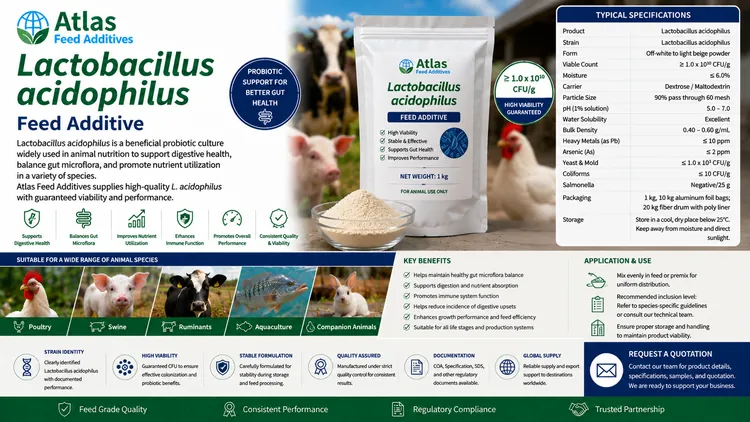
Lactobacillus acidophilus feed additive visual

Product role

Where Lactobacillus acidophilus fits

Lactobacillus acidophilus belongs to the probiotics and fermentation products group. In feed applications, it is normally evaluated as a live microbial ingredient whose commercial value depends on strain identity, declared viable count, stability through handling, compatibility with feed processing, and suitability for the intended animal species.

Feed mills, premix producers, distributors, and livestock integrators often consider L. acidophilus when they want to support a more stable digestive environment during early growth, feed changes, transport stress, diet reformulation, antibiotic-reduction programs, or production-stage transitions. The product should always be selected according to formulation purpose, local feed legislation, label restrictions, and customer documentation requirements.

Atlas Feed Additives coordinates international supplier options for buyers who need feed-grade material, export documentation, batch-level quality records, practical packaging options, and quotation support for recurring or project-based procurement.

Typical applications

L. acidophilus may be considered in complete feeds, premixes, concentrates, milk replacer programs, liquid applications, and specialty nutrition products, depending on the formulation objective and stability data.

  • Starter feeds for young animals during early digestive development
  • Feed-transition programs where diets, ingredients, or production phases change
  • Antibiotic-reduction or antibiotic-free nutrition strategies
  • Rumen and hindgut stability support, where suitable for the species and product specification
  • Aquaculture and companion animal diets requiring probiotic-positioned ingredients
  • Premix and specialty additive blends combined with enzymes, organic acids, yeast products, or prebiotic fibers

Buyer quality checklist

Because probiotic performance is closely linked to the exact microorganism and its viable count, buyers should compare offers on a specification-to-specification basis rather than on product name alone.

  • Full strain identification and taxonomic name
  • Declared viable count, usually expressed as CFU per gram or CFU per kilogram
  • Analytical method used for enumeration
  • Carrier or excipient type and inclusion level
  • Storage temperature, humidity limits, and shelf-life conditions
  • Pelleting, heat, pressure, moisture, and premix stability data
  • Absence of relevant contaminants and undesirable microorganisms
  • Antimicrobial resistance and safety documentation where required

Specification guidance

How to define the right Lactobacillus acidophilus specification

A clear purchase specification helps prevent mismatched quotations. For probiotic products, the most important comparison points are usually the strain, viable count, stability profile, carrier system, purity, shelf life, and document package. The same product name can represent different strengths, carriers, production processes, and quality levels.

Core specification points

  • Strain identity: request genus, species, and strain designation when available.
  • Viable count: define minimum CFU at production and, when relevant, minimum CFU at end of shelf life.
  • Physical form: powder, granule, coated powder, soluble form, or premix-ready blend.
  • Carrier: maltodextrin, starch, limestone, silica, dextrose, or another approved carrier, depending on supplier and market.
  • Moisture and water activity: important for shelf stability and microbial viability.
  • Particle size: relevant for premix distribution, dust control, flowability, and blend uniformity.
  • Solubility or dispersibility: relevant for liquid feeding, milk replacer, or top-dressing applications.
  • Stability: request data for storage, transport, premix retention, pelleting, and finished-feed shelf life.
  • Contaminant limits: confirm microbiological purity, heavy metals, mycotoxins, and other market-specific limits.
  • Regulatory status: verify acceptability in the destination country before shipment.

Species and formulation use

Application considerations by animal segment

Poultry

In broiler, layer, breeder, and turkey programs, L. acidophilus may be positioned for gut microflora support, feed transition resilience, litter-quality programs, and performance consistency. Buyers should check compatibility with pelleted feed and whether post-pellet application is more suitable.

Swine

In piglet, grower, finisher, and sow diets, probiotic products are often evaluated around weaning stress, diet change, digestive stability, and antibiotic-reduction strategies. Finished-feed viability and correct dosage per animal or per ton of feed should be confirmed.

Ruminants

In calves, dairy cattle, beef cattle, sheep, and goats, product selection should consider rumen and hindgut targets, diet type, farm management, and whether the microorganism is intended for complete feed, calf milk replacer, mineral premix, or top-dress use.

Aquaculture

In fish and shrimp nutrition, probiotic ingredients may be reviewed for feed stability, water exposure, digestive support, and compatibility with extrusion or coating systems. Buyers should ask whether the product is suitable for aquatic feed processing and storage conditions.

Companion animals

In pet food, treats, and supplements, L. acidophilus may be used in digestive-support positioning. The key checks are palatability, survival through processing, declared count at end of shelf life, regulatory wording, and packaging protection.

Specialty premixes

L. acidophilus can be included in specialty premixes with enzymes, yeast derivatives, organic acids, minerals, vitamins, and prebiotic ingredients, provided compatibility, moisture, pH, storage temperature, and shelf-life retention are verified.

Procurement note

Ask for the right specification before comparing prices.

Price comparisons are meaningful only when strain, assay method, CFU level, carrier, particle size, packaging, origin, and documentation are aligned. For probiotic products, also review storage conditions, shelf life, viability after transport, and compatibility with pelleting, extrusion, premix blending, or liquid application.

A low unit price may not be the best option if the product has a lower viable count, weaker stability data, shorter shelf life, unclear strain identification, insufficient documentation, or packaging that is not suitable for the destination climate and logistics chain.

Quality and safety

Documentation buyers should request

A complete document package helps buyers confirm product identity, suitability, safety, shipment readiness, and compliance with the destination market. Requirements vary by country, animal species, claim wording, and buyer quality system.

  • Product specification sheet with declared strain and viable count
  • Certificate of Analysis for the offered batch
  • Safety Data Sheet
  • Country of origin and manufacturer or supplier declaration where available
  • Batch number, manufacturing date, expiry date, and shelf-life statement
  • Microbiological purity results and contaminant limits
  • Heavy metal and undesirable substance information where required
  • GMO, allergen, irradiation, animal-origin, or vegan statements if relevant to the buyer
  • Halal, ISO, GMP+, FAMI-QS, HACCP, or other certificates if required by market or customer
  • Import, registration, or feed-additive compliance documents for the destination country

Storage and handling

Protect viability from factory to feed

Probiotic products contain live microorganisms, so their commercial value depends on maintaining viability. Storage temperature, humidity, oxygen exposure, packaging integrity, and time in transit can all influence final performance.

  • Store in a cool, dry, well-ventilated area unless the supplier specifies refrigerated storage.
  • Keep bags sealed until use and avoid repeated opening in humid environments.
  • Protect from direct sunlight, high heat, condensation, and strong odors.
  • Use first-expired, first-out stock rotation.
  • Avoid long exposure in hot warehouses, ports, or trucks.
  • Confirm whether the product is suitable for premix storage with minerals, organic acids, or other reactive ingredients.
  • Request stability data for the expected climate, packaging, and transport route.

Formulation guidance

How nutrition teams evaluate inclusion

Inclusion rate should be based on the supplier specification, desired final CFU in the complete feed, expected losses during processing and storage, animal species, feed intake, and regulatory limits. Formulators should not assume that every L. acidophilus product has the same potency or stability.

Practical formulation questions

  • What final CFU per gram of feed or per animal per day is required?
  • Will the product be added before pelleting, after pelleting, in premix, in water, or as a top-dress?
  • What is the expected retention after heat, moisture, pressure, and storage?
  • Is the strain compatible with enzymes, organic acids, coccidiostats, minerals, medications, or preservatives?
  • Does the finished feed need a probiotic label declaration at production or at end of shelf life?
  • Does the product need special handling during premix manufacturing?

Commercial support

How Atlas Feed Additives supports sourcing

Supplier matching

Atlas reviews available supplier options according to product strength, documentation, packaging, origin, lead time, export readiness, and buyer-specific technical requirements.

Specification alignment

Before comparing prices, Atlas helps clarify the exact specification requested by the buyer, including viable count, carrier, stability, documents, and destination-market expectations.

Export coordination

Atlas can support quotation preparation with shipment terms, packing information, document review, and communication between buyer and supplier during order planning.

Repeat supply planning

For recurring demand, buyers can share forecast volumes so sourcing can be reviewed around production schedule, shelf-life management, stock availability, and shipment timing.

Questions

Useful answers

What is Lactobacillus acidophilus used for in animal nutrition?

Lactobacillus acidophilus is used as a probiotic feed additive to support stable digestive microflora, especially during feed changes, environmental stress, early growth phases, production transitions, and nutrition programs focused on gut-health support. Use should follow the target species, formulation objective, product specification, supplier instructions, and applicable market rules.

Is every Lactobacillus acidophilus product the same?

No. Products may differ by strain, viable count, carrier, manufacturing method, protective technology, particle size, storage requirement, shelf life, pelleting stability, and document package. Buyers should compare products by full specification rather than by product name only.

What does CFU mean?

CFU means colony-forming units. It is a common way to express the number of viable microorganisms in a probiotic product. Buyers should confirm whether the declared CFU is guaranteed at manufacture, during shelf life, or at expiry, and which analytical method is used.

Can Atlas Feed Additives quote Lactobacillus acidophilus?

Yes. Send your required specification, quantity, destination country, packaging preference, delivery terms, target animal species, and document requirements so Atlas Feed Additives can review suitable supplier options for Lactobacillus acidophilus.

What quality documents should buyers request?

Common documents include specification, certificate of analysis, safety data sheet, origin information, batch number, manufacturing date, expiry date, microbiological results, contaminant information, and market-specific certificates required by the buyer or importer.

Can Lactobacillus acidophilus be used in pelleted feed?

Suitability depends on product technology and processing conditions. Pelleting temperature, conditioning time, steam, moisture, pressure, and storage can reduce viability. Buyers should request pelleting-stability data or consider post-pellet liquid application when needed.

How should Lactobacillus acidophilus be stored?

Storage depends on supplier instructions. In general, probiotic products should be protected from heat, moisture, sunlight, oxygen exposure, and long delays in uncontrolled warehouses. Some products may require cool or refrigerated storage.

What information is needed for a fast quotation?

Please provide product name, target CFU strength, order quantity, destination, required documents, preferred packaging, intended animal species, application method, and preferred shipment terms. This helps Atlas compare suitable offers on a like-for-like basis.

Can L. acidophilus be combined with other additives?

It may be combined with other additives in premix or feed programs, but compatibility should be checked. Minerals, acids, preservatives, moisture, heat, and certain active ingredients may affect viability. Ask for compatibility and stability information before finalizing a formulation.

Does Atlas provide regulatory approval?

Atlas Feed Additives can help coordinate supplier documents and quotation information, but buyers and importers should confirm local registration, labeling, permitted claims, and feed-additive compliance in the destination market.

Request a quotation

Tell us what you need

Send your product list, target specification, destination country, packaging preference, and required documents. For Lactobacillus acidophilus, please also include the desired CFU strength, target animal species, use in premix or complete feed, storage requirements, and whether pelleting stability data is required. Our team will review your request and respond from orders@feedgradeadditives.com.