Silage and forage additives

Lactobacillus plantarum Silage Inoculant

Lactobacillus plantarum Silage Inoculant is selected for forage preservation programs where buyers need fermentation control, rapid lactic acid development, dry-matter preservation, crop-quality protection, and consistent application across corn silage, grass silage, alfalfa, haylage, and high-moisture grain systems.

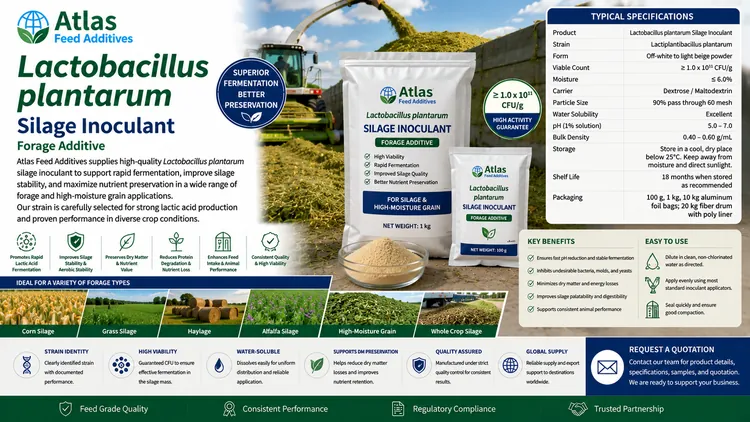
Lactobacillus plantarum Silage Inoculant feed additive visual

Product role

Where Lactobacillus plantarum Silage Inoculant fits

Lactobacillus plantarum Silage Inoculant is part of the silage and forage additives group. It is used in forage preservation systems where controlled fermentation, dry-matter conservation, feedout consistency, and practical forage quality are important for dairy, beef, sheep, goat, and mixed ruminant programs.

Buyers typically evaluate this product by strain identity, viable microbial count, CFU declaration, activity guarantee, carrier, water solubility, crop suitability, application rate, tank stability, applicator compatibility, storage conditions, shelf life, microbial purity, packaging, and documentation requirements.

Atlas Feed Additives can coordinate international supplier options for dairy farms, beef producers, forage contractors, feed mills, premix producers, silage additive distributors, and importers that need consistent feed-grade forage additive products with export-oriented documentation and clear quotation support.

Technical identity

Key product profile

  • Product group: silage and forage additives.
  • Functional role: supports fermentation control, lactic acid fermentation, dry-matter preservation, and forage quality management.
  • Common organism type: Lactobacillus plantarum, also classified in modern taxonomy as Lactiplantibacillus plantarum, depending on supplier labeling.
  • Activity basis: typically expressed as colony-forming units, or CFU, per gram and as target CFU applied per ton of forage.
  • Commercial forms: water-soluble powder, dry concentrate, granule, sachet, pouch, drum, or multi-strain inoculant blend.
  • Use context: corn silage, grass silage, alfalfa, haylage, whole-crop cereal silage, high-moisture grain, and forage preservation programs.
  • Buyer focus: strain identity, viable activity, end-of-shelf-life guarantee, water solubility, applicator performance, and storage recommendations.
  • Process relevance: performance depends on crop moisture, sugar availability, chop length, packing density, oxygen exclusion, sealing quality, and feedout management.

Commercial positioning

Why specifications matter

Silage inoculants are not interchangeable by product name alone. Two offers may both contain Lactobacillus plantarum but differ in strain, viable count, target application rate, carrier, crop suitability, water solubility, storage temperature, shelf life, and support data.

For a meaningful commercial comparison, buyers should align the target crop, forage moisture, storage system, CFU guarantee, application rate per ton, product form, applicator method, packaging, storage expectations, and destination-market documents before comparing price per kilogram or price per sachet.

Applications

Typical use areas in forage preservation

Corn silage

Lactobacillus plantarum Silage Inoculant is commonly evaluated in corn silage programs where fast fermentation, dry-matter preservation, stable silage quality, and consistent feed value are important. Buyers should consider crop maturity, dry matter, kernel processing, chop length, packing density, sealing, and feedout conditions.

  • Dairy and beef corn silage programs
  • Bunker, pile, bag, and tower silos
  • High-volume harvest systems
  • Programs focused on fermentation efficiency
  • Use with applicator systems on forage harvesters

Grass silage and haylage

Grass silage and haylage can vary significantly in moisture, sugar level, buffering capacity, and harvest conditions. Lactobacillus plantarum inoculants may be considered to support desirable fermentation when crop conditions are suitable and application is well managed.

  • Ryegrass, pasture grass, and mixed grass silages
  • Haylage and wilted forage systems
  • Dairy forage programs
  • Small ruminant forage programs
  • Moisture-sensitive harvest windows

Alfalfa and legume silage

Legume crops such as alfalfa may have a higher buffering capacity than corn silage, so fermentation can require more careful management. Buyers should review whether the selected strain and application rate are suitable for legume silage and local harvest conditions.

  • Alfalfa silage
  • Legume-grass mixed forage
  • Dairy cow forage programs
  • High-protein forage systems
  • Programs where wilting and packing discipline are important

Whole-crop cereal silage

Whole-crop wheat, barley, oats, rye, and triticale silages may be treated with inoculants where fermentation control and feed value preservation are important. Crop dry matter, starch development, chop length, and storage system should be reviewed before selecting an inoculant.

  • Whole-crop wheat silage
  • Barley, rye, oat, and triticale silage
  • Beef and dairy forage programs
  • Regional forage preservation strategies
  • Storage systems requiring rapid fermentation support

High-moisture grain

High-moisture corn and other high-moisture grain systems may require targeted fermentation support depending on moisture level, grain processing, storage structure, packing density, and feedout speed. Buyers should confirm whether the offered inoculant is suitable for high-moisture grain applications.

  • High-moisture corn
  • Processed grain storage systems
  • Feedlot and dairy grain programs
  • Bunker, bag, or sealed storage
  • Programs requiring practical application guidance

Dairy and beef forage programs

Forage quality directly affects ration consistency, dry-matter intake, milk production programs, beef performance strategies, and feed cost control. Lactobacillus plantarum Silage Inoculant should be considered as part of a complete harvest, packing, sealing, storage, and feedout management plan.

  • Dairy herd forage management
  • Beef and feedlot roughage programs
  • Ration consistency support
  • Forage inventory protection
  • Professional nutrition and forage-management programs

Specification control

Common specification points to request

  • Declared species and strain identity
  • CFU per gram or CFU per dose
  • Target CFU application rate per ton of forage
  • Whether viable count is guaranteed at production, delivery, or end of shelf life
  • Single-strain or multi-strain formulation
  • Carrier type and carrier declaration
  • Water solubility and dispersibility
  • Recommended dilution rate and tank-mix instructions
  • Applicator compatibility and nozzle guidance
  • Moisture content and water activity where available
  • Microbial purity and contaminant controls
  • Pathogen absence statements where required
  • Compatibility with enzymes, sugars, preservatives, or other silage additives
  • Storage temperature requirements
  • Shelf life and packaging protection
  • Crop-specific application guidance

Quality documents

Buyer quality checklist

  • Product specification sheet
  • Certificate of Analysis
  • Safety Data Sheet
  • Technical data sheet or product brochure
  • Strain declaration
  • CFU guarantee or viable count statement
  • Batch number and manufacturing date
  • Country of origin statement
  • Shelf-life or retest-date statement
  • Storage and handling guidance
  • Application instructions and dilution guidance
  • Microbiological quality statement
  • Feed-grade or feed-use suitability declaration
  • GMO, allergen, BSE/TSE, halal, kosher, or other declarations if requested
  • Market-specific import and compliance documents
  • Technical support data or forage-trial references where available

Procurement note

Ask for the right specification before comparing prices.

Price comparisons are meaningful only when strain identity, CFU guarantee, application rate, crop target, carrier, solubility, packaging, origin, shelf life, storage requirements, and documentation are aligned. A lower price per kilogram may not be more economical if it delivers fewer viable organisms per ton of forage or has limited stability under the buyer’s storage conditions.

For live microbial forage additives, buyers should compare practical cost by treated tons of forage, viable CFU delivered at application, end-of-shelf-life guarantee, ease of mixing, applicator reliability, storage temperature, and suitability for the intended crop and harvest conditions.

Harvest and application

Practical considerations for silage programs

Crop moisture and maturity

Silage inoculant selection should consider crop maturity, dry matter, sugar availability, buffering capacity, and harvest timing. Forage that is too wet, too dry, poorly chopped, or contaminated with soil may require additional management beyond inoculant selection.

Water quality and mixing

Many inoculants are mixed in water before application. Buyers should review water quality, chlorine level, tank cleanliness, mixing time, water temperature, dilution rate, and whether the product remains evenly dispersed during field use.

Applicator compatibility

Uniform application is essential. Buyers should confirm whether the product is suitable for low-volume or high-volume applicators, forage harvester systems, baler applicators, pumps, lines, filters, and nozzles used in their harvest operation.

Packing and oxygen exclusion

Even a strong inoculant cannot compensate for poor packing or oxygen exposure. Chop length, packing density, filling speed, sealing quality, face management, and plastic integrity strongly influence final silage quality.

Feedout management

After opening, silage quality depends on feedout rate, face cleanliness, bunker width, ambient temperature, oxygen exposure, and removal technique. Inoculant programs should be combined with good feedout discipline, especially in warm weather.

Program selection

Lactobacillus plantarum is often associated with homofermentative fermentation support. In some situations, buyers may also evaluate Lactobacillus buchneri, Pediococcus pentosaceus, Enterococcus faecium, or enzyme blends depending on aerobic stability, crop type, and forage-management goals.

Packaging

Common packaging options

Packaging availability depends on supplier capability, CFU concentration, dose size, order quantity, storage requirements, and destination-market rules. Atlas Feed Additives can review available packaging options during quotation.

  • Small sachets for defined treated-ton applications
  • Foil pouches or moisture-barrier bags for live microbial stability
  • Plastic jars, tubs, or bottles for farm and contractor use
  • Drums or cartons for distributor and large-volume programs
  • Multi-dose packs for forage harvesters and applicator systems
  • Batch number, CFU claim, net weight, application rate, and storage information on labels
  • Cold-chain or temperature-controlled shipment where required by the supplier
  • Private-label or buyer-specific marking where available

Storage and handling

Practical handling guidance

  • Store according to the supplier’s recommended temperature range.
  • Protect from heat, direct sunlight, humidity, condensation, and contamination.
  • Keep packaging tightly closed until use.
  • Use first-in, first-out stock rotation.
  • Do not leave opened product in applicator tanks or field vehicles longer than recommended.
  • Mix only the amount required for the intended application period when supplier guidance requires it.
  • Clean tanks, filters, pumps, lines, and nozzles before use.
  • Follow the Safety Data Sheet and local occupational safety rules.

Quotation preparation

Information to send for a faster Lactobacillus plantarum Silage Inoculant quotation

Technical details

  • Required strain or accepted strain options
  • Target CFU per gram, per dose, or per ton of forage
  • Whether viable count must be guaranteed at production, delivery, or end of shelf life
  • Single-strain or multi-strain preference
  • Water-soluble powder, granule, sachet, pouch, or blend preference
  • Storage temperature requirement
  • Required shelf life and packaging format

Application details

  • Target crop: corn silage, grass silage, alfalfa, haylage, whole-crop cereal, or high-moisture grain
  • Expected dry matter or moisture range
  • Storage system: bunker, pile, bag, bale, tower, or clamp
  • Applicator type and application volume
  • Target treated tons per package
  • Harvest season and expected field conditions
  • Any previous supplier specification used as reference

Commercial details

  • Required quantity
  • Trial order or annual volume estimate
  • Preferred packaging
  • Destination country and delivery address or port
  • Preferred Incoterms
  • Target shipment period
  • Payment and documentation expectations

Documentation details

  • COA format requirements
  • SDS language requirements
  • Strain declaration requirement
  • CFU or viable count statement requirement
  • Origin documentation
  • Feed-grade declaration
  • GMO, allergen, BSE/TSE, halal, kosher, or other declarations
  • Import permit, registration, or authorization needs

Buyer comparison

How to compare silage inoculant offers

When several suppliers quote Lactobacillus plantarum products, buyers should compare each offer against the same activity, crop, application, and logistics baseline.

  • Strain identity: confirm organism and strain information where available.
  • Activity basis: compare CFU per gram and CFU delivered per ton of forage.
  • Guarantee basis: confirm whether viable count is guaranteed through shelf life.
  • Application cost: compare cost per treated ton, not only price per kilogram.
  • Crop suitability: check whether the product is recommended for the buyer’s forage type.
  • Solubility and applicator fit: review water mixing, tank stability, filters, pumps, and nozzle compatibility.
  • Storage stability: check temperature limits, packaging barrier, shelf life, and distribution requirements.
  • Documents: confirm COA, SDS, specification, origin, CFU guarantee, and market declarations.

Risk control

Questions to ask before placing an order

  • What strain of Lactobacillus plantarum is used?
  • What is the declared CFU per gram or per package?
  • How many tons of forage does each package treat?
  • Is the viable count guaranteed at production, delivery, or end of shelf life?
  • What storage temperature is required?
  • Is the product stable during the expected shipment route?
  • Is it water-soluble and compatible with the buyer’s applicator?
  • Is it suitable for the target crop and moisture range?
  • Are all feed-use, import, and market-specific documents available before shipment?

Atlas support

Export-focused sourcing for silage and forage additives

Atlas Feed Additives supports buyers by reviewing technical requirements, supplier availability, viable activity, strain information, product form, packaging options, storage requirements, application instructions, quality documentation, destination logistics, and quotation details. For Lactobacillus plantarum Silage Inoculant, this can include comparing CFU levels, treated-ton economics, solubility, shelf life, and documentation packages.

Atlas can help dairy farms, beef producers, forage contractors, feed mills, premix producers, silage additive distributors, and importers source feed-grade forage additives that match commercial, technical, and regulatory requirements.

Best-fit buyer profile

  • Dairy farms preserving corn silage, haylage, or alfalfa silage
  • Beef producers and feedlots managing forage inventories
  • Forage contractors treating large harvest volumes
  • Feed mills and premix producers distributing silage additive programs
  • Distributors building forage preservation portfolios
  • Importers requiring export-ready documentation and supplier coordination
  • Nutrition companies designing forage-quality programs

Questions

Useful answers about Lactobacillus plantarum Silage Inoculant

What is Lactobacillus plantarum Silage Inoculant used for in animal nutrition?

Lactobacillus plantarum Silage Inoculant supports fermentation control, dry-matter preservation, lactic acid fermentation, forage quality, and consistent silage program outcomes. It should be used according to crop type, moisture level, application rate, storage system, supplier guidance, and applicable market rules.

Can Atlas Feed Additives quote Lactobacillus plantarum Silage Inoculant?

Yes. Send your required specification, strain or CFU target, treated-ton requirement, quantity, destination, packaging preference, application method, and required documents so Atlas Feed Additives can review suitable supplier options for Lactobacillus plantarum Silage Inoculant.

What quality documents should buyers request for Lactobacillus plantarum Silage Inoculant?

Common documents include specification, Certificate of Analysis, Safety Data Sheet, strain declaration, viable count or CFU statement, origin information, batch details, shelf-life statement, storage guidance, application instructions, microbial purity information, and any market-specific certificates required by the buyer.

Why is CFU count important?

CFU count indicates viable microbial activity. Buyers should confirm whether the declared CFU is guaranteed at production, at delivery, or through the end of shelf life, and how much viable activity is delivered per ton of treated forage.

Is Lactobacillus plantarum suitable for all crops?

Suitability depends on the exact product, strain, crop type, dry matter, sugar content, buffering capacity, harvest conditions, and supplier guidance. Buyers should confirm the intended application before purchasing.

Can it improve poor silage management?

A silage inoculant can support fermentation, but it cannot replace good harvest and storage management. Chop length, moisture, packing density, sealing, oxygen exclusion, bunker-face management, and feedout rate remain critical.

What affects inoculant stability?

Stability can be affected by heat, humidity, oxygen exposure, storage time, packaging quality, water quality, tank holding time, and transport conditions. Proper storage and handling are important for maintaining viable activity.

Can Lactobacillus plantarum be blended with other inoculants?

It may be included in blends with other lactic acid bacteria or silage enzymes depending on the product design and target crop. Buyers should compare strain composition, CFU contribution, application rate, and supplier support data before substituting or blending products.

Does Atlas provide application-rate recommendations?

Atlas Feed Additives supports sourcing, documentation, and quotation coordination. Application rates and forage program decisions should be made by qualified forage, nutrition, or technical professionals according to crop type, product specification, supplier recommendation, and local regulations.

What information should I include in my quotation request?

Please include required strain or CFU specification, crop type, target treated tons, product form, quantity, destination, packaging preference, storage requirements, applicator type, Incoterms, and required documents. A previous specification sheet or COA is helpful when available.

Request a quotation

Tell us what you need

Send your product list, target specification, strain or CFU requirement, destination country, packaging preference, order quantity, treated-ton target, crop application, storage requirements, applicator details, and required documents. Our team will review your request and respond from orders@feedgradeadditives.com.