What is Betaine Anhydrous used for in animal nutrition?
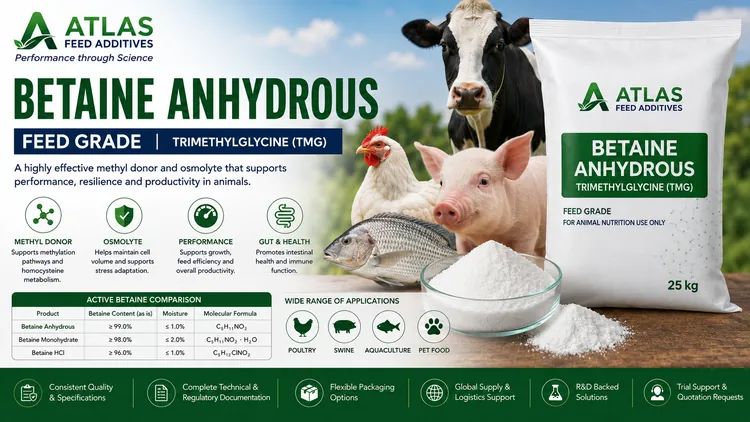
Betaine Anhydrous is used as a concentrated source of betaine activity. It may be evaluated for methyl-donor support, osmotic balance support, heat-stress and stress-period nutrition, palatability, protein-efficiency strategies, and economical ration formulation. It should be used according to the target species, diet design, nutritionist guidance, and applicable market rules.
Is Betaine Anhydrous the same as Betaine Hydrochloride?
No. Betaine Anhydrous and Betaine Hydrochloride are different commercial forms. Betaine Hydrochloride includes the hydrochloride salt portion, while Betaine Anhydrous is the water-free betaine form. Buyers should compare active betaine equivalent, assay, chloride contribution, moisture, particle size, solubility, processing behavior, and documentation before replacement.
Can Betaine Anhydrous replace methionine or choline chloride?
It should not be treated as a direct replacement without formulation review. Betaine can contribute methyl-donor activity, but practical substitution depends on species, diet composition, methionine level, choline level, production goal, raw-material cost, and local rules. A qualified nutritionist should confirm any replacement strategy.
Which species commonly use Betaine Anhydrous?
It may be considered in poultry, swine, aquaculture, pet food, ruminant, and selected specialty feed applications. Suitability depends on the species, life stage, diet design, processing conditions, final product claim, and local feed regulations.
What is the typical appearance of feed-grade Betaine Anhydrous?
Feed-grade Betaine Anhydrous is commonly supplied as a white to off-white crystalline powder or granule. Exact appearance, particle size, odor, flowability, and bulk density should be confirmed from the supplier specification and certificate of analysis.
What assay should buyers request?
The correct specification depends on the intended formulation, supplier grade, active betaine requirement, and market rules. Buyers should compare assay together with active betaine equivalent, moisture, impurities, particle size, solubility, packaging, and documentation.
Can Betaine Anhydrous be used in aquaculture feeds?
Yes, it may be evaluated in fish and shrimp feeds where osmotic balance, palatability, feed intake, low-fishmeal formulation, or salinity stress are relevant. Suitability depends on the species, feed format, water stability, processing method, and final formulation objective.
Is Betaine Anhydrous suitable for pelleted or extruded feed?
Suitability depends on the supplier specification and processing conditions. Buyers should confirm heat tolerance, moisture sensitivity, particle size, mixing behavior, and post-processing stability before selecting the best application point.
What quality documents should buyers request?
Common documents include product specification, certificate of analysis, safety data sheet, origin declaration, batch information, manufacturing date, expiry or retest date, heavy-metal declaration, microbiological declaration when applicable, and any certificates required by the buyer’s market.
How should Betaine Anhydrous be stored?
Store according to the supplier’s instructions, generally in a cool, dry, well-ventilated warehouse. Keep bags sealed, protect from moisture and direct sunlight, avoid strong odors and contamination, and apply first-in, first-out stock rotation.
Can Atlas Feed Additives support recurring supply?
Yes. Atlas Feed Additives can review recurring monthly demand, supplier availability, packaging needs, shipment planning, documentation requirements, and distributor support for regular feed-additive supply programs.
Can Atlas Feed Additives quote Betaine Anhydrous?
Yes. Send your required specification, quantity, destination, packaging preference, delivery terms, and required documents so Atlas Feed Additives can review suitable supplier options for Betaine Anhydrous and prepare a quotation.