Amino acids and nitrogen nutrients

Betaine Hydrochloride

Feed-grade Betaine Hydrochloride, also known as Betaine HCl or betaine chloride, is used in animal nutrition programs where methyl-donor support, osmotic balance support, protein-efficiency goals, and economical ration formulation are important.

  • Commonly supplied as crystalline powder or granule for premix and compound feed use
  • Specification review available for assay, moisture, particle size, origin, and documentation
  • Suitable quotation support for feed mills, premix producers, distributors, and integrators
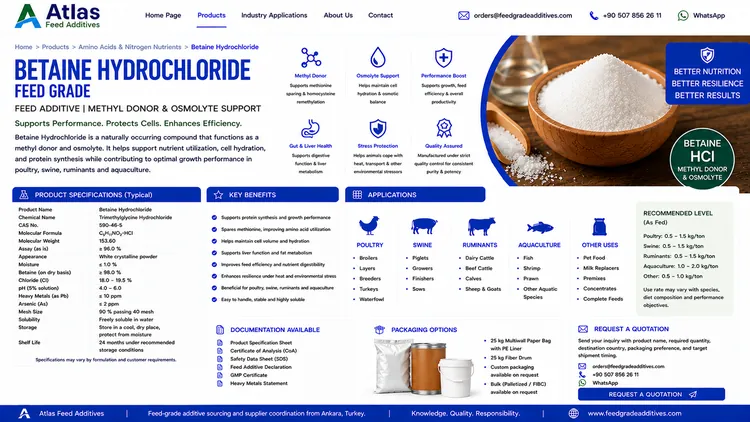
Betaine Hydrochloride feed additive visual

Product role

Where Betaine Hydrochloride fits in feed formulation

Betaine Hydrochloride belongs to the amino acids and nitrogen nutrients category because it is used as a nutritional feed additive that contributes betaine activity. In practical feed formulation, buyers usually evaluate the product by its declared assay, active betaine equivalent, physical form, moisture profile, solubility, handling behavior, origin, documentation package, and compatibility with premix or complete-feed manufacturing.

In animal nutrition, betaine is widely discussed for two major functional roles: it can act as a methyl donor in one-carbon metabolism, and it can support cellular osmotic balance. These roles are why nutritionists may consider betaine sources when formulating diets under cost pressure, heat stress, osmotic stress, high-performance production targets, or reduced crude-protein strategies.

Atlas Feed Additives coordinates international supplier options for feed mills, premix manufacturers, distributors, livestock integrators, aquaculture producers, pet food manufacturers, and regional importers that need consistent feed-grade material with reliable documentation.

Nutrition function

Why formulators use Betaine Hydrochloride

  • Methyl-donor support: betaine participates in methyl-group metabolism and may help formulators manage methionine, choline, and overall amino-acid strategy when technically appropriate.
  • Osmotic balance support: betaine is commonly considered an organic osmolyte, helping cells manage water balance under stress conditions.
  • Protein-efficiency programs: it may be reviewed in diets designed to reduce crude protein while maintaining performance targets through precise amino-acid formulation.
  • Heat-stress and stress-period support: nutritionists may evaluate betaine sources during periods of heat stress, transport stress, diet transitions, salinity challenge in aquaculture, or other management pressure.
  • Economic ration design: because feed cost is sensitive to methionine, choline, energy, and protein inputs, betaine may be part of cost-optimization reviews.

Buying focus

Key points before comparing offers

  • Confirm whether the offer is Betaine Hydrochloride, anhydrous betaine, coated betaine, or another commercial form.
  • Compare active betaine equivalent, not only headline product assay.
  • Request the latest COA for the actual batch or shipment lot whenever available.
  • Check moisture, particle size, flowability, packaging, palletization, origin, and shelf-life.
  • Confirm whether the product is intended for feed use and whether documents match your importing country.

Technical overview

Commercial forms and active comparison

Betaine is available in different commercial forms, including Betaine Hydrochloride, anhydrous betaine, coated betaine products, and sometimes liquid or carrier-based blends. These forms should not be compared only by price per metric ton. A correct comparison should consider the active betaine contribution, assay, moisture, chloride content, physical handling, stability, dosage objective, and formulation constraints.

Betaine Hydrochloride is the hydrochloride salt form. Because the hydrochloride portion contributes to the total molecular weight, the active betaine equivalent is not identical to anhydrous betaine. When replacing one source with another, formulators should calculate the equivalent contribution carefully and follow professional nutrition guidance.

Atlas Feed Additives can help buyers request supplier specifications in a comparable format so that commercial offers can be reviewed on a like-for-like basis.

Typical applications

Application areas in animal nutrition

Poultry

In broiler, layer, breeder, and turkey feed programs, Betaine Hydrochloride may be evaluated for methyl-donor support, performance-focused amino-acid balancing, osmotic stress support, litter-quality programs, and diets exposed to heat stress or high stocking pressure. It is often reviewed together with methionine, choline chloride, energy level, electrolyte balance, and crude-protein reduction targets.

  • Broiler starter, grower, and finisher programs
  • Layer and breeder diets where egg production, feed efficiency, and stress support are priorities
  • Heat-stress management programs when supported by a qualified nutritionist

Swine

In pig nutrition, betaine sources may be considered for nursery, grower-finisher, and sow programs where amino-acid precision, carcass-quality targets, stress management, or methyl-donor balance are relevant. Diet design should consider methionine, choline, energy density, fiber level, electrolyte balance, and overall health status.

  • Nursery diets during transition from milk to solid feed
  • Grower-finisher diets where feed conversion and lean-growth goals are important
  • Sow programs where reproductive stage, intake, and heat stress require careful formulation

Aquaculture

In aquaculture feeds, betaine sources may be reviewed for osmotic balance, feed-attraction considerations, and diet transitions involving plant-protein replacement or salinity changes. Use should be matched to species, water conditions, feed manufacturing method, and farm-management objectives.

  • Fish and shrimp feed where palatability and osmotic challenge are formulation topics
  • Feeds exposed to extrusion or pelleting processes
  • Programs requiring careful water stability and ingredient compatibility review

Pet food and specialty feed

For pet food, specialty feed, and selected ruminant or companion-animal products, Betaine Hydrochloride may be considered when the final application, regulatory status, processing conditions, and labeling requirements are suitable. Buyers should confirm whether the supplier specification supports the intended market and final claim language.

  • Dry pet food, premix, and specialty nutrition concepts
  • Formulas where methyl-donor balance is part of the nutritional design
  • Applications requiring extra document review before import or label approval

Specification guidance

Typical feed-grade specification items

The values below are procurement guidance points, not a universal specification. Exact limits vary by producer, origin, grade, and contract. Buyers should always confirm the latest supplier specification and certificate of analysis before purchase.

Common specification table

Parameter Typical buyer expectation Why it matters
Appearance White to off-white crystalline powder or granule Indicates physical consistency and supports visual receiving checks.
Assay Commonly requested as 95% or 98%, depending on source Core value for formulation, pricing, and supplier comparison.
Active betaine equivalent To be calculated from declared form and assay Important when comparing Betaine HCl with anhydrous or coated betaine products.
Moisture / loss on drying Supplier-specific limit Affects flowability, shelf-life, caking risk, and storage behavior.
Particle size Mesh or granulation range requested by buyer Influences premix uniformity, segregation risk, and dosing accuracy.
Solubility Water soluble or as declared by supplier Relevant for certain premix, liquid-feed, or application-specific processes.
Heavy metals Lead, arsenic, cadmium, mercury limits as required Required for feed safety, import clearance, and customer quality programs.
Microbiological status Supplier or market-specific declaration Important for premix producers and buyers serving strict feed-safety systems.
Residual solvents / impurities As applicable to manufacturing route Supports safety review and supplier qualification.
Packaging Commonly 25 kg bags; big bags may be available Impacts warehouse handling, container loading, palletization, and moisture protection.
Shelf-life As declared by producer Needed for stock planning, import timing, and customer resale requirements.
Country of origin Declared on commercial and quality documents Often required for import clearance and buyer compliance checks.

Formulation note

Use with professional ration design

Betaine Hydrochloride should be included according to the target species, physiological stage, feed type, local regulations, and the nutritionist’s formulation objective. It should not be treated as a simple one-to-one replacement for methionine, choline, anhydrous betaine, or any other ingredient unless equivalent contribution and biological purpose have been reviewed.

  • Confirm the active betaine contribution before substitution.
  • Review methionine, choline, lysine, energy, electrolyte balance, and crude-protein level together.
  • Check compatibility with enzymes, vitamins, minerals, organic acids, coccidiostats, binders, and premix carriers.
  • Validate dosage with a qualified nutritionist and according to market rules.

Processing note

Premix, pelleting, and handling considerations

Buyers should review how the selected Betaine Hydrochloride grade behaves in their production system. Particle size, flowability, moisture sensitivity, mixing order, premix carrier, pelleting temperature, residence time, and bag-opening practices may all influence practical performance in the factory.

  • Request particle-size data when uniform mixing is critical.
  • Keep bags sealed until use to reduce moisture exposure.
  • Review pelleting or extrusion stability with the supplier when high heat is used.
  • Avoid long exposure to humid air during dosing and warehouse handling.

Quality assurance

Documents buyers should request

Documentation requirements vary by buyer, species, country, final label, and import procedure. Atlas Feed Additives can help collect and review supplier documentation before confirming an order.

Core commercial and quality documents

  • Product specification sheet
  • Certificate of analysis for the offered batch or representative lot
  • Safety data sheet
  • Commercial invoice and packing list
  • Certificate of origin or origin declaration when required
  • Batch number, manufacturing date, expiry date, or retest date

Additional declarations when required

  • Heavy-metal declaration
  • Microbiological declaration
  • GMO status statement
  • Allergen statement
  • Animal-origin-free or BSE/TSE statement, if applicable
  • Halal, Kosher, ISO, GMP+, FAMI-QS, or other certificates when available and relevant

Procurement note

Ask for the right specification before comparing prices.

Price comparisons are meaningful only when assay, active betaine equivalent, physical form, particle size, packaging, origin, lead time, payment terms, and documentation are aligned. A lower unit price may not be economical if the active contribution, moisture profile, shelf-life, or import documentation does not match the buyer’s requirements.

For sensitive purchasing decisions, Atlas Feed Additives recommends comparing each offer through a structured procurement file that includes specification, COA, origin, delivery terms, packaging pictures, pallet configuration, and document availability.

Storage and handling

Protect product quality from moisture and contamination

Betaine Hydrochloride should be stored according to the supplier’s instructions. As with many crystalline feed additives, practical warehouse control is important for preserving flowability and reducing caking risk.

  • Store in a cool, dry, well-ventilated warehouse.
  • Keep bags closed and protected from humidity.
  • Keep away from direct sunlight, water, strong odors, and incompatible materials.
  • Use pallets or racking to avoid direct contact with warehouse floors.
  • Apply first-in, first-out stock rotation.
  • Do not use damaged or wet bags without quality review.

Logistics

Packaging and shipment planning

Packaging, palletization, container loading, and labeling should be confirmed before shipment. Export buyers should also check whether their importing country requires pre-shipment documents, special labeling language, veterinary clearance, feed registration, or additional certificates.

  • Common packaging: 25 kg net bags, usually with inner liner or moisture-protective structure.
  • Big bags may be available depending on supplier and order volume.
  • Palletized or non-palletized loading should be agreed before quotation.
  • Container loading quantity depends on packaging, pallet use, and local road or port limits.
  • Buyers should confirm HS code, import permits, and feed registration requirements with local authorities.

Supplier qualification

How Atlas Feed Additives supports buyers

1. Requirement review

We review your target grade, assay, species application, destination country, packaging preference, delivery terms, and documentation requirements before matching supplier options.

2. Specification alignment

We help align offers so that assay, active betaine equivalent, physical form, moisture, particle size, origin, and quality documents can be compared clearly.

3. Quotation coordination

We coordinate price, lead time, payment terms, shipment terms, packaging, palletization, document availability, and any market-specific request before order confirmation.

4. Export-focused follow-up

We support buyers with practical export communication, document tracking, and shipment coordination from inquiry stage through commercial execution.

Buyer checklist

Information to send for a faster quotation

  • Product name: Betaine Hydrochloride / Betaine HCl
  • Required assay or preferred supplier specification
  • Target species or application, if relevant to documentation
  • Monthly, trial, or spot quantity requirement
  • Destination country and delivery port or address
  • Preferred Incoterms, such as EXW, FOB, CFR, CIF, or DAP
  • Packaging preference: 25 kg bags, palletized cargo, big bags, or other format
  • Required documents, certificates, declarations, or registration support
  • Any restrictions on origin, manufacturer, shelf-life, or certification
  • Expected order timing and target shipment date

Questions

Useful answers about Betaine Hydrochloride

What is Betaine Hydrochloride used for in animal nutrition?

Betaine Hydrochloride is used as a feed-grade source of betaine activity. It is commonly reviewed for methyl-donor support, osmotic balance support, protein-efficiency strategies, and economical ration formulation. The product should be used according to the target species, diet design, nutritionist guidance, and applicable market rules.

Is Betaine Hydrochloride the same as anhydrous betaine?

No. Betaine Hydrochloride is the hydrochloride salt form of betaine, while anhydrous betaine is a different commercial form. Buyers should compare active betaine equivalent, assay, moisture, particle size, physical form, and final formulation objective before replacing one source with another.

Can Betaine Hydrochloride replace methionine or choline?

It should not be treated as a direct replacement without formulation review. Betaine can contribute methyl-donor activity, but practical substitution depends on species, diet composition, methionine level, choline level, production goal, raw-material cost, and local rules. A qualified nutritionist should confirm any replacement strategy.

Which species commonly use Betaine Hydrochloride?

It may be considered in poultry, swine, aquaculture, pet food, and selected specialty feed applications. Suitability depends on the species, life stage, processing conditions, final product claim, and local feed regulations.

What is the typical appearance of feed-grade Betaine Hydrochloride?

Feed-grade Betaine Hydrochloride is commonly supplied as a white to off-white crystalline powder or granule. Exact appearance, particle size, odor, flowability, and bulk density should be confirmed from the supplier specification and COA.

What assay should buyers request?

Many buyers request 95% or 98% material, but the correct specification depends on the intended formulation and available supplier grade. Buyers should compare assay together with active betaine equivalent, moisture, impurities, particle size, and documentation.

What quality documents should buyers request?

Common documents include product specification, certificate of analysis, safety data sheet, origin declaration, batch information, manufacturing date, expiry or retest date, heavy-metal declaration, microbiological declaration when applicable, and any certificates required by the buyer’s market.

How should Betaine Hydrochloride be stored?

Store according to the supplier’s instructions, generally in a cool, dry, well-ventilated warehouse. Keep bags sealed, protect from moisture, avoid direct sunlight, keep away from strong odors and incompatible materials, and apply first-in, first-out stock rotation.

Can Atlas Feed Additives provide private-label or distributor support?

Atlas Feed Additives can review distributor, importer, and recurring-supply requirements. Packaging, labeling, origin, certificates, and minimum order quantities depend on supplier availability and the buyer’s market requirements.

Can Atlas Feed Additives quote Betaine Hydrochloride?

Yes. Send your required specification, quantity, destination, packaging preference, delivery terms, and required documents so Atlas Feed Additives can review suitable supplier options for Betaine Hydrochloride and prepare a quotation.

Request a quotation

Tell us what you need

Send your product list, target specification, destination country, packaging preference, quantity, delivery terms, and required documents. Our team will review your request and respond from orders@feedgradeadditives.com.

For faster pricing, include:

  • Required assay or supplier specification
  • Order quantity and delivery frequency
  • Destination country and port
  • Packaging and pallet preference
  • Required certificates or declarations