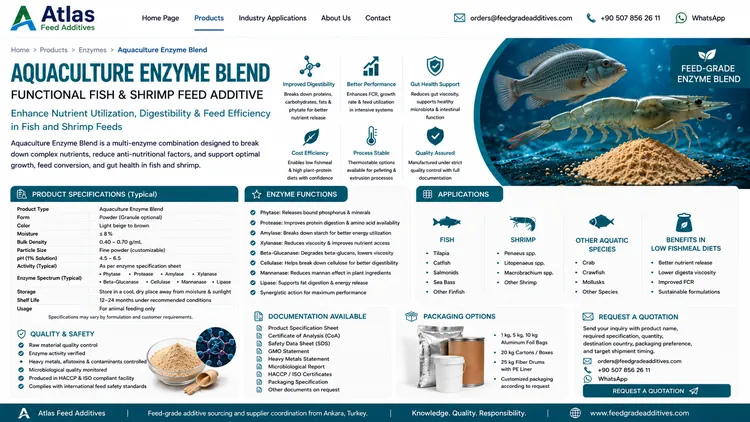
| Product identity |
Trade name, technical name, product category, feed-grade status, intended species, intended use, and local regulatory category where available. |
Confirms that the offered product matches the buyer’s formulation purpose and regulatory category. |
| Enzyme profile |
Declared enzymes such as phytase, protease, xylanase, beta-glucanase, cellulase, mannanase, amylase, lipase, pectinase, alpha-galactosidase, or other components. |
Different enzyme combinations target different substrates and have different cost-in-use values. |
| Activity declaration |
Activity units per gram or kilogram, analytical method, minimum guaranteed activity, target activity at expiry, and whether the declaration applies before or after processing. |
Enzyme products should be compared by active units and expected activity after storage and processing, not only by price per kilogram. |
| Substrate target |
Phytate, protein, starch, arabinoxylan, beta-glucan, cellulose, mannan, lipid, pectin, or other substrate information. |
Enzyme choice should match the feed formula and ingredient matrix. |
| Physical form |
Powder, granule, coated granule, carrier-based blend, particle size, bulk density, flowability, and dusting tendency. |
Affects mixing uniformity, worker handling, dosing accuracy, segregation risk, and premix performance. |
| Carrier system |
Mineral carrier, organic carrier, starch carrier, fermentation carrier, coated carrier, oil-compatible carrier, or customer-specific carrier declaration. |
Carrier type may influence flow, compatibility, stability, moisture sensitivity, and inclusion flexibility. |
| pH profile |
Activity range and optimum pH for each declared enzyme where available. |
Digestive pH conditions differ by species and life stage, so pH activity may influence practical performance. |
| Processing tolerance |
Thermostability data, conditioning temperature tolerance, extrusion tolerance, coating protection, drying tolerance, and post-process recovery data. |
Aquafeed extrusion and pelleting can reduce enzyme activity if the product is not protected or applied correctly. |
| Application route |
Premix inclusion, pre-pellet addition, pre-extrusion addition, post-pellet coating, oil coating, liquid application, or top-dress guidance. |
Application point affects enzyme survival, distribution, operator handling, and activity in finished feed. |
| Moisture and water activity |
Moisture range, water activity where available, humidity protection, storage conditions, and opened-bag guidance. |
Enzymes are sensitive biological proteins and may lose activity when exposed to unsuitable moisture or storage conditions. |
| Microbiological quality |
Total plate count, yeast and mold, Salmonella status, Enterobacteriaceae limits, E. coli limits, and other relevant microbiological parameters. |
Supports feed safety, especially for imported additives and premix applications. |
| Contaminants |
Heavy metals, mycotoxins, dioxins or PCBs where relevant, pesticide residues where relevant, and unwanted impurities. |
Supports feed safety, export compliance, and buyer-specific quality programs. |
| Stability |
Shelf-life, expiry date, retest date, activity retention during storage, storage temperature, and humidity limits. |
Helps buyers manage inventory planning, shipment routes, warehouse conditions, and production scheduling. |
| Packaging |
Net weight, bag type, inner liner, carton or drum option, pallet configuration, container loading estimate, label language, and batch coding. |
Affects logistics, warehouse control, moisture protection, traceability, and feed mill receiving procedures. |
| Documents |
Technical data sheet, specification, COA, SDS, origin statement, batch details, GMO or non-GMO statement where relevant, allergen statement, BSE/TSE statement, and market-specific certificates. |
Allows importers and feed manufacturers to confirm compliance before shipment. |