Aquaculture functional additives

Squid Flavor Attractant

Squid Flavor Attractant is an aquaculture palatability additive used to support feed intake, feeding response, and acceptance of fish and shrimp feeds, especially in functional diets and low-fishmeal formulations.

Atlas Feed Additives supports international buyers with Squid Flavor Attractant sourcing, marine-source review, active specification comparison, water-stability checks, quality-document coordination, packaging options, and export-focused quotation service for aquafeed mills, shrimp feed producers, fish feed manufacturers, premix producers, distributors, and aquaculture nutrition companies.

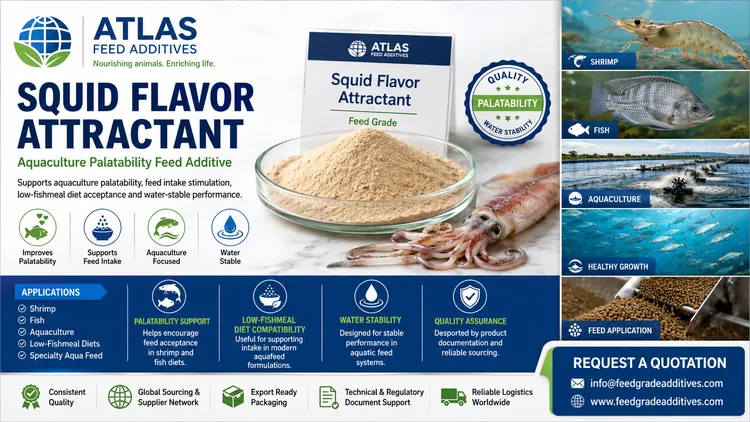
Squid Flavor Attractant feed additive visual

Product role

Where Squid Flavor Attractant fits

Squid Flavor Attractant is part of the aquaculture functional additives group. It is commonly evaluated in shrimp and fish feed formulations where rapid feed detection, feed acceptance, palatability, intake consistency, and reduced feed waste are important commercial goals. It can be used in starter diets, grow-out feeds, hatchery feeds, functional feeds, and formulas with reduced marine ingredient levels.

Buyers typically evaluate this product by marine source, active attractant profile, soluble fraction, peptide level, amino acid profile, odor intensity, taste profile, water stability, carrier system, particle size, heat or extrusion tolerance, shelf-life, microbiological status, heavy metal limits, origin, and documentation quality. Because aquaculture attractants vary widely, a product name alone is not enough for a meaningful price comparison.

Atlas Feed Additives can coordinate international supplier options for customers that need consistent feed-grade material, responsive documentation, export support, and clear comparison of technical and commercial offers.

Technical identity

Product names and commercial descriptions

Suppliers may describe squid-based attractants using different technical and commercial names. Buyers should confirm the exact composition, source material, processing method, carrier system, and intended aquafeed application before approving a supplier.

  • Squid Flavor Attractant
  • Squid Attractant
  • Squid-Based Feed Attractant
  • Squid Flavor Feed Additive
  • Aquaculture Feed Attractant
  • Shrimp Feed Attractant
  • Fish Feed Palatability Additive
  • Marine Flavor Attractant
  • Squid Hydrolysate Flavor
  • Water-Stable Aquafeed Attractant

Palatability role

Why attractants matter in aquafeed

In aquaculture, feed must be detected, accepted, and consumed quickly before nutrients leach into water or pellets break down. A well-matched attractant can support feeding response and help maintain intake when formulas change or marine ingredients are reduced.

  • Supports feed detection and acceptance in fish and shrimp
  • Helps improve palatability in low-fishmeal or alternative-protein diets
  • Useful in starter, hatchery, nursery, and transition feeds
  • Can support feed intake during stress linked to handling, water quality, or diet change
  • Helps reduce uneaten feed risk when used correctly
  • Can complement nucleotides, betaine, amino acids, peptides, hydrolysates, and marine meals

Formulation value

A marine palatability tool for shrimp and fish diets

Squid Flavor Attractant is commonly selected when formulators need a marine sensory profile that encourages feed approach, biting, intake, and diet acceptance. It may be especially useful when fishmeal, squid meal, krill meal, shrimp meal, or other marine ingredients are reduced for cost, sustainability, or formulation flexibility.

The practical value of the product depends on active composition, water stability, solubility, coating behavior, pellet processing tolerance, odor intensity, and consistency between batches. A meaningful comparison should consider delivered attractant value, not only the price per kilogram.

Typical applications

Where Squid Flavor Attractant is commonly evaluated

Squid Flavor Attractant may be used in extruded feeds, pelleted feeds, crumble feeds, microdiets, coated products, functional aquafeeds, and specialty premixes. Final use should always match the species, feed format, application method, processing conditions, water stability target, and local feed regulations.

Shrimp feed

Used in vannamei, monodon, and other shrimp diets where feed search behavior, palatability, water stability, and intake consistency are critical. Buyers should review leaching behavior, coating options, pellet durability, and attraction under pond or tank conditions.

Marine fish feed

Reviewed for seabass, seabream, grouper, flounder, cobia, salmonids, and other marine fish feeds where feed acceptance, fishmeal reduction, and marine flavor positioning are important.

Freshwater fish feed

Evaluated in tilapia, carp, catfish, trout, pangasius, eel, and other freshwater feeds where palatability, intake consistency, alternative protein use, and pellet quality are important.

Starter and nursery diets

Useful in larval, juvenile, nursery, and starter programs where animals are sensitive to feed smell, taste, texture, and particle size. Microdiet compatibility and water stability should be checked carefully.

Low-fishmeal formulas

Reviewed when fishmeal or marine ingredients are reduced and plant proteins, single-cell proteins, insect meals, rendered meals, or other alternative ingredients are increased. Attractant support may help maintain acceptance of the adjusted formula.

Functional aquafeeds

Can be included in formulas containing probiotics, prebiotics, organic acids, enzymes, immunonutrients, pigments, vitamins, minerals, or health-support additives where maintaining feed intake is important.

Specification guide

What to check before approving a Squid Flavor Attractant supplier

Squid Flavor Attractant specifications vary by source material, processing method, carrier, physical form, active fraction, and target application. Buyers should align the following details before comparing offers.

Parameter Why it matters What to request
Marine source declaration Confirms whether the product is squid-derived, squid-flavored, hydrolysate-based, or a formulated marine attractant blend. Source material, origin, species or raw-material description, and supplier declaration.
Active attractant profile Determines the product's practical value for feed attraction and palatability. Peptide, amino acid, soluble fraction, nucleotide, betaine-like component, or flavor-profile information where available.
Protein or peptide level Useful when the product is hydrolysate-based or positioned as a marine peptide attractant. Crude protein, peptide level, degree of hydrolysis, amino nitrogen, or amino acid profile if available.
Physical form Affects dosing, mixing, coating, extrusion, dusting, and handling. Powder, granule, liquid, coated powder, carrier-based blend, bulk density, and appearance.
Water stability Aquafeed attractants must remain effective long enough for feed detection and intake without excessive leaching. Water-stability guidance, leaching data, recommended coating method, or application timing.
Heat and extrusion tolerance Processing can reduce volatile flavor value or change active fractions. Pelleting, extrusion, drying, coating, or post-application guidance from the supplier.
Odor intensity and consistency Strong marine odor can affect palatability, warehouse handling, cross-contamination risk, and batch consistency. Odor description, sensory profile, batch consistency data, and storage guidance.
Carrier system Carrier affects active concentration, flowability, mixing, label declaration, and cost per active unit. Carrier type, feed-grade declaration, carrier percentage, allergen status, and GMO statement where required.
Salt and ash Marine ingredients can contribute salt and ash that may affect formulation limits and osmoregulation-sensitive diets. Salt, ash, mineral profile, and sodium or chloride levels when relevant.
Microbiological quality Important for aquafeed safety, export approval, and customer audits. Total plate count, yeast and mold, Salmonella, E. coli, coliforms, Vibrio where required, and other requested parameters.
Heavy metals and marine contaminants Marine-source products may require additional checks for feed safety and import approval. Lead, arsenic, cadmium, mercury, dioxins, PCBs, histamine where relevant, and other buyer-specific contaminant limits.
Regulatory suitability Permitted use, species claims, origin declarations, and import requirements differ by destination market. Feed-grade declaration, origin statement, market-specific compliance documents, and label guidance.

Formulation considerations

How buyers evaluate practical use

Squid Flavor Attractant should be evaluated as a functional palatability tool within the full aquafeed formula. Its performance depends on dose, application method, feed format, pellet water stability, species feeding behavior, and the background palatability of the base diet.

  • Confirm whether the attractant is mixed before extrusion or applied after processing.
  • Review compatibility with oils, binders, coatings, enzymes, probiotics, organic acids, pigments, and medications where applicable.
  • Check whether the product is designed for shrimp, fish, or both.
  • Evaluate leaching risk in water before feeding response occurs.
  • Match particle size and flowability with the feed mill dosing system.
  • Consider whether the product supports low-fishmeal, plant-protein, or functional diet concepts.
  • Review odor transfer risk to nearby ingredients and finished feed.
  • Use qualified aquaculture nutritionist guidance for inclusion levels and application method.

Application review

Questions before use

  • Which species and life stage will use the feed?
  • Is the target product a shrimp feed, fish feed, hatchery feed, nursery feed, grow-out feed, or functional feed?
  • Will the attractant be included before extrusion, after extrusion, by coating, or in a premix?
  • What fishmeal or marine ingredient reduction target is being used?
  • What pellet size, water stability, and feeding time are required?
  • Will the formula include high plant protein, insect meal, single-cell protein, or rendered animal protein?
  • Are there limits on odor intensity, salt, ash, marine allergens, or raw-material origin?
  • Does the destination country require special registration, import documents, or species-specific labeling?

Buyer quality checklist

Documents to request for Squid Flavor Attractant

Documentation requirements vary by buyer, country, species, and application. For aquaculture attractants, procurement teams normally request a complete technical, quality, marine-source, and regulatory package before approving a new supplier.

Core product documents

  • Product specification sheet
  • Certificate of Analysis
  • Safety Data Sheet
  • Technical Data Sheet
  • Manufacturing date, batch number, and shelf-life
  • Country of origin statement
  • Feed-grade declaration
  • Recommended storage and application guidance

Marine-source documents

  • Squid-source or marine-source declaration
  • Raw-material origin statement
  • Species or source description when available
  • Hydrolysate or processing-method statement when relevant
  • Carrier and processing-aid declaration
  • Allergen declaration for marine-derived material
  • Sustainability or fishery documentation where requested by the buyer

Analytical and safety controls

  • Protein, peptide, amino nitrogen, or amino acid data where available
  • Moisture, ash, salt, and water activity
  • Microbiological limits
  • Heavy metal limits
  • Dioxin, PCB, or PAH statement when requested
  • Histamine or biogenic amine data when relevant
  • GMO, BSE/TSE, animal-origin, and customer-specific statements when required

Market certificates

  • Halal certificate when required
  • Kosher certificate when required
  • ISO, GMP+, HACCP, FAMI-QS, or similar quality-system documents when available
  • Free sale certificate or registration support when needed
  • Import documentation support for the destination country
  • Customer-specific questionnaire or vendor approval package

Procurement note

Ask for the right specification before comparing prices.

Price comparisons are meaningful only when marine source, active attractant profile, protein or peptide level, carrier, physical form, application method, water stability, packaging, shelf-life, origin, regulatory status, and documentation are aligned. A lower price per kilogram may not be the best value if the product has weak attraction, poor water stability, unclear marine-source documentation, high carrier dilution, or unsuitable processing tolerance.

For sensitive aquafeed products, buyers should also review feed format, pellet size, coating system, extrusion exposure, target feeding behavior, farm conditions, and destination-market rules. Atlas Feed Additives can help collect supplier information so your technical, regulatory, and purchasing teams can compare offers clearly.

Storage and handling

Practical warehouse guidance

Storage and handling should always follow the supplier's SDS, label, and technical sheet. Marine flavor products can be sensitive to moisture, heat, oxidation, odor transfer, and microbial quality risks if packaging is damaged or storage conditions are poor.

  • Keep bags, drums, cartons, or containers tightly closed when not in use.
  • Store in a clean, cool, dry, well-ventilated warehouse.
  • Protect from humidity, condensation, and direct water contact.
  • Avoid excessive heat and direct sunlight.
  • Segregate from odor-sensitive ingredients when necessary.
  • Prevent contamination with non-feed materials.
  • Use appropriate personal protective equipment according to the SDS.
  • Maintain batch traceability and first-in, first-out stock rotation.
  • Do not use expired, caked, wet, or damaged material without quality approval.

Packaging options

Common commercial packing

Available packaging depends on supplier, product form, order size, and export route. Atlas Feed Additives can request packaging alternatives during quotation.

  • Small bags for premix and hatchery feed users
  • Aluminum foil bags for moisture- and odor-sensitive blends
  • Multi-layer paper or composite bags with inner liner
  • Fiber drums or plastic drums for specialty formats
  • HDPE drums or sealed containers for liquid products
  • Palletized cargo for safer export handling
  • Customer-specific labeling when available
  • Sample packing for palatability trials when supplier policy allows
  • Container-load options for distributors and aquafeed mills

Quotation preparation

Information to send for a faster Squid Flavor Attractant offer

To prepare a complete quotation, please include technical, commercial, and documentation requirements. This helps match the correct supplier, product form, packing, and export document package.

Product requirements

  • Required product name: Squid Flavor Attractant
  • Target species: shrimp, fish, hatchery, nursery, or grow-out application
  • Required product form: powder, granule, liquid, hydrolysate, coated, or carrier-based blend
  • Application method: pre-extrusion, post-coating, premix, or direct feed inclusion
  • Water-stability or leaching requirement
  • Current specification sheet if available
  • Any approved source, manufacturer, or audit requirement

Commercial requirements

  • Required quantity
  • Trial order, spot order, tender, or regular monthly volume
  • Destination country and destination port
  • Preferred Incoterms
  • Target delivery schedule
  • Preferred payment and shipping document requirements

Documentation requirements

  • Specification and COA
  • SDS and technical data sheet
  • Marine-source and origin declaration
  • Feed-grade statement
  • Heavy metals and microbiology limits
  • Allergen, GMO, BSE/TSE, halal, kosher, or customer-specific statements
  • Registration, import, or audit documents required by your market

Commercial support

How Atlas Feed Additives supports your purchase

Supplier matching

We review your target species, product form, attractant profile, processing conditions, destination market, order size, packaging preference, and documentation needs to identify suitable Squid Flavor Attractant supplier options.

Specification comparison

We help collect and organize key details such as marine source, active profile, protein or peptide level, amino acid data, solubility, water stability, carrier, origin, shelf-life, packing, and available batch documents.

Document coordination

We coordinate supplier communication for specifications, COA, SDS, technical data sheets, origin declarations, marine-source statements, feed-grade documents, quality-system certificates, and other documents required for import or customer approval.

Export-focused service

We support international customers with quotation follow-up, packing clarification, shipment timing, document expectations, and communication from Ankara, Turkey.

Questions

Useful answers

What is Squid Flavor Attractant used for in animal nutrition?

Squid Flavor Attractant is used in aquaculture feeds to support palatability, feeding response, feed acceptance, intake consistency, and functional feed performance in fish and shrimp programs. It should be used according to the target species, formulation objective, processing method, and applicable market rules.

Which species commonly use Squid Flavor Attractant?

It may be reviewed for shrimp, tilapia, trout, salmon, carp, catfish, pangasius, seabass, seabream, grouper, eel, and other aquaculture species. Final suitability depends on species, life stage, feed format, water stability, and formulation target.

Why is Squid Flavor Attractant useful in low-fishmeal diets?

When fishmeal or other marine ingredients are reduced, feed aroma and taste can change. Squid Flavor Attractant can help support feed acceptance and palatability in formulas that include more plant proteins, alternative proteins, rendered meals, or functional additives.

Can Squid Flavor Attractant be used in extruded feeds?

It may be used in extruded feeds when the product is suitable for the processing method. Buyers should request supplier guidance on heat tolerance, post-coating options, water stability, leaching behavior, and recommended inclusion point.

What should buyers compare before purchasing Squid Flavor Attractant?

Buyers should compare marine source, active attractant profile, protein or peptide level, amino acid data, physical form, solubility, water stability, odor intensity, carrier system, heat tolerance, packaging, shelf-life, documentation, origin, and destination-market suitability.

What quality documents should buyers request for Squid Flavor Attractant?

Common documents include product specification, certificate of analysis, safety data sheet, technical data sheet, origin statement, marine-source declaration, batch details, shelf-life, microbiological quality, heavy metal limits, contaminant controls, and market-specific certificates required by the buyer.

Can Atlas Feed Additives quote Squid Flavor Attractant?

Yes. Send your required specification, target species, feed type, quantity, destination, packaging preference, processing conditions, and documents so Atlas Feed Additives can review suitable supplier options for Squid Flavor Attractant.

What should be included in a quotation request?

Please include the product name, target species, feed type, product form, required quantity, destination country and port, Incoterms, packaging preference, required documents, processing method, water-stability requirement, and whether the order is for a trial, spot purchase, tender, or regular supply.

How should Squid Flavor Attractant be stored?

Follow the supplier's SDS and technical sheet. In general, keep Squid Flavor Attractant in tightly closed packaging in a clean, cool, dry, ventilated area, away from moisture, excessive heat, direct sunlight, incompatible materials, and odor-sensitive goods.

Can Squid Flavor Attractant be combined with probiotics, enzymes, or organic acids?

It may be combined with aquaculture probiotics, enzymes, organic acids, prebiotics, pigments, or other functional additives when compatible. Buyers should request supplier guidance because pH, heat, moisture, coating method, and storage conditions can affect different additive systems.

Request a quotation

Tell us what you need

Send your product list, target specification, species application, feed type, processing conditions, destination country, packaging preference, quantity, and required documents. Our team will review your request and respond from orders@feedgradeadditives.com.

Suggested message details

  • Required product: Squid Flavor Attractant
  • Target species and life stage
  • Feed type: shrimp feed, fish feed, hatchery feed, nursery feed, or grow-out feed
  • Application method: pre-extrusion, post-coating, premix, or direct inclusion
  • Water-stability or leaching requirement
  • Required quantity and delivery schedule
  • Destination country and port
  • Required documents and certificates
  • Current specification sheet if available