Aquaculture functional additives

Aquaculture Prebiotic Blend

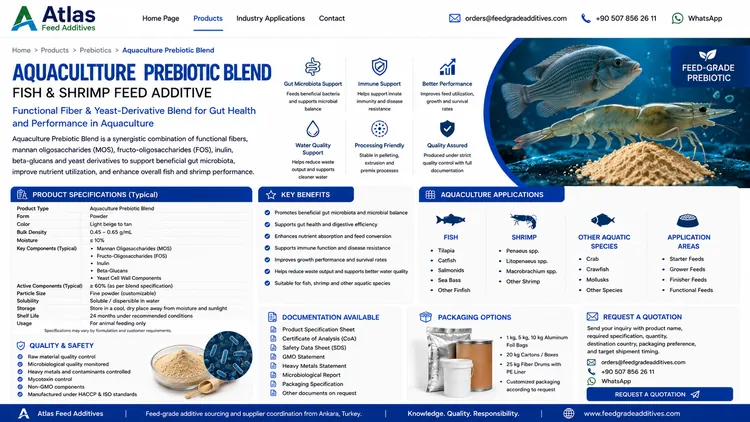
Aquaculture Prebiotic Blend is a feed-grade functional additive concept for fish and shrimp feeds, typically reviewed for gut microbiota support, digestive resilience, functional fiber contribution, low-fishmeal diet strategies, plant-protein diet support, and stress-period feeding programs.

Atlas Feed Additives helps aquafeed producers, premix manufacturers, integrators, distributors, fish producers, shrimp producers, hatchery operators, and aquatic animal nutrition companies request supplier options with clear specifications, active-component descriptions, source-material details, processing-stability information, packaging details, and export-focused documentation.

Fish feed Shrimp feed Functional aquafeeds Gut support Low-fishmeal diets Documentation
Aquaculture Prebiotic Blend feed additive visual

Product role

Where Aquaculture Prebiotic Blend fits

Aquaculture Prebiotic Blend is part of the aquaculture functional additives group. In practical sourcing discussions, buyers usually evaluate this type of product by reviewing the active prebiotic components, source material, carrier, physical form, solubility or dispersibility, processing tolerance, intended aquaculture species, feed form, application method, inclusion guidance, and destination-market documentation requirements.

In aquafeed programs, prebiotic blends are commonly considered as one part of a wider nutrition and farm-management strategy. That wider strategy may include raw-material quality, feed hygiene, water quality, pond or tank management, probiotics, organic acids, enzymes, yeast derivatives, attractants, binders, pigments, mineral programs, immunostimulant concepts, and species-specific nutrition.

Prebiotic blends should not be evaluated by product name alone. Two offers may both be described as “aquaculture prebiotic blend” while differing significantly in active component level, yeast-cell-wall fraction, fiber source, purity, particle size, carrier, solubility, documentation, label status, packaging, and cost-in-use.

Atlas Feed Additives can coordinate international supplier options for aquafeed mills, premix producers, distributors, integrators, fish producers, shrimp producers, and animal nutrition companies that need consistent feed-grade material with clear commercial and technical documentation.

Typical applications

Application areas buyers may discuss

  • Shrimp, tilapia, trout, salmonid, carp, catfish, pangasius, seabass, seabream, sturgeon, ornamental fish, and other aquaculture feed programs
  • Hatchery, nursery, grow-out, and finishing-stage feed concepts where permitted and technically appropriate
  • Functional aquafeeds designed around digestive support, gut-environment management, microbial balance, and resilience during production stress
  • Low-fishmeal or plant-protein diets where functional fibers and fermentable substrates are considered as part of a broader gut-support strategy
  • Feeds used during handling, grading, transport, salinity change, water-quality changes, temperature fluctuation, or other stress-sensitive periods
  • Programs combining prebiotics with probiotics, organic acids, enzymes, yeast derivatives, attractants, binders, pigments, or immunostimulant concepts where compatibility is confirmed
  • Pelleted, crumbled, coated, extruded, cold-pelleted, microbound, or top-dressed aquafeed applications depending on product form and supplier guidance
  • Premix systems for aquafeed manufacturers requiring standardized functional additive packages with consistent documentation

Buyer quality checklist

Information to request before comparing offers

  • Declared prebiotic components or active functional ingredients
  • Source material, carrier, physical form, moisture level, particle size, and flowability
  • Active level, marker compounds, purity, fiber fraction, yeast-cell-wall fraction, or blend ratio where available
  • Water dispersibility, feed-mixing behavior, coating suitability, and compatibility with aquafeed processing
  • Pelleting, extrusion, coating, cold-pellet, microdiet, or post-pellet application tolerance
  • Recommended storage conditions, remaining shelf life, humidity limits, and packaging barrier quality
  • Species-specific use guidance, suggested inclusion range, and practical application method where available
  • Specification, certificate of analysis, safety data sheet, origin information, label information, and export documents
  • Microbiological data, contaminant statements, heavy metal information, allergen or GMO statements, and market-specific declarations when required

Specification focus

Ask for the right component profile before comparing prices.

Price comparisons are only meaningful when the offered products have comparable active components, source material, blend ratio, carrier, physical form, particle size, moisture, packaging, shelf life, inclusion guidance, processing tolerance, and document package. A low price may not be useful if the product does not meet the intended feed-processing, storage, or destination-market requirements.

For aquaculture prebiotic blends, buyers should also clarify whether the product is intended for direct feed inclusion, premix use, post-pellet coating, oil coating, water application, hatchery use, nursery diets, microdiets, or another application route. Suitability may differ depending on species, production stage, feed technology, water system, and supplier directions.

Buyers should identify whether the product is a single prebiotic ingredient, a multi-component prebiotic blend, a yeast-derived product, a plant-fiber concept, a seaweed-derived product, a fermentation-derived product, or a synbiotic-style concept that also includes live microorganisms. Each category requires different technical and documentation review.

Suggested specification request

“Please quote Aquaculture Prebiotic Blend with declared active components, source material, carrier, active level or blend ratio, marker compounds if available, recommended inclusion, processing tolerance, shelf life, storage condition, packing, origin, COA, SDS, microbiological data, contaminant statements, and destination-market documentation for shipment to [destination].”

Technical evaluation

Key points for aquafeed formulation and processing teams.

Component profile

Confirm whether the blend contains mannan oligosaccharides, fructooligosaccharides, inulin, beta-glucans, yeast derivatives, cell-wall fractions, functional fibers, plant extracts, seaweed derivatives, fermentation substrates, or other gut-support ingredients.

Source material

Review whether the product is derived from yeast, plant fiber, chicory, seaweed, cereal fiber, fermentation material, legume fiber, purified carbohydrate fractions, or a supplier-specific blend. Source can affect composition, consistency, documentation, and label wording.

Active level

Ask whether the supplier declares beta-glucan content, MOS content, FOS content, inulin level, soluble fiber, insoluble fiber, total dietary fiber, marker compounds, yeast-cell-wall fraction, or another measurable quality parameter.

Processing tolerance

Check whether the product is suitable for pelleting, extrusion, steam conditioning, coating, microdiet production, or post-pellet application. Heat, moisture, pressure, drying time, and shear can affect physical quality or functional consistency.

Feed application method

Clarify whether the product is designed for premix inclusion, direct feed mixing, top coating, oil-based coating, water application, microdiet inclusion, or another route. Application method affects uniform distribution and practical use.

Compatibility

Review compatibility with probiotics, organic acids, enzymes, minerals, binders, essential oils, antioxidants, attractants, pigments, medications where relevant, and other additives used in the same premix or finished feed.

Physical behavior

Check flowability, dust level, caking tendency, bulk density, particle size, segregation risk, and mixing uniformity. These details matter for premix production, micro-ingredient dosing, and finished-feed consistency.

Regulatory positioning

Confirm whether the product is sold as a feed material, technological additive, zootechnical additive, sensory support ingredient, functional blend, or another category in the destination market. Classification affects labels and permitted claims.

Species and feed-stage examples

  • Shrimp feeds: hatchery, nursery, grow-out feed concepts, molting-period support, pond-stress periods, low-fishmeal diets, and gut-environment programs
  • Tilapia feeds: plant-protein diets, gut-support programs, feed-efficiency strategies, high-density systems, and stress-period applications
  • Trout and salmonid feeds: performance diets, oil-rich feeds, pigment programs, plant-protein inclusion strategies, and digestive-support concepts
  • Carp and catfish feeds: commercial grow-out diets, pond-management programs, cost-sensitive formulas, and functional feed positioning
  • Marine fish feeds: seabass, seabream, and other species where feed intake, gut support, raw-material transitions, and production resilience are commercial priorities
  • Hatchery and nursery feeds: microdiets, crumbles, small-particle feeds, and early-stage programs where uniformity, water behavior, and product stability need special review

Aquaculture context

Product choice depends on species, water system, feed form, and production stage.

A prebiotic blend that fits one aquaculture program may not automatically fit another. Shrimp production, freshwater fish systems, marine cage culture, recirculating aquaculture systems, pond systems, raceways, hatcheries, nurseries, and grow-out operations can have different feed forms, feeding behavior, water-quality pressure, disease pressure, density levels, raw-material profiles, and regulatory requirements.

Before purchasing, buyers should define the target species, feed type, production stage, expected challenge, application method, water system, feed-processing conditions, and whether the additive is intended for general feed inclusion, functional feed positioning, a low-fishmeal reformulation, or a specific stress-period program.

The commercial evaluation should also consider whether the product will be used continuously, seasonally, during diet transitions, during hatchery or nursery periods, during transport preparation, after handling stress, or as part of a broader functional aquafeed strategy.

Aquafeed production

Processing route can determine the right prebiotic format.

Extruded feed

Extrusion exposes ingredients to heat, moisture, pressure, shear, and drying. Buyers should confirm whether the prebiotic blend maintains physical quality and functional consistency under the intended extrusion conditions.

Pelleted feed

Steam conditioning and pelleting may affect some components, carriers, binders, or coatings. Ask for pelleting guidance, expected tolerance, and whether the product is better added before or after pelleting.

Post-pellet coating

Some blends may be compatible with post-processing coating systems. Oil compatibility, suspension behavior, dosing accuracy, mixing time, and coating uniformity should be reviewed.

Premix inclusion

Premix storage can expose prebiotics to minerals, acids, enzymes, probiotics, vitamins, pigments, and other active ingredients. Compatibility and storage duration should be checked before inclusion in premix systems.

Microdiets and crumbles

Small-particle feeds require attention to particle size, uniform distribution, segregation risk, dusting, water stability, leaching, and practical inclusion level.

Water application

If the product is intended for water application rather than feed inclusion, dispersion, salinity, contact time, system type, and local approval status should be reviewed separately.

Component review

Important questions for the supplier

  • Which prebiotic components or active functional ingredients are included?
  • Is the product based on yeast derivatives, MOS, beta-glucans, FOS, inulin, plant fiber, seaweed, fermentation material, or a blended concept?
  • Is any marker level declared, such as beta-glucans, MOS, FOS, inulin, soluble fiber, total dietary fiber, or yeast-cell-wall fraction?
  • What is the recommended inclusion rate by species, feed type, or production stage?
  • Is the product designed for extrusion, pelleting, direct mixing, premix inclusion, coating, or water application?
  • Does the supplier provide processing-stability or application guidance?
  • Are there compatibility warnings with acids, probiotics, enzymes, minerals, preservatives, or heat treatment?
  • Which documents are available before shipment and which are available after batch allocation?

Commercial review

Important questions for the purchasing team

  • Is the product approved or acceptable in the destination market?
  • Does the supplier provide documents before shipment or only after payment?
  • Is the minimum order quantity suitable for the buyer’s usage rate and shelf life?
  • Does packaging protect the product during long-distance transport and humid storage?
  • Is the offer valid long enough for technical and regulatory review?
  • Can the supplier support repeat orders with consistent component profile and quality documents?
  • Does the total landed cost include freight, duties, documents, palletizing, and storage risk?
  • Can the product be sampled or evaluated before a long-term supply program?

Documentation

Quality documents help confirm the product behind the quotation.

For prebiotic blends, documentation should support the active component profile, source material, feed-grade suitability, storage conditions, application guidance, and batch traceability. Documentation availability may differ by supplier, destination country, batch status, product registration, and order stage.

Atlas Feed Additives can coordinate available supplier documents so buyers can review product suitability before confirming an order. Final regulatory acceptance, permitted use, label wording, claims, and local authorization remain the buyer’s responsibility.

Specification sheet

Should identify product description, active component profile, source material, carrier, appearance, physical form, moisture, particle size, packing, storage, shelf life, and suggested inclusion.

Certificate of analysis

May include batch number, production date, expiry date, moisture, active marker level, microbiological data, contaminant checks, heavy metal data, and other product-specific release parameters.

Safety data sheet

Useful for handling, transport, warehouse, safety, spill response, and workplace documentation, especially when importing into formal feed supply chains.

Origin and export documents

Buyers may request origin information, packing list, commercial invoice, transport documents, label details, and market-specific certificates depending on destination.

Regulatory information

Where available, request permitted species, allowed label category, claims guidance, inclusion limits, and destination-market documentation.

Source and declaration data

Buyers may request GMO status, allergen statement, BSE/TSE statement, fermentation-source information, animal-origin status, vegan suitability, or religious certification where relevant.

Commercial evaluation

Compare cost-in-use, not only price per kilogram.

Aquaculture prebiotic offers should be compared by technical equivalence and practical value. The cheapest offer may not be the most economical if the product has lower active content, unclear composition, unsuitable packaging, poor flowability, weaker dispersibility, shorter shelf life, missing documents, or limited supplier support.

Active component level

Compare declared active components, marker levels, blend ratios, and recommended inclusion. Cost-in-use depends on functional concentration and dose, not only invoice price.

Processing suitability

If the product is exposed to heat, pressure, moisture, drying, or coating systems, review whether the supplier provides processing-stability data or recommends post-processing application.

Packaging and shelf life

Review bag or carton type, moisture barrier, inner liner, net weight, pallet configuration, storage requirement, production date, expiry date, and remaining shelf life.

Supplier reliability

Consider documentation speed, batch traceability, export experience, lead time, offer validity, repeat-supply capacity, and willingness to clarify technical questions.

Destination rules

Confirm whether the prebiotic or functional additive is permitted in the destination market, species, feed type, inclusion level, and label format before purchasing.

Total landed cost

Review product price together with freight, duties, document fees, packaging, minimum order quantity, storage cost, customs risk, and possible quality risk during long transit.

Questions to send with your inquiry

  1. Which prebiotic components or active functional ingredients are included?
  2. What source material is used: yeast, plant fiber, chicory, seaweed, cereal fiber, fermentation material, or another source?
  3. Is any marker level declared, such as MOS, FOS, beta-glucans, soluble fiber, inulin, or total active fraction?
  4. What carrier and physical form does the product use?
  5. Is the product suitable for pelleting, extrusion, microdiet production, or post-pellet coating?
  6. What species and feed stages are covered by supplier guidance?
  7. What is the recommended inclusion rate or application method?
  8. What storage temperature and humidity limits apply?
  9. Which documents are available before shipment?
  10. Are complementary probiotic, organic acid, enzyme, immunostimulant, attractant, binder, yeast derivative, or pigment products available?
  11. Can the supplier provide a sample, retained batch reference, or trial quantity?
  12. Is the product designed for feed inclusion, water application, or both?

Procurement note

Ask technical questions before comparing supplier prices.

In aquaculture prebiotic sourcing, two offers with the same product name may differ significantly in active composition, source material, carrier, functional concentration, processing stability, shelf life, packaging, application guidance, and document support. A structured inquiry helps ensure that suppliers quote the right material.

Atlas Feed Additives can help buyers review supplier options, coordinate document requests, and organize quotations in a way that supports technical, purchasing, quality, regulatory, and import teams.

Handling and storage

Prebiotic quality depends on careful storage and application.

Prebiotic blends are generally more stable than many live microbial products, but they can still be affected by moisture, poor packaging, contamination, excessive heat, storage time, pests, damaged bags, and incompatible premix conditions. Buyers should verify storage recommendations and application limits before selecting a product for premix or feed production.

For export shipments, long transit time, hot containers, humidity, customs delays, and warehouse conditions can affect sensitive additives. Packaging selection, pallet protection, shipment timing, and remaining shelf life should be reviewed before confirming order quantity.

Opened packaging should normally be closed tightly and used according to supplier guidance. Feed plants should avoid unnecessary exposure to humid air, high heat, chemical fumes, strong odors, pests, and contamination sources.

Warehouse storage

Keep products in original packaging, away from heat, moisture, pests, strong odors, and direct sunlight. Follow supplier temperature and humidity guidance.

FIFO rotation

Use first-in, first-out inventory rotation and check production date, expiry date, and remaining shelf life before issuing material to production.

Premix handling

Review whether extended premix storage or contact with minerals, acids, oils, enzymes, probiotics, salts, or other active ingredients may affect product quality.

Feed processing

Confirm whether the product should be included before processing, after pelleting, in a coating system, through a premix, or through another application route.

Transport protection

For sea freight or long road transport, review container heat, humidity, pallet wrapping, inner liner quality, and moisture-barrier packaging.

Production records

Record batch number, inclusion level, feed batch, production date, and application route so finished-feed traceability is maintained.

Program design

Aquaculture prebiotic blends are often evaluated with complementary additives.

In functional aquafeed design, prebiotic blends may be considered alongside probiotics, synbiotics, organic acids, enzymes, attractants, pigments, binders, yeast derivatives, immunostimulant concepts, nucleotides, mineral programs, and water-quality support concepts. The best approach depends on species, raw-material profile, production system, target challenge, feed-processing technology, and local rules.

Buyers can request a single product or ask Atlas Feed Additives to review a broader aquaculture functional additive program based on the intended species, diet type, quantity, destination, and document requirements.

Prebiotic plus probiotic concepts

Some buyers evaluate synbiotic-style programs where selected prebiotic substrates are paired with probiotic microorganisms. Compatibility, registration status, inclusion level, strain fit, and supplier guidance should be reviewed.

Prebiotic plus organic acid concepts

Organic acids may be used in aquafeed strategies, but acids can affect some additives depending on product form and application route. Compatibility testing and supplier guidance are important.

Prebiotic plus enzyme concepts

Enzymes may support nutrient utilization in selected diets, especially plant-protein or high-fiber formulations. Processing conditions and additive compatibility should be reviewed before blending.

Prebiotic plus attractant concepts

Attractants may support feed intake, while prebiotic blends may be reviewed for functional feed positioning. Coating method, feed stability, and application sequence can affect both components.

Broader aquaculture portfolio

Build a functional aquafeed inquiry around the full production challenge.

Aquaculture feed programs often need more than one additive category. A shrimp nursery feed may require different support than a marine fish grow-out diet, a freshwater pond system, a RAS system, a hatchery microdiet, or a premium salmonid feed. The right inquiry should describe the species, feed form, production stage, processing technology, water system, climate, raw-material profile, target challenge, and required documents.

Atlas Feed Additives can support structured sourcing conversations for prebiotics, probiotics, organic acids, enzymes, attractants, binders, pigments, yeast derivatives, immunostimulant concepts, functional blends, and other aquaculture feed additive tools.

Risk management

Common mistakes in prebiotic sourcing

  • Comparing prices without aligning active component level, marker compound, and recommended inclusion rate
  • Assuming all MOS, FOS, inulin, beta-glucan, or yeast-derivative products perform the same way
  • Ignoring processing effects during extrusion, pelleting, drying, coating, or premix storage
  • Buying more stock than can be used within the practical shelf-life window
  • Storing products in hot, humid, or poorly ventilated warehouses
  • Mixing prebiotic blends with incompatible acids, enzymes, minerals, probiotics, or aggressive additives without review
  • Using generic product names without checking source material and documentation
  • Making label claims before confirming destination-market rules
  • Assuming a product tested in one species, water system, or feed form automatically applies to another

Best practice

How to prepare a stronger buying file

  • Define target species, feed stage, diet type, water system, and expected application route
  • Request component profile, active marker level, source material, carrier, physical form, and shelf-life guarantee
  • Collect COA, SDS, specification, origin, storage guidance, and packaging details
  • Check processing conditions and whether post-processing application is preferred
  • Review compatibility with other ingredients in the premix or final feed
  • Confirm local authorization, import rules, and label requirements
  • Compare cost-in-use rather than only product price per kilogram
  • Keep retained samples, batch records, and supplier documents for traceability

Responsible use

Final use should be confirmed by qualified technical and regulatory teams.

Aquaculture Prebiotic Blend is a feed additive sourcing topic, not a veterinary treatment claim. It should not be presented as a replacement for biosecurity, water-quality management, vaccination where applicable, veterinary oversight, raw-material control, hatchery hygiene, pond management, or correct feed manufacturing practices.

Before purchase and use, buyers should confirm permitted status, species approval, label requirements, inclusion level, claims, import documents, and compatibility with the intended feed program in the destination market.

Buyer responsibility

Product use, inclusion rate, species suitability, claims, labels, and market compliance should be reviewed by the buyer’s nutritionist, veterinarian, quality manager, regulatory specialist, or authorized local adviser. Atlas Feed Additives supports sourcing, quotation, documentation, and supplier communication.

Questions

Useful answers

What is Aquaculture Prebiotic Blend used for in animal nutrition?

Aquaculture Prebiotic Blend is typically reviewed for fish and shrimp feed programs where gut microbiota support, digestive resilience, functional fiber contribution, stress-period nutrition, low-fishmeal diet strategies, and functional aquafeed positioning are part of the formulation objective. It should be used according to the target species, supplier directions, nutritionist guidance, and applicable market rules.

Can Atlas Feed Additives quote Aquaculture Prebiotic Blend?

Yes. Send your required component profile if known, active level, source material preference, carrier preference, physical form, quantity, destination, packaging preference, processing conditions, and document requirements so Atlas Feed Additives can review suitable supplier options for Aquaculture Prebiotic Blend.

What quality documents should buyers request for Aquaculture Prebiotic Blend?

Common documents include product specification, certificate of analysis, safety data sheet, active-component information where available, batch details, origin information, shelf-life and storage guidance, packaging details, microbiological data, contaminant statements, and any market-specific certificates required by the buyer.

Which species can be discussed for this product?

Buyers may discuss shrimp, tilapia, trout, salmonids, carp, catfish, pangasius, seabass, seabream, sturgeon, ornamental fish, and other aquaculture species. Final suitability depends on product specification, diet type, water system, production stage, destination-market rules, and qualified technical review.

What is the most important specification for an aquaculture prebiotic?

There is no single universal specification. Buyers usually review active component profile, source material, marker level, carrier, physical form, processing tolerance, storage stability, recommended inclusion, species guidance, application route, and document availability together.

Can Aquaculture Prebiotic Blend be used in extruded feed?

Possibly, but suitability depends on the supplier’s product technology and the feed process. Buyers should confirm heat, pressure, moisture, shear, drying conditions, and post-processing application guidance before using any prebiotic blend in extruded or pelleted feeds.

Can this product be combined with probiotics, organic acids, or enzymes?

Combination programs may be possible, but compatibility should be reviewed carefully. Acids, heat, moisture, minerals, preservatives, probiotics, and enzymes can affect product quality or program design, depending on the product and application method.

Are aquaculture prebiotics allowed in every country?

No. Feed additive authorization, labeling, claims, inclusion levels, and species applications may vary by destination market. Buyers should confirm local requirements before purchase and use.

What should I send for a faster quotation?

Send product name, required component profile if known, target species, feed type, processing method, application route, quantity, destination country, packaging preference, required documents, preferred Incoterm, and target shipment timing.

Does Atlas Feed Additives provide veterinary or disease-treatment advice?

No. Atlas Feed Additives focuses on sourcing, quotation, documentation, and supplier coordination. Veterinary, disease-management, regulatory, and formulation decisions should be made by qualified professionals.

How should aquaculture prebiotic blends be stored?

They should generally be stored in original sealed packaging, protected from heat, moisture, direct sunlight, pests, strong odors, and contamination. Always follow the supplier’s storage-temperature, humidity, shelf-life, and handling instructions.

What is the difference between a prebiotic and a probiotic?

A probiotic normally contains live microorganisms, while a prebiotic is a substrate or functional ingredient concept intended to support beneficial microbial activity or gut-environment objectives. Product definitions and permitted claims vary by market, so buyers should confirm local rules.

What is a synbiotic concept?

A synbiotic concept generally combines probiotic and prebiotic components. In aquafeed sourcing, buyers should check compatibility, strain fit, prebiotic substrate, processing tolerance, storage stability, and destination-market authorization before purchasing a combined product.

Request a quotation

Tell us what you need

Send your target specification, component profile, active-level requirement, source-material preference, destination country, packaging preference, quantity, processing method, application route, and required documents. Our team will review your request and respond from orders@feedgradeadditives.com.

For faster evaluation, include target species, feed type, water system, production stage, expected inclusion rate, annual demand, preferred origin, shipment timing, Incoterm preference, and any local registration or document requirements.