Aquaculture functional additives

Fish Pigment Premix

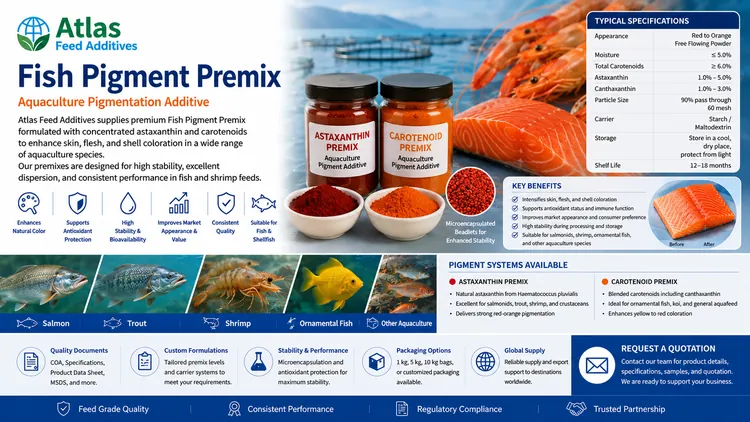
Fish Pigment Premix is an aquaculture carotenoid system designed to support target flesh, skin, and shell coloration in fish and shrimp feeds while helping feed manufacturers control pigment stability, dispersion, processing tolerance, and regulatory documentation.

Fish Pigment Premix feed additive visual

Product role

Where Fish Pigment Premix fits in aquafeed production

Fish Pigment Premix belongs to the aquaculture functional additives group. In commercial aquafeed, pigment premixes are used to deliver carotenoids such as astaxanthin, canthaxanthin, or natural carotenoid sources into fish and shrimp diets with the goal of achieving consistent, market-acceptable coloration in the final animal product.

Pigmentation programs are especially important in salmonids such as salmon and trout, where flesh color is a key market attribute, and in shrimp or crustacean feeds, where shell coloration, cooked color, and consumer appearance may influence product value. Some specialty aquaculture and ornamental species may also require pigment programs for skin, scale, fin, or external color expression.

Buyers usually evaluate Fish Pigment Premix by matching active carotenoid level, pigment source, assay method, isomer profile where relevant, beadlet or coating technology, carrier, dispersion behavior, extrusion stability, water stability, target species, legal status, packaging, shelf life, and documentation requirements.

Atlas Feed Additives can coordinate international supplier options for aquafeed mills, premix producers, salmonid feed producers, shrimp feed manufacturers, fish integrators, hatchery feed companies, distributors, and importers that need consistent feed-grade pigment systems with export-focused service.

Why pigmentation matters

Color consistency is a technical, commercial, and regulatory challenge in aquafeed.

Pigmentation in aquaculture is not simply a visual detail. For salmon, trout, shrimp, ornamental fish, and selected specialty species, color can influence market acceptance, grading, customer expectations, product differentiation, and the value of the final product. A pigment program must deliver color consistently across feed batches, production sites, water conditions, growth stages, and harvest schedules.

  • Supports target flesh color in salmonid fish where permitted.
  • Supports skin, shell, fin, or external pigmentation programs in selected species.
  • Helps feed manufacturers standardize pigmentation across raw-material changes.
  • Can support brand-specific color targets in premium aquafeed programs.
  • Requires control of active pigment content, stability, processing loss, and feed intake.

Pigment deposition depends on many factors beyond the premix itself. Species, genetics, growth stage, dietary fat level, lipid quality, health status, feed intake, water temperature, pigment source, processing conditions, feed storage, and legal limits all influence final color expression. For this reason, pigment premixes should be evaluated through both specification review and practical feeding data.

  • Response can vary between salmon, trout, shrimp, tilapia, seabass, seabream, and ornamental species.
  • Feed intake and growth rate affect pigment deposition per kilogram of biomass.
  • Oxidized fat, poor storage, or harsh extrusion may reduce pigment effectiveness.
  • Color cards, instrumental color measurement, and tissue assay can help validate programs.
  • Regulatory status must be confirmed before import, formulation, or label claims.

Product identity

A pigment premix is a formulated delivery system, not only an active molecule.

Fish Pigment Premix may include one or more active carotenoids, a carrier, stabilizers, antioxidants, emulsifiers, protective matrices, beadlet technology, coating systems, or oil-dispersible components depending on the supplier and target application. Two products with the same declared active pigment can perform differently if their physical form, protection system, and processing stability are different.

In aquafeed production, pigments must survive storage, premix blending, extrusion, drying, oil coating, transport, and feed storage before they are consumed by the animal. The buyer should therefore evaluate the complete pigment delivery system, not only the label name or nominal active content.

Because supplier grades can differ significantly, buyers should confirm active pigment level, source, standardization method, carrier, particle size, beadlet integrity, dispersion, oxidative stability, water stability, heat tolerance, permitted species, declaration requirements, and document package before comparing prices.

Pigment systems

Common pigment directions used in aquaculture feed programs

Astaxanthin systems

Astaxanthin is one of the most widely used carotenoids for salmonid pigmentation programs. It may be supplied from synthetic sources, algal sources, yeast sources, bacterial fermentation sources, or stabilized commercial preparations, depending on the supplier, market, and customer specification.

  • Commonly used for pink to orange-red flesh coloration in salmonid feeds where permitted.
  • Available in beadlet, coated, oil-dispersible, or carrier-supported preparations.
  • Requires stability protection against oxygen, heat, light, and moisture.
  • Should be compared by active astaxanthin content, source, isomer profile where relevant, and bioavailability.

Canthaxanthin systems

Canthaxanthin is another carotenoid pigment that may be used in selected feed coloration programs where authorized. It can contribute orange-red color and may be used alone or in combination with other pigments depending on species, regulatory status, and target color tone.

  • May be used in selected salmonid pigmentation programs where permitted.
  • Often compared with astaxanthin for color tone, deposition, cost, and legal status.
  • Requires a stabilized delivery system for feed applications.
  • Should be checked carefully for maximum levels and declaration requirements.

Natural carotenoid sources

Natural carotenoid systems may include algae meal, yeast-derived pigments, microbial carotenoid sources, crustacean-derived meals, marigold-derived xanthophylls, paprika-derived pigments, or other authorized botanical or microbial sources. These products may be selected for natural-positioning, label preference, organic program requirements, or customer-specific specifications.

  • Useful when buyers require natural-source pigment declarations.
  • Active carotenoid content can vary by raw material, extraction method, and standardization.
  • May contain additional lipids, proteins, antioxidants, or natural matrix components.
  • Requires confirmation of legal status, contaminants, and consistency across batches.

Custom pigment blends

Custom blends may combine different carotenoids, carriers, stabilizers, antioxidants, and application systems to achieve a target color score, improve feed process tolerance, reduce cost per active pigment unit, or meet a specific regulatory and label requirement.

  • Can be designed for salmonid flesh color targets or shrimp shell color objectives.
  • May include coated beadlets for extrusion tolerance and storage stability.
  • Can be optimized for oil-coated feeds, water stability, or post-extrusion application.
  • Requires sample approval, retained references, and finished-feed validation.

Technical data

Typical Fish Pigment Premix specification points buyers review

Common commercial profile

Fish Pigment Premix specifications vary by active pigment, source, carrier, concentration, protection technology, regulatory status, and target species. The points below are general purchasing references. Final values must always be confirmed against the supplier’s current specification, safety data sheet, certificate of analysis, and legal status in the destination market.

Product
Fish Pigment Premix
Functional class
Aquaculture functional additive / pigment premix / carotenoid delivery system
Typical active pigments
Astaxanthin, canthaxanthin, carotenoid-rich natural sources, stabilized pigment preparations, or customer-specific blends
Typical active concentration
Supplier-specific; commonly expressed as percent active pigment, grams per kilogram, or milligrams per kilogram
Typical form
Powder, beadlet, granule, coated premix, oil-dispersible preparation, water-dispersible preparation, or carrier-supported blend
Typical carrier options
Starch, gelatin, carbohydrate matrix, vegetable carrier, silica, calcium carbonate, oil carrier, or supplier-specific encapsulation matrix
Appearance
Red, orange, orange-red, dark red, brown-red, or product-specific powder/granule depending on pigment source and concentration
Odor
Characteristic carotenoid or carrier odor; natural-source products may have algae, yeast, marine, or botanical notes
Solubility / dispersibility
Supplier-specific; confirm oil dispersibility, water dispersibility, premix compatibility, or feed coating suitability
Main performance target
Target flesh, skin, shell, or external coloration in aquaculture species where permitted
Primary comparison basis
Active pigment assay, stability, bioavailability, source, legal status, carrier, coating technology, and cost per active pigment unit
Typical packaging
Foil bags, cartons, drums, pails, vacuum packaging, nitrogen-flushed bags, or supplier-specific light- and oxygen-protective packaging

Specification comparison

What to align before comparing Fish Pigment Premix prices

Pigment premixes are high-value ingredients, and a low price per kilogram can be misleading if active pigment content, stability, bioavailability, processing tolerance, or legal status differs. Buyers should compare cost per active pigment unit and cost per ton of finished feed at the target color program, not only product price.

Parameter Why it matters What to ask the supplier
Active pigment content Determines the real pigment value being purchased. Request assay result, test method, unit basis, and COA for the offered batch.
Pigment source Natural, synthetic, algae, yeast, microbial, botanical, or marine sources may differ in legal status and market positioning. Ask for source declaration, production method, and allowed-use statement.
Stabilization system Carotenoids are sensitive to oxygen, light, heat, and moisture. Request beadlet, coating, antioxidant, or encapsulation details.
Bioavailability Two products with the same assay may deposit pigment differently in the animal. Ask for species-specific performance data or feeding trial references where available.
Isomer profile Relevant for certain carotenoid sources and regulatory or performance comparisons. Request isomer or carotenoid profile if needed for customer approval.
Processing tolerance Extrusion, drying, steam, pressure, and oil coating can reduce pigment activity. Ask for extrusion stability, pelleting tolerance, and finished-feed retention data.
Water stability Aquafeed nutrients can leach before consumption, especially in shrimp and slow-feeding systems. Ask for water stability data under the target feed type and feeding conditions.
Carrier system Carrier affects flowability, declaration, dust, dispersion, and active concentration. Request carrier declaration and compatibility with the buyer’s premix or feed matrix.
Particle size Affects mixing uniformity, segregation risk, beadlet damage, and visual distribution. Request particle size distribution, mesh range, or beadlet size profile.
Packaging Light, oxygen, heat, and moisture protection are critical for pigment stability. Confirm foil bag, liner, drum, carton, oxygen barrier, vacuum, or nitrogen-flushed packaging.
Regulatory status Permitted species, maximum levels, labeling, and declaration rules vary by market. Ask for destination-market compliance statements before purchase.
Commercial basis The cheapest product may not be cheapest in use if deposition or stability is poor. Compare cost per active pigment unit, cost per ton of feed, and cost per target color score.

Applications

Typical application areas for Fish Pigment Premix in aquafeed supply chains

Salmon and trout feeds

  • Salmonid grower and finisher feeds where flesh color is a market specification.
  • Programs using astaxanthin, canthaxanthin, or approved carotenoid sources where permitted.
  • Feeds designed around target color cards or instrumental color measurement.
  • High-fat extruded feeds requiring pigment retention through extrusion, drying, and oil coating.
  • Harvest-timed pigmentation programs that consider growth rate, feed intake, and deposition efficiency.

Shrimp feeds

  • Shrimp grower and finisher diets where shell color and cooked color are commercially important.
  • Programs using carotenoids from natural or standardized sources where permitted.
  • Feeds requiring strong water stability and low leaching before consumption.
  • Formulas exposed to high moisture, warm climates, and long storage conditions.
  • Functional programs combining pigments with antioxidants, vitamins, immune-support ingredients, and gut-support additives.

Red sea bream and specialty marine fish

  • Feeds for species where skin, scale, or external color is a quality attribute.
  • Carotenoid programs that support consumer-preferred appearance at harvest.
  • High-value marine species diets requiring premium documentation and stable color performance.
  • Programs that monitor skin color, feed intake, growth, and survival.
  • Custom pigment blends where tone and deposition pattern are species-specific.

Tilapia, carp, seabass, and seabream programs

  • Selected pigmentation programs for skin, fin, or market-specific color positioning.
  • Functional aquafeeds where pigment is combined with antioxidant and stress-support strategies.
  • Feeds requiring cost-efficient pigment systems for regional market expectations.
  • Private-label formulas where visual product consistency matters.
  • Programs that require careful legal review because pigment permissions differ by species and country.

Ornamental fish and specialty feeds

  • Ornamental fish diets where external coloration is a key product promise.
  • Small-pellet and microfeed applications requiring fine particle distribution.
  • Custom color-enhancing blends with carotenoids, vitamins, minerals, and functional additives.
  • Feeds requiring attractive finished-feed appearance and stable pigment dispersion.
  • Programs where label claims and permitted ingredients must be checked carefully.

Premixes and distributor blends

  • Aquaculture premixes for regional feed mills and integrators.
  • Custom pigment premixes for salmonid, shrimp, ornamental, or specialty fish feeds.
  • Private-label blends with defined active pigment levels and standard documentation.
  • Distributor products requiring easy dosing, stable shelf life, and export-ready packaging.
  • Combination systems with antioxidants, vitamins, immune-support additives, and gut-support ingredients.

Mode of action

How carotenoid pigment premixes support aquaculture coloration

Carotenoids are fat-soluble pigments that may be absorbed through the digestive tract and deposited in tissues such as fish flesh, skin, gonads, or shrimp shell depending on species, pigment type, diet composition, and physiological status. In salmonids, pigment deposition is commonly managed to reach a target flesh color at harvest. In shrimp and specialty species, the target may be shell, skin, or external appearance.

The final color response depends on active pigment intake, pigment source, bioavailability, dietary fat level, feed conversion, growth rate, feed intake, health status, water temperature, genetics, harvest timing, and oxidative stability. Pigment premixes therefore need both technical specification control and practical feeding validation.

  • Active supply: Provides a controlled amount of carotenoid pigment in the feed.
  • Protection: Stabilized forms help protect carotenoids from oxidation and processing loss.
  • Dispersion: Good carrier and particle design help achieve uniform distribution in feed.
  • Deposition: Species-specific metabolism influences tissue pigment uptake and retention.
  • Color target: Programs may use visual color cards, digital colorimetry, or lab pigment assays.
  • Validation: Results should be checked with actual feed, real processing, and target species trials.

Stability and processing

Carotenoid pigments require protection from oxidation, heat, light, and moisture.

Extrusion and pelleting

Aquafeed processing can expose pigment premixes to heat, moisture, steam, shear, pressure, drying, and oil coating. Pigment loss can occur if the product is not protected or if processing conditions are too severe. The right grade should be selected according to the feed mill’s process and finished-feed guarantee.

  • Confirm extrusion or pelleting tolerance with the supplier.
  • Check pigment retention after conditioning, extrusion, drying, and cooling.
  • Evaluate whether the pigment should be added pre-extrusion or post-extrusion.
  • Consider coated or beadlet forms when processing stability is critical.

Oil coating and fat quality

Many aquafeeds are oil-coated after extrusion. Oil quality, antioxidant system, coating temperature, mixing uniformity, and storage conditions can influence pigment stability and distribution. Oxidized oil can reduce carotenoid effectiveness and finished-feed quality.

  • Check compatibility with fish oil, poultry oil, vegetable oil, or specialty lipid blends.
  • Review antioxidant systems such as tocopherols or approved synthetic antioxidants where permitted.
  • Monitor peroxide value and oil freshness when pigment stability is critical.
  • Evaluate pigment distribution after vacuum coating or drum coating.

Water stability and leaching

Fish and shrimp feeds may remain in water before consumption. Poor water stability can cause pigment and other nutrients to leach, reducing intake of active material and increasing waste. Shrimp feeds, slow-feeding systems, and high-water-exposure conditions require particular attention.

  • Request water stability data for the intended feed type.
  • Check pellet durability, sinking behavior, and leaching under farm conditions.
  • Evaluate coated or encapsulated pigments for slow-feeding species.
  • Review binder compatibility when water stability is a key performance target.

Storage and shelf life

Carotenoids are sensitive to oxygen, light, heat, and moisture. Poor storage can reduce active pigment content before the product is even used. Packaging, warehouse temperature, humidity, stock rotation, and container closure after opening are therefore important purchasing and quality factors.

  • Use light- and oxygen-protective packaging where possible.
  • Keep containers tightly closed after opening.
  • Store away from heat, sunlight, steam, and reactive chemicals.
  • Track sealed-container and open-container shelf life separately when required.

Premix compatibility

Pigment premixes may be combined with vitamins, minerals, binders, enzymes, probiotics, antioxidants, organic acids, oils, and functional additives. Compatibility should be reviewed because moisture, trace minerals, oxidants, and aggressive feed additives can affect pigment stability.

  • Check compatibility with trace minerals and oxidizing ingredients.
  • Review whether pigment should be separated from mineral premixes.
  • Evaluate compatibility with probiotic, enzyme, and organic acid blends.
  • Use retained samples and stability testing for complex premixes.

Color measurement

Pigment programs should use measurable targets whenever possible. Visual color cards, instrumental color meters, pigment residue assays, and harvest data can help feed producers adjust programs and avoid overuse of expensive pigment ingredients.

  • Define target color score before formulation.
  • Use consistent sampling locations and timing.
  • Compare feed pigment content with animal tissue color response.
  • Track color results by batch, farm, feed intake, and harvest date.

Quality assurance

Buyer quality checklist for Fish Pigment Premix procurement

Documents to request

  • Current product specification
  • Certificate of analysis for each batch
  • Safety data sheet in the required language
  • Active pigment assay and test method
  • Total carotenoid statement where relevant
  • Astaxanthin, canthaxanthin, or pigment source declaration
  • Natural, synthetic, algae, yeast, bacterial, botanical, or marine source statement
  • Carrier, antioxidant, stabilizer, and coating declaration where available
  • Shelf-life and sealed/open-container stability statement
  • Recommended storage condition statement
  • Country of origin statement
  • Manufacturing site or producer declaration where available
  • Feed-grade suitability statement where applicable
  • Heavy metals, dioxins, PCBs, pesticides, solvents, and microbiological statements where required
  • Allergen, GMO, animal-origin, BSE/TSE, irradiation, and solvent statements where required
  • Halal, Kosher, FAMI-QS, GMP+, ISO, HACCP, or other certificates where relevant and available
  • Destination-market compliance statements for the target species and application

Batch review points

  • Batch number and manufacturing date
  • Expiry date or retest date
  • Active pigment assay result
  • Moisture or loss on drying
  • Appearance, color, odor, and physical condition
  • Particle size or beadlet size where specified
  • Bulk density and flowability where specified
  • Carrier and dilution level where applicable
  • Isomer profile or carotenoid profile where required
  • Heavy metals and contaminant results where specified
  • Packaging integrity and oxygen/light barrier condition
  • Remaining shelf life at dispatch
  • Label accuracy and destination-language requirements
  • Consistency between COA, invoice, packing list, label, and product specification
  • Retention sample availability for future comparison

Supplier approval

How to evaluate a new Fish Pigment Premix supplier

A new pigment premix supplier should be approved through document review, sample testing, processing trials, feed stability checks, and species-specific performance review where possible. Products with the same declared active pigment may differ in bioavailability, stability, dispersion, and cost-in-use.

Evaluation step Purpose Recommended action
Document review Confirms whether the material can be considered for approval. Review specification, COA, SDS, origin, active assay, legal status, and stability statement.
Sample approval Creates a reference for future deliveries. Retain a sealed sample with supplier name, product code, batch number, date, and active pigment level.
Laboratory comparison Checks active content and physical quality. Compare pigment assay, moisture, color, particle size, flowability, and contaminant results.
Premix trial Shows behavior in the buyer’s actual carrier and formula. Evaluate mixing uniformity, segregation, dust, beadlet damage, and micro-dosing accuracy.
Processing test Checks pigment retention through feed manufacturing. Measure active pigment before and after extrusion, drying, cooling, and oil coating.
Water stability test Checks leaching and retention before animal consumption. Test finished feed under target salinity, temperature, immersion time, and pellet type.
Feeding trial Confirms practical color response in the target species. Monitor feed intake, growth, color score, tissue pigment, health, and harvest results.
Commercial validation Confirms repeatability and landed value. Review batch consistency, complaint history, lead time, documentation accuracy, and cost per active unit.

Storage and handling

Recommended storage review for Fish Pigment Premix shipments

Always follow the supplier’s safety data sheet and product label. Carotenoid pigments are sensitive ingredients, so warehouse discipline is important for maintaining active content and color performance.

  • Store in a cool, dry, well-ventilated warehouse.
  • Protect from direct sunlight, moisture, oxygen exposure, and excessive heat.
  • Keep bags, cartons, drums, and liners tightly closed when not in use.
  • Store away from oxidizing agents, strong odors, chemicals, and incompatible materials listed in the SDS.
  • Use first-expired, first-out stock rotation.
  • Track sealed-container shelf life and open-container shelf life separately where required.
  • Inspect packaging for punctures, broken seals, vacuum loss, moisture damage, caking, or color change at receipt.
  • Use dust control procedures when handling fine powder or beadlet grades.
  • Avoid crushing beadlets or damaging protective coatings during transfer.
  • Use clean, dry dosing equipment, scoops, hoppers, and transfer containers.
  • Keep retained samples and warehouse records for batch number, receipt date, dispatch date, and stock rotation.

Regulatory note

Check pigment authorization, species scope, maximum level, and declaration rules before use.

Pigment premixes are highly regulated in many markets because they may function as color additives, sensory additives, technological additives, or specific feed additives depending on the active pigment, species, and country. The product name “Fish Pigment Premix” is not enough to confirm legal use.

Astaxanthin, canthaxanthin, astaxanthin derivatives, algae meal, yeast-derived pigments, botanical pigments, and other carotenoid sources can have different authorization conditions. Rules may define the permitted animal species, maximum finished-feed level, active pigment calculation, labeling requirements, fish or seafood declaration requirements, and whether the pigment must be used only as part of a stabilized mixture.

Buyers should confirm the latest local requirements with their regulatory team, importer, customs broker, feed authority, or customer approval department before purchase. This is especially important for salmonid feeds, shrimp feeds, organic aquaculture, natural-source claims, pet or ornamental fish feeds, and products exported across multiple regulatory markets.

Atlas Feed Additives can help collect supplier statements and technical documents, but final compliance, labeling, species selection, formulation, and use decisions belong to the buyer, importer, feed manufacturer, and local regulatory advisor.

Comparison guide

How buyers compare Fish Pigment Premix with related aquaculture additives

Fish Pigment Premix is one part of a broader aquaculture functional additive toolbox. Pigmentation programs are often combined with antioxidants, vitamins, immune-support additives, probiotics, prebiotics, organic acids, enzymes, binders, and palatability enhancers to support overall feed performance and product quality.

Product type Common role Buyer notes
Fish Pigment Premix Carotenoid delivery for target flesh, skin, shell, or external coloration. Compare active pigment assay, source, stability, legal status, and cost per active unit.
Aquaculture Probiotic Blend Live microbial support for gut and water-quality related programs. Check strain identity, CFU, stability, heat tolerance, and compatibility with pigment premixes.
Aquaculture Prebiotic Blend Functional substrates for gut-support and synbiotic programs. Can be paired with probiotics; check water stability and species-specific response.
Aquaculture Organic Acid Blend Acidification, hygiene, and digestive-support strategy. Check compatibility because low pH, moisture, or acids can affect pigment stability in premixes.
Aquaculture Enzyme Blend Digestibility support in plant-protein or low-fishmeal diets. Review extrusion tolerance and whether enzymes should be coated or post-applied.
Antioxidant premix Protects fats, oils, carotenoids, vitamins, and finished feed from oxidation. Often important for pigment retention and oil-coated aquafeed stability.
Binder and water-stability aid Improves pellet durability and reduces nutrient leaching. Useful in shrimp feeds and slow-feeding systems where pigment leaching is a concern.
Palatability enhancer Supports feed intake and attraction in fish and shrimp. Feed intake strongly affects pigment consumption and final color response.

Procurement note

Ask for the right specification before comparing prices.

Price comparisons are meaningful only when active pigment content, pigment source, carrier, beadlet or coating technology, processing stability, water stability, packaging, origin, shelf life, and documentation are aligned. For pigment premixes, buyers should also evaluate legal status, target color performance, deposition efficiency, and cost per active pigment unit.

Atlas Feed Additives helps buyers prepare clear RFQs, compare supplier offers, request samples, review quality documents, and coordinate export-focused service from quotation to shipment planning.

  • Define the target species: salmon, trout, shrimp, red sea bream, tilapia, seabass, seabream, ornamental fish, or specialty species.
  • State the target pigment: astaxanthin, canthaxanthin, natural carotenoid source, or custom blend.
  • Confirm required active pigment level and unit basis.
  • Share the desired color target, current product, or customer color standard.
  • State whether the feed is mash, pellet, extruded, oil-coated, sinking, floating, or microfeed.
  • Confirm whether processing stability or post-extrusion application is required.
  • List all required certificates and regulatory statements before requesting final price.
  • Request samples and approve retained references before placing commercial orders.

Logistics

Packaging, shipping, and import planning

Packaging review

Packaging has a direct effect on pigment stability. Light, oxygen, moisture, heat, and poor closure after opening can reduce active carotenoid content. Buyers should review the package before purchase, especially for long-distance export shipments and warm or humid destinations.

  • Confirm net weight and gross weight per bag, carton, drum, or pallet.
  • Ask whether packaging is foil-lined, vacuum-packed, nitrogen-flushed, or oxygen-barrier protected.
  • Request pallet dimensions and container loading estimate.
  • Ask for label photos before shipment if customs or customer approval is strict.
  • Confirm whether packaging protects the product during long sea freight or humid climates.
  • Ask how opened packaging should be resealed, stored, and used within open-container shelf life.

Shipment planning

For international shipments, align documentation early. Pigment premix shipments can be delayed if product name, active pigment, source, HS code, batch number, origin, invoice, packing list, SDS, COA, and regulatory statements are inconsistent.

  • Confirm HS code with the importer or customs broker.
  • Check whether the destination requires feed additive registration or color additive approval.
  • Align invoice name with approved product specification.
  • Request SDS and batch quality documents before dispatch.
  • Confirm whether legalized, apostilled, or chamber-certified documents are required.
  • Plan cold-chain or temperature-controlled storage only if supplier specification requires it.

Decision guide

When Fish Pigment Premix may be a key ingredient in your aquafeed

Fish Pigment Premix may be considered when the buyer needs reliable color delivery in salmonid, shrimp, ornamental, or specialty aquafeed programs. The decision should be based on target species, legal status, active pigment content, processing stability, expected feed intake, color target, supplier data, and practical trial results.

  • The product is intended for fish or shrimp where color is commercially important.
  • The buyer needs a defined active carotenoid level rather than a generic colored carrier.
  • The feed process includes extrusion, drying, oil coating, or long storage.
  • The program requires color consistency across farms, harvests, and feed batches.
  • The final market requires documentation for pigment source and legal use.
  • The feed must meet a specific color card, tissue pigment, or customer color target.
  • The product can legally be used in the destination market and target species.

Technical trial planning

How to test a new Fish Pigment Premix source

A new pigment source should be validated in the intended feed process and target species before full commercial approval. Laboratory assay is important, but final value depends on processing retention, feed stability, feed intake, deposition efficiency, and harvest color response.

  • Request a representative sample from the same grade that will be quoted commercially.
  • Record supplier name, product code, pigment source, active level, batch number, origin, and packaging.
  • Compare COA results against the buyer’s approved specification.
  • Check appearance, odor, particle size, beadlet integrity, flowability, and dust behavior.
  • Mix into the real premix or aquafeed matrix, not only a neutral carrier.
  • Evaluate pigment retention after extrusion, drying, cooling, and oil coating.
  • Test water stability and leaching in the target feeding conditions.
  • Run feeding trials with clear color score, tissue pigment, intake, growth, and feed conversion endpoints.
  • Calculate cost per active pigment unit, cost per ton of feed, and cost per achieved color target.
  • Keep approved reference samples for future batch comparison.

Questions

Useful answers about Fish Pigment Premix

What is Fish Pigment Premix used for in aquaculture?

Fish Pigment Premix is used to support target coloration in fish flesh, fish skin, shrimp shells, and other market-relevant pigmentation programs. It should be used according to target species, feed type, supplier instructions, and applicable market rules.

Which active pigments are commonly used?

Common pigment systems may include astaxanthin, canthaxanthin, natural carotenoid sources, algae-derived pigments, yeast-derived pigments, botanical carotenoids, stabilized beadlets, coated preparations, and customer-specific pigment blends.

Is Fish Pigment Premix only for salmon?

No. Salmonid pigmentation is a major use area, but pigment premixes may also be evaluated for trout, shrimp, red sea bream, ornamental fish, and other specialty species where permitted and technically suitable.

Can Fish Pigment Premix be used in shrimp feed?

Pigment premixes may be used in shrimp feeds where permitted and technically justified. Buyers should review active pigment source, water stability, shell color target, cooked color objective, processing tolerance, and local regulations.

What is the difference between astaxanthin and canthaxanthin?

Astaxanthin and canthaxanthin are different carotenoid pigments with different chemical structures, color tone, deposition behavior, regulatory status, and species-specific application rules. They should not be substituted without technical and regulatory review.

Does pigment source matter?

Yes. Synthetic, algae-derived, yeast-derived, bacterial, botanical, and marine sources may differ in active content, isomer profile, bioavailability, contaminants, customer perception, organic suitability, legal status, and documentation requirements.

Does extrusion reduce pigment activity?

Extrusion, steam, pressure, drying, and oil coating can reduce pigment activity if the product is not protected. Buyers should request processing-stability data and test active pigment retention in their own feed process.

Why is water stability important?

Fish and shrimp feeds may remain in water before consumption. Poor water stability can lead to leaching, reduced pigment intake, and lower cost efficiency. Shrimp feeds and slow-feeding systems require special attention to leaching and pellet durability.

Can pigment premix improve fish growth or immunity?

Some carotenoids are associated with antioxidant-related nutritional roles, but a pigment premix should not be treated as a guaranteed growth or immunity product unless the supplier has species-specific data and the claim is permitted in the destination market.

How is color performance measured?

Color performance may be measured by visual color cards, digital colorimetry, tissue pigment analysis, shell or flesh color scoring, customer harvest standards, and comparison against approved feed and animal samples.

What quality documents should buyers request for Fish Pigment Premix?

Common documents include product specification, certificate of analysis, safety data sheet, origin information, active pigment assay, pigment source declaration, carrier declaration, stability statement, shelf-life statement, storage statement, contaminant statements, and market-specific certificates required by the buyer.

What should be checked on the certificate of analysis?

Buyers should check batch number, active pigment assay, moisture, appearance, particle size where listed, contaminant results where required, manufacturing date, expiry or retest date, and consistency with the approved specification.

How should Fish Pigment Premix be stored?

Follow the supplier’s SDS and label. In general, pigment premixes should be stored in a cool, dry, well-ventilated area, protected from direct sunlight, moisture, oxygen exposure, excessive heat, and poor closure after opening.

How should buyers compare Fish Pigment Premix prices?

Buyers should compare active pigment content, source, stability, bioavailability, legal status, processing retention, water stability, packaging, documentation, and cost per active pigment unit. Price per kilogram alone may not show real value.

Can Atlas Feed Additives quote Fish Pigment Premix?

Yes. Send the target species, required active pigment content, pigment source, color target, quantity, destination, packaging preference, feed process, preferred Incoterm, and required documents so Atlas Feed Additives can review suitable supplier options.

Is Fish Pigment Premix allowed in every country?

No. Authorization, species scope, maximum level, label declaration, source restrictions, and import rules can vary by country and pigment type. Buyers should verify current local requirements before import, formulation, or resale.

Request a quotation

Tell us what you need

Send your product list, target species, required active pigment level, pigment source preference, target color objective, destination country, packaging preference, feed process, delivery schedule, and required documents. Our team will review your request and respond from orders@feedgradeadditives.com.

Fast RFQ checklist

  • Product name: Fish Pigment Premix
  • Target pigment: astaxanthin, canthaxanthin, natural carotenoid source, or custom blend
  • Required active level and unit basis
  • Target species and feed type
  • Color objective, current product, or approved color standard
  • Processing conditions: mash, pellet, extrusion, drying, oil coating, or post-application
  • Annual volume and first order quantity
  • Destination country and preferred Incoterm
  • Packaging, barrier, and shelf-life requirements
  • Required certificates and regulatory documents