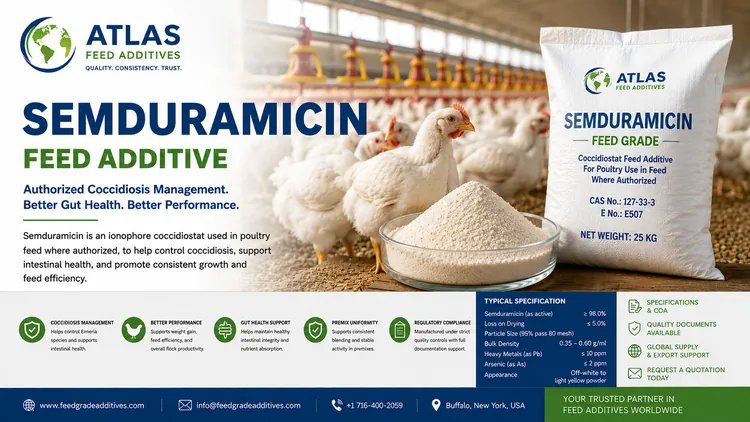
What is Semduramicin used for in animal nutrition?
Semduramicin is used only where authorized as part of professionally designed coccidiosis management
programs. It should be used according to the authorized species, approved inclusion rules, withdrawal
requirements, feed mill controls, veterinary or qualified technical guidance, label instructions, and
applicable market regulations.
Can Atlas Feed Additives quote Semduramicin?
Yes. Send your required specification, active concentration, destination market, intended species, quantity,
packaging preference, preferred Incoterms, and required documents. Atlas Feed Additives can review suitable
supplier options and provide quotation support for Semduramicin where legally permitted.
What quality documents should buyers request for Semduramicin?
Common documents include product specification, certificate of analysis, safety data sheet, country of
origin information, batch details, shelf-life statement, packaging information, label instructions,
regulatory status documents, active assay declaration, and any certificates required by the destination
market or buyer’s internal approval process.
Is Semduramicin suitable for every animal feed application?
No. Semduramicin is not a general-purpose feed additive. Suitability depends on destination-market
authorization, species, production class, approved use level, withdrawal requirements, feed mill controls,
veterinary or qualified technical guidance, and customer or export-market restrictions.
Why are withdrawal requirements important?
Withdrawal requirements are part of the authorized use conditions for regulated coccidiosis management
programs. Buyers should confirm the applicable withdrawal period, label instructions, and any residue or
market restrictions before purchasing or using the product.
Why are carryover controls important for Semduramicin?
Carryover controls help prevent unintended presence in unauthorized feeds. Feed mills should apply
validated sequencing, flushing, cleaning, labeling, storage separation, sampling, and finished-feed release
procedures according to local regulations and internal quality systems.
What makes Semduramicin offers difficult to compare?
Offers may differ by active assay, premix concentration, carrier system, particle size, uniformity data,
authorization context, withdrawal guidance, packaging, origin, lead time, document quality, shipment terms,
and payment terms. Buyers should compare the complete technical, regulatory, and commercial offer, not only
the price per kilogram.
What details should be included in a Semduramicin quotation request?
A complete request should include product name, active concentration, intended species, destination market,
authorization context, quantity, preferred Incoterms, packaging preference, required documents, target
shipment date, and any registration, label, residue, import, or customer-specific requirements.
How should Semduramicin be stored?
Semduramicin should be stored according to the supplier’s safety data sheet, product label, and applicable
regulations. In general, buyers should keep the product in clean, dry, controlled storage, protect it from
moisture and contamination, keep packaging closed and clearly labeled, restrict unauthorized access, and
rotate stock according to production date and shelf life.