
Coccidiosis management additives

Salinomycin

Salinomycin is an ionophore feed additive used only where authorized as part of professionally designed coccidiosis management programs for animal nutrition operations.

  • Feed-grade sourcing
  • Documentation review
  • Export support
  • Specification alignment
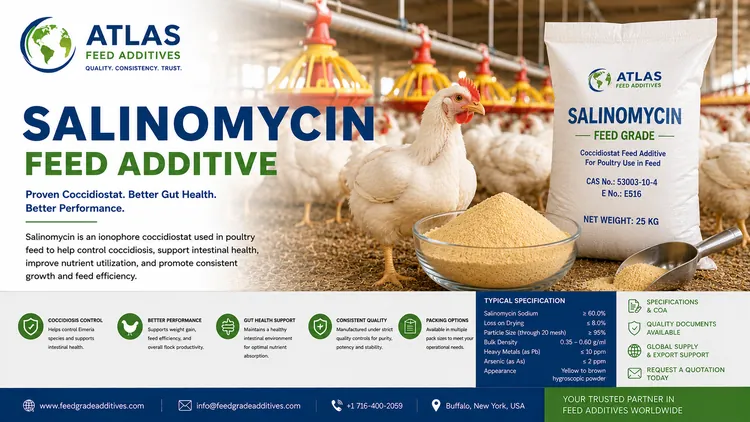
Salinomycin feed additive visual

Product role

Where Salinomycin fits

Salinomycin belongs to the coccidiosis management additives group and is typically evaluated by feed mills, premix producers, integrators, and distributors that need a controlled, documented, feed-grade product for permitted animal nutrition programs.

Because salinomycin is a sensitive regulated feed additive, purchasing decisions should not be based on price alone. Buyers should compare active assay, carrier system, physical form, granulation, moisture, packaging, origin, shelf life, document package, and destination-market rules before confirming an order.

Atlas Feed Additives supports buyers by coordinating supplier options, checking quotation details, requesting core quality documents, and helping align commercial terms with shipment requirements.

Procurement overview

Built for buyers who need more than a basic quote

Salinomycin purchasing requires careful alignment between technical requirements, local authorization, feed program design, and logistics. A strong quote should clearly identify the product grade, active level, packaging, batch documentation, shipment terms, and the regulatory assumptions behind the offer.

Specification first Assay, carrier, form, moisture, particle profile, and packaging should be aligned before price comparison.
Documents matter COA, SDS, origin, batch details, shelf life, and market-specific certificates help reduce import and quality risk.
Use rules vary Species, feed type, withdrawal, combination restrictions, and registration status must be checked locally.
Logistics affect value Lead time, Incoterms, palletization, minimum order quantity, and port requirements influence total landed cost.

Application areas

Typical applications

  • Broiler, turkey, pullet, and other programs only where permitted by local rules.
  • Coccidiosis management strategies designed by qualified nutrition, veterinary, or production specialists.
  • Feed mills that require controlled handling, sequencing, flushing, and carryover prevention.
  • Premix and compound feed operations that need reliable documentation and batch traceability.

Quality focus

Buyer quality checklist

  • Confirmed active assay and product identification.
  • Specification sheet matching the quotation and intended market.
  • Certificate of analysis for the offered batch or representative lot.
  • Safety data sheet and safe handling guidance.
  • Packaging, batch number, shelf life, and storage conditions.
  • Country-of-origin and manufacturer or supplier traceability details.

Compliance focus

Regulatory review points

  • Local authorization status for the destination country.
  • Permitted species, age group, and production stage.
  • Withdrawal period and label restrictions where applicable.
  • Compatibility with other medicated or non-medicated feed components.
  • Import documentation, registration, and customs requirements.
  • Customer responsibility for final use under local regulations.

Technical profile

Key points to confirm before ordering

For salinomycin, small differences in specification and documentation can create large differences in procurement risk. Before confirming a purchase, buyers should make sure the quoted material is technically suitable for the intended feed program and commercially suitable for the destination market.

Review area What to confirm
Product identity Product name, active compound, grade, intended use, and supplier reference.
Active level Declared assay, test method, acceptable range, and whether results are shown on the COA.
Physical form Powder, granular, premix, carrier type, flowability, dust control, and blending behavior.
Packaging Bag size, inner liner, palletization, labeling, moisture protection, and container loading plan.
Shelf life Manufacturing date, expiry or retest date, storage conditions, and remaining shelf life at shipment.
Compliance Destination-country authorization, permitted species, withdrawal requirements, and import documents.
Commercial terms MOQ, lead time, Incoterms, payment terms, quotation validity, and document availability.

Procurement note

Ask for the right specification before comparing prices.

Price comparisons are meaningful only when assay, carrier, particle size, packaging, origin, documentation, and shipment terms are aligned. For sensitive feed additives, buyers should also review storage conditions, shelf life, compatibility with pelleting or premix processes, and controls for cross-contamination.

Atlas Feed Additives helps buyers clarify these variables before supplier comparison, reducing the risk of mismatched offers, incomplete documentation, or delays during import review.

Handling and feed mill control

Operational topics buyers often review

Storage conditions

Request supplier guidance for storage temperature, humidity control, ventilation, pallet stacking, and protection from direct sunlight or moisture. Confirm whether the product requires original sealed packaging until use.

Cross-contamination control

Feed mills should review sequencing, flushing, line cleaning, dust control, and carryover procedures according to their internal quality system and local regulations.

Batch traceability

Each shipment should be traceable through batch number, production date, expiry or retest date, COA reference, packaging labels, and supplier documentation.

Pelleting compatibility

Processing conditions can affect feed additives. Buyers should review supplier data and formulation guidance for pelleting, premixing, conditioning, and thermal exposure.

Document retention

Keep COA, SDS, invoice, packing list, origin statement, import documents, and internal approval records for quality audits and customer traceability.

Program responsibility

Final product use should be approved by qualified technical personnel and should always follow the destination market’s rules, label directions, and veterinary or nutrition guidance.

Sourcing process

How Atlas Feed Additives supports Salinomycin buyers

  1. Requirement review

    Atlas reviews your target specification, destination country, packaging preference, quantity, timeline, and document requirements.

  2. Supplier option check

    Available supplier options are compared against product grade, documentation readiness, lead time, commercial terms, and export suitability.

  3. Quotation alignment

    The quotation is checked for active level, packaging, Incoterms, MOQ, validity, delivery assumptions, and required certificates.

  4. Document coordination

    Core documents such as specification, COA, SDS, origin details, batch information, and shipping documents are coordinated where available.

  5. Shipment follow-up

    Atlas supports communication from order confirmation through dispatch planning, document preparation, and shipment follow-up.

Common buying risks

What can go wrong without enough detail?

Important: Salinomycin should only be sourced and used in accordance with applicable local regulations, authorized species, label requirements, and professional guidance. Atlas Feed Additives provides sourcing and quotation support; the buyer is responsible for confirming the final regulatory status and permitted use in the destination market.

Risk How to reduce it
Wrong specification Share the required active level, form, carrier, and reference specification before requesting price.
Incomplete documents List mandatory documents before order confirmation, especially for regulated import markets.
Regulatory mismatch Confirm destination-country authorization, species, withdrawal, and label requirements locally.
Unclear landed cost Compare Incoterms, freight assumptions, packaging, palletization, and customs requirements.
Feed mill carryover Review handling, sequencing, flushing, and quality assurance procedures before production use.

Commercial details

Information that improves quotation accuracy

Specification details

  • Active ingredient and declared level.
  • Physical form and carrier preference.
  • Moisture, particle size, and flowability expectations.
  • Reference standard or current supplier specification.

Destination details

  • Country of import and final use market.
  • Preferred port, airport, warehouse, or delivery city.
  • Required language for labels or documents.
  • Any import permit, registration, or consignee requirement.

Order details

  • Trial quantity, first order volume, or annual demand.
  • Preferred Incoterm and shipment mode.
  • Payment preference and quotation validity needs.
  • Target dispatch date or delivery deadline.

Questions

Useful answers

What is Salinomycin used for in animal nutrition?

Salinomycin is used only under local rules as part of professionally designed poultry and livestock coccidiosis management programs. It should be used according to the target species, formulation objective, label restrictions, withdrawal requirements, and applicable market rules.

Can Atlas Feed Additives quote Salinomycin?

Yes. Send your required specification, quantity, destination, packaging preference, delivery terms, and documents so Atlas Feed Additives can review suitable supplier options for Salinomycin.

What quality documents should buyers request for Salinomycin?

Common documents include product specification, certificate of analysis, safety data sheet, origin information, batch details, shelf-life statement, packaging details, and any market-specific certificates required by the buyer or destination country.

What should buyers check before comparing prices?

Buyers should align active assay, carrier, form, particle profile, packaging, origin, shelf life, lead time, Incoterms, MOQ, document package, and destination-country compliance requirements before comparing offers.

Is Salinomycin suitable for all animal species?

No. Suitability depends on local authorization, target species, production stage, feed program, label restrictions, withdrawal requirements, and professional guidance. It should not be used outside permitted conditions.

Can Salinomycin be used with other feed additives or medicated ingredients?

Compatibility must be checked by qualified technical personnel and according to local regulations, product labels, and formulation guidance. Buyers should review combination restrictions and feed mill controls before use.

Why is the certificate of analysis important?

The COA helps buyers verify batch-specific quality information such as assay, identification, test results, production or batch references, and compliance with the agreed specification.

What information helps Atlas respond faster?

The fastest quotation requests usually include active level, target quantity, destination country, delivery terms, packaging preference, required documents, order timeline, and any current specification sheet.

Request a quotation

Tell us what you need

Send your product list, target specification, destination country, packaging preference, and required documents. Our team will review your request and respond from orders@feedgradeadditives.com.