Coccidiosis management additives

Monensin

Monensin is an ionophore feed additive used only where authorized as part of professionally designed coccidiosis-management and livestock nutrition programs, with strict attention to target species, approved use, documentation, withdrawal rules, and feed-mill carryover control.

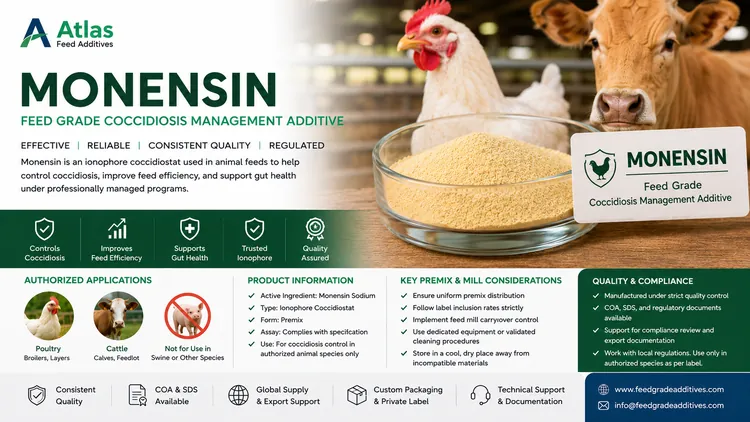
Monensin feed additive visual

Product role

Where Monensin fits

Monensin is part of the coccidiosis management additives group. It is generally evaluated as a regulated ionophore product that must be matched to the correct market authorization, target species, product label, active specification, premix carrier, physical form, feed-manufacturing conditions, and quality documentation requirements.

In commercial feed supply chains, Monensin is not treated like a basic nutritional ingredient. It requires careful purchasing control, accurate identification, secure storage, precise dosing systems, trained personnel, label review, carryover prevention, and traceability from supplier to finished feed batch.

Atlas Feed Additives can coordinate international supplier options for feed mills, premix producers, distributors, integrators, and importers that need consistent feed-grade material and complete commercial documentation. Every quotation request should be reviewed against local regulations and professional veterinary or nutritionist guidance before purchase or use.

Typical authorized-use contexts

  • Broiler, turkey, pullet, cattle, or other livestock programs only where local authorization permits use
  • Coccidiosis-control programs designed by qualified poultry, livestock, veterinary, or nutrition specialists
  • Rotation or shuttle programs where permitted and professionally supervised
  • Feed mills with validated dosing, sequencing, flushing, and carryover-control procedures
  • Premix operations with strict batch identity, label control, and storage segregation
  • Integrated production systems that require traceable medicated or regulated feed-additive documentation

Buyer quality checklist

  • Approved target species and feed-use category in the destination market
  • Active assay, declared potency, carrier description, and batch uniformity information
  • Certificate of analysis, safety data sheet, product specification, and label-related documents
  • Withdrawal requirements, restrictions, warnings, and incompatibility statements where applicable
  • Feed-mill cross-contamination, carryover, flushing, and sequencing controls
  • Packaging integrity, label clarity, storage conditions, shelf life, and batch traceability

Regulatory and safety note

Monensin must be purchased, stored, and used only under approved conditions.

Monensin is a sensitive regulated feed additive. Before comparing prices or confirming an order, buyers should verify whether the product is authorized in the destination country, whether the intended species and production stage are permitted, whether the supplier documentation matches the local registration or import requirements, and whether the feed mill can prevent exposure to non-target species.

Monensin can be dangerous to species for which it is not intended. Equine exposure is a particularly serious concern, and feed mills should use strict segregation, labeling, sequencing, flushing, and recordkeeping practices to reduce accidental carryover into horse feed, pet food, or other non-target feeds.

Critical buyer confirmations

Authorization
Confirm destination-market approval before purchase
Target species
Use only for species and feed categories allowed by the applicable label and law
Withdrawal rules
Review local withdrawal and residue requirements where applicable
Non-target exposure
Prevent accidental use in equine, companion-animal, or other non-target feeds
Professional guidance
Use under qualified veterinary, nutritionist, or regulatory supervision

Technical overview

How buyers evaluate Monensin offers

Monensin quotations should be assessed on more than headline price. Buyers typically review the active ingredient level, carrier system, physical form, production site, batch-to-batch consistency, documentation package, local authorization status, label language, safety warnings, packaging type, shelf life, storage requirements, and supplier reliability.

Active specification

The declared active concentration, assay method, tolerance range, batch result, and certificate of analysis should be consistent with the buyer’s approved formula, internal QA procedure, and destination-market rules. Buyers should not compare offers unless the active basis is clearly aligned.

Carrier and physical form

Carrier composition, particle size, flowability, dust level, bulk density, and blend uniformity affect handling, dosing accuracy, premix distribution, and finished-feed consistency. These details are especially important for micro-ingredient systems and medicated or regulated-feed production lines.

Compliance documents

Depending on the market, importers may require a specification sheet, certificate of analysis, safety data sheet, product label, origin information, manufacturer statement, regulatory authorization reference, contaminant declaration, and any customer-specific feed-safety documentation.

Feed-mill controls

Monensin should be handled only in facilities capable of managing controlled storage, restricted access, clear labeling, accurate dosing, production sequencing, flushing, cleaning verification, batch traceability, and non-target-feed protection.

Application considerations

Species and program review

  • Poultry programs: Review whether Monensin is authorized for the specific poultry class, feed phase, production system, withdrawal requirements, and any rotation or shuttle strategy.
  • Cattle programs: Confirm whether the product is permitted for the intended cattle class, feed system, production objective, and destination-market rules.
  • Turkey and pullet programs: Verify authorization, target age or production stage, feed type, and label restrictions before purchase.
  • Premix programs: Confirm compatibility with the premix carrier, dilution plan, batch size, labeling, and final-feed manufacturing controls.
  • Non-target species: Prevent accidental exposure to horses, dogs, companion animals, and any species not approved by the product label or local regulation.

Feed-mill control points

Operational questions before sourcing

  • Does the facility have separate storage for regulated additives?
  • Are ingredient labels, batch numbers, and intake records checked before unloading?
  • Is the dosing system calibrated and appropriate for the product concentration?
  • Are production sequencing, flushing, and cleaning steps documented?
  • Are non-target feeds protected from accidental carryover?
  • Are operators trained on hazards, label restrictions, and emergency procedures?
  • Are retained samples and batch records kept according to internal QA policy?

Procurement note

Ask for the right specification before comparing prices.

Price comparisons are meaningful only when active assay, product form, carrier, particle size, packaging, origin, authorization status, label information, safety documentation, shipment terms, and quality documents are aligned. A lower price is not useful if the offered product cannot be legally imported, approved by the buyer’s QA team, safely handled by the feed mill, or used for the intended species.

Specification alignment

Confirm the exact Monensin product form, declared active concentration, assay method, carrier type, physical form, appearance, odor, bulk density, particle-size range, and shelf-life statement before comparing supplier offers.

Regulatory alignment

Verify destination-market authorization, target-species permissions, label language, withdrawal rules, import requirements, and any buyer-specific registration obligations before ordering. Regulatory suitability should be confirmed before commercial negotiation is finalized.

Documentation alignment

Request the full document package early. Missing documents can delay customs clearance, internal QA approval, customer registration, tender evaluation, or feed-mill release even when the product itself is commercially available.

Logistics alignment

Review packaging, palletization, container loading, humidity protection, label visibility, bag strength, transport class information when applicable, and warehouse conditions before confirming shipment.

Handling and storage

Maintain identity, safety, and traceability from receipt to use.

Monensin should be stored in its original, clearly labeled packaging in a clean, dry, secure, and well-ventilated area. Keep it away from non-target animal feed ingredients, open food materials, damaged bags, water exposure, and unauthorized personnel. Follow the supplier safety data sheet, approved label, local regulations, and the buyer’s feed-safety management system.

For feed mills and premix plants, key controls include restricted access, ingredient identity checks, first-in-first-out stock rotation, sealed packaging after partial use, dust management, spill-control procedures, retained samples, production records, and documented cleaning or flushing after use.

Quality documents

Documents commonly requested by buyers

  • Technical specification sheet
  • Certificate of analysis for the offered batch or recent production
  • Safety data sheet
  • Product label or use instructions where applicable
  • Origin statement and manufacturer information when available
  • Batch number, production date, expiry date, and shelf-life statement
  • Packaging specification and net-weight declaration
  • Feed-grade, GMP, HACCP, ISO, FAMI-QS, or other quality certificates where applicable
  • Market-specific import, registration, or compliance documents requested by the buyer
  • Statements covering contaminants, heavy metals, microbiology, dioxins, or prohibited substances when required

RFQ preparation

Information that helps us quote faster

  • Product name and required Monensin form or concentration
  • Approved target species and intended feed-use category
  • Required quantity, shipment frequency, and forecast volume
  • Destination country, destination port, or delivery address
  • Preferred Incoterm such as EXW, FOB, CFR, CIF, DAP, or DDP
  • Packaging preference such as bags, cartons, drums, pallets, or buyer-specific format
  • Required documentation list for customs, QA approval, registration, or tender submission
  • Expected shipment date, payment terms, and whether the request is spot, annual, or contract-based

Supplier review

Commercial reliability matters for regulated feed additives.

For regulated additives such as Monensin, a supplier should be evaluated not only on availability and price, but also on document readiness, communication speed, batch consistency, complaint handling, labeling accuracy, origin transparency, and ability to support repeat orders. Atlas Feed Additives helps buyers compare offers in a structured way before confirming a shipment.

For repeat programs, buyers may request pre-shipment document review, sample evaluation, internal QA approval, packaging confirmation, supplier questionnaire completion, and logistics planning before opening a long-term purchase schedule.

Recommended commercial checks

Supplier identity
Confirm manufacturer, trader, origin, and product traceability
Document readiness
Check whether required documents are available before payment or shipment
Batch consistency
Review COA values, physical form, and packaging consistency
Label accuracy
Confirm product name, active content, lot number, expiry, warnings, and destination requirements
After-sales support
Confirm complaint, claim, and replacement procedures before repeat supply

Responsible use statement

Monensin should be managed as a controlled feed additive.

Atlas Feed Additives supports sourcing and documentation coordination, but the buyer remains responsible for confirming local authorization, target-species suitability, formulation decisions, label compliance, withdrawal requirements, feed-mill controls, and safe use. Monensin should only be handled and used by trained personnel under the direction of qualified professionals and in compliance with all applicable laws.

Questions

Useful answers

What is Monensin used for in animal nutrition?

Monensin is used only under local rules as part of professionally designed coccidiosis-management, livestock nutrition, or feed programs. It should be used according to the approved target species, product label, formulation objective, withdrawal requirements, and applicable market rules.

Can Atlas Feed Additives quote Monensin?

Yes. Send your required specification, target species, quantity, destination, packaging preference, Incoterm, shipment timing, and document requirements so Atlas Feed Additives can review suitable supplier options for Monensin.

What quality documents should buyers request for Monensin?

Common documents include specification, certificate of analysis, safety data sheet, product label or use documentation where applicable, origin information, batch details, shelf-life information, and market-specific certificates required by the buyer or local authority.

Is Monensin suitable for all species?

No. Monensin must only be used for species and feed categories permitted by local regulation and product labeling. Buyers must prevent accidental exposure to non-target species, especially horses and companion animals.

Why is feed-mill carryover control important?

Carryover control is critical because residues from a regulated additive can enter feeds for non-target species if sequencing, flushing, cleaning, storage, dosing, or labeling controls are weak. Facilities handling Monensin should have documented procedures and trained operators.

What should be checked before comparing Monensin prices?

Buyers should align active concentration, assay method, carrier, physical form, packaging, shelf life, origin, authorization status, target species, documentation package, Incoterm, shipment timing, and supplier reliability before comparing prices.

Can Monensin be used in premixes?

Monensin may be supplied as a premix or carrier-based preparation where authorized. Premix use requires accurate dilution, validated mixing, clear labeling, batch traceability, and strict control to prevent contamination of non-target feeds.

How should Monensin be stored?

Store Monensin in original, sealed, clearly labeled packaging in a dry, clean, secure, and well-ventilated area. Keep it separated from non-target feeds and follow the supplier safety data sheet, approved label, and local handling requirements.

Does Monensin require regulatory review before import?

Yes. Requirements vary by country. Importers should confirm authorization, registration, labeling, documentation, permitted species, withdrawal rules, customs requirements, and feed-safety obligations before purchase.

What details should be included in a Monensin RFQ?

A strong RFQ should include product form, active concentration, target species, destination country, quantity, packaging, Incoterm, required documents, shipment timing, and any local registration or buyer-approval requirements.

Request a quotation

Tell us what you need

Send your product list, required Monensin specification, approved target species, destination country, quantity, packaging preference, Incoterm, shipment timing, and required documents. Our team will review your request and respond from orders@feedgradeadditives.com.