Coccidiosis management additives

Narasin

Narasin is a regulated coccidiosis management additive used only where locally authorized and only within professionally designed poultry or livestock programs that control species approval, dose, withdrawal period, residues, feed mill carryover, cross-contamination, and sensitive-species restrictions.

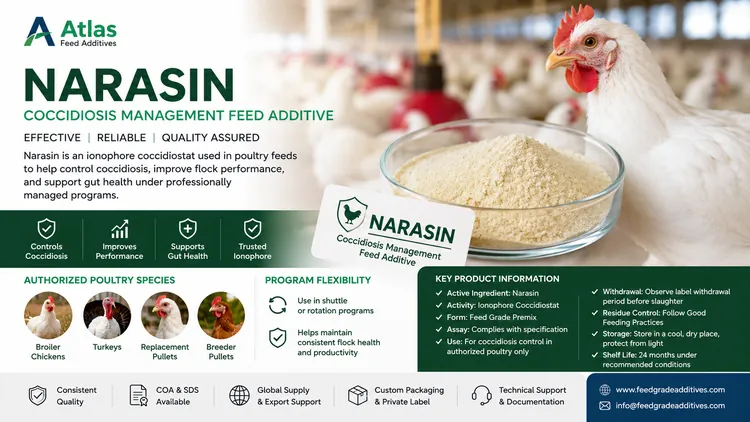
Narasin feed additive visual

Product role

Where Narasin fits

Narasin is part of the coccidiosis management additives group. It is used in regulated anticoccidial programs where authorized species, target dose, withdrawal period, feed manufacturing controls, veterinary or nutritionist oversight, and residue-management requirements are clearly defined before purchase and use.

Commercial Narasin products may be supplied as a concentrated active ingredient, medicated article, premix, granule, powder, carrier-based preparation, or custom coccidiosis-management blend, depending on the supplier and destination-market rules. Buyers should confirm whether the material is intended for direct premix manufacture, finished feed inclusion, distributor resale, or private-label registration.

Narasin is not a general-use nutritional additive. It should be handled as a regulated ionophore coccidiostat or related veterinary feed additive category where authorized. Atlas Feed Additives can coordinate international supplier options for feed mills, premix producers, poultry integrators, distributors, and registered feed additive companies that require consistent feed-grade material, clear documentation, export support, and quotation handling.

Coccidiosis program role

Why Narasin is evaluated in professional feed programs

Coccidiosis control is a critical part of commercial poultry health, welfare, and performance management. Narasin may be evaluated within professionally designed programs that consider Eimeria challenge, flock history, litter conditions, anticoccidial rotation, shuttle strategy, vaccine use, farm biosecurity, withdrawal requirements, feed mill capability, and local regulatory authorization.

In practical sourcing, Narasin should be evaluated not only by its product name but also by active assay, premix concentration, particle size, carrier, uniformity, heat stability, label registration, authorized species, incompatibilities, withdrawal period, residue marker, cross-contamination controls, sensitive-species restrictions, and feed mill sequencing requirements. These factors determine whether a quotation is technically and legally comparable.

Practical value

Procurement-focused benefits

  • Supports regulated coccidiosis-management programs where Narasin is locally authorized.
  • Can be evaluated in broiler, turkey, pullet, or other approved programs according to destination-market rules.
  • May be incorporated into rotation or shuttle programs designed by poultry veterinarians, nutritionists, or coccidiosis specialists.
  • Allows buyers to compare suppliers by active assay, premix strength, carrier, particle size, uniformity, stability, and documentation.
  • Supports procurement for feed mills that operate strict sequencing, flushing, carryover, and cross-contamination controls.
  • Can be requested with COA, SDS, specification, label information, origin details, batch traceability, sensitive-species warnings, and market-specific regulatory documents.

Typical applications

Species, feed types, and controlled use situations

Narasin should be considered only where authorized and only within professionally managed coccidiosis programs. Final suitability depends on target species, approved dose, feeding phase, withdrawal requirement, regulatory status, flock program, feed mill controls, compatibility with other products, and supplier instructions.

  • Broiler coccidiosis programs where Narasin use is authorized and label conditions are followed.
  • Turkey, pullet, or other poultry programs only where the product, species, dose, and withdrawal requirements are locally approved.
  • Rotation programs designed to manage coccidiosis pressure across production cycles.
  • Shuttle programs where anticoccidial strategy changes between starter, grower, and finisher phases under professional guidance.
  • Feed mills with validated batching, sequencing, flushing, cleanout, and carryover-control procedures.
  • Premix manufacturing systems that require uniform active distribution and strict medicated-feed controls.
  • Distributor programs where resale is allowed only with appropriate registration, labeling, and documentation.
  • Programs requiring strict prevention of carryover into feeds for horses, non-target poultry, companion animals, or other sensitive species.

Regulated use and feed mill control

Narasin requires authorization, withdrawal control, and carryover management

Narasin is a regulated coccidiosis-management additive in many markets. It must be used only according to the approved label, authorized species, permitted concentration, withdrawal period, and local feed regulations. Buyers should not assume that a product registered in one country can be legally used, labeled, or imported in another country without review.

Key regulatory and safety control points

  • Confirm that Narasin is authorized for the target species and use program in the destination market.
  • Confirm approved dose range, feed phase, and withdrawal period before purchase.
  • Review residue marker requirements, maximum residue limits, and monitoring obligations where applicable.
  • Confirm whether use in layers, breeders, egg-producing birds, horses, companion animals, or other sensitive groups is restricted or prohibited under local rules.
  • Use only in feed mills that can control medicated-feed sequencing, flushing, and cleanout.
  • Prevent cross-contamination into non-target feeds and feeds for sensitive species.
  • Maintain batch traceability from raw material to premix and finished feed.
  • Keep label instructions, safety guidance, and regulatory documents available for operators.
  • Follow veterinary, nutritionist, or regulatory guidance for rotation and shuttle programs.
  • Confirm compatibility and restrictions when combining with other anticoccidials, tiamulin or other veterinary medicines where relevant, or feed additives.

Buyer quality checklist

What to confirm before comparing Narasin offers

Narasin products should not be compared by price per kilogram alone. Two offers can differ significantly in active concentration, assay method, carrier, particle size, premix uniformity, stability, registration status, withdrawal guidance, residue-control information, and feed mill carryover instructions. Before comparing suppliers, request a complete technical and regulatory package.

Technical specification points

  • Declared product type: Narasin active ingredient, Narasin premix, medicated article, carrier-based preparation, or registered coccidiostat blend.
  • Active concentration and assay method.
  • Residue-marker information where required by the destination market.
  • Carrier material and feed-grade suitability.
  • Physical form: powder, granule, microgranule, premix, or coated preparation.
  • Particle size, bulk density, dusting tendency, flowability, and segregation risk.
  • Premix uniformity and mixing guidance.
  • Recommended inclusion rate and final feed concentration according to authorized label.
  • Authorized species, feed phases, and production classes.
  • Withdrawal period, stop-feeding requirement, and residue-control guidance.
  • Compatibility or restrictions with other anticoccidials, ionophores, veterinary medicines, vitamins, minerals, and feed additives.
  • Sensitive-species warnings and cross-contamination precautions.
  • Heat stability during conditioning, pelleting, or feed processing.
  • Storage stability, shelf life, and opened-package handling.
  • Carryover-control instructions, sequencing guidance, and flushing recommendations.
  • Cross-contamination warnings for non-target species and feeds.
  • Contaminant controls, including heavy metals, microbiology, residual solvents, and undesirable substances where required.
  • Packaging size, liner type, moisture barrier, pallet configuration, lot traceability, and tamper-control requirements.
  • Destination-market regulatory status, label authorization, import permission, and registration documents.

Program design

How buyers define the right Narasin specification

The best Narasin specification depends on the target species, approved local label, farm coccidiosis history, feed phase, anticoccidial rotation, shuttle strategy, withdrawal requirement, sensitive-species restrictions, and feed mill capability. A broiler starter program, grower program, turkey program, pullet program, or registered premix product may require different active concentration, label wording, and documentation.

  • Define the target species and feed phase before requesting a quote.
  • Confirm whether Narasin is authorized for the intended use in the destination market.
  • Request the active concentration and assay method.
  • Share whether the product is needed as active ingredient, premix, granule, carrier-based product, or private-label formulation.
  • Confirm the desired final feed concentration and inclusion rate according to local authorization.
  • Review whether the product will be used alone, in a rotation program, or in a shuttle program.
  • Confirm stop-feeding, withdrawal, residue-management, and cross-contamination requirements.
  • Check whether the feed mill can prevent carryover into unauthorized or sensitive-species feeds.

Processing notes

Feed manufacturing factors that affect Narasin use

Narasin products require strong attention to dosing accuracy, premix uniformity, segregation risk, dust control, sequencing, flushing, and cross-contamination prevention. Feed mills should validate mixing procedures and maintain appropriate records for medicated or regulated feed production.

  • Confirm whether the product is suitable for premix, complete feed, pellet, crumble, mash, or registered medicated-feed production.
  • Check flowability and dusting tendency for automated dosing and worker handling.
  • Review particle size and density to reduce segregation risk in premixes and finished feeds.
  • Ask whether the product is compatible with the carrier, vitamins, minerals, enzymes, acidifiers, and other anticoccidial program components.
  • Confirm whether pelleting temperature affects active stability.
  • Establish production sequencing to reduce carryover into non-target feed.
  • Use validated flushing or cleanout procedures when switching to non-medicated or unauthorized feeds.
  • Follow supplier guidance for shelf life, opened-package use, and warehouse storage.

Procurement note

Ask for the right specification before comparing prices.

Price comparisons are meaningful only when active concentration, assay method, carrier, particle size, packaging, origin, shelf life, storage conditions, registration status, withdrawal guidance, and documentation are aligned. For regulated coccidiosis-management additives, buyers should also review authorized species, feed phase, residue-control rules, feed mill carryover procedures, cross-contamination controls, sensitive-species restrictions, and destination-market label requirements.

For export orders, confirm regulatory status, permitted source names, maximum inclusion levels, species authorization, label wording, import documents, withdrawal period, safety statements, and permitted claims before purchase. Atlas Feed Additives can help organize supplier communication so each quotation is evaluated against the same technical, regulatory, and commercial basis.

Documentation

Documents commonly requested for Narasin

Document requirements vary by destination country, product form, target species, final label claim, registration route, and whether the product is supplied as active ingredient, premix, medicated article, or private-label coccidiosis-management additive. Buyers should confirm required documents before order confirmation so the supplier can verify availability and lead time.

Quality and technical documents

  • Product specification sheet.
  • Certificate of analysis for the supplied batch.
  • Safety data sheet.
  • Active assay declaration and assay method.
  • Residue-marker and withdrawal guidance where applicable.
  • Authorized species, feed phase, and dose information according to local label.
  • Carrier, particle size, bulk density, flowability, and uniformity information.
  • Heat-stability, premix-stability, and finished-feed stability data where available.
  • Feed mill sequencing, flushing, and carryover-control guidance.
  • Cross-contamination warning statement for non-target species and feeds.
  • Sensitive-species warning statement where required by product label or destination-market rules.
  • Compatibility or contraindication statement for other feed additives or veterinary medicines where relevant.
  • Batch number, production date, retest date, and expiry date.
  • Storage and handling instruction sheet.
  • Product label or draft label for approval.
  • Registration certificate, free sale certificate, or regulatory approval documents where available and required.
  • Heavy metal, microbiological, residual solvent, dioxin, PCB, or undesirable substance statements when required by the buyer.

Trade and shipment documents

  • Commercial invoice and packing list.
  • Certificate of origin, if required.
  • Health certificate, free sale certificate, veterinary certificate, or registration-support documents when applicable.
  • Bill of lading, airway bill, or road transport document depending on shipment mode.
  • Insurance certificate when required by Incoterms.
  • Import registration or buyer-specific declaration forms.
  • Private-label artwork approval and label compliance documents.
  • Transport classification review if required by product form and shipping rules.
  • Halal, kosher, ISO, GMP+, FAMI-QS, HACCP, or other quality certificates when available and required.

Packaging and storage

Handling Narasin products correctly

Because Narasin is used in regulated feed programs, packaging and storage must support traceability, stability, label control, and safe handling. Buyers should confirm recommended storage temperature, moisture protection, shelf life, transport classification, and opened-package handling before shipment.

  • Keep the product in unopened, labeled packaging until it is ready for authorized use.
  • Protect from moisture, direct sunlight, excessive heat, and repeated temperature cycling.
  • Store separately from non-medicated feed ingredients when required by internal quality systems.
  • Follow the supplier's storage temperature and expiry guidance.
  • Reseal opened packs quickly if partial use is allowed by the supplier.
  • Maintain batch traceability through premix and finished feed production.
  • Confirm whether the product is suitable for sea freight, air freight, or road transport.
  • Use appropriate worker-handling precautions, dust control, PPE, and spill procedures.
  • Review warehouse rotation and first-expiry-first-out control for regulated feed additives.

Formulation compatibility

Questions for premix and private-label buyers

When Narasin is used in a premix, medicated feed additive, shuttle program, rotation program, or private-label product, buyers should confirm compatibility with all ingredients, feed phases, sensitive-species restrictions, and destination-market rules. Regulatory compliance and carryover control are the main priorities.

  • Is the Narasin product compatible with the planned carrier and premix base?
  • Can it be blended with vitamins, minerals, enzymes, pigments, acidifiers, probiotics, or other anticoccidial program components?
  • Are there restrictions on combination with ionophores, chemicals, veterinary medicines, or other feed additives?
  • Will the product remain stable and uniform for the required shelf life?
  • Does the product tolerate the expected feed mill temperature and processing conditions?
  • Is the powder, granule, or premix form suitable for the buyer's dosing system?
  • Are label claims, withdrawal statements, sensitive-species warnings, and species declarations approved for the destination market?
  • Does the product need additional safety labeling, segregated storage, or special transport review?

Quotation request guide

Information to send for a faster Narasin offer

Atlas Feed Additives can review supplier options more efficiently when the request includes both technical and regulatory details. If you do not yet have a final specification, send the target species, destination country, active concentration, product form, intended feed phase, and required documents so the team can help identify the missing parameters.

Technical and regulatory details

  • Required product name: Narasin.
  • Target product form: active ingredient, premix, medicated article, granule, powder, carrier-based preparation, or registered blend.
  • Target species: broilers, turkeys, pullets, breeders, or other authorized species.
  • Target feed phase: starter, grower, finisher, shuttle phase, rotation phase, or premix manufacturing.
  • Required active concentration and assay method.
  • Desired final feed concentration according to local authorization.
  • Withdrawal period, residue-control, and label requirements for the destination market.
  • Sensitive-species restrictions and cross-contamination controls required by the buyer or local rules.
  • Current coccidiosis program, including rotation, shuttle, vaccine, or alternative anticoccidial use.
  • Feed mill carryover controls, sequencing system, and cleanout requirements.
  • Required registration, free sale, veterinary, or import documents.
  • Destination-market regulatory, safety, label, and claim requirements.

Commercial details

  • Required order quantity or annual forecast.
  • Destination country and delivery address or port.
  • Preferred Incoterms and shipment method.
  • Packaging preference and pallet requirements.
  • Target delivery date or seasonal demand window.
  • Private-label, neutral-label, or Atlas-coordinated supplier-label requirement.
  • Buyer company details for proforma invoice preparation.
  • Sample request details, including sample quantity, target formula, and testing timeline.

Technical buying notes

Important points for feed additive distributors and coccidiosis-program buyers

Active assay matters

Narasin products should be compared by active concentration, assay method, and authorized final-feed contribution. A low-cost product may not be suitable if the active assay, uniformity, or registration package does not match the target market.

Withdrawal control matters

Withdrawal periods and stop-feeding requirements must be built into the production program. Buyers should confirm the local label and residue-control rules before purchasing or using Narasin.

Carryover control matters

Feed mills must prevent carryover into unauthorized feeds and sensitive-species feeds. Sequencing, flushing, cleanout, validation, and recordkeeping are especially important when regulated coccidiostats are handled.

Sensitive-species control matters

Ionophore coccidiostats can be hazardous to certain non-target species when used incorrectly or when carryover occurs. Buyers should confirm label warnings, species restrictions, and feed mill segregation procedures before purchase.

Regulatory wording matters

Product names, species authorization, feed phase, maximum levels, withdrawal requirements, residue statements, and coccidiosis claims vary by country. Buyers should confirm whether the intended product and label are allowed in the destination market.

Questions

Useful answers

What is Narasin used for in animal nutrition?

Narasin is used only where locally authorized as part of professionally designed coccidiosis management programs. It should be used according to the target species, approved dose, withdrawal period, veterinary or nutritionist guidance, feed mill controls, and applicable market rules.

Is Narasin a general feed additive?

No. Narasin is a regulated coccidiosis-management additive or ionophore coccidiostat where authorized. It should not be treated as a routine nutritional additive and should not be used without regulatory and professional review.

Which species can use Narasin?

Species authorization depends on destination-market rules and the approved product label. Broiler programs are common in many markets, while use in turkeys, pullets, breeders, layers, ruminants, or other animals must be confirmed before purchase.

Why are withdrawal periods important?

Withdrawal periods help manage residues before slaughter or production endpoints. Buyers should confirm the approved withdrawal period, residue marker, and local maximum residue requirements before using Narasin in any feed program.

Can Narasin be used in shuttle or rotation programs?

It may be used in shuttle or rotation programs where authorized and professionally designed. The program should consider flock history, farm challenge, coccidiosis pressure, vaccine use, other anticoccidials, withdrawal requirements, and local rules.

Can Narasin be mixed with other anticoccidials?

Combination or sequential use depends on the approved label, species, feed phase, and destination-market regulations. Buyers should confirm compatibility and legal status before combining Narasin with ionophores, chemicals, veterinary medicines, or other feed additives.

Why is carryover control important?

Carryover can expose non-target animals to regulated additives. Narasin should be handled only in feed mills with appropriate sequencing, flushing, cleanout, labeling, and records to prevent cross-contamination into unauthorized feeds.

What specification should buyers request?

Buyers should request active concentration, assay method, product form, carrier, particle size, premix uniformity, authorized species, withdrawal period, residue marker, carryover guidance, sensitive-species warnings, shelf life, storage conditions, and required documents.

What quality documents should buyers request for Narasin?

Common documents include a specification sheet, certificate of analysis, safety data sheet, active assay declaration, label information, withdrawal guidance, batch number, manufacturing date, expiry date, storage instructions, origin information, regulatory documents, and any market-specific certificates required by the buyer.

Can Atlas Feed Additives quote Narasin?

Yes. Send your required specification, active concentration, target species, destination country, authorized use details, required quantity, packaging preference, shipment terms, and documents so Atlas Feed Additives can review suitable supplier options.

What should I include in the message when requesting a price?

Please include target species, feed phase, active concentration, product form, destination country, registration requirements, withdrawal requirements, order quantity, packaging preference, required documents, and whether the product is for resale, premix production, private label, or direct feed mill use.

Can Narasin be supplied under private label?

Private-label availability depends on supplier capability, order quantity, registration status, product form, packaging format, label wording, withdrawal statements, active declaration, sensitive-species warnings, artwork approval, and destination-market rules. Atlas Feed Additives can review private-label options when the buyer provides the required label and regulatory details.

Request a quotation

Tell us what you need

Send your product list, target specification, active concentration requirement, product form, target species, feed phase, destination country, packaging preference, expected order quantity, Incoterms, regulatory documents, withdrawal requirements, sensitive-species restrictions, and required certificates. Our team will review your request and respond from orders@feedgradeadditives.com.

Important: Narasin is a regulated coccidiosis-management additive. Product availability, specification, documents, labels, authorized species, permitted dose, withdrawal period, residue requirements, sensitive-species warnings, and permitted claims depend on supplier confirmation and destination-market rules. Information on this page is for B2B sourcing support and does not replace veterinary, nutritionist, legal, or regulatory review.