Coccidiosis management additives

Lasalocid

Lasalocid is a regulated coccidiosis management feed additive used only where authorized and only as part of professionally designed poultry and livestock programs with strict attention to species approval, withdrawal rules, residue control, feed mill carryover prevention, and market-specific documentation.

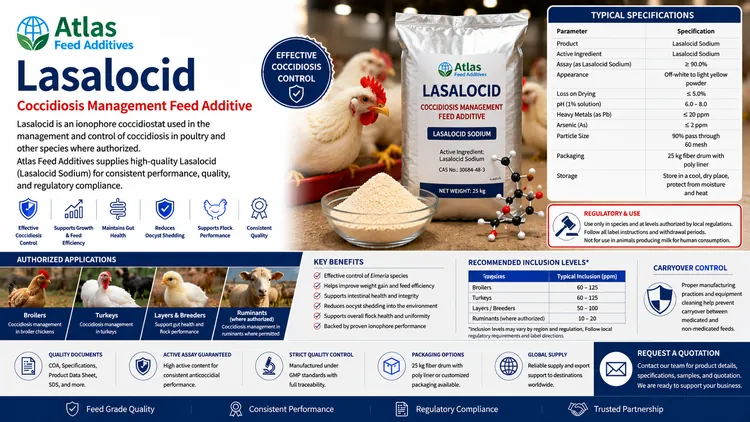
Lasalocid feed additive visual

Product role

Where Lasalocid fits

Lasalocid is part of the coccidiosis management additives group. It is evaluated by buyers, veterinarians, nutritionists, and regulatory teams as a specialized feed additive for authorized coccidiosis control programs in poultry and certain livestock uses where local rules permit.

Because Lasalocid is a regulated additive, buyers should not compare offers by name alone. A complete evaluation should include active concentration, assay method, carrier system, premix uniformity, authorized species, withdrawal requirements, product registration, residue-control expectations, feed mill carryover procedures, packaging, shelf life, label requirements, and documentation.

Atlas Feed Additives can coordinate international supplier options for feed mills, premix producers, distributors, and integrators that require consistent feed-grade material, export-oriented documentation, and clear quotation support for sensitive feed additive procurement.

Technical identity

Key product profile

  • Product group: coccidiosis management additives.
  • Functional classification: anticoccidial feed additive or coccidiostat where authorized.
  • Common active form: Lasalocid sodium or supplier-specific formulated premix.
  • Primary use context: professionally managed feed programs for permitted species, age groups, and production stages.
  • Buyer concern: correct active concentration, safe handling, accurate dosing system compatibility, withdrawal compliance, and legal authorization.
  • Critical controls: cross-contamination prevention, sequencing, flushing, cleaning, residue management, label compliance, and documentation traceability.
  • Regulatory note: authorization, permitted use, withdrawal requirements, species limitations, and labeling rules vary by country and must be checked before purchase or use.

Important caution

Use only where legally authorized

Lasalocid is not a general-purpose nutritional ingredient. It is a regulated feed additive that should only be used in accordance with applicable laws, product registration, professional veterinary or nutrition guidance, and label directions in the destination market.

Atlas Feed Additives supports sourcing, documentation, and quotation coordination. Final approval for import, sale, formulation, feed labeling, inclusion rate, withdrawal period, and use conditions must be confirmed by the buyer’s responsible technical and regulatory teams.

Applications

Typical use areas where authorized

Broiler programs

Lasalocid may be evaluated for broiler coccidiosis management programs only where it is legally approved and properly registered. Buyers should confirm the permitted species, feed type, inclusion limits, withdrawal period, label statements, and compatibility with the complete coccidiosis control strategy.

  • Authorized broiler feed programs
  • Professional coccidiosis prevention strategies
  • Feed mill dosing systems with controlled premix handling
  • Programs designed by qualified poultry specialists
  • Clear separation from non-authorized feed production

Turkey, pullet, and other poultry programs

In some markets, Lasalocid may be considered for specific poultry programs beyond broilers. Use conditions can differ by species, age group, production stage, and country, so authorization and label directions must be confirmed before procurement.

  • Turkey programs where permitted
  • Pullet programs where permitted
  • Species-specific label review
  • Withdrawal and residue-control review
  • Veterinary and regulatory confirmation before use

Livestock programs where permitted

Lasalocid may have authorized livestock applications in certain markets. Buyers should verify the exact species, production stage, intended use, label claims, residue rules, and feed manufacturing requirements before importing or formulating any product.

  • Market-specific livestock applications where authorized
  • Ruminant programs where permitted by local rules
  • Strict label and registration review
  • Feed mill carryover control
  • Professional nutrition and veterinary oversight

Rotation and shuttle programs

In some poultry systems, anticoccidial products are managed through rotation or shuttle programs to support flock health planning. Such programs must be designed by qualified specialists and aligned with local regulations, veterinary oversight, farm history, feed mill capability, and residue-control expectations.

  • Professionally designed anticoccidial rotation plans
  • Shuttle programs where permitted
  • Integration with flock monitoring and farm history
  • Clear separation from non-target feeds
  • Documentation of product sequence and feed use

Premix manufacturing

Premix producers handling Lasalocid must pay close attention to active concentration, carrier distribution, homogeneity, worker safety, weighing accuracy, batch traceability, cleaning procedures, and cross-contamination control. Small dosing errors can be commercially and regulatory significant.

  • Controlled weighing and micro-dosing
  • Validated blending uniformity
  • Batch records and traceability
  • Dedicated or carefully sequenced production
  • Controlled packaging and labeling

Feed mill operations

Feed mills should review whether their equipment, sequencing, flushing, labeling, and storage systems are suitable before handling Lasalocid. Cross-contact with feeds for non-target species or non-authorized production stages can create serious safety and compliance risks.

  • Sequencing and flushing procedures
  • Carryover risk assessment
  • Finished-feed labeling controls
  • Clear separation of medicated and non-medicated feeds where required
  • Retained samples and production traceability where applicable

Specification control

Common specification points to request

  • Declared active ingredient and active concentration
  • Lasalocid sodium content or equivalent active basis
  • Assay method and acceptable assay range
  • Carrier type and carrier declaration
  • Appearance, color, odor, and physical form
  • Particle size or granulation profile
  • Bulk density and flowability
  • Moisture limit
  • Blend uniformity or homogeneity information
  • Stability data under recommended storage conditions, where available
  • Heavy metals and contaminant limits
  • Microbiological or impurity controls where required
  • Packaging type, net weight, palletization, and labeling
  • Shelf life, retest date, and storage conditions
  • Authorized species, feed type, and destination-market registration status

Quality documents

Buyer documentation checklist

  • Product specification sheet
  • Certificate of Analysis
  • Safety Data Sheet
  • Batch number and manufacturing date
  • Country of origin statement
  • Manufacturer or supplier declaration
  • Active assay and analytical method information
  • Carrier declaration
  • Feed additive registration or authorization documents where applicable
  • Label or technical data sheet approved for the relevant market where required
  • Withdrawal-period information where required by local rules
  • Residue-control or compliance statement where applicable
  • GMO, allergen, BSE/TSE, halal, kosher, or other declarations if requested
  • Import documents required by the destination country

Procurement note

Ask for the right specification before comparing prices.

Price comparisons are meaningful only when active concentration, assay range, carrier type, particle size, packaging, origin, registration status, shelf life, and documentation are aligned. For Lasalocid, the buyer should also confirm authorized species, withdrawal requirements, residue-control expectations, labeling rules, and feed mill compatibility before considering any offer commercially equivalent.

Regulated additives require more than a basic quotation. Buyers should review whether the supplier can provide appropriate documents before shipment and whether the product can legally enter, be sold, and be used in the destination market. Import permission, registration, and product-use responsibility remain with the buyer and their local regulatory advisors.

Feed mill control

Operational considerations for regulated additives

Authorized species and feed types

Before purchase or formulation, buyers should confirm whether Lasalocid is authorized for the intended species, age group, production stage, feed type, and destination country. Authorization status and use conditions can vary significantly between markets.

Cross-contamination control

Lasalocid requires careful control of carryover risk. Feed mills should evaluate sequencing, flushing, cleaning, dust collection, conveyors, bins, bagging lines, bulk loading, and finished-feed storage to reduce unintended transfer into non-target feed.

Premix uniformity

Uniform distribution is essential in medicated or regulated feed additive systems. Buyers should review whether the product’s carrier, particle size, density, and flowability are suitable for their micro-dosing, premix, and complete-feed manufacturing equipment.

Labeling and traceability

Clear labeling, batch records, production logs, and retained samples may be required by the buyer’s internal quality system or local regulation. Each batch should be traceable from supplier documentation through premix or finished-feed production.

Withdrawal and residue rules

Where withdrawal rules apply, they must be followed according to the destination market and product label. Buyers should confirm these requirements with qualified regulatory, veterinary, or nutrition professionals before use.

Worker safety

Handling should follow the Safety Data Sheet and local occupational safety rules. Facilities should consider dust control, ventilation, protective clothing, gloves, masks or respirators where required, eye protection, and clear training for employees handling regulated feed additives.

Packaging

Packaging and shipment points

Packaging depends on supplier capability, product concentration, destination regulation, order quantity, and export requirements. Atlas Feed Additives can review available packaging options during the quotation process.

  • Small bags for premix or feed mill use, depending on supplier format
  • Cartons, drums, or composite packaging where offered
  • Moisture-protected and tamper-evident packaging where available
  • Palletized shipment for export handling
  • Clear product name, batch number, net weight, storage, and handling information
  • Labeling aligned with destination-market requirements where applicable
  • Protected packaging to reduce moisture exposure, tearing, and contamination
  • Containerized shipment for international orders

Storage

Storage and handling guidance

  • Store in a clean, dry, cool, covered, and well-ventilated area.
  • Keep packaging closed when not in use.
  • Protect from moisture, direct sunlight, heat, and contamination.
  • Follow the supplier’s Safety Data Sheet and label instructions.
  • Use first-in, first-out stock rotation.
  • Keep away from non-target feed ingredients where cross-contact risk exists.
  • Restrict handling to trained personnel when required by local rules or quality systems.
  • Maintain batch records, receiving records, and internal traceability documents.

Quotation preparation

Information to send for a faster Lasalocid quotation

Technical details

  • Required active concentration
  • Target product form or premix format
  • Carrier preference, if any
  • Required assay range
  • Particle size or flowability needs
  • Any specific contaminant or impurity limits
  • Required shelf life or retest period

Regulatory details

  • Destination country
  • Target species and feed type
  • Required registration or authorization documents
  • Labeling requirements
  • Withdrawal-period documentation requirements
  • Residue-control documentation requirements
  • Import permit requirements
  • Any local compliance statement required by the buyer

Commercial details

  • Required order quantity
  • Trial order or annual demand estimate
  • Preferred packaging
  • Destination port or delivery address
  • Preferred Incoterms
  • Target shipment date
  • Payment and documentation expectations

Quality-system details

  • COA format requirements
  • SDS language requirements
  • Batch traceability expectations
  • Supplier approval forms
  • Questionnaires or audit requirements
  • Sampling and retained-sample expectations
  • Special declarations such as GMO, allergen, BSE/TSE, halal, or kosher when needed

Buyer comparison

How to compare Lasalocid offers

When comparing suppliers, buyers should use a detailed technical and regulatory checklist rather than only unit price.

  • Active concentration: confirm declared active level and acceptable assay range.
  • Regulatory status: confirm whether the product is approved for the intended market and use.
  • Carrier and uniformity: compare carrier quality, premix homogeneity, and handling performance.
  • Documents: ensure COA, SDS, specification, origin, registration, withdrawal information, and declarations are available.
  • Packaging: compare package size, labeling, moisture protection, palletization, and transport suitability.
  • Lead time: review production availability, document preparation, booking time, and transit time.
  • Total landed cost: evaluate product price together with freight, duties, documentation, storage, and local handling.

Risk control

Questions to ask before purchase

  • Is the product legally authorized in the destination market?
  • Is the intended species and feed type permitted?
  • Are withdrawal requirements clearly documented where applicable?
  • Is the COA batch-specific or representative?
  • Does the supplier provide a current Safety Data Sheet?
  • Can the supplier confirm active concentration and assay method?
  • Are carrier, particle size, and handling properties suitable for the buyer’s process?
  • Can the feed mill control carryover and cross-contamination risk?
  • Are labeling and import documents available before shipment?

Atlas support

Export-focused sourcing for sensitive feed additives

Atlas Feed Additives supports buyers by reviewing product requirements, supplier availability, technical documentation, packaging options, order volume, destination logistics, and quotation conditions. For regulated additives such as Lasalocid, documentation review and market authorization checks are especially important before commercial commitment.

Atlas can help coordinate supplier communication, request technical documents, clarify packaging and shipment details, and support international quotation workflows. Product approval, import permission, local registration, and correct use remain the responsibility of the buyer and their qualified regulatory, veterinary, and nutrition advisors.

Best-fit buyer profile

  • Feed mills with controlled medicated-feed systems
  • Premix producers with micro-ingredient handling capability
  • Poultry integrators operating under professional technical programs
  • Livestock feed producers working in authorized markets
  • Distributors serving regulated feed additive markets
  • Importers requiring export-ready documentation and supplier coordination

Questions

Useful answers about Lasalocid

What is Lasalocid used for in animal nutrition?

Lasalocid is used only under local rules as part of professionally designed poultry and livestock coccidiosis programs. It should be used according to the target species, formulation objective, product label, withdrawal rules, veterinary or nutrition guidance, and applicable market regulations.

Can Atlas Feed Additives quote Lasalocid?

Yes. Send your required specification, active concentration, quantity, destination, packaging preference, required documents, and regulatory requirements so Atlas Feed Additives can review suitable supplier options for Lasalocid.

What quality documents should buyers request for Lasalocid?

Common documents include specification, Certificate of Analysis, Safety Data Sheet, origin information, batch details, carrier declaration, active assay, registration or authorization documents where applicable, withdrawal information where required, and any market-specific certificates required by the buyer.

Why is regulatory review important before buying Lasalocid?

Lasalocid is a regulated additive. The right to import, sell, formulate, or use it depends on destination-country rules, species authorization, product registration, labeling requirements, withdrawal rules, residue-control expectations, and feed mill compliance controls.

Can Lasalocid be used in any animal feed?

No. It should only be used for species, production stages, and feed types where it is authorized. Feeds for non-target species or non-authorized production stages must be protected from accidental cross-contact.

Why are cross-contamination controls important?

Cross-contamination can create safety, residue, and compliance risks. Feed mills should use appropriate sequencing, flushing, cleaning, labeling, storage, dust-control, and traceability procedures when handling regulated additives such as Lasalocid.

Does Atlas provide dosage or treatment recommendations?

No. Atlas Feed Additives supports sourcing, documentation, and quotation coordination. Inclusion rates, program design, withdrawal rules, residue requirements, and use decisions must be determined by qualified veterinary, nutrition, and regulatory professionals according to local laws and product labels.

What information should I include in my quotation request?

Please include the required active concentration, target market, species, quantity, destination, packaging preference, Incoterms, shipment timing, required documents, and any registration, labeling, withdrawal, residue-control, or import requirements. A previous specification sheet is helpful when available.

Request a quotation

Tell us what you need

Send your product list, target specification, active concentration, destination country, intended market, packaging preference, required documents, and delivery expectations. Our team will review your request and respond from orders@feedgradeadditives.com.