Coccidiosis management additives

Robenidine

Robenidine is a regulated coccidiosis management feed additive used only where authorized and only within professionally designed poultry or livestock programs that follow local rules, product-label requirements, feed mill controls, and veterinary or technical guidance.

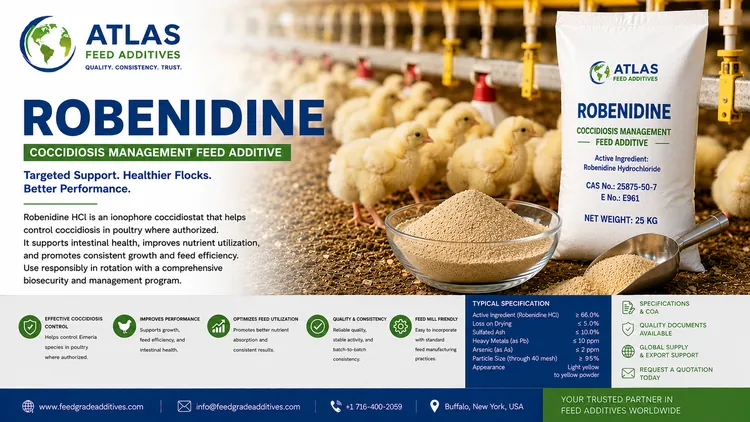
Robenidine feed additive visual

Product role

Where Robenidine fits

Robenidine is part of the coccidiosis management additives group. It is evaluated by feed manufacturers, premix producers, distributors, and integrated animal production companies that require controlled sourcing of regulated anticoccidial feed ingredients where their use is legally permitted.

Coccidiosis management programs are highly technical and market-specific. Buyers typically evaluate Robenidine by active specification, premix concentration, carrier system, physical form, target species authorization, withdrawal requirements, compatibility with feed processing, quality documentation, and feed mill carryover control procedures.

Atlas Feed Additives can coordinate international supplier options for buyers that need feed-grade material, specification alignment, export documentation, batch information, and quotation support. Robenidine should never be selected only by price; compliance status and correct technical fit are essential.

Typical applications

  • Authorized poultry coccidiosis management programs where the product is permitted by local rules.
  • Broiler, turkey, pullet, breeder, or other species programs only when specifically allowed by the destination market and product label.
  • Rotation or shuttle programs designed by qualified nutrition, veterinary, or technical specialists.
  • Premix production where active uniformity, carrier compatibility, and traceability are controlled.
  • Feed mills with strict sequencing, flushing, line-clearance, and carryover-prevention procedures.
  • Integrated production systems requiring consistent documentation and batch-to-batch supplier control.
  • Distributor portfolios serving customers that require regulated coccidiosis management products with complete documentation.

Buyer quality checklist

  • Confirm authorized species, animal category, and permitted use in the destination market.
  • Confirm withdrawal period, label conditions, and any customer-specific restrictions.
  • Review active assay, analytical method, premix concentration, and batch certificate of analysis.
  • Check premix uniformity, particle size, carrier, flowability, and segregation risk.
  • Assess feed mill cross-contamination controls and carryover prevention procedures.
  • Request safety data sheet, technical data sheet, specification, origin information, and batch documentation.
  • Confirm whether additional veterinary, regulatory, import, or customer approvals are required.
  • Verify packaging, shelf life, storage conditions, and transport suitability before shipment.

Technical overview

Why Robenidine sourcing requires extra control

Robenidine is not a general commodity ingredient. It belongs to a sensitive category of coccidiosis management additives where incorrect product selection, incomplete documentation, poor premix uniformity, unauthorized use, or carryover into non-target feed can create regulatory, commercial, and animal-production risks.

Before comparing offers, buyers should define the exact active specification, formulation form, destination market, species category, required documents, shipment route, packaging size, and customer approval process. A supplier offer is only meaningful when these requirements are aligned.

Atlas Feed Additives supports buyers by organizing the commercial and documentation side of the sourcing process. Final product use, feed formulation, veterinary decisions, withdrawal compliance, and regulatory approval remain the responsibility of the buyer and relevant qualified professionals.

Specification guidance

Common Robenidine specification items

Final parameters depend on supplier, active form, concentration, carrier, regulatory status, and the buyer's destination market. Buyers should request a current specification sheet and certificate of analysis for the exact grade and batch being offered.

Identity and active declaration

  • Product name and grade name.
  • Active compound declaration, such as Robenidine or Robenidine Hydrochloride where applicable.
  • Active concentration or premix strength.
  • Assay method and acceptance range.
  • Batch number and manufacturing information.
  • Country of origin and manufacturing site information where available.

Physical characteristics

  • Appearance, color, odor, and physical form.
  • Carrier or diluent system.
  • Particle size or mesh size.
  • Bulk density and flowability.
  • Dusting tendency and handling behavior.
  • Segregation risk during premix and feed manufacturing.

Quality and purity controls

  • Active assay result on certificate of analysis.
  • Uniformity or homogeneity information where applicable.
  • Moisture or loss on drying where specified.
  • Heavy metals according to buyer or destination-market requirements.
  • Microbiological limits where relevant to the product form.
  • Undesirable substances and contaminant declarations where required.

Commercial and logistics data

  • Packaging type and net weight per bag, drum, or carton.
  • Pallet configuration and container loading estimate.
  • Shelf life, storage conditions, and transport precautions.
  • Minimum order quantity and production lead time.
  • Incoterms, destination port, and required shipping documents.
  • Batch traceability and document availability before shipment.

Compliance-first procurement

Regulatory and customer checks before purchase

Robenidine should be purchased and used only when the buyer has confirmed that the exact product, species, feed category, inclusion purpose, and destination market are authorized. Requirements may differ by country, animal species, production stage, and customer policy.

Market authorization

Confirm whether the exact active, product form, concentration, supplier, and intended application are permitted in the destination market. Do not assume that authorization in one country means authorization in another country.

Species and category restrictions

Verify the allowed species and animal category before use. Coccidiosis management products may have specific restrictions by production stage, feed type, and end-market requirement.

Withdrawal and label requirements

Buyers should obtain and follow the applicable label, withdrawal, and usage requirements. Atlas Feed Additives can help coordinate product documents, but final compliance decisions must be made by the buyer and qualified professionals.

Customer and certification rules

Export customers, retailers, processors, or certification programs may apply stricter rules than local law. Buyers should confirm acceptance before ordering material for a specific production chain.

Feed mill control

Handling Robenidine in controlled production systems

Feed mills handling coccidiosis management additives should maintain documented procedures for receiving, storage, weighing, dosing, mixing, sequencing, flushing, label control, batch records, and cleaning. These controls help reduce the risk of incorrect inclusion or carryover into feeds where the product is not intended.

Premix uniformity is especially important. Buyers should review carrier compatibility, particle size, bulk density, and segregation risk so the active ingredient remains evenly distributed during handling, transport, and feed production.

Operational checklist

Common control points

  • Dedicated or clearly identified storage area.
  • Controlled weighing and dosing procedures.
  • Validated mixing time and uniformity checks.
  • Clear product labeling and batch traceability.
  • Production sequencing for medicated and non-medicated feeds.
  • Flushing or cleaning procedure where required.
  • Carryover monitoring according to internal and local rules.
  • Staff training for regulated feed additive handling.

Quality documents

Documents to request before purchase

Documentation requirements vary by destination market, customer, regulatory status, and product form. Atlas Feed Additives can help buyers organize supplier documentation for commercial and technical review before shipment.

Core product documents

  • Product specification sheet.
  • Certificate of analysis for the offered batch or representative batch.
  • Safety data sheet.
  • Technical data sheet.
  • Label or usage information where available and applicable.
  • Batch number, production date, expiry date, and shelf-life statement.

Compliance and import documents

  • Country of origin certificate when required.
  • Invoice, packing list, and transport documents.
  • Regulatory declaration or market-specific feed additive documentation where applicable.
  • GMO, allergen, BSE/TSE, irradiation, or residual solvent statements where required.
  • Heavy metal, microbiological, contaminant, or purity results where requested.
  • GMP+, FAMI-QS, ISO, HACCP, or other quality system certificates when available.

Storage and handling

Protect product identity, stability, and traceability

Robenidine should be stored according to the supplier's label and safety documents. In general, regulated feed additives should be kept in sealed, clearly labeled packaging, protected from moisture, heat, direct sunlight, contamination, and unauthorized access.

Warehouse and production teams should record batch numbers, receiving dates, expiry dates, and stock movement. First-expiry, first-out inventory rotation helps maintain traceability and reduces the risk of using expired or unidentified material.

Warehouse checklist

  • Keep packaging closed and intact.
  • Store in a clean, dry, well-ventilated area.
  • Separate clearly from non-medicated or incompatible materials.
  • Restrict access according to internal quality procedures.
  • Record batch, lot, receiving date, and expiry date.
  • Use first-expiry, first-out stock rotation.
  • Inspect packaging before accepting delivery.
  • Follow the safety data sheet for handling precautions.

Procurement note

Ask for the right specification before comparing prices

Price comparisons are meaningful only when active assay, concentration, carrier, particle size, packaging, origin, shelf life, documentation, and compliance requirements are aligned. A lower price may not be suitable if the product lacks the required authorization, documents, batch traceability, or technical fit.

For regulated additives, buyers should complete regulatory, veterinary, technical, and customer approval checks before confirming an order. The quotation process should include not only price and lead time but also documentation readiness and import feasibility.

Quotation preparation

Information to send for a faster quote

  • Required product name and active concentration.
  • Destination country and target market.
  • Intended species or feed category, where legally appropriate to disclose.
  • Required quantity and expected annual demand.
  • Preferred packaging size and pallet requirement.
  • Required documents and certificates.
  • Target Incoterms, destination port, or delivery location.
  • Required shipment timeline and import constraints.

Program planning

Robenidine in broader coccidiosis management strategies

Coccidiosis management is normally planned as a complete program rather than as a single-ingredient purchase. Product choice may depend on farm history, production goals, local authorization, veterinary guidance, rotation strategy, feed type, and customer requirements.

Rotation and shuttle programs

Some production systems use different authorized coccidiosis management tools over time or across production phases. Any program involving Robenidine should be designed by qualified professionals and must follow applicable regulations and label instructions.

Feed formulation coordination

Robenidine sourcing should be coordinated with the nutrition, veterinary, regulatory, quality, and production teams so that formulation, feed labeling, withdrawal requirements, and production controls are aligned before manufacturing begins.

Monitoring and records

Buyers should maintain records for raw material receipt, batch use, finished feed production, sequencing, flushing, and distribution. Strong records support traceability and customer audits.

Professional responsibility

Atlas Feed Additives provides sourcing and quotation coordination. It does not replace veterinary diagnosis, prescription, regulatory review, feed formulation responsibility, or local compliance approval.

Related products

Other coccidiosis management additives

Atlas Feed Additives can support sourcing requests for Robenidine and other coccidiosis management products where authorized. Buyers should verify local authorization, target species, label requirements, withdrawal rules, and customer acceptance before purchase or use.

Questions

Useful answers

What is Robenidine used for in animal nutrition?

Robenidine is used only where authorized as part of professionally designed coccidiosis management programs. It should be used according to the target species, product label, formulation objective, withdrawal requirements, veterinary or technical guidance, and applicable market rules.

Can Atlas Feed Additives quote Robenidine?

Yes. Send your required specification, active concentration, quantity, destination country, packaging preference, intended use area, and required documents so Atlas Feed Additives can review suitable supplier options for Robenidine.

Is Robenidine suitable for all animal species?

No. Robenidine must be used only for species, categories, and applications permitted by the destination market, product label, and applicable rules. Buyers should not assume cross-species suitability without written technical and regulatory confirmation.

What quality documents should buyers request for Robenidine?

Common documents include specification, certificate of analysis, safety data sheet, technical data sheet, origin information, batch details, manufacturing and expiry dates, shelf-life statement, and market-specific certificates required by the buyer.

Why is active assay important?

Active assay confirms whether the supplied batch meets the declared concentration. It is essential for specification comparison, premix formulation, quality approval, and supplier evaluation.

Why are carryover controls important?

Carryover controls help prevent unintended transfer of regulated additives into feeds where they are not authorized or not intended. Feed mills should use validated sequencing, flushing, cleaning, labeling, and recordkeeping procedures according to local rules and internal quality systems.

Can Robenidine be compared only by price per kilogram?

No. Buyers should compare active concentration, assay, carrier, documentation, regulatory fit, packaging, shelf life, supplier reliability, import feasibility, and cost-in-use. Price alone can be misleading for regulated feed additives.

Does Atlas Feed Additives provide veterinary instructions?

No. Atlas Feed Additives provides sourcing and quotation coordination. Veterinary decisions, formulation instructions, withdrawal compliance, and local regulatory approval must be handled by the buyer and qualified professionals.

Request a quotation

Tell us what you need

Send your product list, target specification, active concentration, destination country, packaging preference, expected quantity, required documents, and any compliance requirements. Our team will review your request and respond from orders@feedgradeadditives.com.