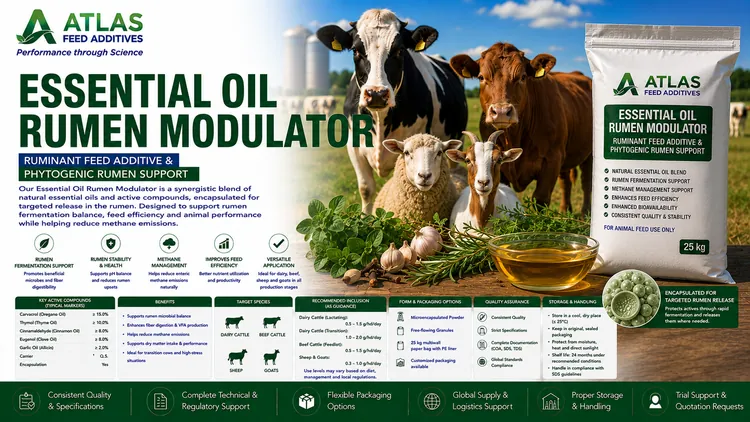
| Product name |
Essential Oil Rumen Modulator, phytogenic rumen modulator, ruminant essential oil blend, rumen fermentation support additive, or protected botanical active premix depending on supplier documentation and market classification. |
| Functional category |
Specialty ruminant additive, sensory additive, zootechnical additive, technological additive, or environmental feed additive depending on product design, authorization, and claim. |
| Typical active families |
Phenolic monoterpenes, aldehydes, terpenes, sulfur-containing botanical compounds, aromatic phenols, and other standardized phytogenic actives. |
| Common marker examples |
Carvacrol, thymol, cinnamaldehyde, eugenol, garlic-derived sulfur compounds, menthol, anethole, limonene, citral, cineole, capsaicinoids, and other defined markers depending on formulation. |
| Active declaration |
Request the marker-compound profile, minimum active concentration, analytical method, batch-to-batch tolerance, and whether the actives are natural, nature-identical, synthetic, or blended. |
| Analytical method |
GC-FID, GC-MS, HPLC, or supplier-validated methods may be used depending on the active compounds and matrix. Confirm whether the method works for encapsulated or carrier-based products. |
| Delivery technology |
Liquid blend, adsorbed powder, microencapsulation, fat coating, matrix encapsulation, beadlet, mineral-feed carrier, slow-release granule, or protected premix depending on supplier technology. |
| Release profile |
Ask for release behavior in feed, saliva, rumen fluid, pH models, and storage conditions. The intended release point should match the product's claim and target application. |
| Rumen stability |
Request evidence showing how the active compounds behave in rumen conditions, including retention, release, microbial interaction, or disappearance rate where available. |
| Appearance |
Liquid products may be amber, brown, or oil-like. Powder and coated products may be white, cream, tan, brown, granular, beadlet-like, or carrier-based depending on formulation. |
| Odor profile |
Typically aromatic, herbal, spicy, garlic-like, oregano-like, cinnamon-like, clove-like, menthol-like, or mixed botanical. Odor intensity should be evaluated for warehouse and feed intake impact. |
| Carrier system |
For dry products, confirm carrier material, carrier percentage, flowability, particle size, dust level, bulk density, mixing behavior, and compatibility with minerals, buffers, enzymes, vitamins, and fats. |
| Heat and process stability |
Request data for pelleting, extrusion, mineral-feed manufacturing, premix storage, TMR application, and long-distance logistics where relevant. |
| Palatability |
Essential oils can improve or reduce palatability depending on dose, odor strength, diet, and animal adaptation. Buyers should request recommended introduction guidance and feed-intake observations. |
| Recommended inclusion |
Dose depends on active concentration, species, target claim, diet, production stage, delivery technology, and local authorization. Confirm cost per head per day and cost per ton of feed. |
| Compatibility |
Review compatibility with buffers, yeasts, protected amino acids, choline, niacin, mineral premixes, ionophores, acids, enzymes, silage additives, mycotoxin binders, and liquid molasses systems. |
| Trial support |
Request in vitro rumen data, animal trial summaries, dairy or beef field data, methane measurement support, nitrogen-efficiency data, intake records, or production-response evidence for the exact product. |
| Safety review |
Request target-animal safety, user-safety information, skin and eye irritation guidance, inhalation precautions, SDS, and any maximum-use guidance relevant to concentrated essential-oil actives. |
| Packaging |
Common packaging may include 10 kg, 20 kg, or 25 kg bags, foil-lined bags, buckets, drums, cartons, fiber drums, or big bags depending on product form and order quantity. |
| Storage |
Store sealed in a cool, dry, well-ventilated area, protected from heat, sunlight, moisture, oxidation, strong odors, pests, and incompatible materials. Follow supplier SDS and label instructions. |
| Shelf life |
Confirm production date, expiry or retest date, shelf-life statement, storage temperature, oxygen and moisture protection, and whether opened packaging requires faster use. |
| Documentation |
Specification, COA, SDS, technical data sheet, active-marker profile, release-profile data, stability data, origin declaration, batch traceability, recommended inclusion guidance, trial support, packaging list, and market-specific authorization documents. |