
Phytogenics and botanical extracts

Cinnamaldehyde

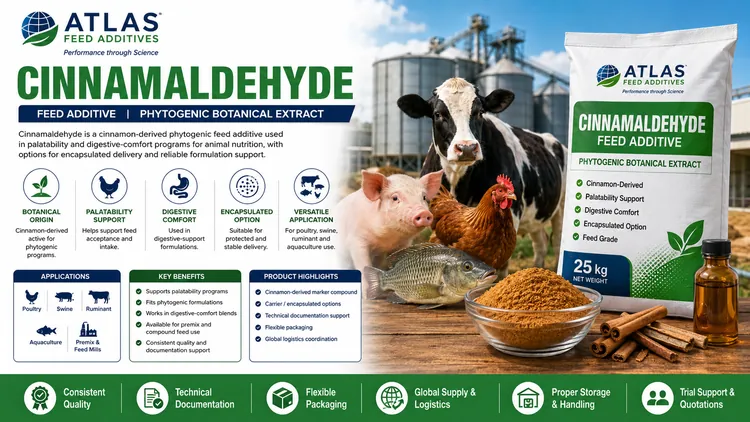
Cinnamaldehyde is a cinnamon-associated phytogenic marker compound used in natural-origin feeding programs focused on palatability, aroma profile, digestive comfort, feed acceptance, and production resilience.

Phytogenic additive Cinnamon-associated marker Palatability support Encapsulation options Export documentation support
Cinnamaldehyde feed additive visual

Product role

Where Cinnamaldehyde fits

Cinnamaldehyde is part of the phytogenics and botanical extracts group. Buyers typically evaluate this product by matching the active marker specification, botanical origin, standardization method, physical form, intended species, processing conditions, stability requirement, and documentation package.

In animal nutrition, Cinnamaldehyde is commonly positioned within plant-derived additive programs that may include essential oil components, botanical extracts, aromatic compounds, encapsulated actives, and multi-component phytogenic blends. Depending on the market and the claim, the product may be treated as a sensory additive, flavoring component, technological support ingredient, or zootechnical additive concept.

Because Cinnamaldehyde is a potent aromatic aldehyde, purchasing decisions should not be based only on product name. Commercial products may differ in Cinnamaldehyde assay, trans-isomer content, carrier, encapsulation system, volatility control, odor intensity, heat stability, handling risk, shelf life, and regulatory status.

Atlas Feed Additives can coordinate international supplier options for feed mills, premix producers, distributors, integrators, aquafeed producers, and pet food manufacturers that need consistent feed-grade phytogenic materials with clear technical and export documentation.

At a glance

Commercial and formulation value

Botanical positioning

Used in natural-origin feed additive programs where cinnamon-associated aroma and phytogenic formulation concepts are important.

Marker standardization

Often purchased by marker compound level, assay method, isomer profile, carrier, and batch-to-batch consistency rather than by product name alone.

Processing sensitivity

Volatility and aroma intensity make encapsulation, carrier selection, packaging, heat stability, and storage conditions important specification points.

Multi-species relevance

Evaluated in poultry, swine, ruminant, aquaculture, pet food, and specialty feed programs where phytogenic concepts are suitable.

Technical profile

Specification points buyers should confirm

Cinnamaldehyde offers should not be compared only by price per kilogram. Meaningful comparison requires the same active marker concentration, assay basis, botanical origin, form, carrier, encapsulation technology, stability data, packaging, shelf life, and documentation package.

Product name Cinnamaldehyde; also commonly referenced as trans-Cinnamaldehyde, cinnamic aldehyde, cinnamon aldehyde, cinnamal, or 3-phenyl-2-propenal.
Product group Phytogenics and botanical extracts for sensory, flavoring, digestive-comfort, and natural-origin feed additive programs.
Chemical formula C9H8O.
Natural association Associated with cinnamon and Cinnamomum botanical materials, especially cinnamon oil and cinnamon bark-derived aroma fractions.
Typical appearance Depending on grade and formulation, may be supplied as a yellowish liquid, liquid premix, absorbed powder, encapsulated powder, granule, or botanical extract blend.
Key active declaration Request declared Cinnamaldehyde content, trans-isomer percentage where relevant, assay method, chromatographic profile, and specification tolerance.
Carrier system Carrier may include silica, maltodextrin, starch, plant fiber, mineral carriers, fat matrices, encapsulation materials, or supplier-specific protective systems. Carrier choice affects flowability, dust, heat stability, and release behavior.
Physical checks Appearance, odor, particle size, bulk density, moisture, flowability, dust level, caking tendency, dispersibility, and compatibility with premix or complete-feed manufacturing.
Process stability Review stability under pelleting, steam conditioning, extrusion, fat coating, mineral premix storage, high-temperature transport, and long warehouse storage.
Contaminant checks Depending on origin and grade, request limits or results for heavy metals, pesticide residues, residual solvents, microbiological contaminants, mycotoxins, adulterants, and non-declared botanical components.
Safety and handling Concentrated aromatic aldehydes can require careful handling. Review the SDS for eye, skin, respiratory, flammability, odor-control, spill, and PPE guidance.
Regulatory note Approved status, permitted claims, labeling language, maximum levels, and target species can vary by market. Confirm destination-market rules before importing, selling, or using the product.

Typical applications

Where Cinnamaldehyde is commonly evaluated

  • poultry, swine, ruminant, aquaculture, and pet food phytogenic programs
  • starter feeds and transition-period formulas where feed acceptance matters
  • palatability and aroma-focused feed concepts
  • digestive-comfort and gut-focused natural-origin formulations
  • antibiotic-reduction and wellness-oriented feeding programs where suitable
  • essential oil blends and standardized botanical extract products
  • encapsulated phytogenic additives for pelleted or heat-processed feeds
  • odor and ammonia-management strategies where supported by product data and local claims
  • aquafeed and pet food formulas where aromatic profile and stability are important
  • multi-active phytogenic blends combined with oregano oil, thyme oil, thymol, carvacrol, garlic extract, capsicum, or other botanical components

Buyer quality checklist

Documents and tests to request

  • declared Cinnamaldehyde marker compound concentration
  • assay method and chromatographic profile
  • trans-Cinnamaldehyde percentage where relevant
  • botanical origin and standardization method
  • carrier declaration and encapsulation technology
  • particle size, moisture, bulk density, and flowability
  • heat-stability and pelleting-recovery data where required
  • certificate of analysis for each supplied batch
  • safety data sheet and handling precautions
  • heavy metals, pesticide residues, microbiology, residual solvents, and mycotoxin controls
  • origin, manufacturer details, shelf life, packaging, and storage conditions
  • market-specific authorization, label, and claim-support documents

Species and formulation context

How buyers typically position Cinnamaldehyde

Cinnamaldehyde should be selected according to target species, feed type, production phase, desired claim, inclusion route, process temperature, storage duration, and local rules. The same material may perform differently depending on whether it is used as a pure liquid active, dry carrier-based product, encapsulated ingredient, or part of a phytogenic blend.

Poultry

Evaluated in broiler, layer, breeder, and pullet programs where feed acceptance, digestive comfort, natural-origin positioning, and heat-stable phytogenic systems are commercial priorities.

Swine

Reviewed for nursery, post-weaning, grower-finisher, and sow formulas where aroma, palatability, transition support, and feed-intake consistency can be important.

Ruminants

Considered in dairy, beef, calf, and small-ruminant programs, especially when phytogenic blends are designed around rumen comfort, feed aroma, or specialty positioning.

Aquaculture and pet food

Used where palatability, aroma profile, water stability, extrusion compatibility, fat coating, and finished-product odor are important technical factors.

Important formulation note: Atlas Feed Additives supports sourcing and documentation coordination. Final inclusion rates, claims, target species suitability, and label language should be confirmed by the supplier, a qualified nutritionist, and applicable feed additive regulations in the destination market.

Form selection

Liquid, dry, encapsulated, or blended: why form matters

Liquid active

Useful for liquid blends or specialized dosing systems, but requires attention to odor, volatility, storage, handling, compatibility, and accurate dosing.

Carrier-based powder

Often easier for premix handling and dry-feed blending. Carrier choice affects active level, flowability, dust, mixing uniformity, and release behavior.

Encapsulated product

Selected when heat stability, odor control, protected release, or improved handling is needed for pelleting, extrusion, or long storage.

Phytogenic blend

May combine Cinnamaldehyde with thymol, carvacrol, essential oils, organic acids, saponins, flavonoids, or other botanical actives.

Procurement tip: Always confirm whether the quoted price is based on pure active Cinnamaldehyde, standardized extract, diluted liquid, carrier-based powder, encapsulated powder, or a multi-active phytogenic blend. These formats are not directly comparable unless active level and application rate are aligned.

Function-focused buying

Questions to ask before selecting a Cinnamaldehyde grade

What is the target function?

Clarify whether the product is being used for aroma, palatability, digestive-comfort positioning, phytogenic blend standardization, natural-origin claims, or a specific zootechnical objective.

What marker level is needed?

Ask for Cinnamaldehyde assay, trans-isomer profile, chromatographic method, tolerance range, and whether the declared level is guaranteed at manufacture or end of shelf life.

Will it survive processing?

Review pelleting temperature, steam conditioning, extrusion, fat coating, premix storage, oxygen exposure, humidity, and packaging barrier requirements.

How strong is the aroma?

Cinnamaldehyde has an intense cinnamon-like profile. Confirm odor intensity, handling limits, worker comfort, finished-feed aroma, and customer acceptance.

What is the carrier?

Carrier selection affects dilution, dust, flow, active release, segregation risk, and compatibility with vitamins, minerals, enzymes, probiotics, acids, and fat matrices.

What claims are allowed?

Market rules may determine whether the product can be described as flavoring, sensory, digestive-support, natural-origin, or zootechnical. Confirm approved claim language before use.

Matrix-specific evaluation

Different feed systems require different product formats

Premixes

Focus on active concentration, dust level, flowability, mineral interaction, vitamin compatibility, odor migration, and uniform distribution.

Pelleted feed

Review heat recovery, encapsulation, steam exposure, residence time, finished-feed aroma, and active retention after storage.

Extruded feed

Check compatibility with extrusion temperature, pressure, moisture, post-extrusion coating, oil application, and finished-product odor.

Liquid systems

Evaluate solubility, emulsification, dosing accuracy, tank compatibility, volatility, odor control, and compatibility with oils or other liquid actives.

Quality and standardization

Why Cinnamaldehyde requires careful supplier screening

Phytogenic products can vary significantly by source, extraction method, purification, carrier, encapsulation, blending technology, and storage stability. A structured supplier review helps buyers avoid non-comparable offers and inconsistent product performance.

Identity confirmation

Request product name, active marker declaration, botanical origin, synthetic or natural-origin status where relevant, assay method, and chromatographic identity profile.

Batch consistency

Review COA values, active marker tolerance, odor profile, moisture, particle size, carrier level, and shelf-life guarantee across multiple batches.

Safety controls

Ask for SDS, heavy metal data, pesticide residue limits, residual solvent controls, microbiology, mycotoxin screening, and adulteration controls where applicable.

Practical warning

Do not compare only by product name.

Two products labeled “Cinnamaldehyde” may differ in active percentage, trans-isomer content, origin, carrier, encapsulation, odor intensity, heat stability, legal status, and inclusion recommendation.

Best practice: compare delivered active content, process survival, product form, documentation quality, regulatory fit, and landed cost together.

Procurement note

Ask for the right specification before comparing prices.

Price comparisons are meaningful only when marker level, assay method, isomer profile, carrier, particle size, packaging, origin, shelf life, storage requirements, application method, shipment terms, and documentation are aligned. For phytogenic products, also review heat stability, odor-control requirements, batch consistency, contaminant controls, and compatibility with pelleting, extrusion, premix, or liquid-feed processes.

1 Define the product format

Confirm whether the request is for liquid Cinnamaldehyde, standardized extract, carrier-based powder, encapsulated product, granule, or phytogenic blend.

2 Confirm active marker level

Request Cinnamaldehyde assay, trans-isomer profile, tolerance range, method of analysis, COA, and whether active level is guaranteed through shelf life.

3 Check process fit

Review pelleting, extrusion, premix storage, fat coating, liquid dosing, odor control, dust control, and compatibility with other additives.

4 Compare landed value

Evaluate price together with active content, carrier, performance data, packaging, freight, lead time, payment terms, regulatory fit, and document completeness.

Processing and compatibility

Questions for feed mills and premix plants

Cinnamaldehyde must match the production system. Dry premix blending, direct feed application, liquid blending, pelleting, extrusion, and post-pellet coating can each require different specification priorities.

  • Is the product liquid, powder, granule, encapsulated, or blended?
  • What is the declared Cinnamaldehyde percentage?
  • Is the product natural-origin, nature-identical, synthetic, or blended?
  • Does the product require encapsulation for heat stability?
  • Does the particle size match the mixer, dosing system, and carrier?
  • Will the product be used before or after pelleting or extrusion?
  • Does the aroma profile affect feed acceptance or customer expectations?
  • Is the product compatible with enzymes, probiotics, vitamins, minerals, organic acids, and preservatives?
  • Are dust, volatility, odor, flammability, or worker-exposure controls needed?
  • Does the supplier provide recovery or stability data under realistic process conditions?

Storage and handling

Protect product quality during use

Cinnamaldehyde should be stored and handled according to the supplier safety data sheet and the buyer’s feed safety system. Because it is aromatic and can be volatile depending on the form, packaging integrity, temperature control, odor management, and worker protection should be reviewed before use.

  • store in a cool, dry, covered, well-ventilated area
  • keep packaging tightly closed when not in use
  • protect from excessive heat, light, moisture, and incompatible materials
  • avoid damaged bags, leaking containers, and strong odor transfer
  • use calibrated weighing and controlled dosing
  • follow SDS guidance for PPE, ventilation, spills, and skin or eye contact
  • segregate from non-feed chemicals and incompatible products
  • use first-expiry-first-out stock rotation
  • record batch numbers for traceability and customer audits
  • confirm opened-package handling and resealing recommendations

Quality and compliance

Recommended documents for Cinnamaldehyde procurement

Commercial documents

Proforma invoice, packing list, commercial invoice, certificate of origin when required, shipment details, Incoterms, lead time, and payment terms.

Quality documents

Product specification, batch COA, marker compound assay, trans-isomer profile where relevant, carrier declaration, particle size, moisture, shelf-life statement, and storage recommendation.

Safety and compliance

SDS, feed-grade declaration, botanical origin, natural-origin statement where required, allergen or GMO statement, halal or kosher certificates if needed, contaminant data, and destination-specific regulatory documents.

Documentation tip: Ask whether the quoted material is pure active, standardized extract, encapsulated product, or finished phytogenic blend. The COA should match the exact commercial form being supplied.

Risk management

Common purchasing risks to avoid

Cinnamaldehyde products can look similar on paper but behave differently in real feed systems. A structured purchasing checklist reduces the risk of buying a product that does not match the intended application.

Unclear active basis

Confirm whether the quoted percentage refers to pure Cinnamaldehyde, standardized extract, active in carrier, or active within a multi-component blend.

Weak heat stability

Unprotected aromatic actives may lose strength during pelleting, extrusion, or long storage. Request recovery data when heat processing is involved.

Incomplete compliance check

Claims, labeling, target species, and permitted use may differ by country. Confirm regulatory fit before purchasing or importing.

Performance reminder

Phytogenic results are formulation-dependent.

Practical outcomes depend on active level, carrier, release profile, feed matrix, processing, animal species, diet composition, management, and the complete additive program.

Best practice: run application trials or request species-specific and process-specific data when the product will be used in high-value premixes, pelleted feeds, aquafeed, or pet food.

Quotation preparation

Information to include in your request

A complete inquiry helps Atlas Feed Additives respond faster and compare supplier options more accurately. Use the checklist below when requesting a quotation for Cinnamaldehyde.

Product details

Required active level, product form, origin preference, carrier, encapsulation need, particle size, moisture limit, and whether pure or blended material is required.

Application details

Target species, production stage, feed type, pelleting or extrusion temperature, inclusion point, desired claim, and compatibility concerns.

Quantity and logistics

Trial quantity, monthly demand, annual forecast, destination country, delivery terms, packaging preference, lead time, and shipment conditions.

Document requirements

COA, SDS, origin, feed-grade statement, assay method, contaminant data, shelf life, halal, kosher, GMO, allergen, natural-origin, or buyer-specific documents.

Supplier coordination

How Atlas Feed Additives supports buyers

Atlas Feed Additives helps customers compare Cinnamaldehyde options from a sourcing perspective: active marker level, form selection, carrier suitability, heat-stability data, supplier reliability, document completeness, packaging suitability, shipment planning, and quotation clarity. This is especially useful for buyers comparing multiple phytogenic offers that may differ in origin, active concentration, encapsulation, and regulatory status.

  • reviewing buyer specifications before quotation
  • checking whether supplier documents match the requested phytogenic grade
  • coordinating product, packaging, and shipment details
  • supporting feed mills, premix producers, distributors, integrators, aquafeed producers, and pet food manufacturers
  • helping buyers avoid non-comparable offers based on different active levels, carriers, or product forms
  • organizing document requests such as COA, SDS, origin, shelf life, carrier declaration, assay, and feed-grade declaration

Questions

Useful answers

What is Cinnamaldehyde used for in animal nutrition?

Cinnamaldehyde supports natural-origin feeding programs focused on palatability, aroma, digestive comfort, and production resilience. It should be used according to the target species, formulation objective, supplier instructions, and applicable market rules.

Why is Cinnamaldehyde considered a phytogenic additive?

Cinnamaldehyde is associated with cinnamon-derived botanical materials and is commonly evaluated as part of plant-derived feed additive programs, essential oil systems, and standardized phytogenic blends.

Can Atlas Feed Additives quote Cinnamaldehyde?

Yes. Send your required specification, active marker level, product form, quantity, destination, packaging preference, delivery terms, and required documents so Atlas Feed Additives can review suitable supplier options for Cinnamaldehyde.

What quality documents should buyers request for Cinnamaldehyde?

Common documents include specification, certificate of analysis, safety data sheet, origin information, batch details, assay method, carrier declaration, shelf-life statement, packaging details, contaminant results, and any market-specific certificates required by the buyer.

What does marker compound concentration mean?

Marker compound concentration is the declared level of Cinnamaldehyde used to standardize the product. It helps buyers compare products and calculate inclusion accurately, especially when the material is a botanical extract, carrier-based powder, or phytogenic blend.

Is Cinnamaldehyde always natural-origin?

Not necessarily. Commercial materials may be natural-origin, nature-identical, synthetic, extracted, purified, diluted, encapsulated, or blended. Buyers should request origin and identity documents that match their labeling and market requirements.

Can Cinnamaldehyde be used in pelleted feed?

Suitability for pelleted feed depends on product form, encapsulation, carrier, steam-conditioning temperature, residence time, moisture, and post-pelleting storage. Request heat-stability or recovery data under conditions similar to your feed mill.

Why does encapsulation matter?

Encapsulation may help protect volatile aromatic compounds, reduce odor intensity during handling, improve heat stability, and influence release behavior. The value depends on the feed process and formulation objective.

What contaminants should be checked?

Depending on the product origin and grade, buyers may request results for heavy metals, pesticide residues, residual solvents, microbiology, mycotoxins, adulterants, and non-declared botanical components.

Can Cinnamaldehyde be combined with oregano oil, thymol, or carvacrol?

Yes, it is often evaluated in multi-active phytogenic concepts, but compatibility, active levels, odor profile, stability, target species, and permitted claims should be reviewed before use.

How should Cinnamaldehyde be stored?

Store according to the supplier specification and SDS. In general, keep the product tightly closed, dry, cool, ventilated, protected from heat and light, and segregated from incompatible materials.

How should buyers compare different Cinnamaldehyde offers?

Compare active marker level, assay method, trans-isomer profile, origin, product form, carrier, encapsulation, heat stability, packaging, shelf life, document quality, regulatory fit, freight, and landed cost.

What information should I send for a fast quotation?

Please send the required active level, product form, target species, feed application, process temperature, order quantity, destination, packaging preference, delivery terms, and required documents.

Request a quotation

Tell us what you need

Send your product list, target specification, required Cinnamaldehyde level, product form, destination country, packaging preference, estimated quantity, target species, feed process, delivery terms, and required documents. Our team will review your request and respond from orders@feedgradeadditives.com.